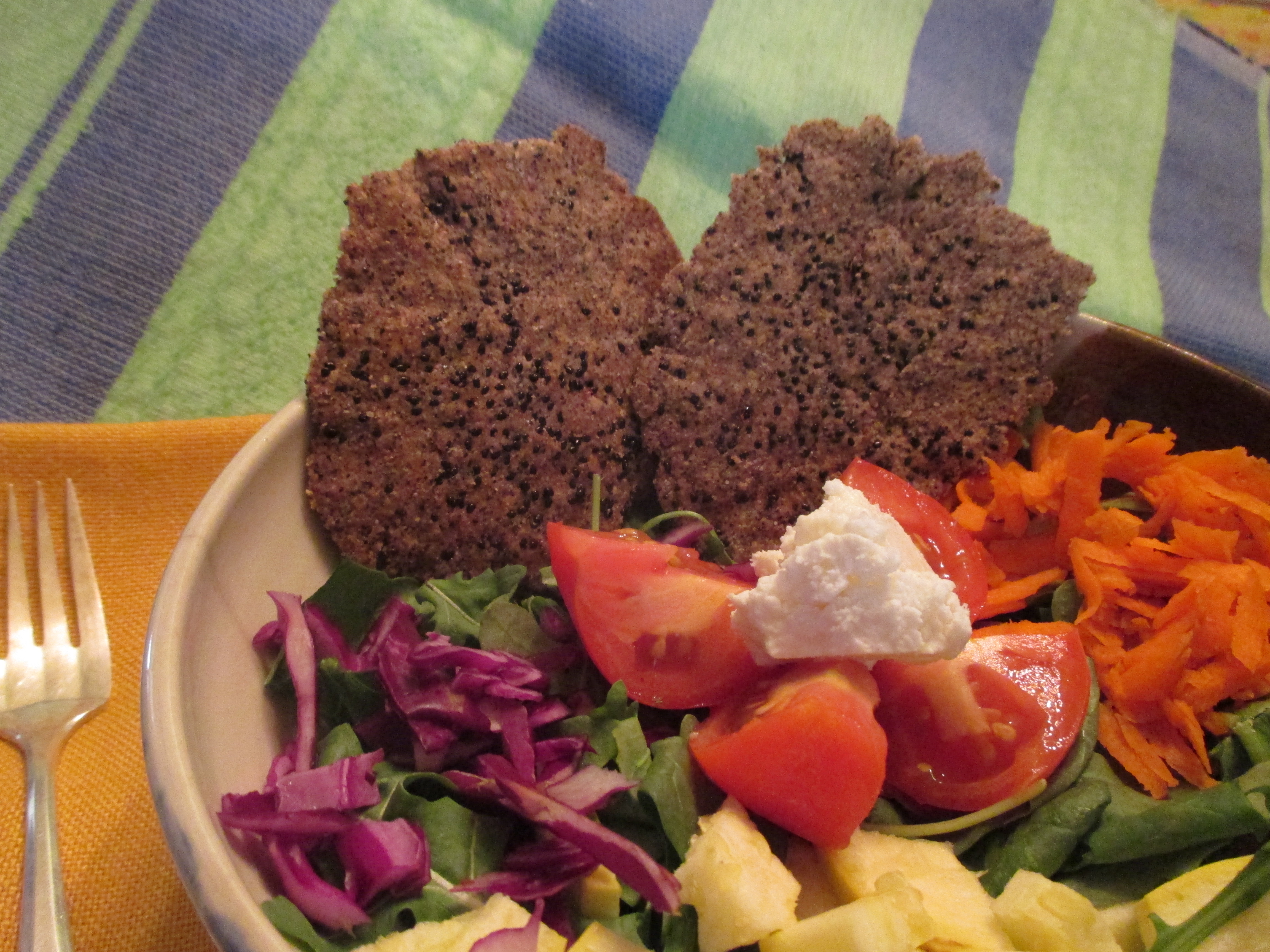
April Brings Nopales

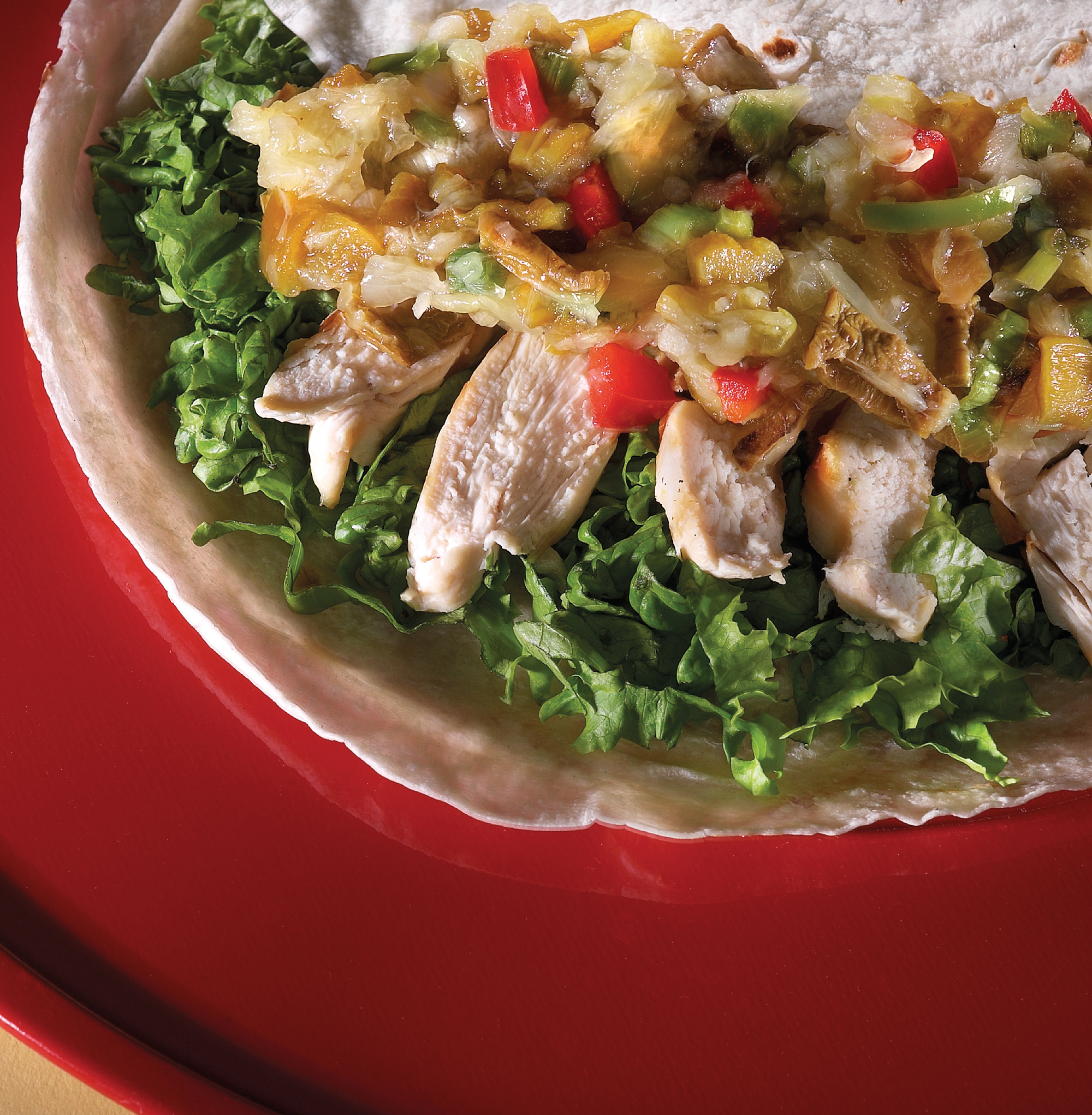
Grilled Chicken with Nopalito and Pineapple Salsa

Grilled Chicken with Nopalito and Pineapple Salsa (from The Prickly Pear Cookbook)

If it’s April, it’s time to gather nopales here on the Sonoran Desert. Carolyn here today tempting you to read further with this photo of a delicious salsa made with nopalitos. (Definition of nopalito: a nopal, or cactus pad, cut into little pieces).  At the bottom of the post, I’m going to give you the recipe and a video of how to turn a cactus pad into a yummy taco.

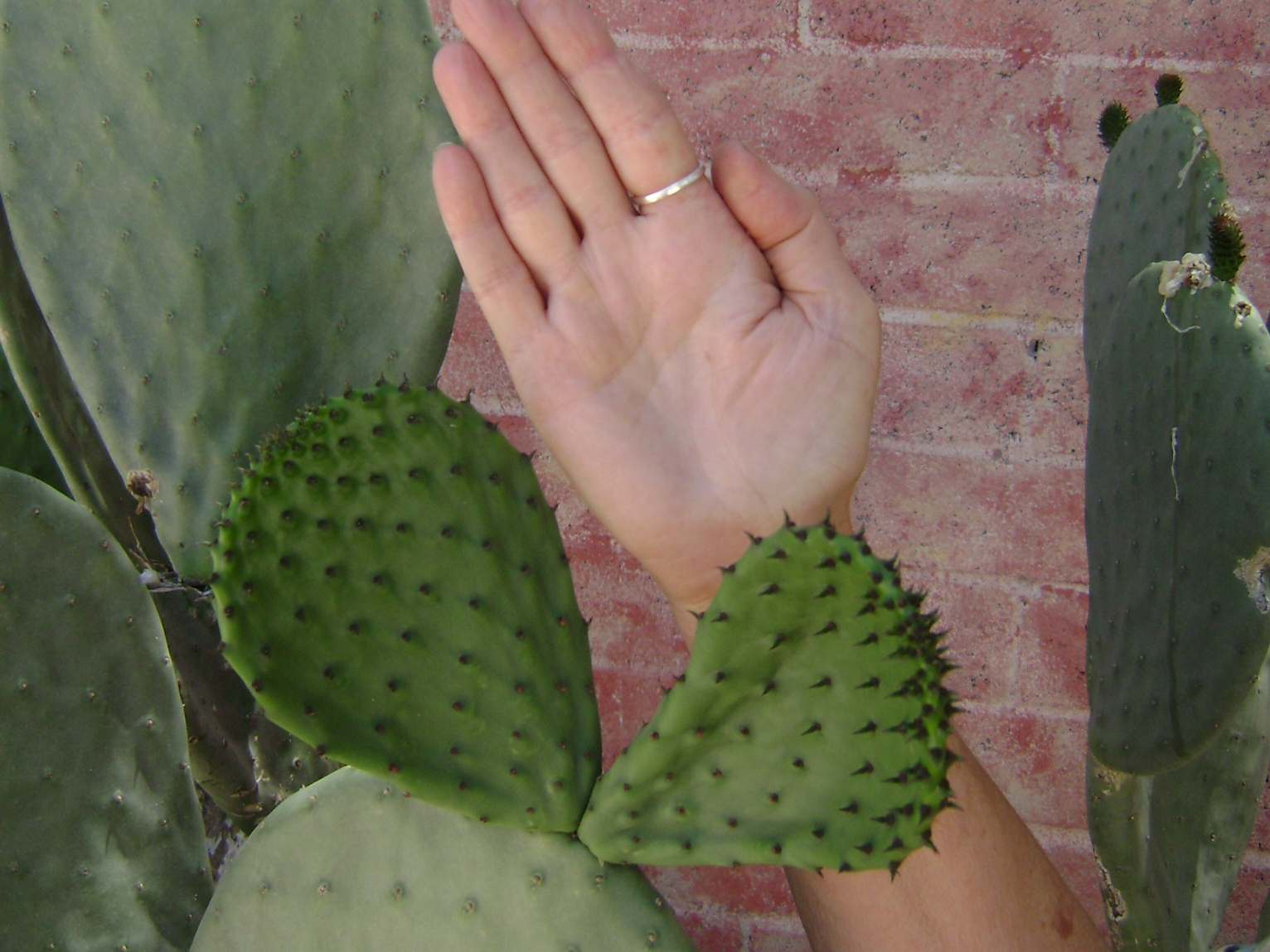
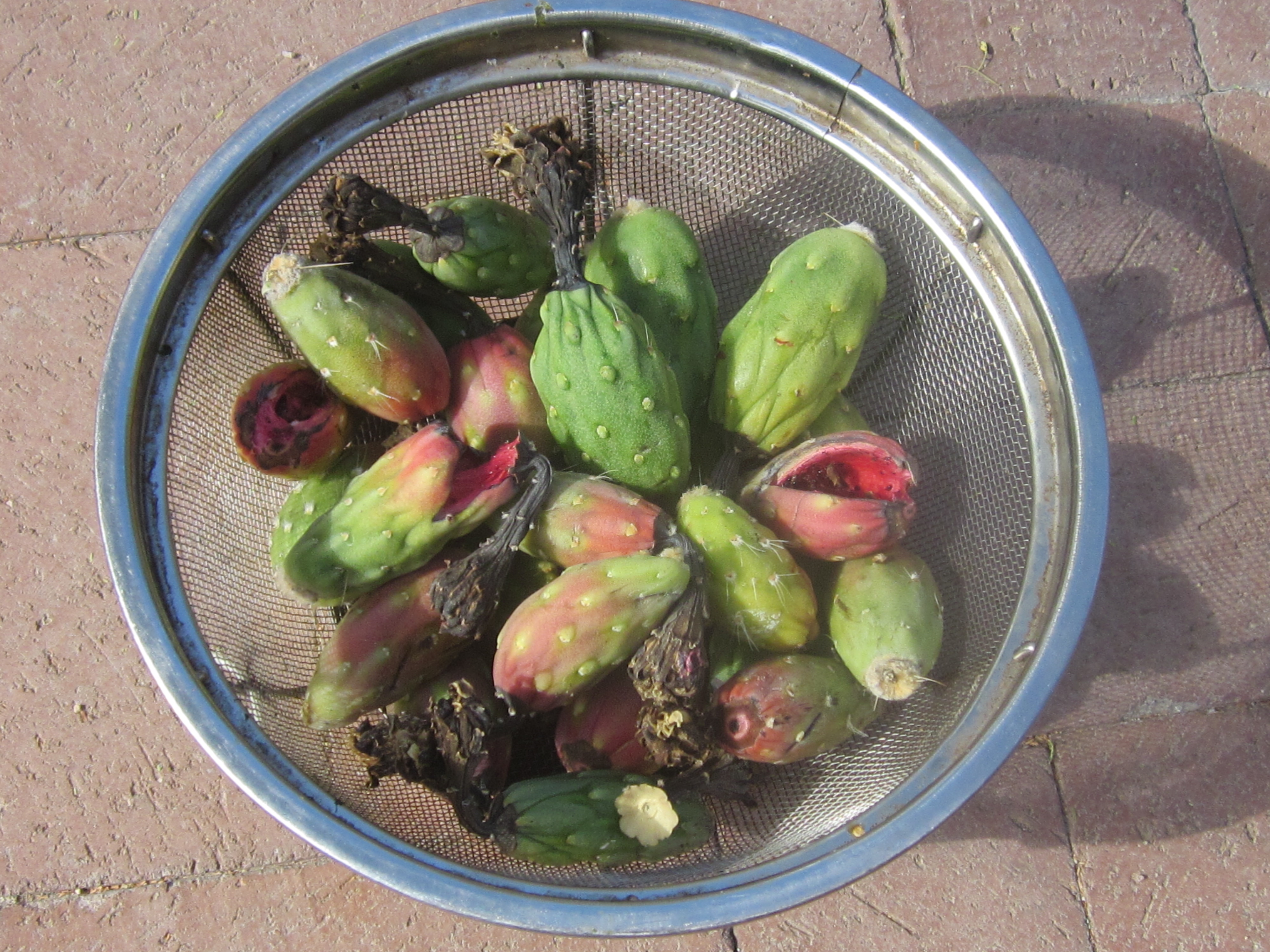
The many varieties of prickly pear put out their new growth when the spring warms up. All prickly pear pads are edible (meaning they not only won’t kill you but in this case are very nutritious), but they are only appropriate for food when they are new. After about six weeks, they develop a fibrous infrastructure. The easiest kind to prepare are the pads from the large Mexican variety of prickly pear that do not grow wild this far north. They are called Ficus indica or sometimes Burbank because Luther Burbank did some breeding work on them. The wild cactus pads are also delicious, but harder to prepare because of the abundance of spines.  You can do a rough estimate of when a pad is ready to pick if it is about the size of your hand. The nopales available in Mexican grocery stores are grown by farmers who know how to manipulate the plant to keep fresh pads coming year ’round.

Pick nopales in the spring when the size of your hand.

Pick nopales in the spring when the size of your hand.

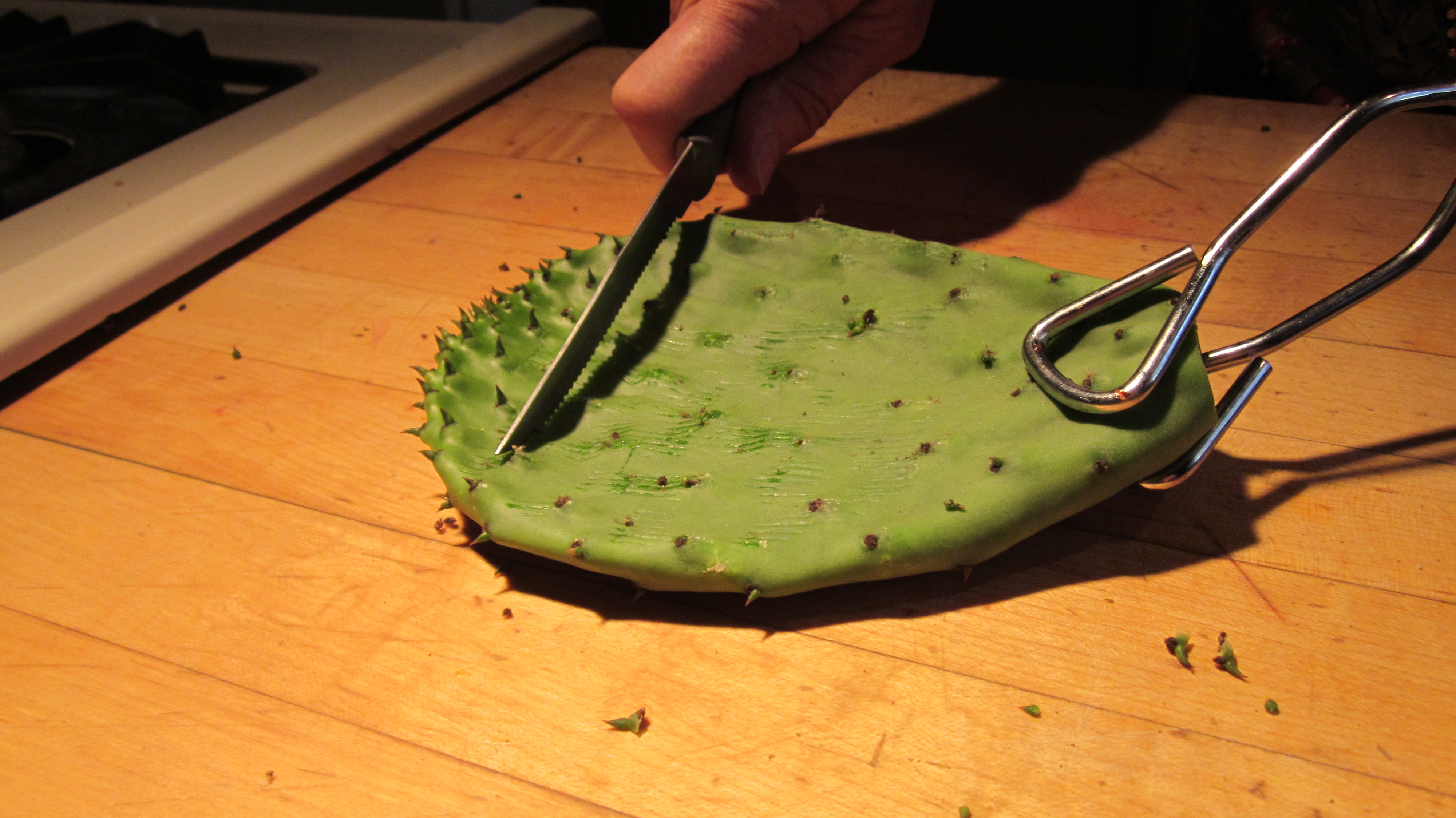
To prepare the nopales, you’ll use  tongs, of course, and then don rubber kitchen gloves to protect your hands as you get rid of the stickers. You don’t need industrial strength gloves, just good quality ones from the grocery store will do. Using a common steak knife, scrape vigorously against the growth (from outer edge to stem) to remove the stickers.

Scrape the thorns vigorously in the direction of the stem.

Scrape the thorns vigorously in the direction of the stem.

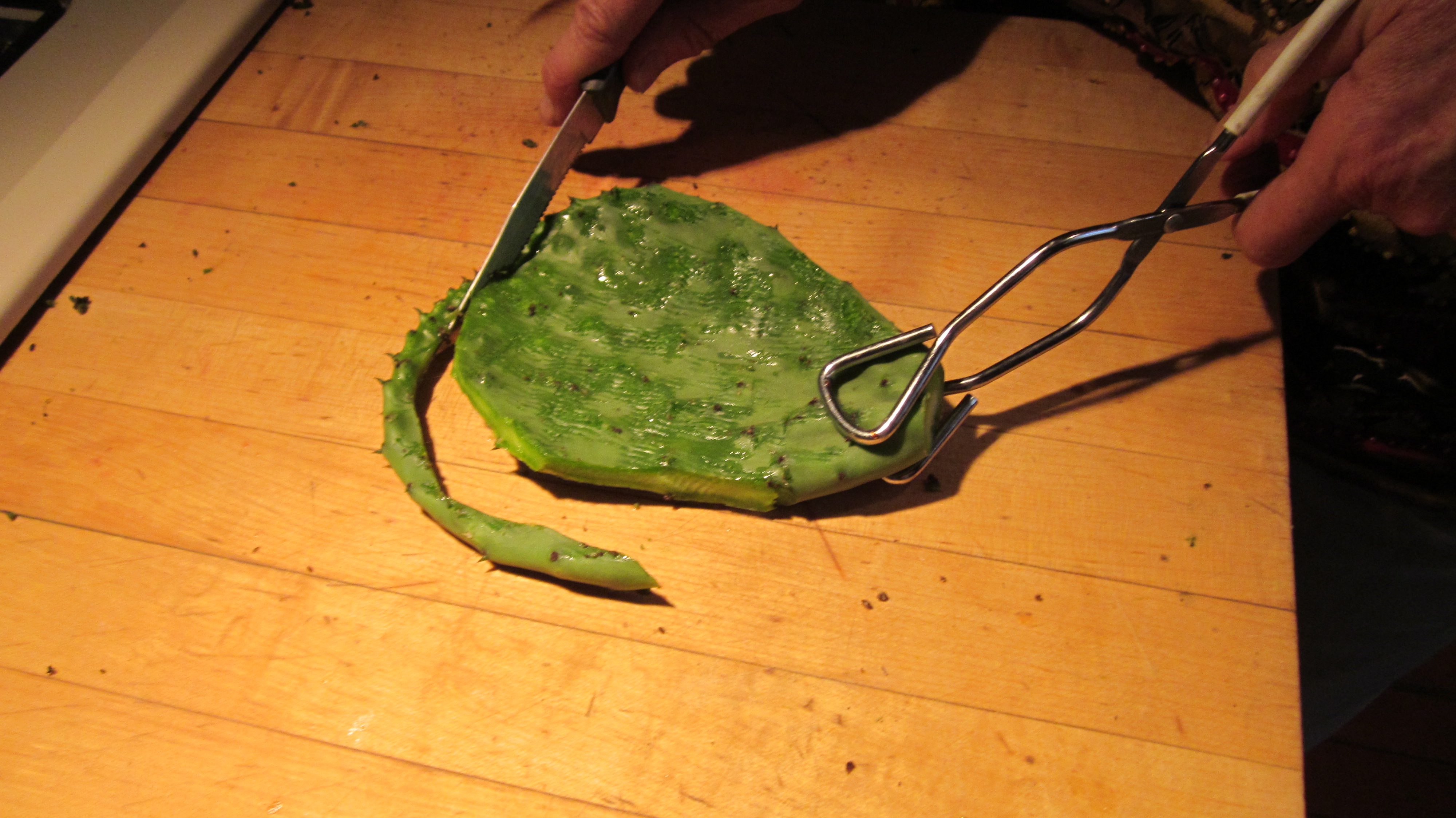
The edge has lots of stickers so just trim it off.

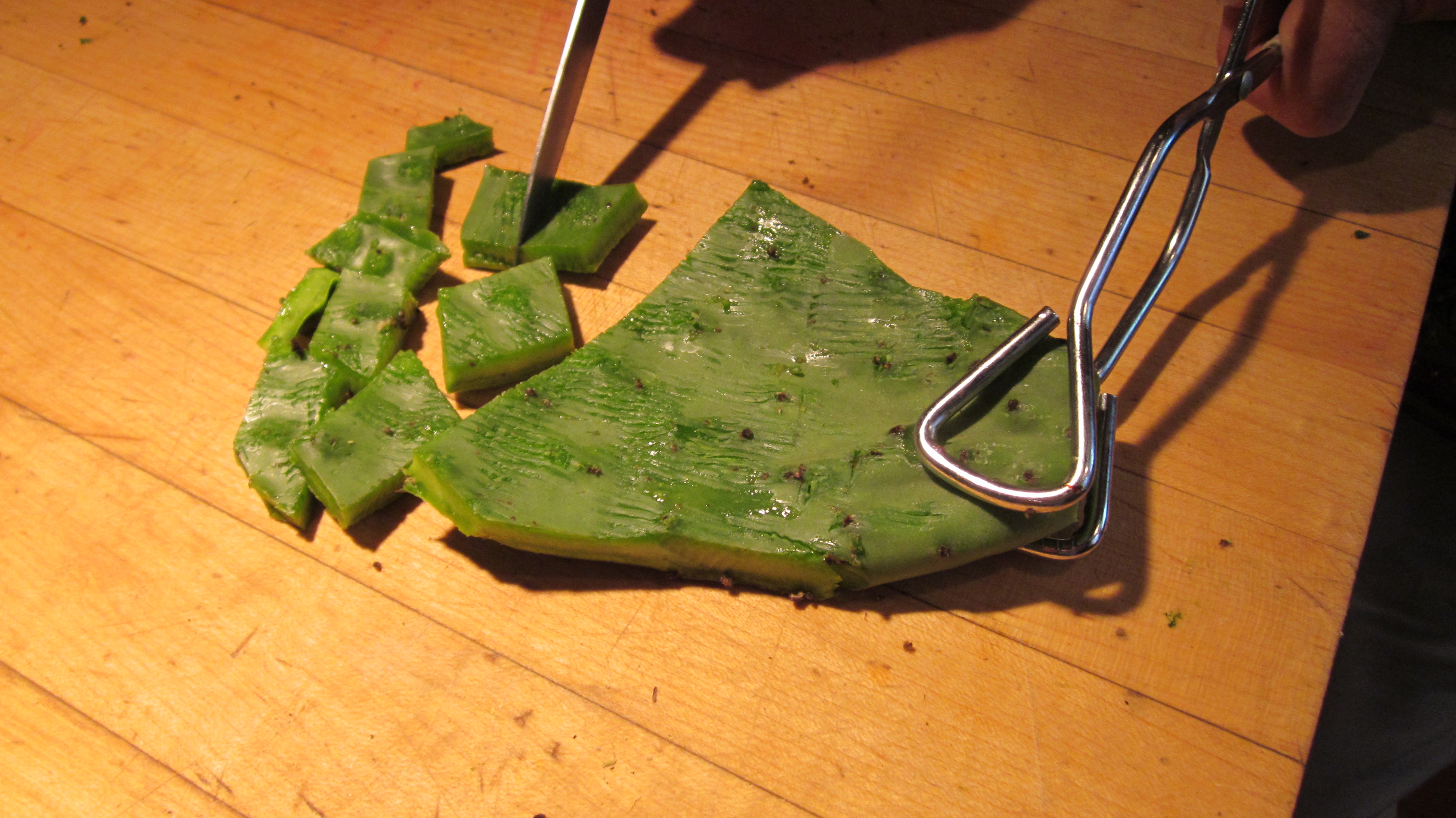
IMG_0196At this point, you can cut it into small pieces to cook or leave it whole and cut it up later. You can cook them in a frying pan filmed with oil, or use the Rick Bayless method (he of TV show fame) and toss them with a little oil, sprinkle with sale, put on a cookie sheet and roast in a 375 degree oven for 20 minutes.  In any case, you should check them and turn them over as they cook.

Cut into small pieces to cook.

Cut into small pieces to cook.

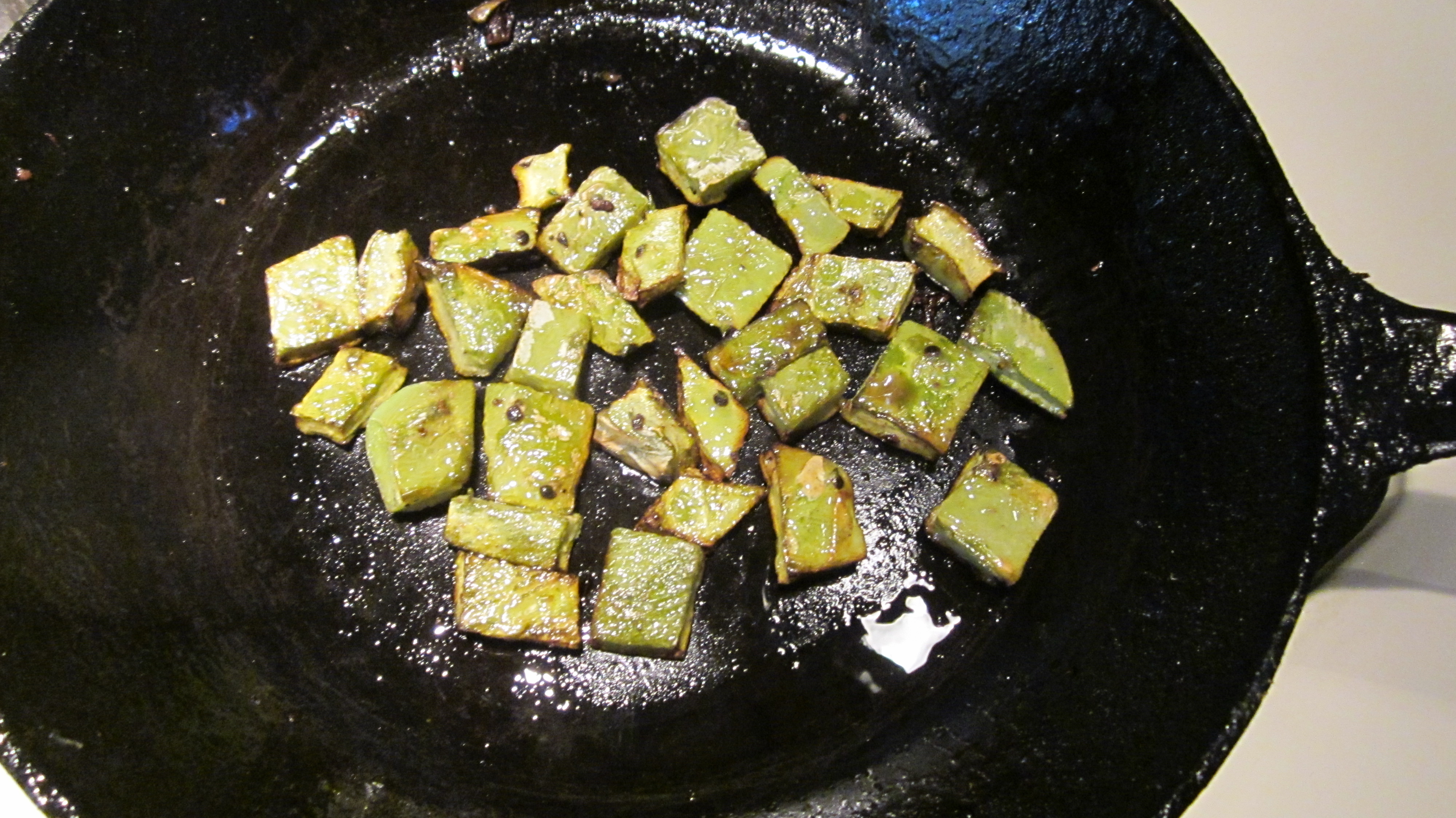
The nopales will turn from bright green to a more olive color as they cook. The gummy sap that some people find objectionable will dry up and become less noticeable.

The cooked nopalitos turn from bright green to olive.

The cooked nopalitos turn from bright green to olive.

You can also cook nopales on the barbecue alongside some chicken to make a delicious taco. This video ( find it at the bottom of the magazine article) shows you how to clean the nopal and grill it.  Take a look here.

Here’s the recipe for the sauce in the picture at the top of the blog:

Grilled Chicken  with Nopalito and Pineapple Salsa

(Makes 4 servings)

This is good to serve as a light entrée with rice and a vegetable.  It is also great as a stuffing for fresh flour tortillas topped with shredded lettuce.

1 raw, cleaned prickly pear pad

1 tablespoon vegetable oil

1 cup canned crushed pineapple packed in it’s own juice

¼ cup finely chopped red bell pepper

¼ cup thinly sliced green onions, including some tops

1 tablespoons canned green chiles

1 finely minced serrano chile (optional)

½ teaspoon finely minced garlic

2 tablespoons lime juice

¼ teaspoon salt

1 tablespoon finely minced cilantro (optional)

4 large boneless chicken breasts

Cut prickly pear pad in 1 ½ inch squares.  Film a heavy frying pan with the oil and add the prickly pear pads.  Cook over low heat, turning occasionally, until pieces have given up much of their juice and are slightly brown. Remove from pan, cool, and chop into pieces as wide as a matchstick and about ¼-inch long.

Transfer to medium bowl.  Add remaining ingredients, stir to combine and set aside for flavors to mingle.

Grill chicken breasts until done. Slice each one crosswise into five or six pieces and arrange each on a plate.  Put a portion of the salsa on top of  or beside the chicken.

______________________

Want more recipes for the bountiful crop of nopales we’ll have this year?  Check out The Prickly Pear Cookbook and Cooking the Wild Southwest.  You can flip through The Prickly Pear Cookbook here. Both books are available locally at Native Seeds/SEARCH on Campbell or from on-line booksellers.

Luscious Lemons

IMG_0092

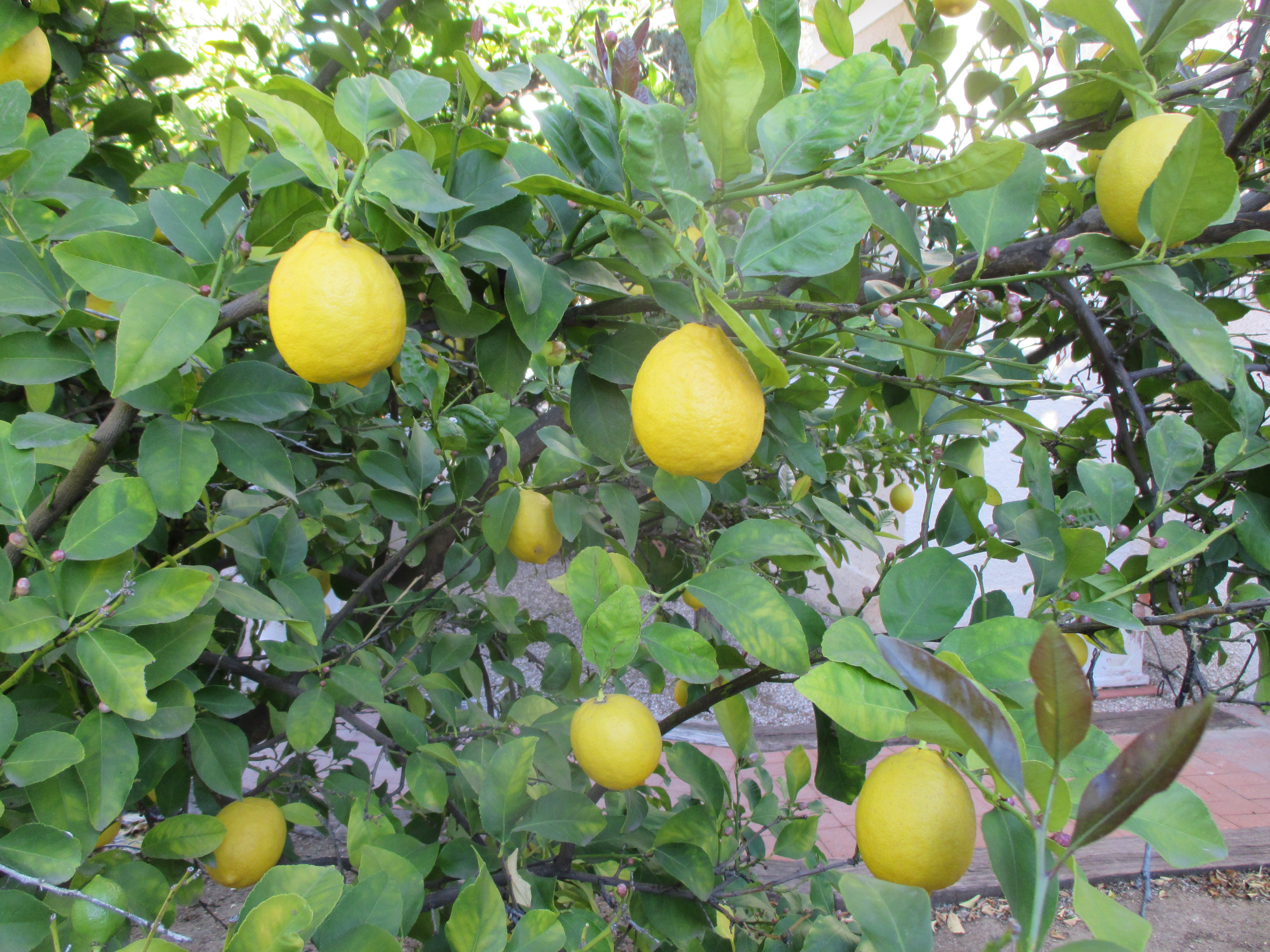
As I write, the citrus trees in my neighborhood are beginning to bloom and sending waves of  scented the air through my exuberantly flowering garden. This is the kind of experience poets rhapsodize about. The two big freezes we had in 2011 and 2013 affected most of Tucson’s lemon trees, and some gardeners went without lemons as the trees recovered. But this spring they came roaring back. It’s Carolyn this week giving you ideas for using lemons from your own trees, those you can beg from neighbors or buy at the farmers’ market.

Make Some Lemon Curd

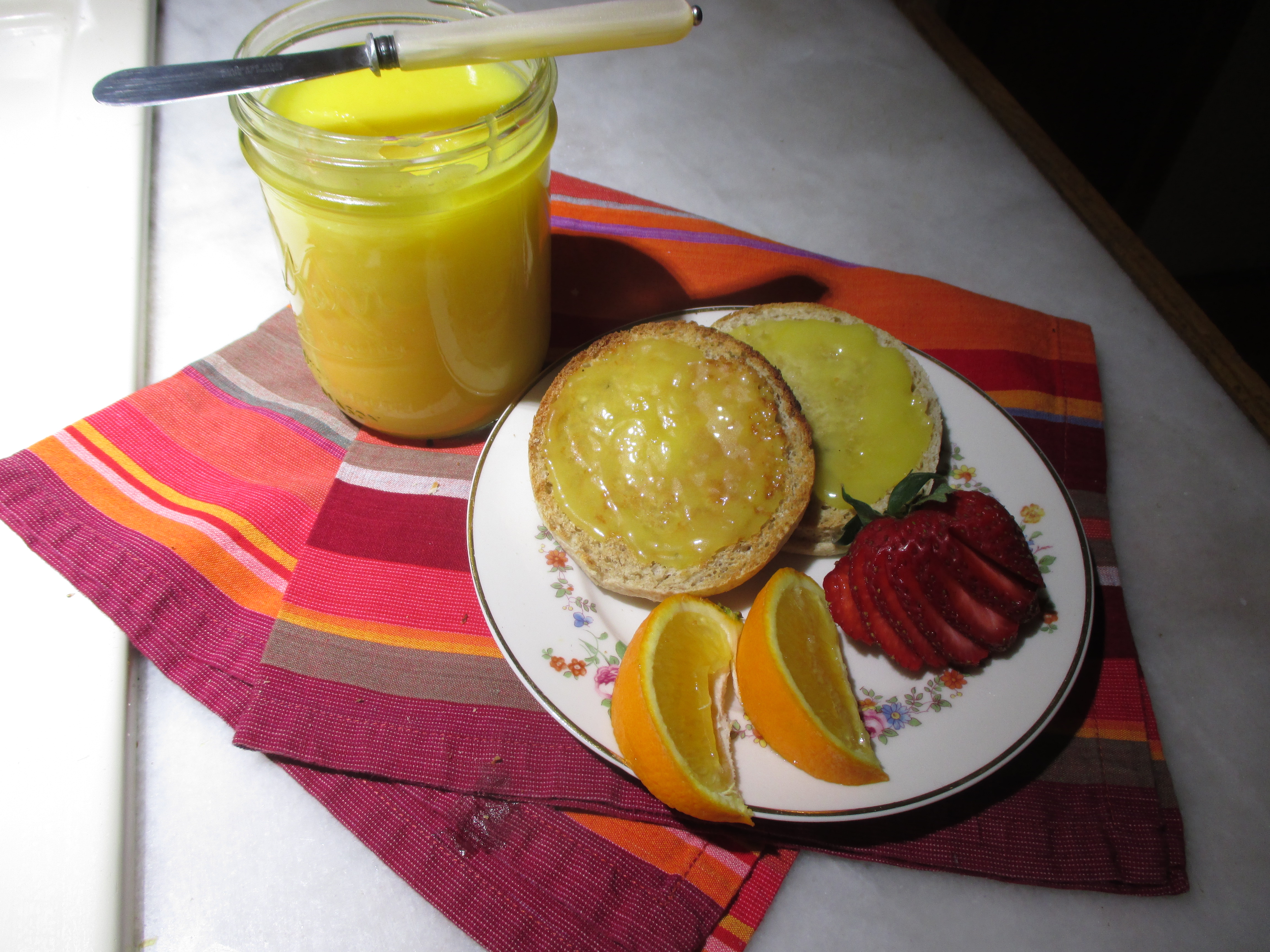
The word “luscious” could have been invented to describe lemon curd. It’s sweet without being cloying; tart without being sour. Yum. I made it once before with so-so results. As with any recipe involving cooked eggs, there is always the chance of curdling if you don’t handle the ingredients delicately. This recipe, developed by Elinor Klivans from Fine Cooking reduces the risk. You can use your lemon curd on toast or scones or fill tiny tart shells for a dessert.

Lemon curd and English muffins make an elegant breakfast.

Lemon curd and English muffins make an elegant breakfast.

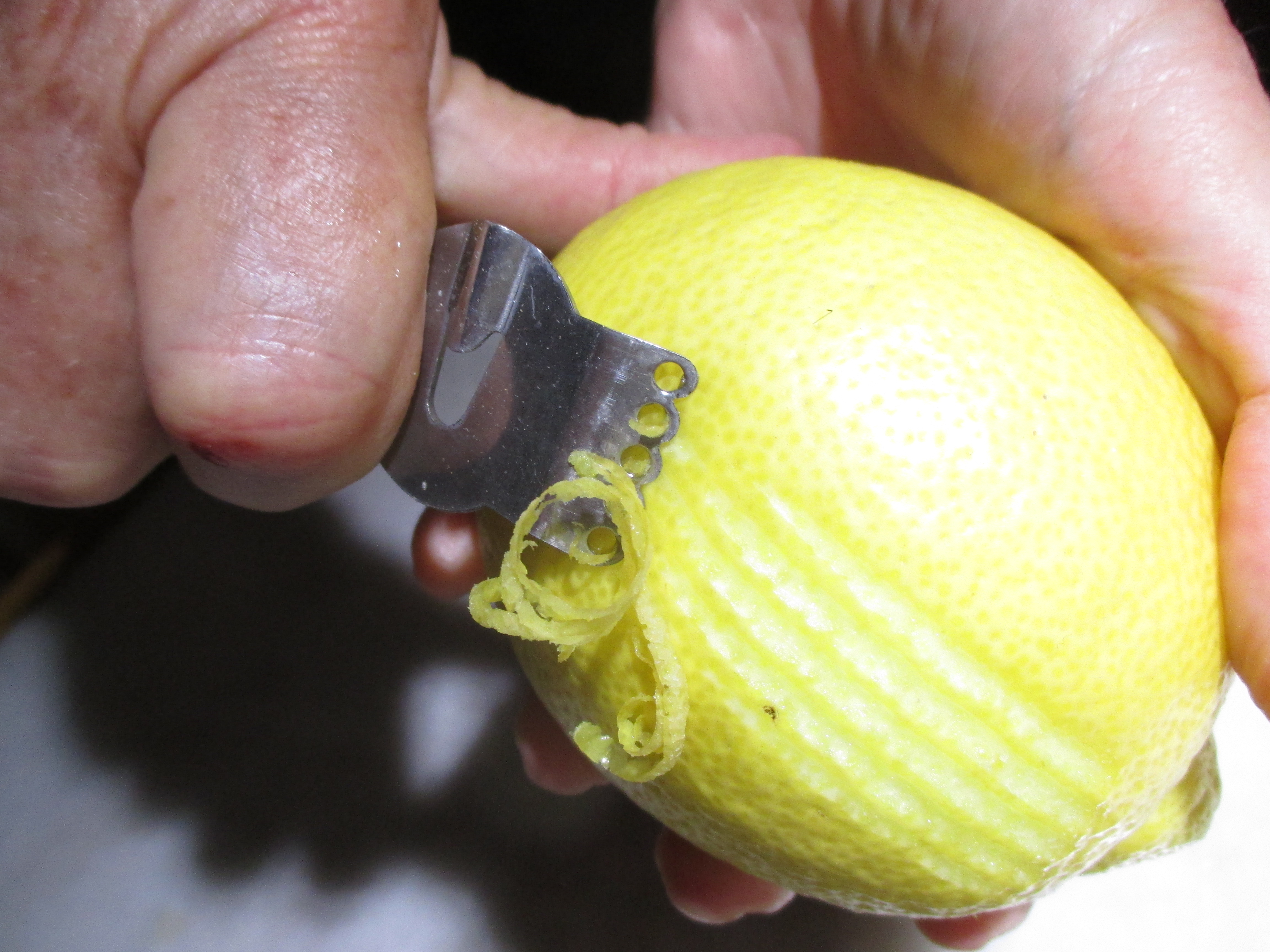
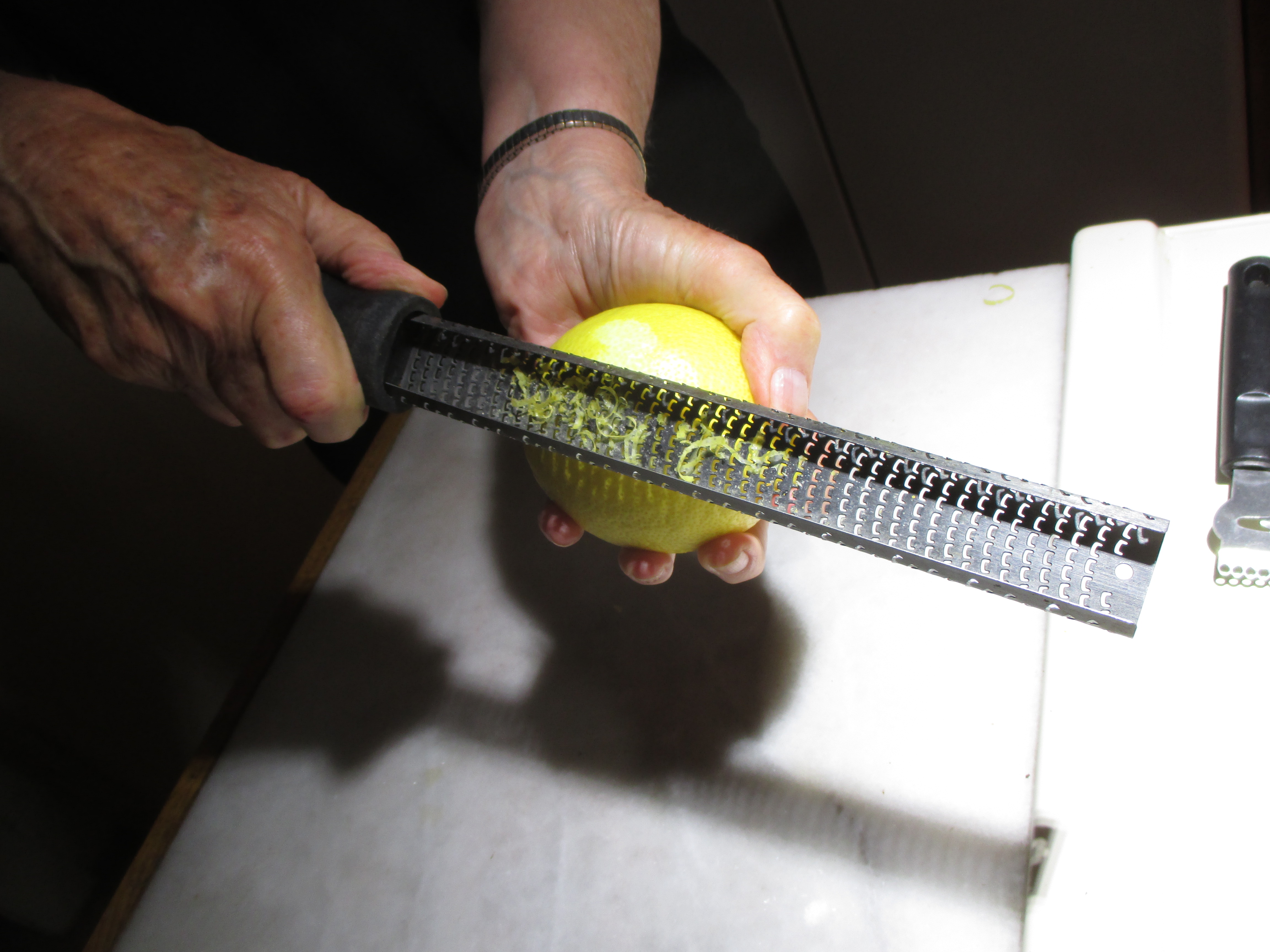
To make lemon curd, you’ll need to zest a lemon first. You only need a tablespoon of zest. You can use a lemon zester or get finer zest with a microplane.

Zesting with a simple lemon zester.

Zesting with a simple lemon zester.

Using a microplane to make lemon zest.

Using a microplane to make lemon zest.

Lemon Curd

by Elinor Klivans from Fine Cooking

6 tablespoons unsalted butter, softened at room temperature

1 cup sugar

2 large eggs

2 large egg yolks

2/3 cup fresh lemon juice

1 tablespoon grated lemon zest

In a large bowl, beat the butter and sugar with an electric mixer, about 2 minutes. Slowly add the eggs one at a time, beating between, then add the yolks. Beat for 1 more minute. Mix in the lemon juice. The mixture will look curdled. Don’t worry as it will smooth out as it cooks.

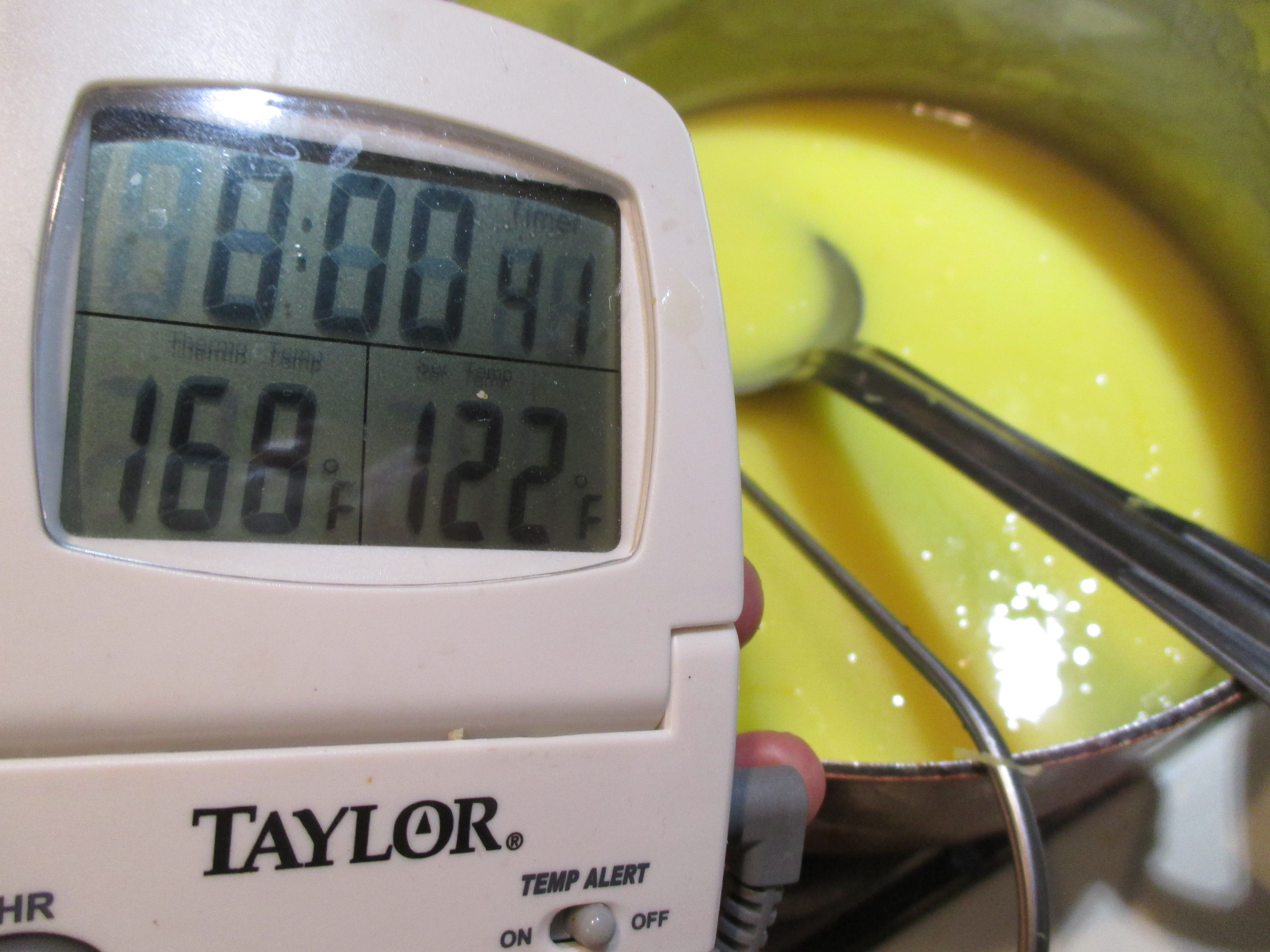
Transfer the mixture to  a medium, heavy-bottomed saucepan and cook the mixture over low heat until it looks smooth. You will find that the curdled appearance will disappear as the butter in the mixture melts. Increase the heat to medium and cook, stirring constantly, until the mixture thickens, from 8 to 15 minutes. Don’t try to rush this. Put on the radio or some music to entertain yourself. If you have a cooking thermometer, it should read 170 degrees F. when the curd is finished.

The curd is almost ready.

The curd is almost ready.

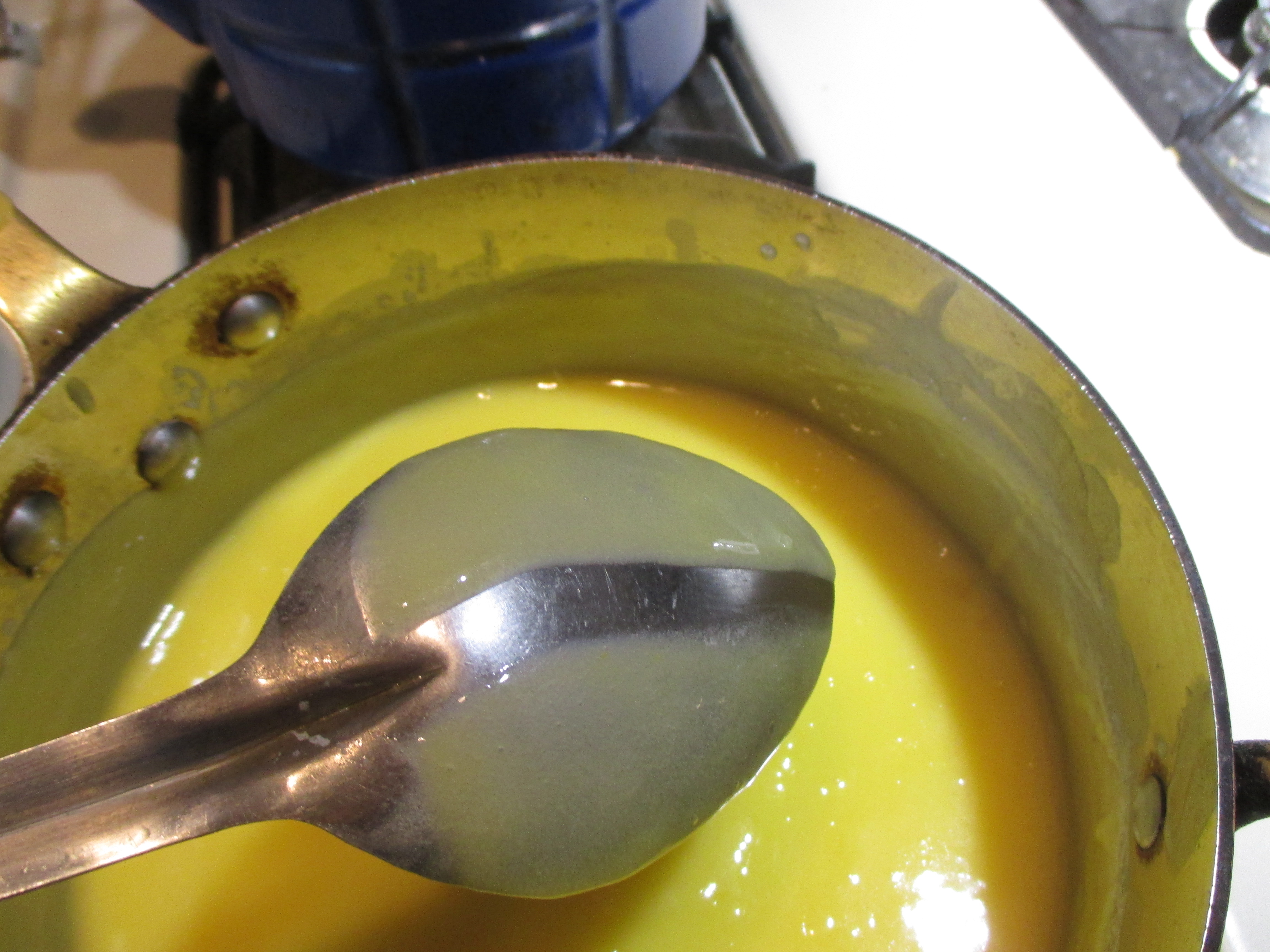
If you don’t have a thermometer, dip the back of a spoon into the sauce, and and run your finger through it. A path should remain. Most important:  Don’t let the mixture boil.

Test doneness without a thermometer.

Test doneness without a thermometer.

Remove the pan from the heat; stir in the lemon zest. Transfer the curd to a bowl. Press plastic wrap on the surface of the lemon curd to keep a skin from forming and chill  in the refrigerator. The curd will thicken further as it cools. Covered tightly, it will keep in the refrigerator for a week and in the freezer for 2 months. Each tablespoon has about 50 calories.

Limoncello: A Treat from Italy

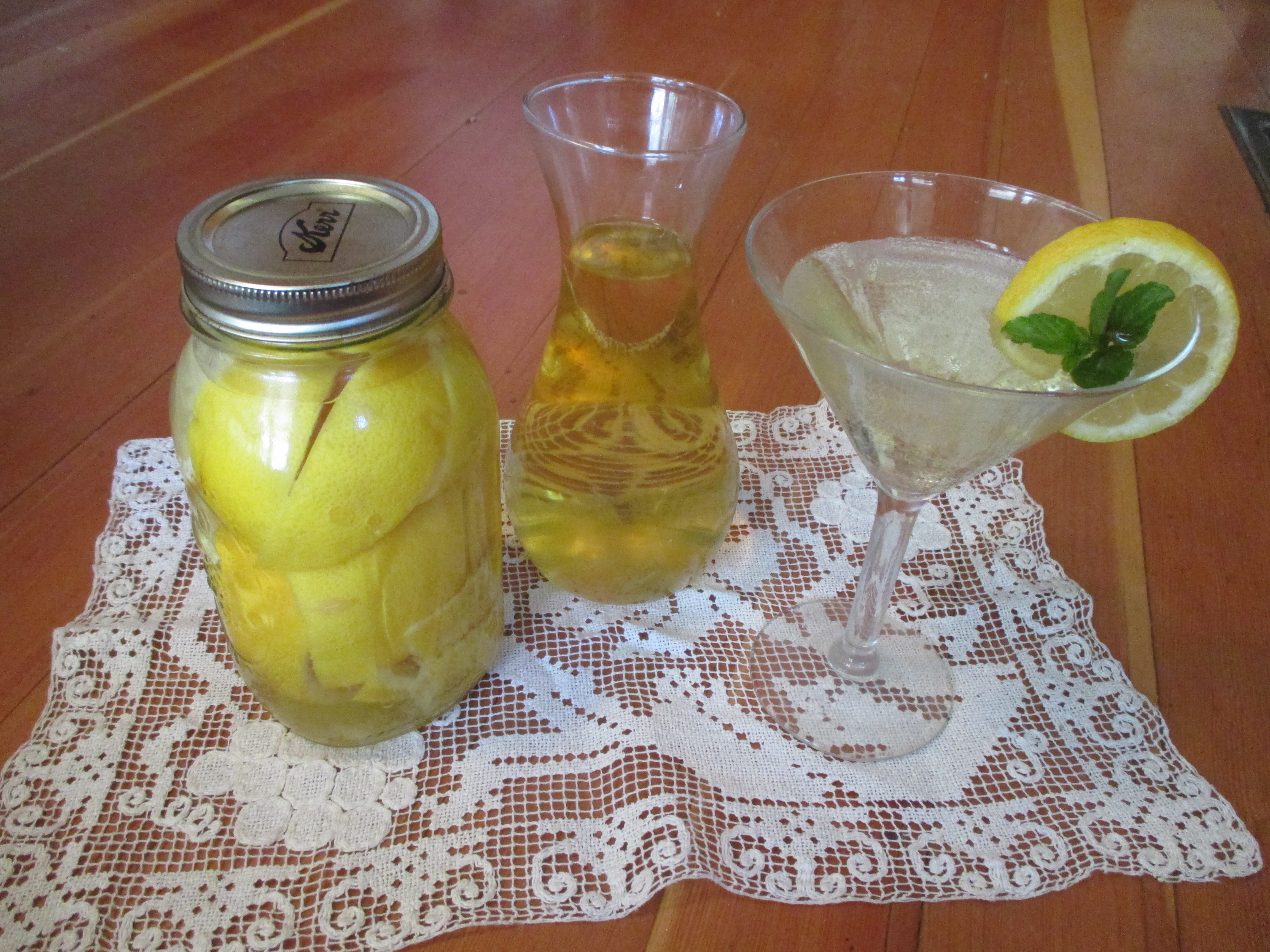
Italian limoncello is easy to make.

Italian limoncello is easy to make.

If you have ever been to Italy, you probably know about limoncello, the generic name for an Italian citrus-based lemon liqueur that is served well chilled in the summer months. All you need is lemons, vodka and sugar. When choosing lemons you want to use organic if possible to avoid wax and pesticides on the peel. This recipe is adapted from one given by the television cook Giada De Laurentiis.

Limoncello

10 lemons
1 (750-ml) bottle vodka
3 1/2 cups water
2 1/2 cups sugar

Start with a clean gallon jar. First, carefully peel the lemons in long strips with a vegetable peeler so there is no white pith on the peel. Use only the outer part of the rind. Put the rinds in the jar and cover with the vodka. Let it sit at room temperature for at least 10 days and up to 40 days in a cool dark place.

When you are ready to proceed, combine the water and sugar in a saucepan, bring to a gentle boil and let it boil 5 to 7 minutes. Remove from heat and let the syrup cool. Add to the limoncello mixture and let it rest from overnight to 10 days (the experts really differ on this. I just waited 2 days and it was fine.) Strain into bottles, seal and refrigerate.

Limoncello Cocktail

Mix half-and-half limoncello, seltzer water, tonic, or champagne and serve over ice.

Easier, Better Lemonade

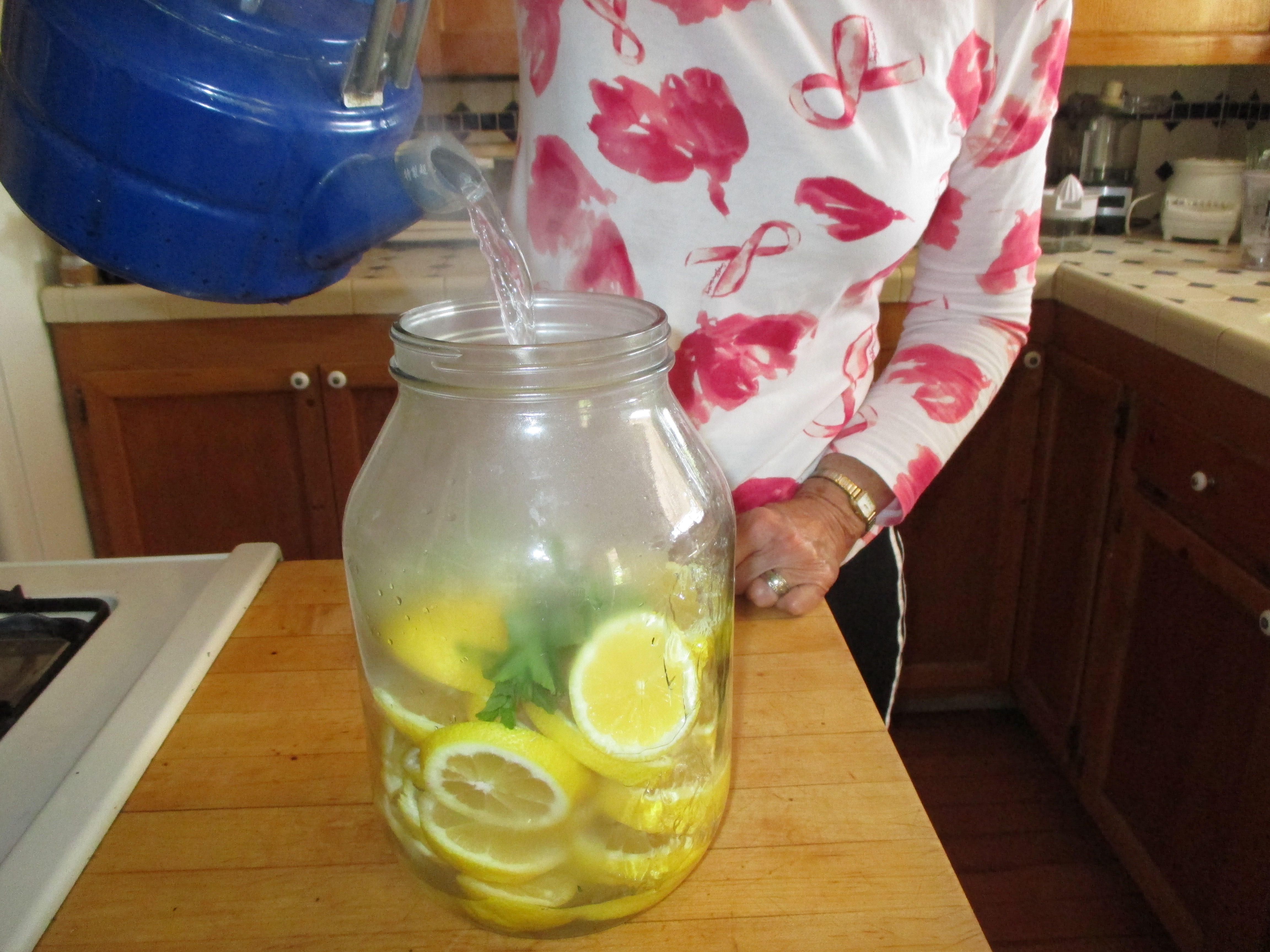
No squeezing needed when you pour boiling water over sliced lemons.

No squeezing needed when you pour boiling water over sliced lemons.

I learned to make the best lemonade from my friend Ann who lives in New Jersey. She learned it from a woman in Germany. Neither of these areas are lemon-growing regions so it may be a way of conserving. Rather than squeezing them, slice the lemons and pour boiling water over them. Let them steep for a couple of hours, pour off the water and repeat. You can keep adding water, letting it sit and draining until the taste grows too weak. This makes a juice with greater depth of flavor because it extracts the lemon oils from the rinds. Sweeten to taste with your choice of sugar, honey or agave syrup.

And Don’t Forget…

Tia Marta is running several classes in gathering and preparing cholla buds. This is a great year for desert plants and the cholla buds are fat and juicy.

Workshop Dates (find a downloadable flyer on the website http://www.flordemayoarts.com):
Saturday April 4, 2015, 7:30-9:30am—register at 520-907-9471
Wednesday, April 8, 8-11am, Pima Co Parks & Rec 520-615-7855 x 6
Saturday, April 11, 8-11am, Westside, sponsored by NativeSeeds/SEARCH, call 520-622-0830×100

Saturday, April 18, 8:30-11:30am, Tohono Chul Park, 520-742-6455 x 228

More Ideas for Wild Dates in Borderlands Towns

Washingtonia filifera near UA main gate (R.Mondt photo)

Our native fan palm, Washingtonia filifera, near UA main gate.  Original seed from Arizona’s KOFA Mountains.   (R.Mondt photo)

Yes, we can delight in the most fabulous wild dates right here in Baja Arizona. We don’t have to put out lots of energy into finding these tasty little morsels because they are now all over the urban landscape. Once, in olden times, they were confined to oases, but now they line every old neighborhood street in low-desert towns. Harvest at the right time and enjoy their bounty.

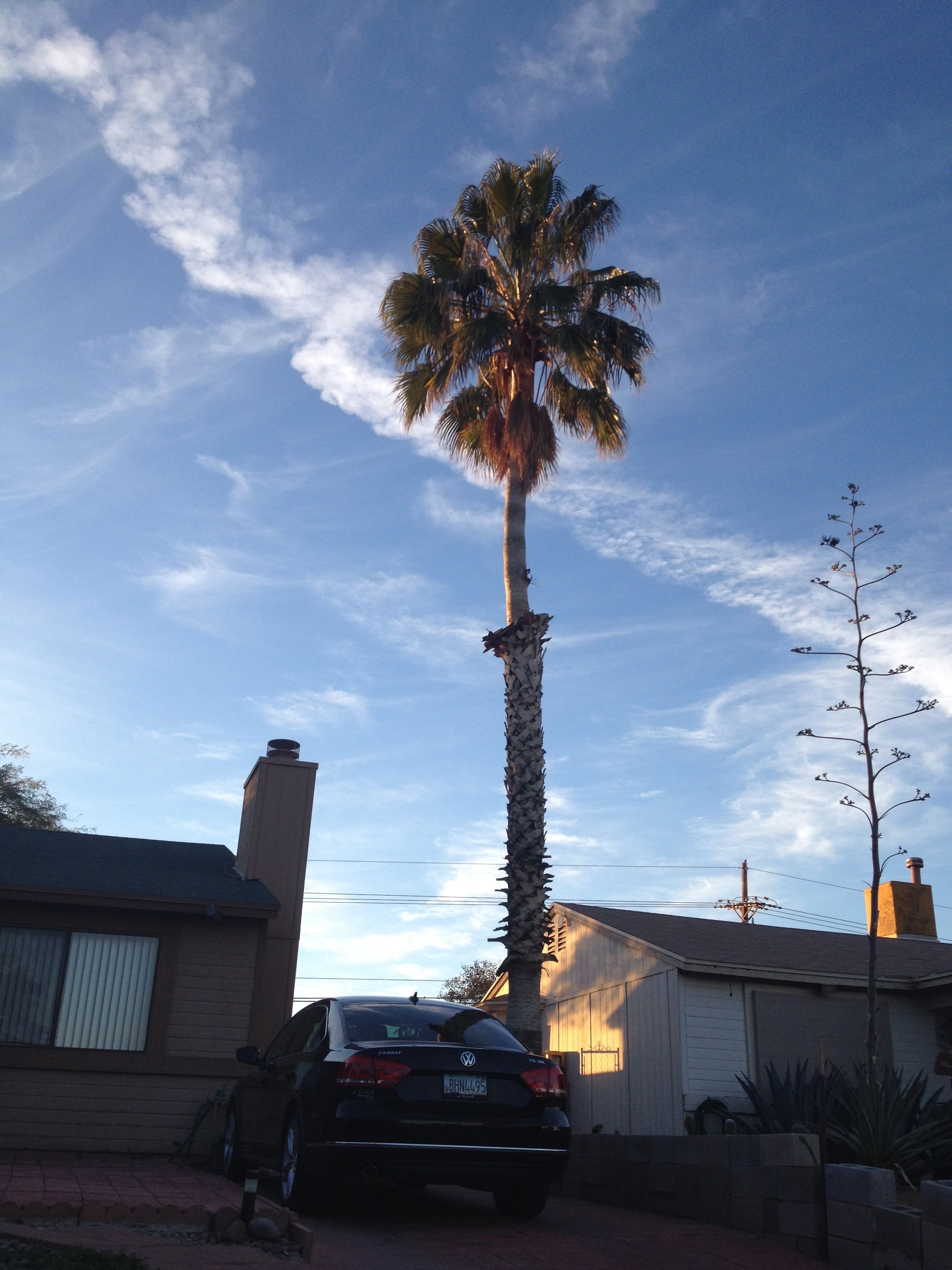
Our Native Fan Palm Washingtonia filifera, UA photo (Note the stout trunk)

Our Native Fan Palm Washingtonia filifera, UA photo (Note the stout trunk)

Tia Marta here to continue our culinary explorations of native fan palm fruit. Our street sentinels are more than vertical shade.  They bear other surprising gifts. Our so called California fan palms (“palma taco”) offer tiny sweet and plentiful fruits (the size of a plump pea), and were harvested and relished by Native People of the Sonoran and Mojave deserts long before Hispanics brought date palms (the pinnate-leafed palms) from the Old World.
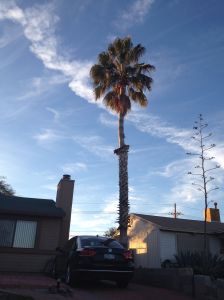
Washingtonia robusta in a S.Tucson landscape

Washingtonia robusta planted in a S.Tucson landscape

When ripe in summer into fall, zillions of fruits hang from pendulous stalks of Washingtonia filifera, with 20 pounds or more of the little buggers in one cluster—talk about prolific! As mentioned in my blog-sister’s post two weeks ago, Carolyn and I were challenged by renowned ethnobotanist Dr Richard Felger to try our hands at creating some “contemporary” recipes for this ancient and well-adapted desert food—which is now disregarded as nothing more than a columnar street planting. We know from ethnographic accounts (see them summarized in Wendy Hodgson’s Food Plants of the Sonoran Desert, UA Press, 2001) that for the Native Cahuilla of Southern California, the fan palm meant survival—a staple in their diet, used both fresh or dried and ground, hard seeds and all, into a flour for cooking or griddling. Another ethnobiologist friend Dr. Amadeo Rea (1997) documented Pima children collecting fan palm fruits as snacks. Dr. Felger intends now to bring this native palm back into new, appropriate use as a sustainable desert food crop.
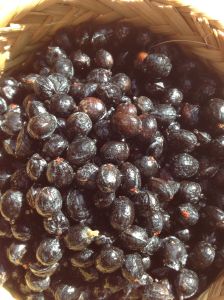
Fruits newly harvested from the California fan palm Washingtonia filifera (MABurgess photo)
Fruits newly harvested from the California fan palm Washingtonia filifera (MABurgess photo)

Washingtonia fruit is mostly seed, but the small amount of pulp has a group impact (MABurgess photo)

Washingtonia fruit is mostly seed, but the small amount of pulp has an impact in numbers (MABurgess photo)

Harvesting the high hanging fruit clusters proves challenging. Native harvesters used a lasso. More recently some harvesters fit a sharp can lid to the end of a pole to cut off the entire fruit stalk. A Tohono O’odham saguaro harvesting kuipaD might suffice—or a long-poled tree-trimmer—both worth a try.


In addition to their success as hot-desert food producers, both fan palms native to southwest North America, Washingtonia filifera (the stout, shorter one) and W.robusta (the super-tall, spindlier one), provide excellent nutrition. It has been estimated that one fan palm’s fruit could sustain one human’s nutritional needs for more than 200 days! Get a load of these figures from James W. Cornett (Principles Jour.Internat.PalmSociety,1987):  Protein 3.1%, Carbs 77.7%, Fiber 10.4%, Calcium 110 mg per 100g, VitaminA(Carotenes) 180mg per 100g.  Comparing these wild date nutritional figures with the commercial date palm (Phoenix dactylifera), our wild fan palm is way ahead on all counts except carbs (carbs 94.1% in standard dates).
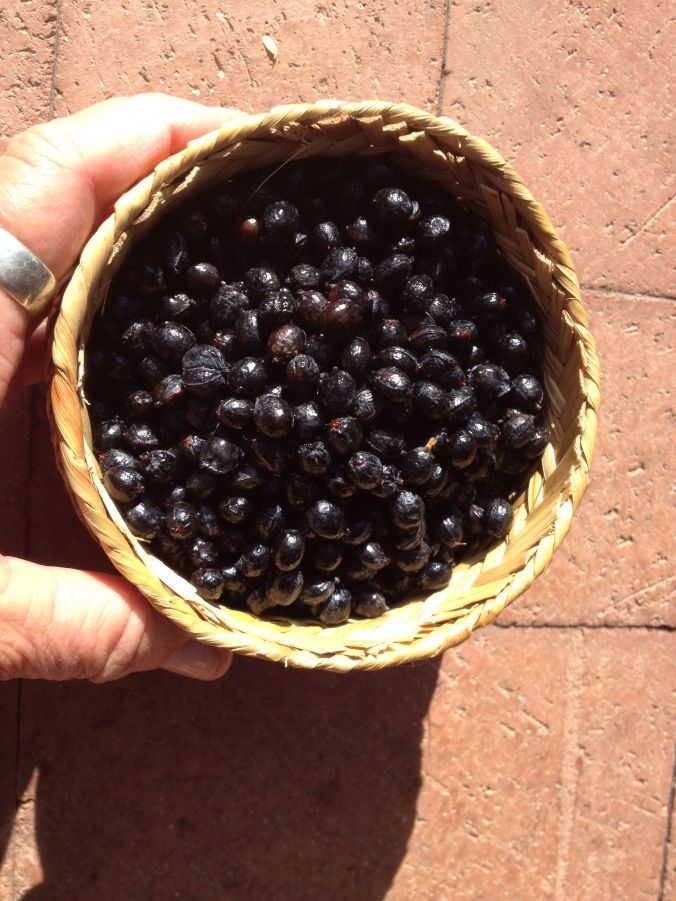
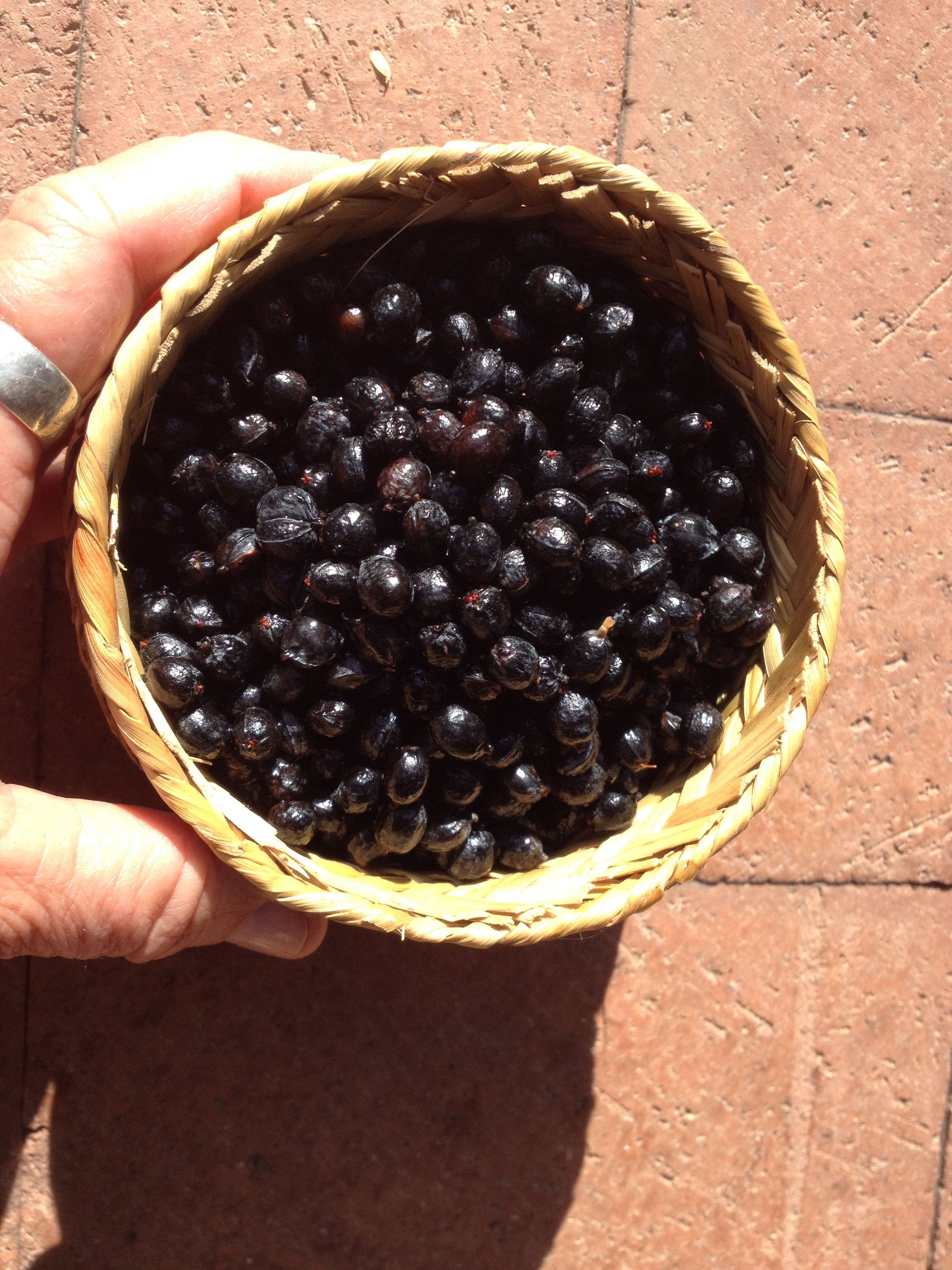
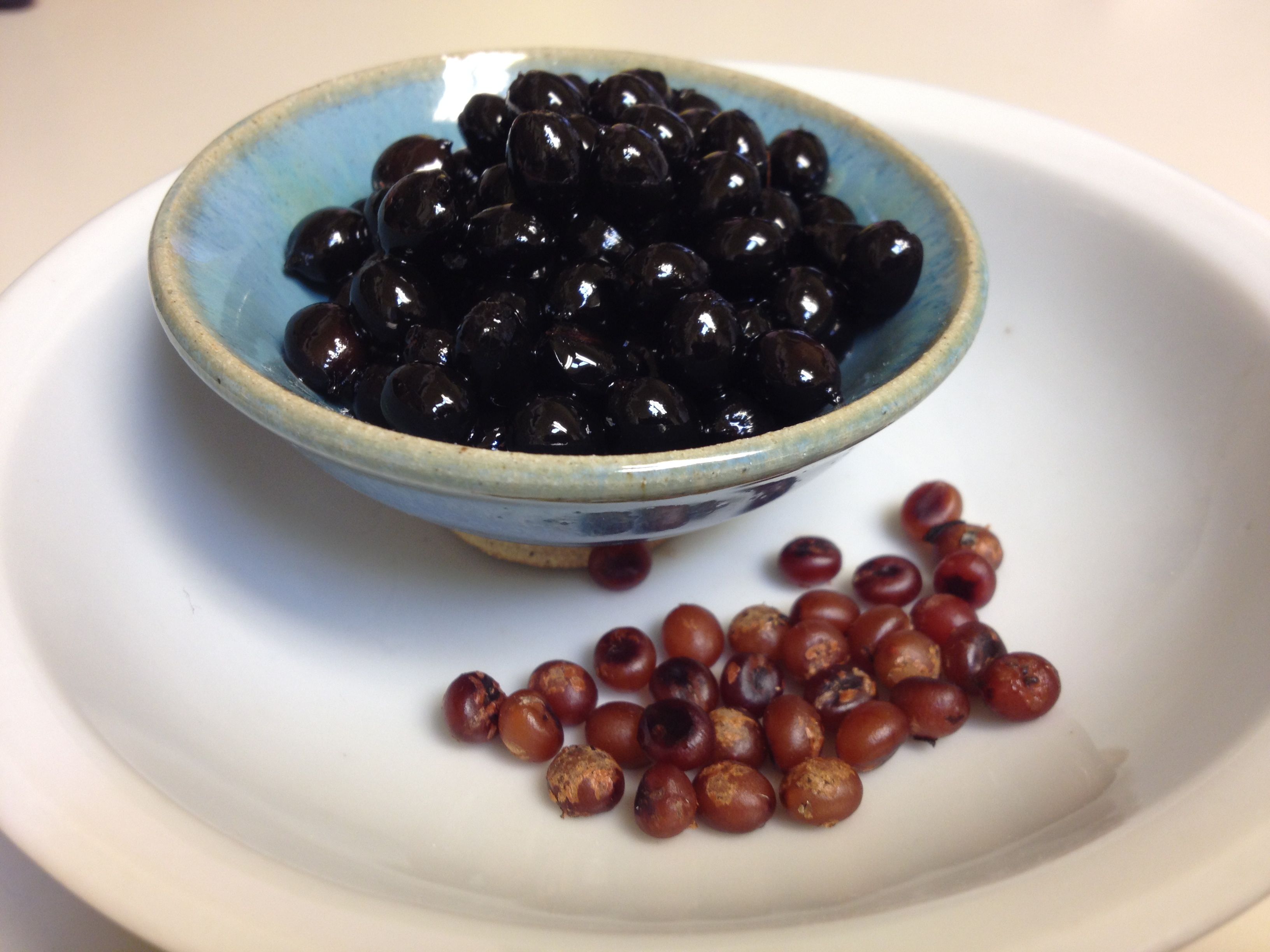
Washed and drained fruits of Washingtonia filifera ready for snacking! (MABurgess photo)

Washed and drained fruits of Washingtonia filifera in Tarahumara sifting basket, ready for snacking! (MABurgess photo)

Since the fruits of W.robusta (the tall one) are even tinier than W.filifera, I chose to do my foodie experiments with the latter one’s “bigger” datelets–both small.  Fruits of both are mostly seed, a stony seed surrounded by a thin layer of sweet skin and dry, date-like pulp. Here are two fun ideas I’ve come up with for using fan palm fruits, which can be done easily in any kitchen or patio. These ideas also might present interesting potential for commercial-scale food production. (I hope our wonderful local companies like Cheri’s Desert Harvest are listening to the significance herein!)                 So, here’s my first idea–really in three delicious parts:
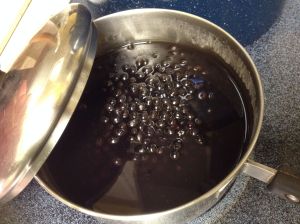
Simmering fan palm fruits

Simmering fan palm fruitsSolar Fan Palm Syrup, Datil Molasses, or Datil Candy

SOLAR FAN PALM SYRUP

Directions:

Wash thoroughly and drain 4 cups desert fan palm fruits. Place in a saucepan with 8 cups drinking water to cover fruit well. On stove-top, gently simmer the fruits for at least 30 minutes, (if using solar oven, make it 1 hour). Add more drinking water to keep fruits covered. Let cool and stand in refrig for 1-3 days. This process is bringing out the complex sugars into solution. Again, when you have a little time, bring back to simmer 15-20 minutes. Taste the liquid. It should be deliciously sweet with a rich, almost smokey bouquet—but still thin. With a sieve, decant the sweet liquid from the cooked fruits, saving the fruits aside.

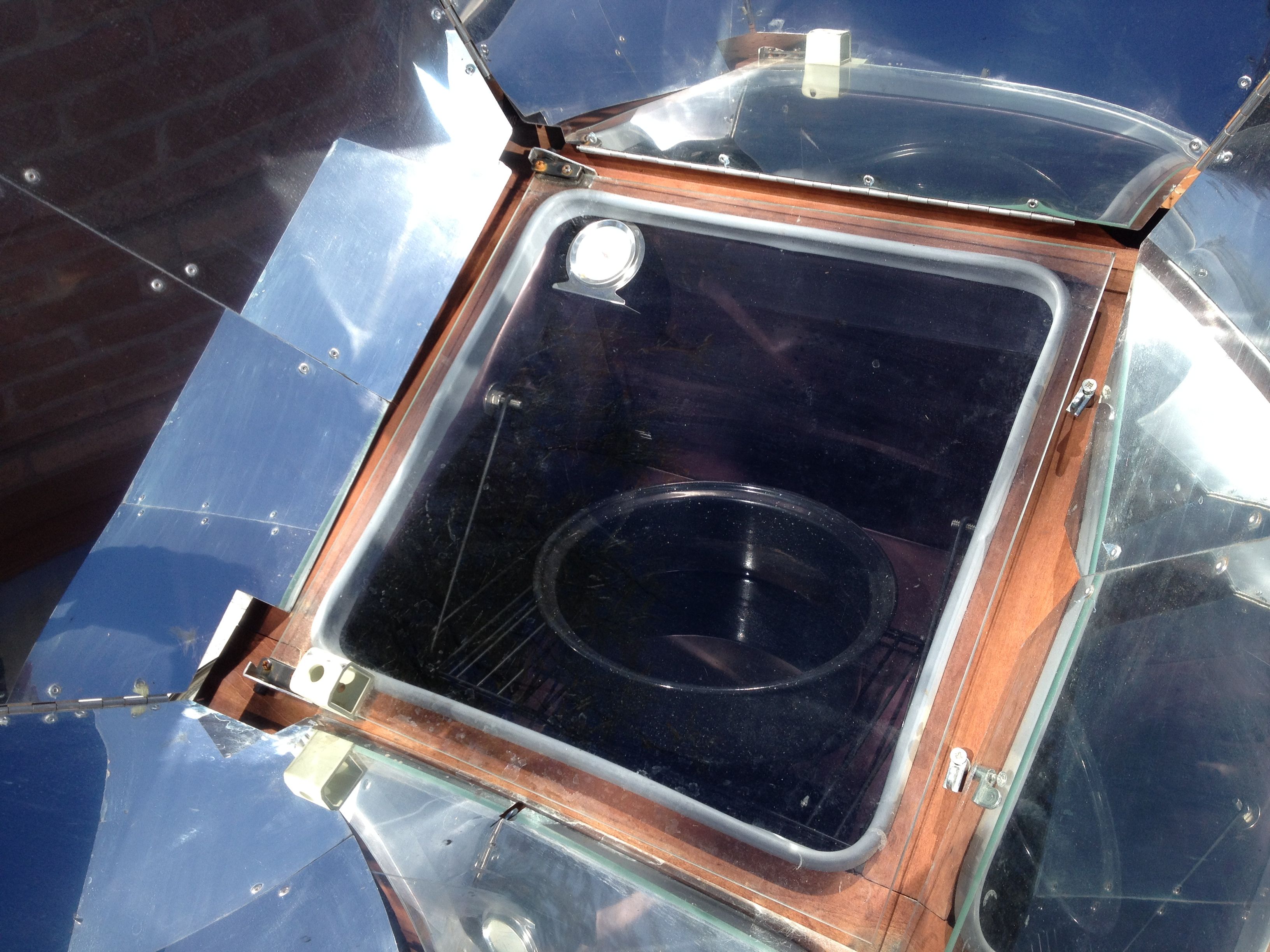
After sieving out the simmered fruit, the liquid is being concentrated in a solar oven with oven cover slightly open to release moisture (MABurgess photo)

After sieving out the simmered fruit, the liquid is being concentrated in a solar oven with oven cover slightly open to release moisture (MABurgess photo

[Here is where my experience reducing thin saguaro fruit juice kicked in. I knew that this thin, sweet liquid from the fan palm dates had to be cooked down slowly.]

Pour the juice into a solar-oven-worthy pan and put in preheated solar oven—without a lid on the pan. Let the glass cover of the oven be slightly open to allow steam/moisture to escape. Check after 15 minutes. If syrup is desired, check for correct syrup consistency.  Keep heating until thickened to pourable syrup.  Then, try this wonderful and healthful solar syrup over mesquite pancakes for the ultimate Southwestern breakfast!
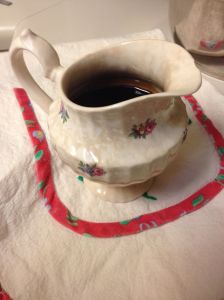
Concentrated Solar Fan Palm Syrup--nothing added--just water and fan palm fruit!  (MABurgess)

Concentrated Solar Fan Palm Syrup–nothing added–just water and fan palm fruit!  Come taste it at the StPhil’s farmers market!(MABurgess)


“DATIL SYLVESTRE” MOLASSES

With more time and further moisture reduction, there are more delicious options….. Here’s one:  For the best, richest “Datil Molasses” you ever tasted, let the liquid cook down for another 45 minutes or an hour (depending on sun intensity).  Be careful not to overcook, which might leave a sweet glue on the bottom of your pan. (The same reduction of liquid can be done of course on the stove-top or over a fire, like reducing maple sap, but hey, this is a desert product. We’ve got our fuel overhead! Let’s use it.)

“DULCES DE DATIL SYLVESTRE”

Carrying the process of concentrating the syrup yet another step further…If an even more chewy candy is desired, you might use the concentrated sweet molasses in a candy mold or for gelling like a fan-palm gummy bear.

Here’s another totally delightsome, exotic yet simple idea for maximum pleasure from fan palm fruits…..

DESERT OASIS CORDIAL

Wild Fan Palm Liqueur (MABurgess photo)

Wild Fan Palm Cordial (MABurgess photo)“Desert Oasis Cordial”

It takes about 4-5 weeks to make this rich cordial liqueur, so plan ahead. With a fall harvest of wild dates you could start making your Desert Oasis Cordial by Thanksgiving and have it ready for Christmas-time celebrations. But don’t wait—when the fruits are ripe, go for it.

This is how I did it:

Wash, wash, wash and drain at least 2 cups of ripe native fan palm fruitlets (W.filifera), enough to pack firmly into a mason jar.  Into the packed jar, pour vodka of your choice, filling all the space between the little fruits to the brim to cover them. (You could use tequila or EverClear for differing degrees of delight.)  Screw on lid and place jar in a cool dark corner of your kitchen, where you can be reminded to agitate it. After a week, open it and add more vodka to cover fruits, as the fruit tissue will have absorbed some of the alcohol. Shake and turn over the closed jar every week.  For the herbalists among us, you will recognize this process is basically tincturing the wild dates. After 4-5 weeks, decant (i.e. separate) the liquid from the fruit. The decanted liquid will be a rich dark chocolate brown color like Godiva liqueur only translucent. Taste it and serve sparingly in small cordial glasses. Store any remaining liqueur in a closed decanter for the next festive occasion.

W.filifera fruit AFTER tincturing and decanting makes a fabulous alcoholic treat (seeds to be discarded)

W.filifera fruit AFTER tincturing and decanting makes a fabulous alcoholic treat (seeds to be discarded) (MABurgess)
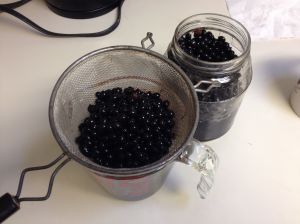
Decanting the marinated fan palm fruits from the liqueur (MABurgess)

Decanting the marinated fan palm fruits from the liqueur (MABurgess)

After both your Fan-Palm Syrup-making and your Desert Oasis Cordial-making, you will have delicious fruits left over in the straining or decanting process.

Don’t forget the simple joy of snacking on little fruits, doing the pulp-from-seed separation maneuver with your tongue and teeth. Move over, sunflower seeds!  The boiled fruits after syrup-making are still tasty.  Better still–the vodka-soaked wild dates give an extra kick, so don’t overindulge.

Both can be briefly quick-whirled or mashed in a blender, meat grinder, or CuisinArt to begin the process of separating the remaining pulp from the hard seeds.
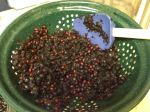
After decanting the cordial, remaining fruit is whirled and put thru colander to separate pulp from seeds

After decanting the cordial, remaining fruit is whirled and put thru colander to separate pulp from seeds

[If someone has a good idea of how best to separate seeds from pulp easily, please share it!] Fruit leathers, energy bars, jams, “datil newtons”, spreads, supplements—there are SO many ways the remaining fruit pulp could be used, so that none of the nutrients and fiber need go to waste. Even the hard seeds could be parched and ground into a nutritious flour—as Native People did in earlier times, to their advantage.
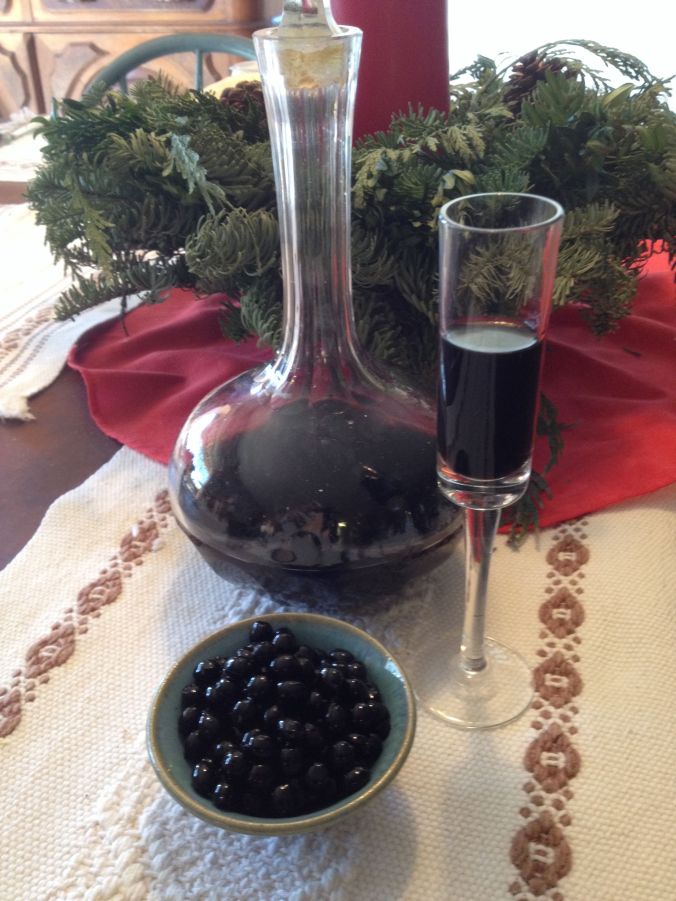
 

"Desert Oasis Cordial" from wild fan palm fruits (MABurgess photo)

“Desert Oasis Cordial” from wild fan palm fruits (MABurgess photo)

BTW, after snacking on Washingtonia fruitlets, be sure to check your smile in the mirror for black flecks of the yummy pulp between your incisors.  I can see it now—the next fad question after “Got milk?” will be “Got datil?”  That could make for a wild date experience. Enjoy!

For a taste of the native fan palm fruits, come by our Flor de Mayo booth at Sunday’s St Phillips farmers market, 9am-1pm. There we also have a demo of solar-oven cookery in action.  The cleverly designed solar ovens are for sale from us with a discount and no shipping costs. We’d like to see every household in Baja Arizona equipped with a solar oven for emergencies as well as for sustainable living.

You can find the perfect makings for the pancakes to eat with your Solar FanPalm Syrup for that Southwestern breakfast–mesquite flour and heirloom White Sonora Wheat flour— at the Native Seeds/SEARCH store (3061 N Campbell, Tucson) and at Flor de Mayo’s booth at St Phillips farmers market.  See you on Sunday! Have your taste-buds ready for a wild date.

Playing with Washingtonia palm fruit

Washingtonia filifera (California fan palm)

Washingtonia filifera (California fan palm)


It’s Carolyn this week, taking you backstage to a food experiment. As we move into a hotter, drier climate here in the Southwest, we’ll have to consider agricultural products that can handle the changes. Although I’ve been playing with edible wild plants for decades and Tia Marta (Muffin Burgess) has put in similar years of work, it’s always exciting for us to find something new. We’re going to do a two-part investigation of what to do with a wild food new to both of us.


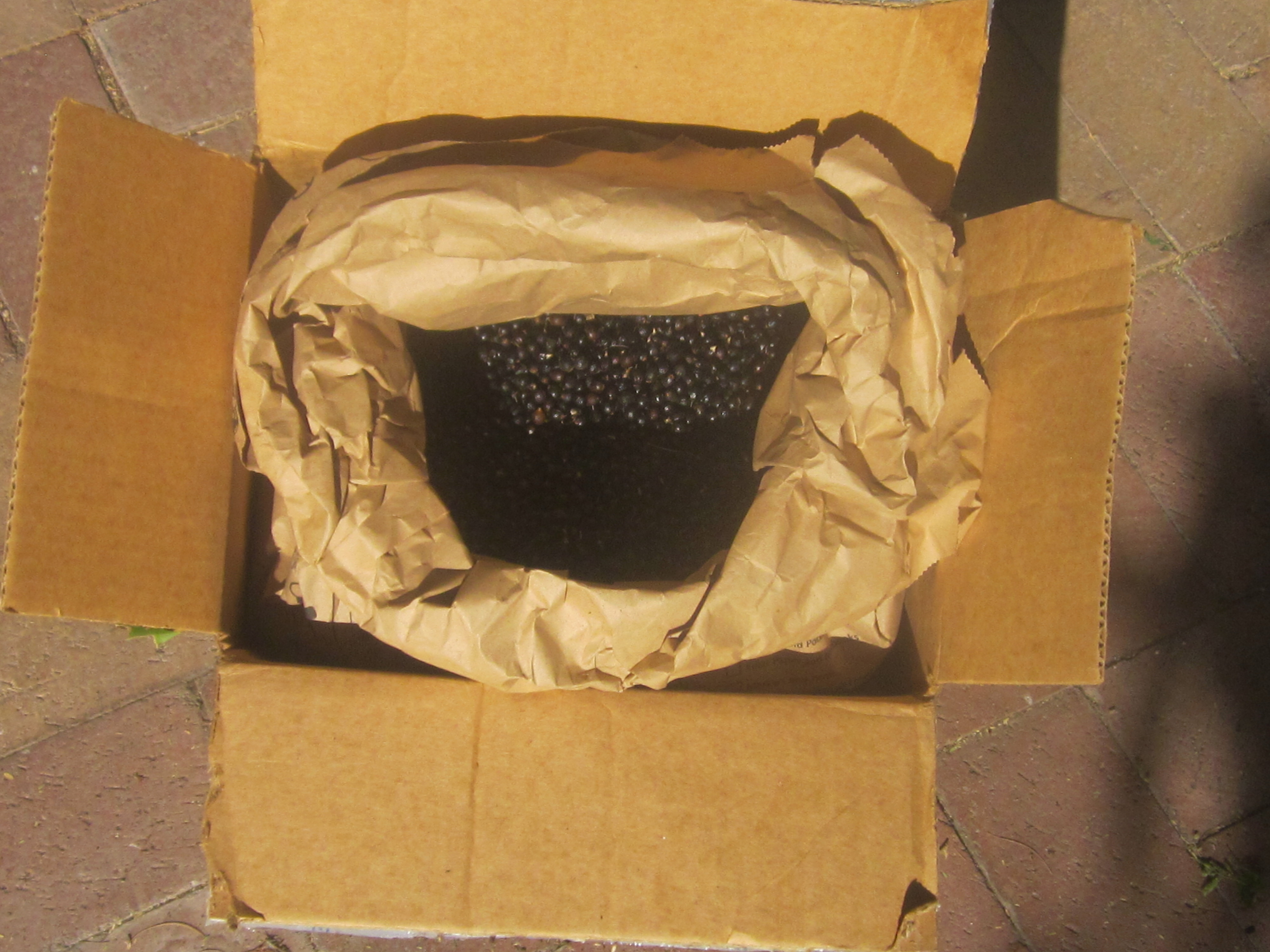
Big box of palm fruit.

A big box of  W. robusta palm fruit arrived at my house.


Last fall I received an email from noted ethnobotanist Dr.Richard Felger. He and a colleague, Dr. Don Hodel, an environmental horticulturist for the University of California Cooperative Extension, were working on some wild palm fruits, two species of Washingtonia, also called Mexican or California fan palm. He wondered if I could come up with some recipes. Back in the early 1970s when I was just beginning work with wild edibles, Dr. Felger took me on one of my first plant walks and over the years has answered many questions for me. I figured I owed him. I also asked Tia Marta if she wanted to join in the fun.

After a couple of days,  FedX deposited a box with about 10 pounds of tiny hard black nodules on my doorstep – Washingtonia robusta fruit gathered from a park in Signal Hill, Calif. , near Long Beach. Not promising, they were little more than skin on seed with almost nonexistent flesh, nothing like their cousins the palm fruits we know as dates. Humans have a long history of using palm fruits – in fact some scholars think that the honey referenced in the Bible was actually date syrup.

Wendy Hodgson, THE expert on wild desert foods, says in her book Food Plants of the Sonoran Desert, that the Washingtonia fruits were very important to the Cahuilla and Cocopa. She writes, “They made flour from the ground dried fruits and mixed it with other flours and water to form a mush.” We don’t eat much mush anymore (unless you consider oatmeal for breakfast), so I’d have to devise something else to do with them.

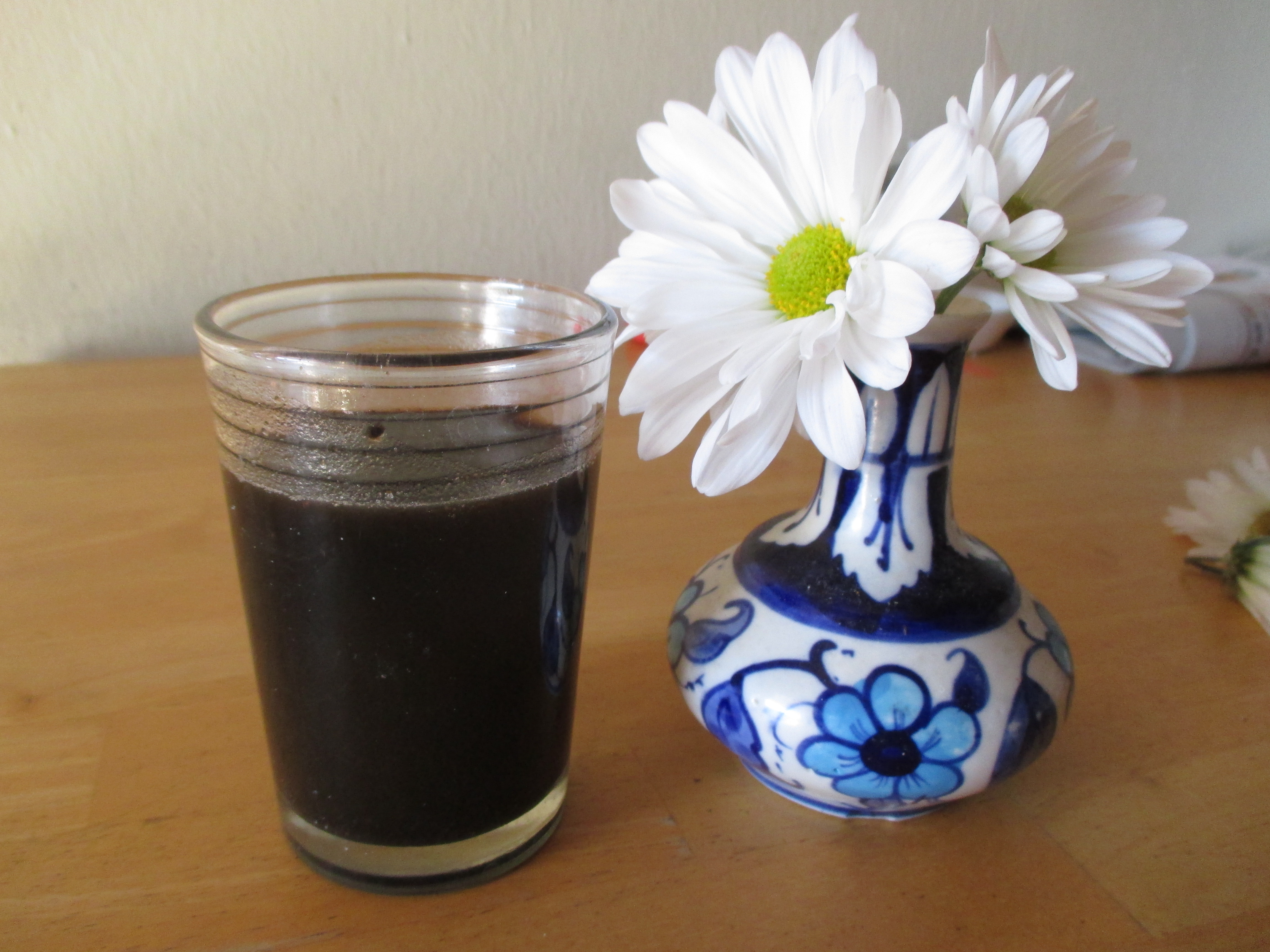
I took 4 cups of fruit and covered them with 8 cups of water. Brought it all it to a boil, then simmered uncovered for 30 minutes. I ran the softened fruit through a blender in batches and strained the liquid, ending up with 5 cups of almost black liquid that tasted something like prune juice.

Even flowers don't make this liquid look appetizing.

Even flowers don’t make this liquid look appetizing.

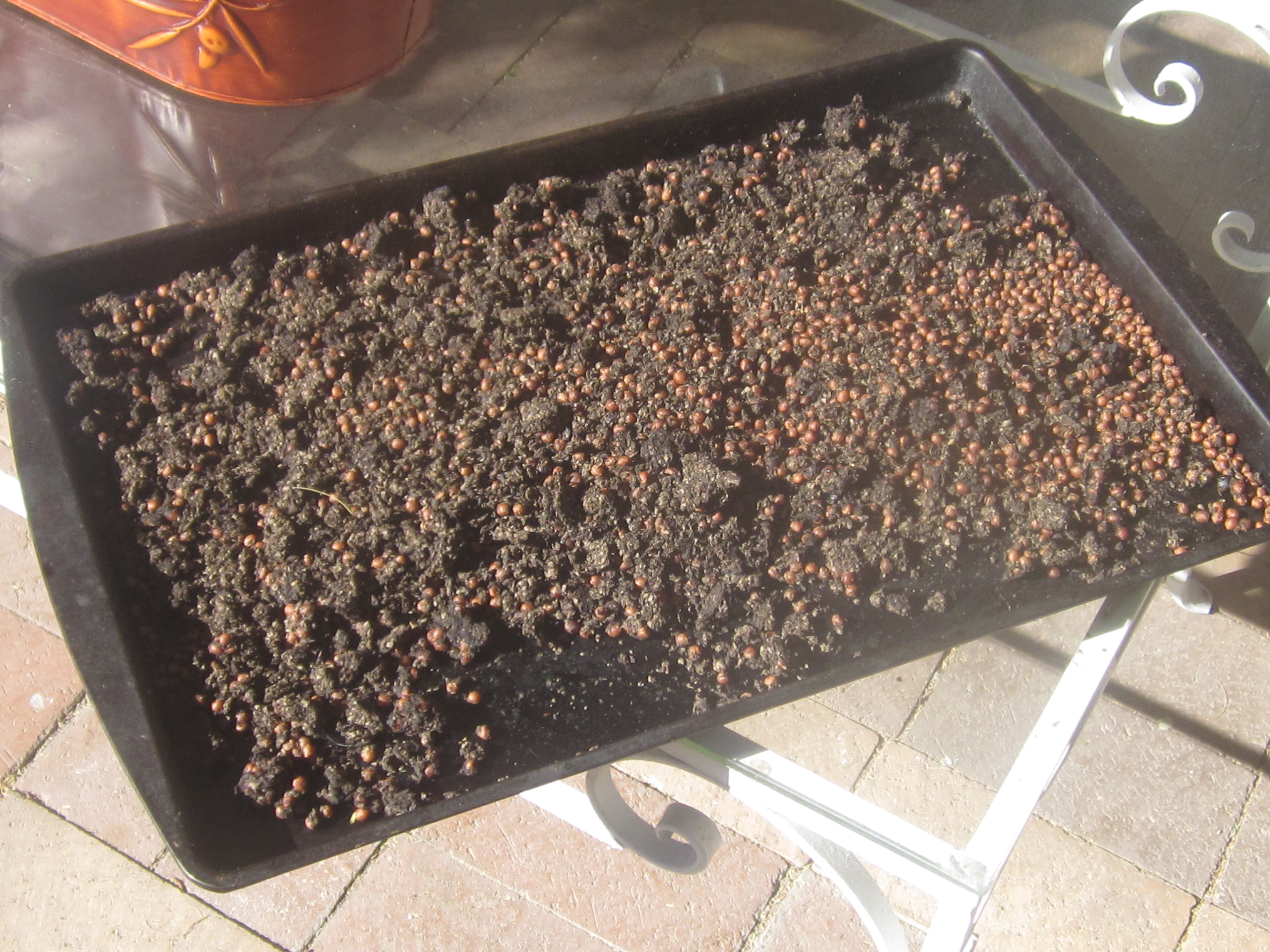
. I simmered it until reduced to ¾ cup pulpy liquid then spread the remaining pulp and seeds on a cookie sheet and put it in sun to dry. Later, I sifted out ¼ cup dried flakes and discarded the hard seeds.

Pulp and seeds drying in the sun.

Pulp and seeds drying in the sun.

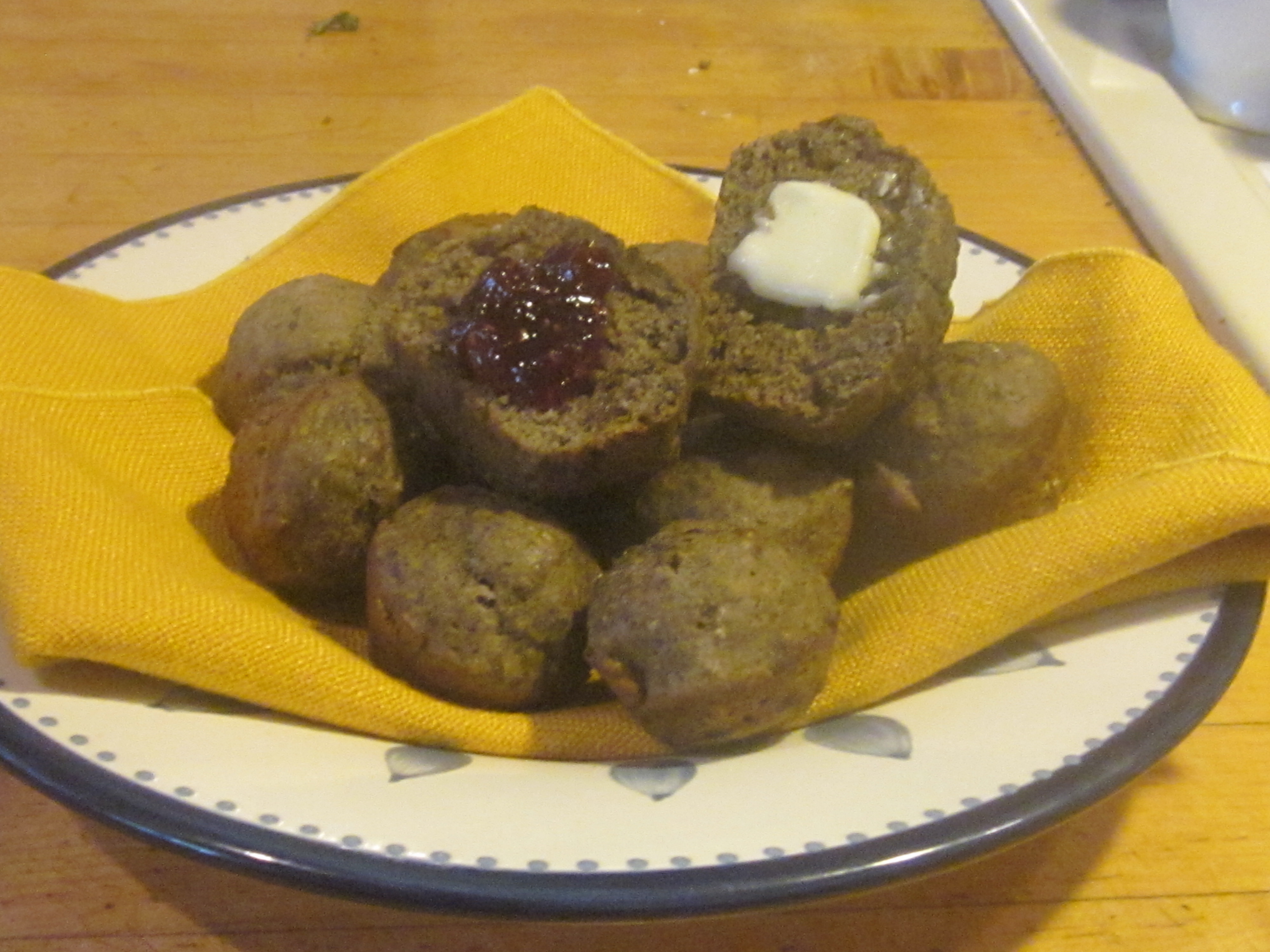
At this point I wrote Dr. Felger my scientific assessment: Sweet — but definitely not yummy. I pressed on and made some tasty muffins. Since there is interest in natural sweeteners, I concentrated on that aspect. Using a standard muffin recipe, I substituted the palm syrup for the liquid milk and reduced the sugar. I added the dried flakes just because I had them and to add some texture.

Muffins with palm syrup and dried flakes.

Muffins with palm syrup and dried flakes.

Fan Palm Muffins

Makes 1 dozen

1 ¾ cup unbleached white flour

¾ teaspoon salt

2 teaspoons baking powder

2 tablespoons sugar

¼ cup dry powdered milk

¼ cup dried Washingtonia  flakes

2 eggs

¾ cup pulpy Washingtonia syrup

3 tablespoons melted butter

Mix dry ingredients in a bowl. In another bowl, mix eggs, Washingtonia syrup and melted butter. Stir wet ingredients into dry ingredients. Do not overmix; some lumps are OK. Bake in greased muffin tins at 400 degrees F for about 15 minutes or until they appear done.

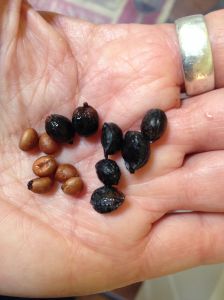
Washingtonia filifera fruit (about 1/4 inch) on left and W. robusta on the right.

Washingtonia filifera fruit (about 1/4 inch) on left and              W. robusta on the right.

Meanwhile, Dr. Hodel acquired some Washingtonia filifera fruit from a street tree near Indio, Calif., and sent another 10 pounds. Oh boy. They were still tiny, but bigger than the robusta. I put them through a similar process of simmering, blending, straining and reducing. The taste difference was subtle – more date-like than prune-like. Better.

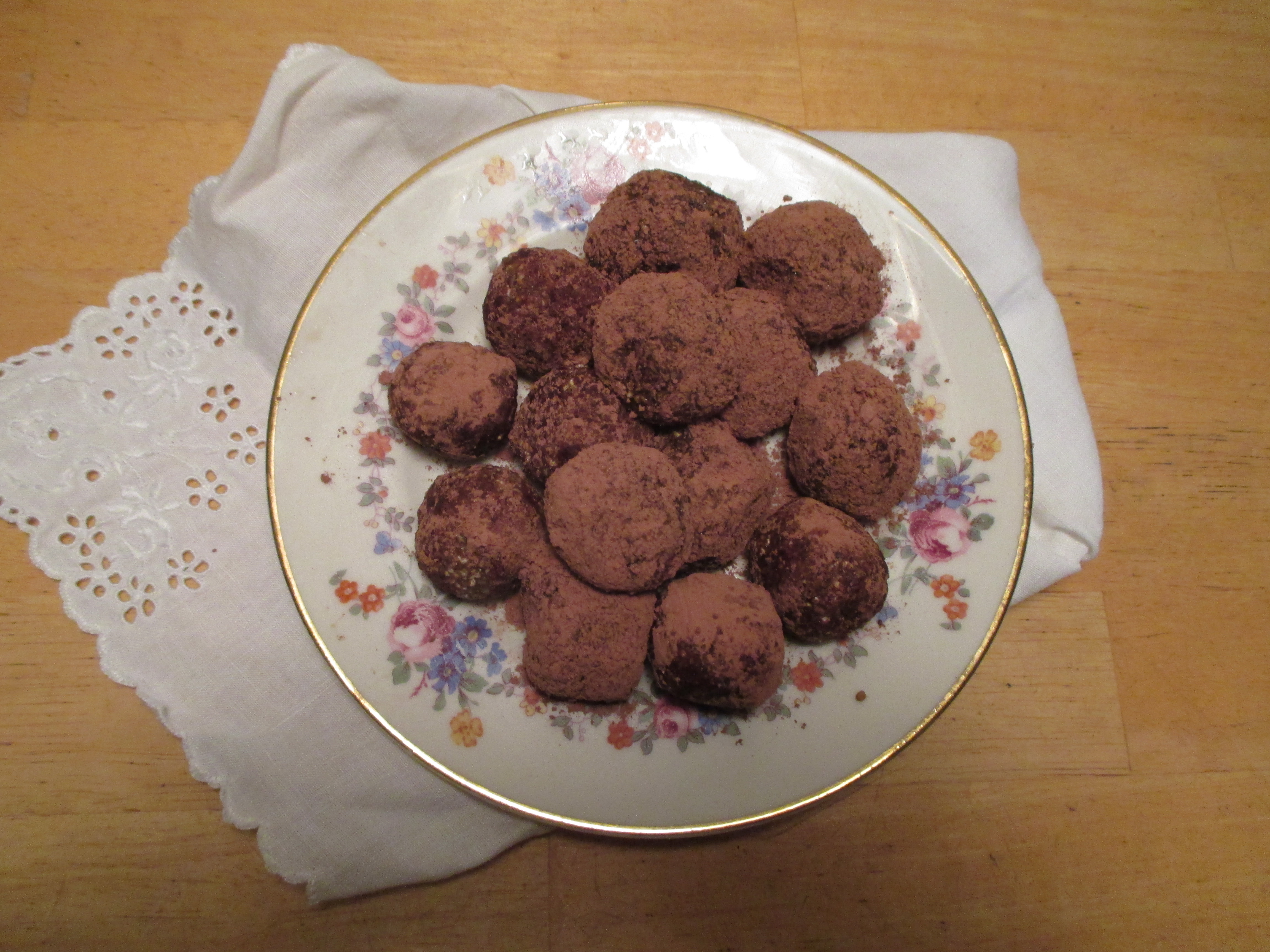
I decided to use the filifera syrup in a healthy treat, showcasing its natural sweetness, and came up with these truffles. I used almond butter, but other nut butters will do.


Nutty truffles sweetened with W. filifera syrup and rolled in cocoa.

Nutty truffles sweetened with palm syrup and rolled in cocoa.

Nutty Truffles

Makes 1 dozen

½ cup almond butter

½  cup popped amaranth grain

¼ cup ground popped amaranth

6 tablespoons Washingtonia filifera palm syrup

1/3 cup cocoa or carob powder

Combine all ingredients except cocoa in a bowl and blend with a spoon. Form into 12 small balls. Roll each in cocoa. (You can buy popped amanranth at Native Seeds SEARCH)

 ♥  ♦  ♥  ♦

What’s the point of trying to find a way to use the fan palm fruits? With climate change bringing hotter, drier summers to the Southwest, ethnobotanists like Dr. Felger and Dr. Hodel are looking for plants that can take those conditions and still produce food.

I don’t expect a rush of  people heading out to gather bushel baskets of fan palm fruits. They’ll appeal to the more ardent wild food enthusiasts who, like me, want to taste every berry on every bush.  But  they may have uses in more industrialized food production. They are sweet and easy to harvest and process. Some entrepreneur may see opportunity there. After all, nobody I know makes their own agave syrup.

(Check out Dr. Richard Felger ‘s article at  “Arizona Native Food Plants for a Dry Future” in The Plant Press: The Arizona Native Plant Society vol. 37, no. 2: 1, 3-5.)


Mesquite Gingerfolk for Christmas

Mesquite Gingerfolk are tasty treats for the holidays.

Mesquite Gingerfolk are tasty treats for the holidays.

It’s Carolyn today sharing one of my favorite holiday recipes. The flavor of mesquite meal blends nicely with the warm spices we like in the winter.  These Mesquite Ginger Folk are pretty cute and they taste wonderful.  I used good quality margarine rather than butter or Crisco because I like the eventual texture and the flavor is good. This recipe makes a spicy cookie. If you want more of the mesquite flavor to come through, cut down on the spices. The dough must be well chilled before you roll it out, so this is a two-step recipe: mixing first, then later rolling and baking.

Mesquite Ginger Folk (makes about 3 1/2 dozen rolled cookies)

In a medium bowl, combine 2 cups all-purpose flour, 1/2 cup whole-wheat flour,  1/2 cup mesquite meal, 1 1/2 teaspoons ground cinnamon, 2 teaspoons ground ginger, 1 teaspoon allspice, 1/2 teaspoon salt, 1/4 teaspoon ground black pepper.  Stir and fluff with a fork and then set aside.

In a large bowl, use an electric mixer to beat 1 1/2 sticks margarine  with 1/2 cup packed brown sugar until fluffy. Beat in 2/3 cup molasses and one large egg. Then gradually add the flour mixture to make a stiff dough. You may need to give up the mixer for a wooden spoon.  Divide the dough into two thick disks and wrap each in plastic wrap.  Refrigerate until chilled, about three hours.

When you are ready to bake, take one disk from the refrigerator .   You’ll want the dough just warm enough to roll without cracking.  While you are waiting, preheat the oven to 350 F. and put out brown paper or wire racks to receive the baked cookies. You’ll also need lots of flour to keep the dough from sticking when rolled.  So get a small bowl of flour, take part of the disk, and roll it in the flour before you roll out with the rolling pin.

Roll a ball of dough in the flour.

Roll a ball of dough in the flour.

Roll out the dough about 1/8-inch thick on flour-dusted surface. Cut out the cookies and transfer them to the cookie sheet, placing them 1 inch apart. Gently knead the scraps together and roll out again.  When you fill one cookie sheet, bake it for about 10 – 12 minutes while you prepare another sheet.

This cutter gives a nice uni-sex cookie.

This cutter gives a nice uni-sex cookie.

If you wish, you can use raisins and dried cranberries to make eyes, a mouth and buttons.  Chop the dried fruit into tiny pieces.

IMG_0413

Sometimes it is difficult to position those tiny pieces on the cookies. But remember those tweezers you keep in the kitchen to deal with cactus stickers?  Perfect for placing the eyes and buttons.

IMG_0408

To further decorate the cookies, perhaps make some shoes or pants, mix up some white frosting using powered sugar, a little butter and a few drops of milk.  If you have a decorator bag, use it to pipe out some decorations or just draw the decorations with a flat-end toothpick.  Either way, you’ll love your Mesquite Ginger Folk and you’ll love sharing them.

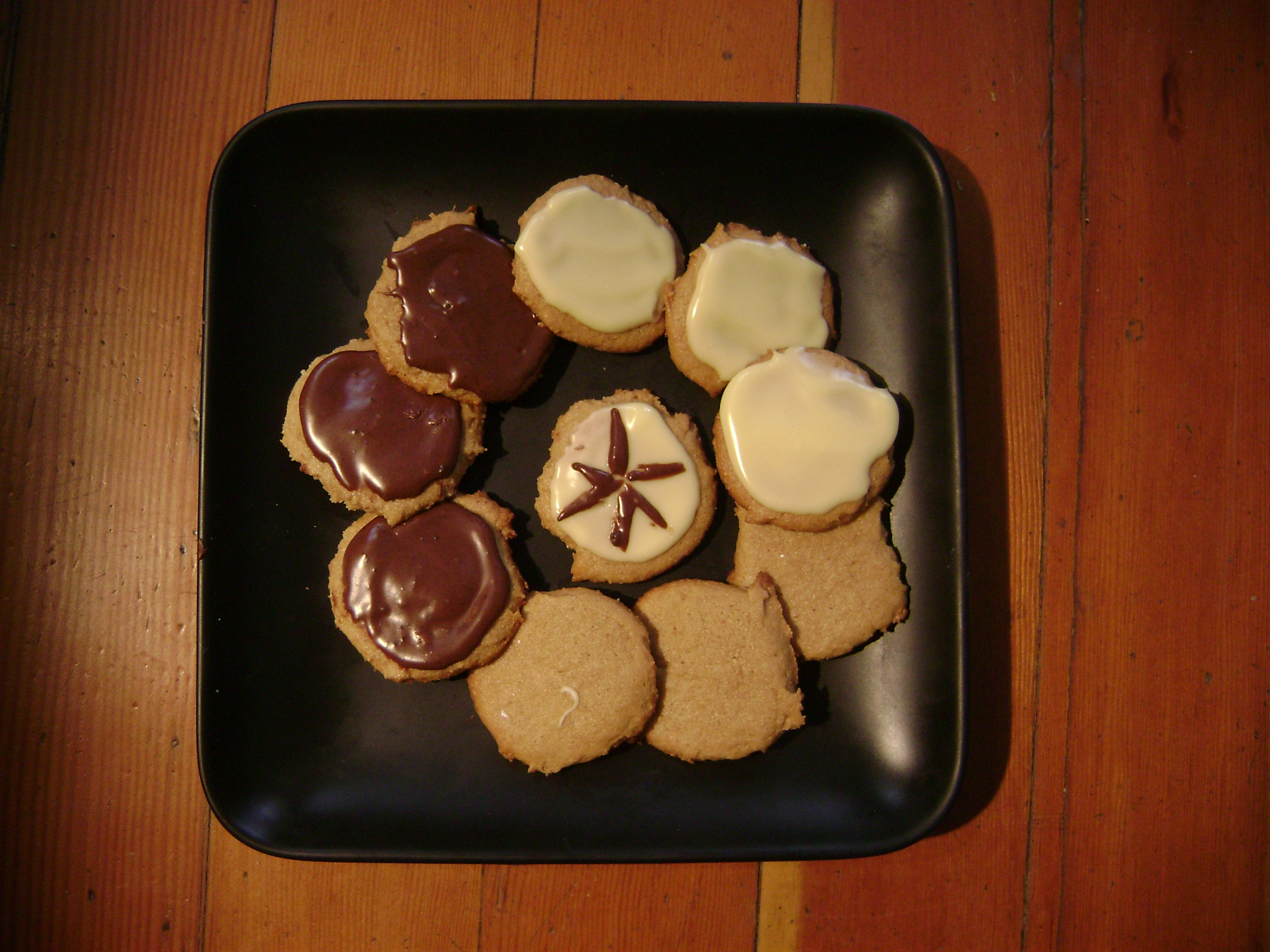
If you’d like to make some mesquite cookies but can’t face the cutting and decorating, you can use the same recipe to make drop cookies. Frost if you have time.

Mesquite Ginger Cookies in simple form.

Mesquite Ginger Cookies in simple form.

If you have not harvested your own mesquite meal, here are a few places to purchase it:  The Flor de Mayo Table at Sunday St. Phillips Farmers Market; the Native Seeds/SEARCH store at 3061 N. Campbell Ave. and http://www.nativeseeds.org for mail order; and the San Xavier Farm Store, http://www.sanxavierfarm.org.  If you are in Phoenix, check the farmers markets there.

For more great mesquite recipes, check out my cookbook Cooking the Wild Southwest: Delicious Recipes for Desert Plants. You’ll learn how to make Mesquite Apple Coffeecake, a fabulous rolled cake with mesquite and coconut, a a dozen other delicious recipes.


Versatile Tomatillo Salsa

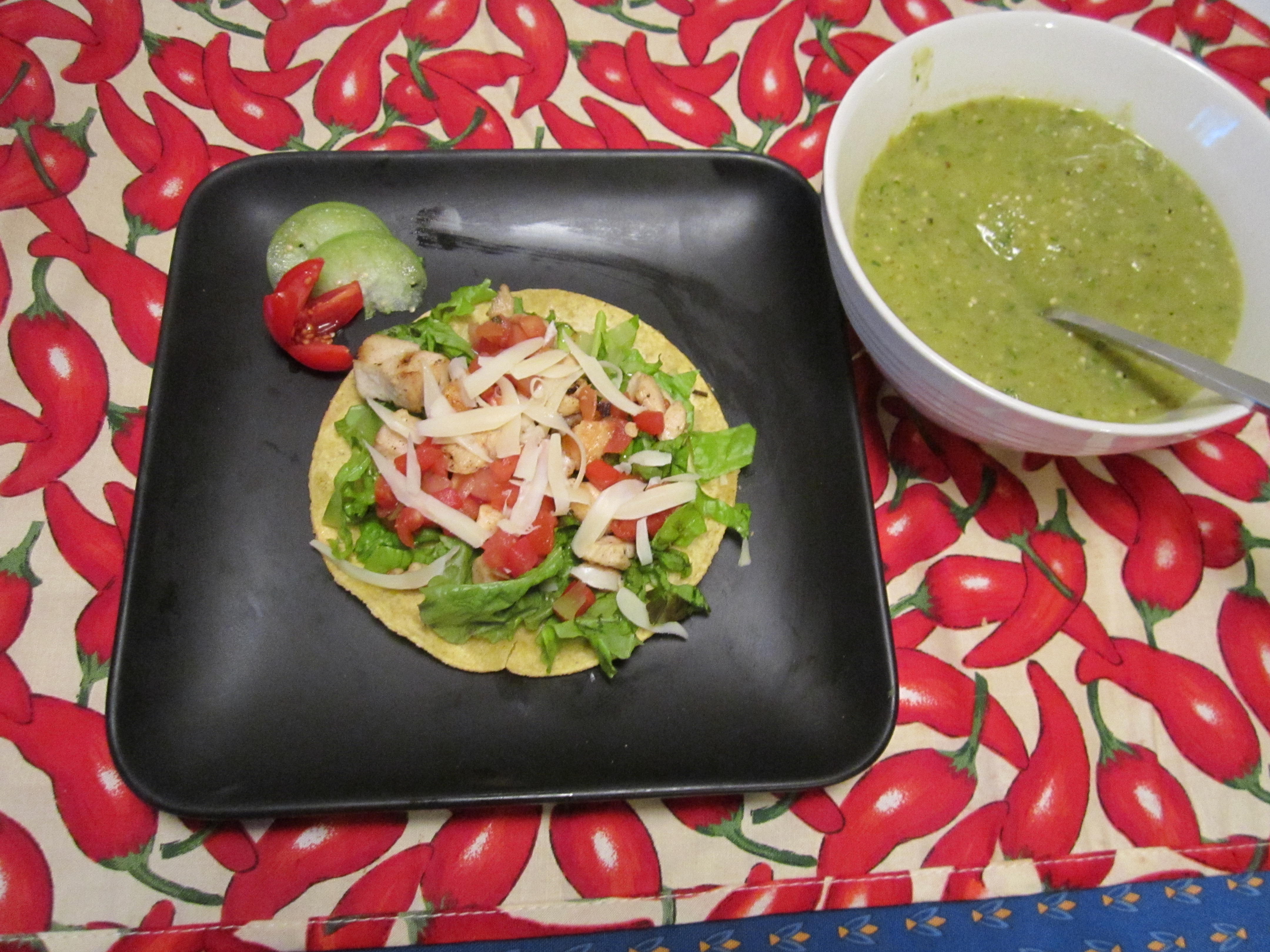
Salsa Verde is the perfect addition to a tostada.

Salsa Verde is the perfect addition to a tostada.

When I was interviewing chefs for my book The New Southwest Cookbook back in 2005, tomatillos were the vegetable du jour — every chef had them on the menu, usually “blackened” or roasted to heighten the flavor.  I gained new respect for how versatile they are.

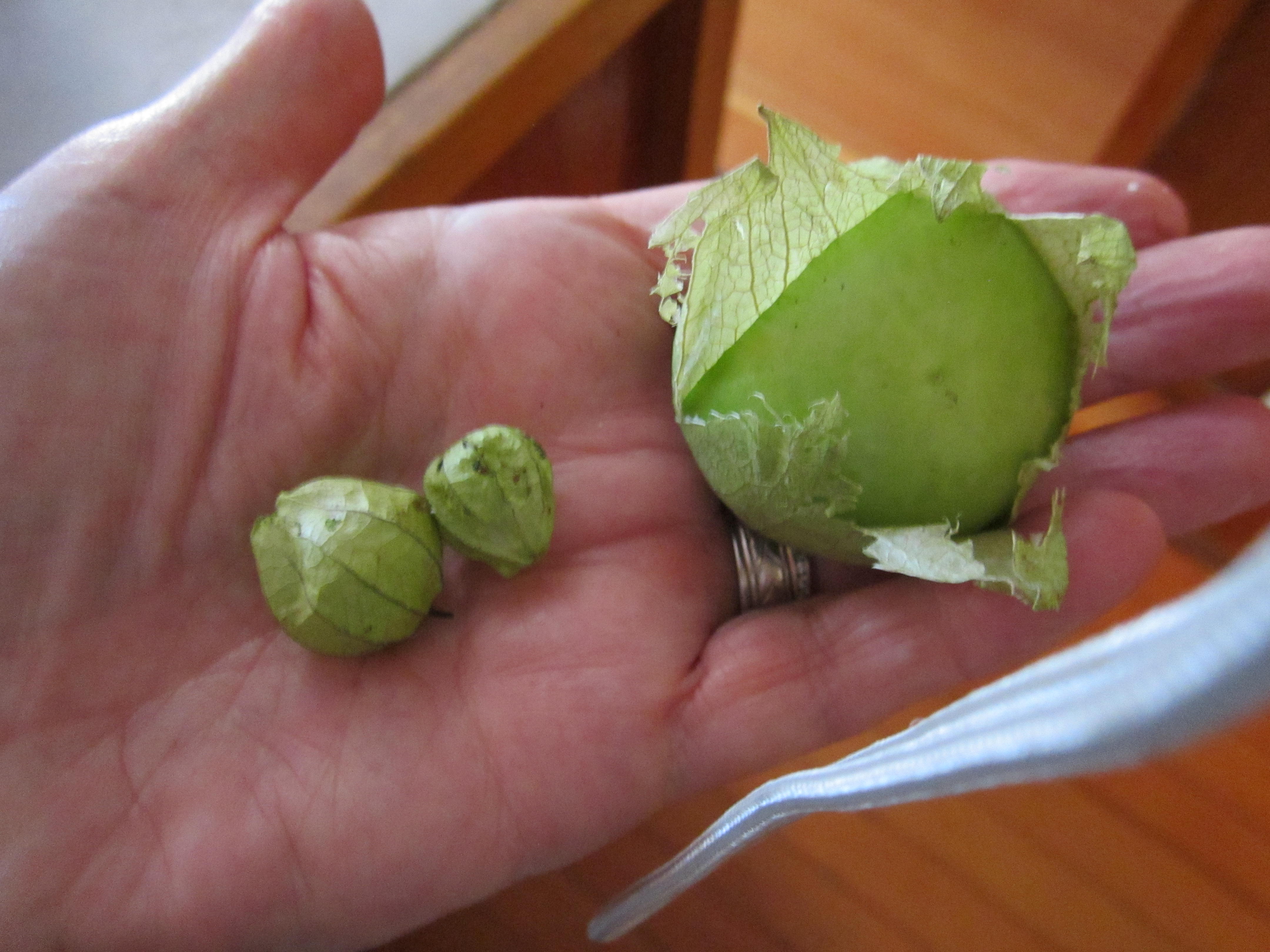
I planted six tomatillo plants in August and hoped for a plentiful harvest, I even dreamed about making enough green salsa to can or freeze. Alas, my homegrown tomatillos were so tiny they weren’t worth the trouble and I ended up buying tomatillos grown by a farmer who had a better technique.

My homegrown tomatillos next to commercial

My homegrown tomatillos next to commercial

In Mexico the tomatillo is called tomate verde, which means “green tomato.” However, tomatillos are not just small, underripe tomatoes, but a distinct vegetable in their own right. Tomatillos are the size of an apricot and covered with a papery husk. They are meatier and less juicy inside than a tomato.  Tomatillos are an essential part of Mexican cuisine and have been since the Aztecs domesticated them. Most tomatillos are harvested slightly underripe when then have a tart, slightly lemony flavor that adds zip to salsas.  As they fully ripen they turn more golden and become sweeter.

Tomatillos are the main ingredient in the classic salsa verde which includes tomatillos, sliced green onions, green chiles of some variety, garlic and cilantro.  Salsa verde can be served raw or very lightly cooked. Of course, you can always put your own spin on salsa verde by using the herbs you have fresh in your garden.

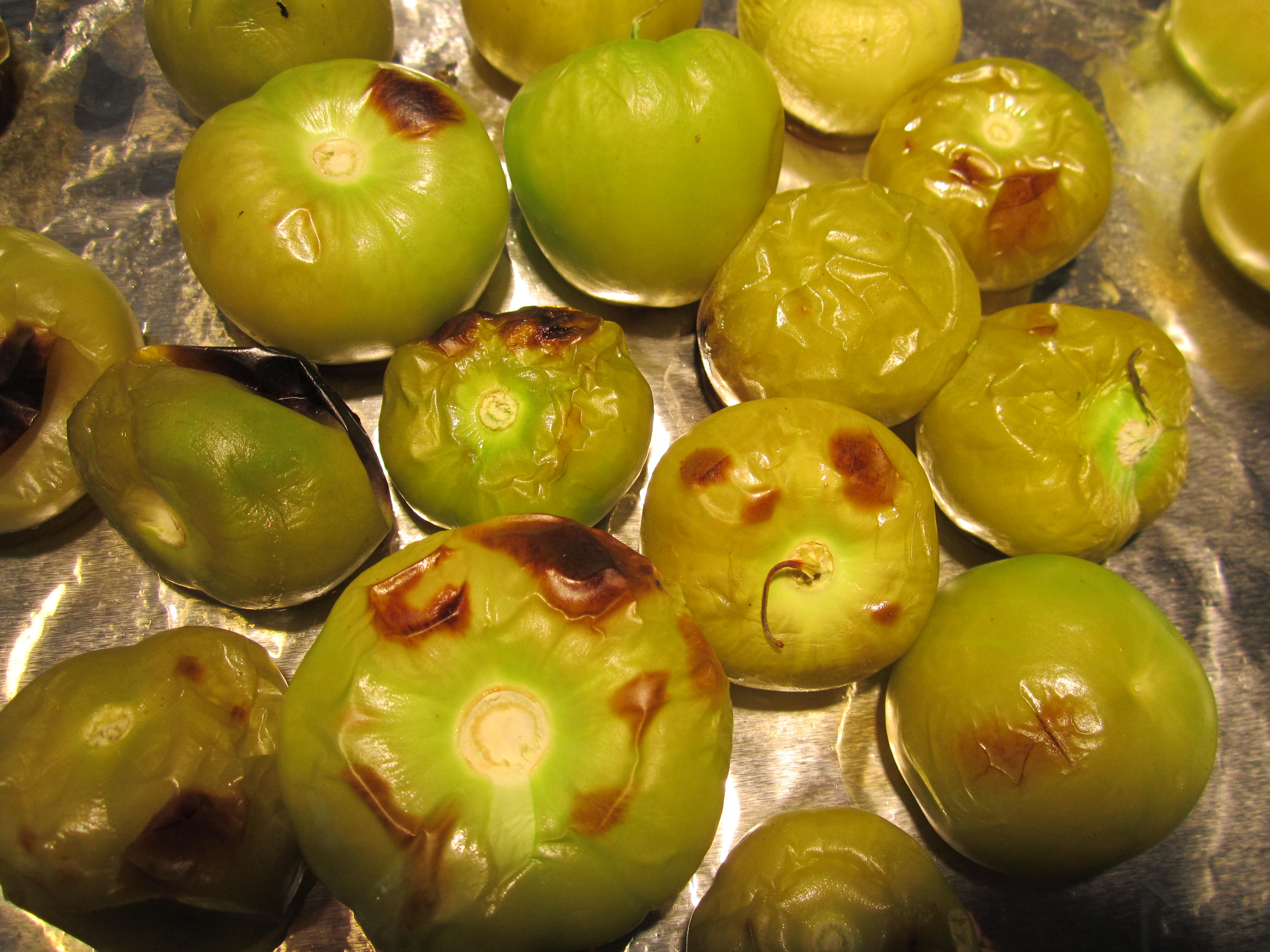
To prepare tomatillos, remove the husk and rinse off the stickly substance on the skin. Rub them with a little oil and then put them under the broiler until they are soft and just slightly brown.

Roast the tomatillos until soft.

Roast the tomatillos until soft.

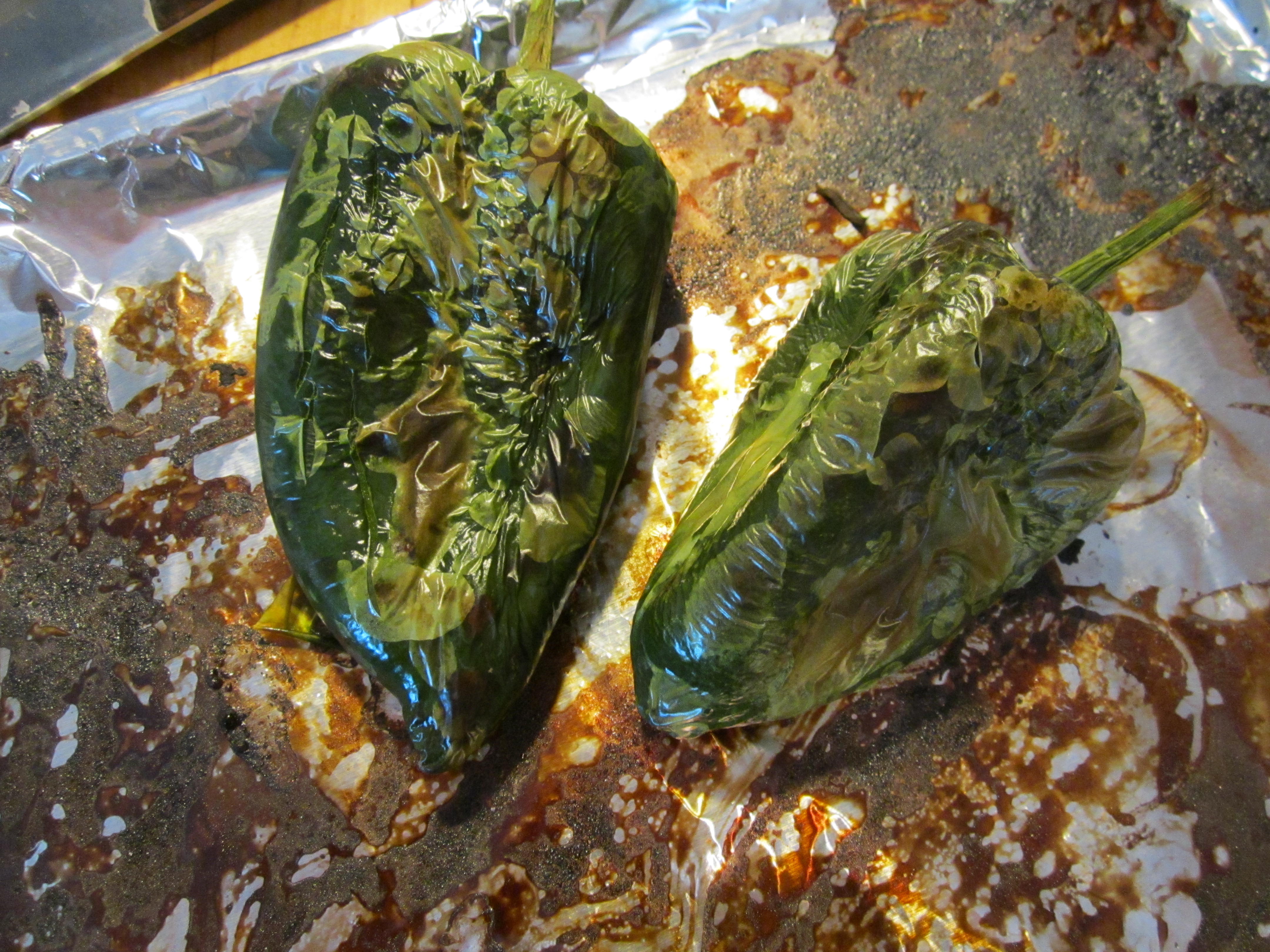
I love the flavor of poblano chiles in anything, so I roasted a couple of those while the tomatillos were cooling.  When their skins were charred on all sides, I put them in a paper bag to sweat for about 10 minutes (OK, 5 minutes, I was impatient).  This makes them easy to peel.  Also take off the stem and the seeds.

Nicely charred poblano chiles.

Nicely charred poblano chiles.

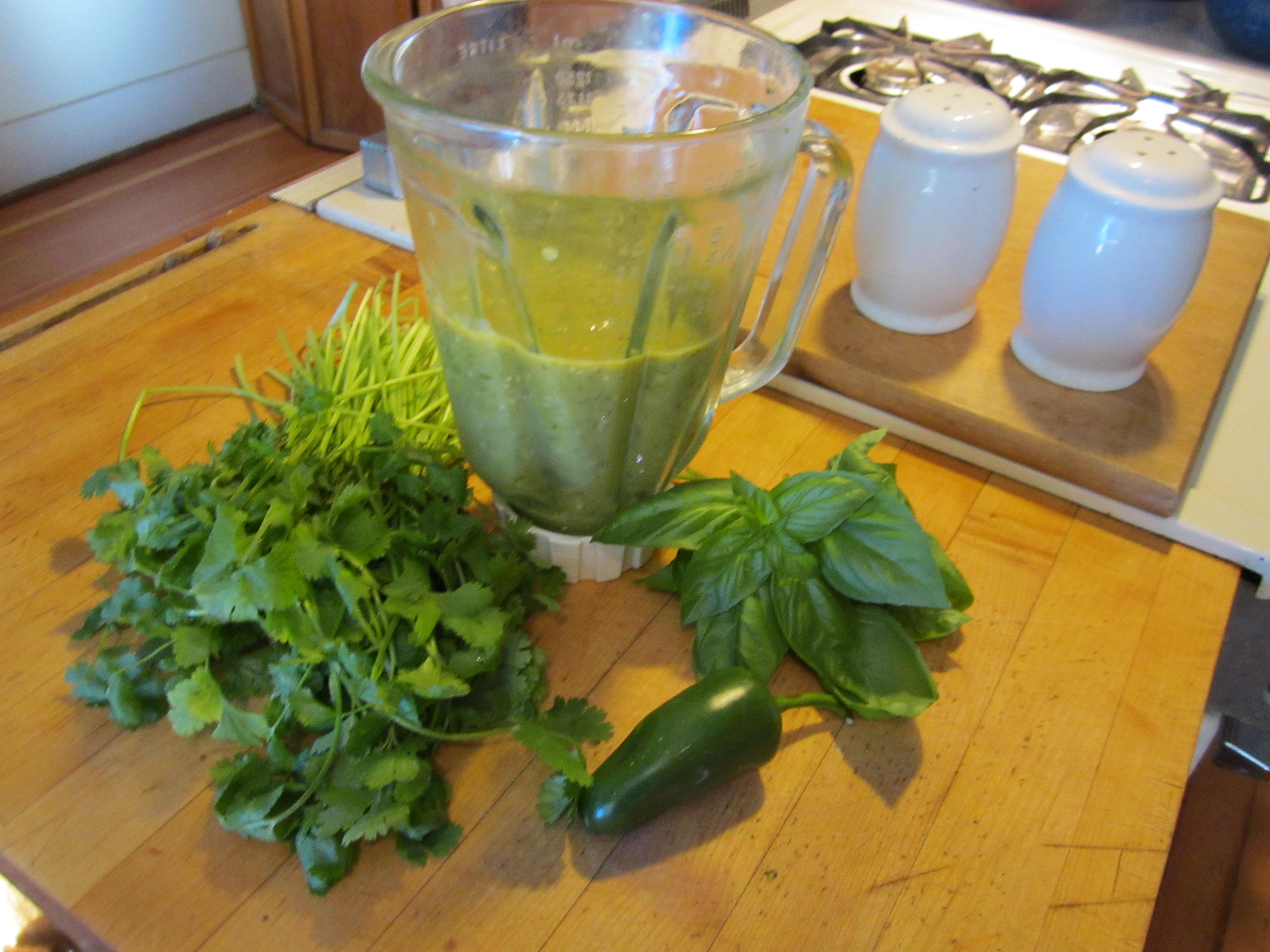
Next it is time to get creative.  Put your tomatillos, skin and all into the blender with some sliced green onions, some peeled garlic cloves, and the peeled chiles. If you want a little more heat, add a half or whole jalapeno, chopped. (And of course you remember to use gloves while chopping the jalapeno and don’t touch your eyes.)  Add some chopped cilantro. I had some lovely fresh basil, so I added that as well. Blend well until you have a nice smooth consistency.  The chef at Medizona, a top Scottsdale restaurant, added a little apple juice to mellow out the tartness.


Blend together tomatillos, chiles, onions, garlic and herbs.

Blend together tomatillos, chiles, onions, garlic and herbs.

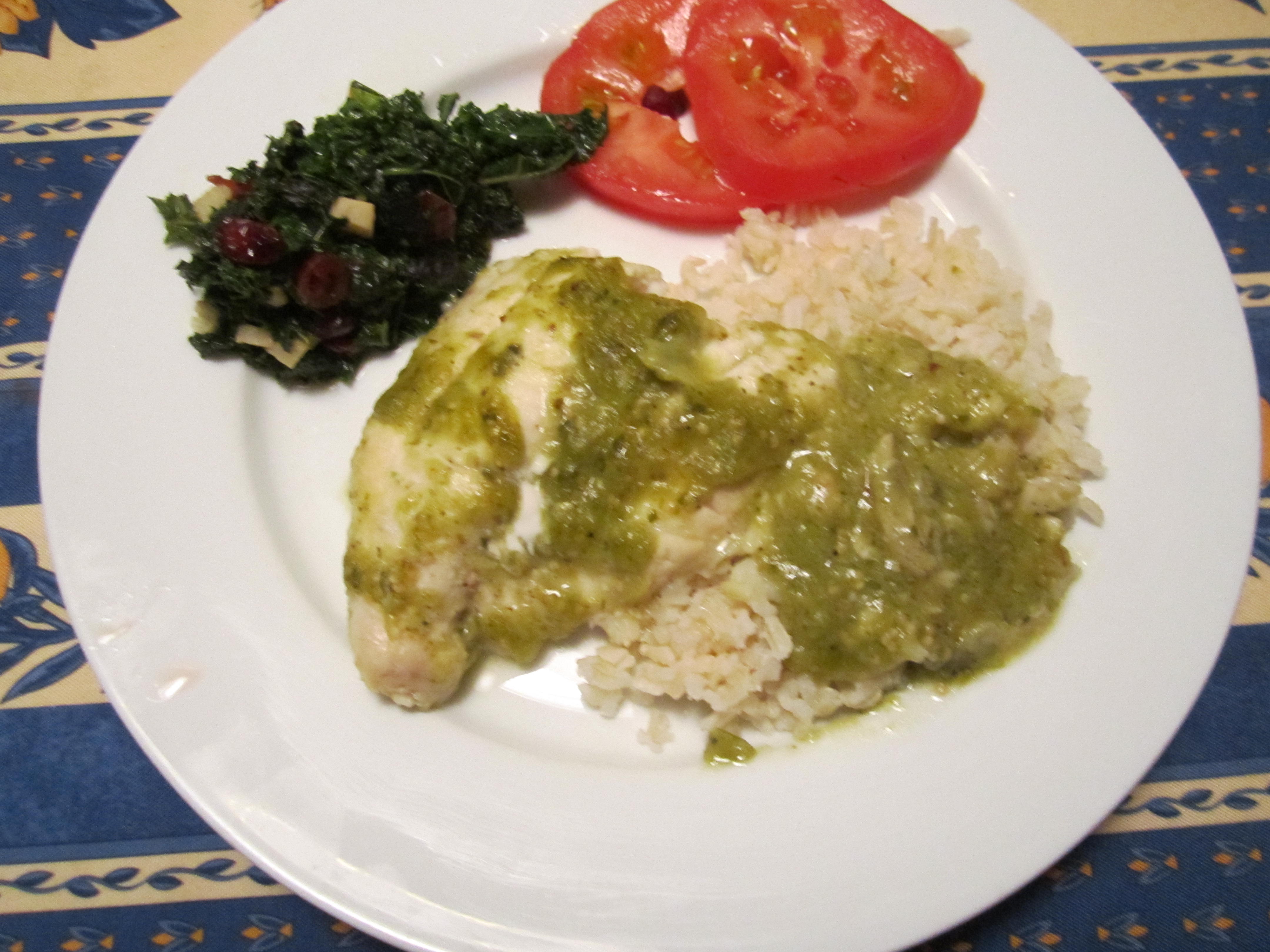
So now you have this wonderful salsa.  How to use it?  Try it on tacos or tostadas (photo top of post) or as a sauce for chicken, pork chops or even shrimp.

Salsa Verde on broiled chicken.

Salsa Verde on broiled chicken.

Charboiled Tomatillo Sauce from Medizona

Feel free to vary the amounts in this recipe.  As they say, “for reference only.”

1/4 pound tomatillos

1 tablespoon olive oil

2 poblano chiles

1/2 jalapeno (optional)

3 green onions, sliced

1/2 cup chopped cilantro leaves

5 cloves garlic, peeled

1/4 cup apple juice

Salt and pepper to taste.

1. Remove husks from tomatillos, wash and rub with oil. Put under boiler until soft and slightly browned. Let cool.

2. Broil or grill poblano chiles until all sides are charred. Sweat in paperbag until skins remove easily. Peel and deseed.

3. Combine all ingredients in a blender and whirl until smooth.  If using on hot food, heat in a saucepan before serving.


And just for fun, here’s a garnish tip I learned from Chef Janos Wilder. Carefully loosen the husk from tomatillos, peel them back and you have a lovely flower. They are a great addition to a cheese plate or relish tray for a party.

IMG_0130____________________________

For more great Southwestern recipes using local ingredients or fruits and vegetables from the wild, check out my cookbooks Cooking the Wild Southwest (University of Arizona), The Prickly Pear Cookbook (Rio Nuevo Press), or The New Southwest Cookbook (Rio Nuevo Press). 


Savoring Our First Anniversary (and Mesquite Cake)

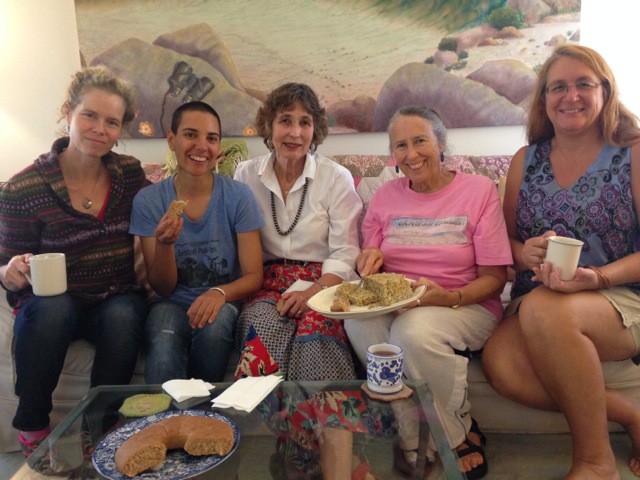
(From left) Aunt Linda, Amy Valdez Schwem, Carolyn Niethammer,  Tia Marta, and Jacqueline Soule.

The Savor sisters: (From left) Aunt Linda, Amy Valdes Schwemm, Carolyn Niethammer, Tia Marta, and Jacqueline Soule.

Carolyn Niethammer here today with this celebratory post. The Savor Sisters, the five writers who bring you Savor the Southwest, got together this week to celebrate the first anniversary of our wide ranging blog about the glories of Southwest food traditions –  traditional, modern, wild and cultivated. The Savor the Southwest month always starts out with Aunt Linda who frequently writes about her bees, recipes with honey, and even making cheese from milk from cows on her ranch. Her posts are lyrical and sometimes spirtual. On the second Friday, you hear from Tia Marta (Muffin Burgess), our ethnobotanist who keeps an eye on what the desert is producing, traditional Native American agricultural products, and ingredients she sometimes uses in her Flor de Mayo products.  I take the third Friday and write about edible desert plants, Southwest specialties and interview other interesting folks in the food world.  On the fourth Friday we hear from Jacqueline Soule who has been taking us through her book Father Kino’s Herbs among other subjects. That’s her gluten-free barrel cactus seed cake Muffin is slicing in the photo. You’ll get the recipe later this month. So far we have only heard from Amy Valdes Schwemm, producer of fabulous spices, on the occasional fifth Friday, but she will be writing more frequently in the coming year.

We are grateful to all of you readers who join us each week as we explore and celebrate the culinary delights of this fabulous area here on the Sonoran desert where we are so privileged to live. Every celebration needs something sweet, so today I’m going to give you a recipe for an easy and delicious mesquite cake that uses whatever fruits are in season. I used peaches and grapes, but plums, pears, apples or even prickly pear would be great additions. This is good for brunch or a not-too-sweet dessert.

Golden Mesquite Fruit Cake

3/4 cup all-purpose flour

1/4 cup mesquite meal

2 teaspoons baking powder

1/2 teaspoon ginger or cinnamon

1/4 teaspoon salt

1 stick soft butter

3/4 cup sugar

2 large egs

1 teaspoon vanilla extract

1 cup chopped fresh fruit

For topping

1 tablespoon mesquite meal

1 tablespoon sugar

1/2 teaspoon ginger or cinnamon

Method:

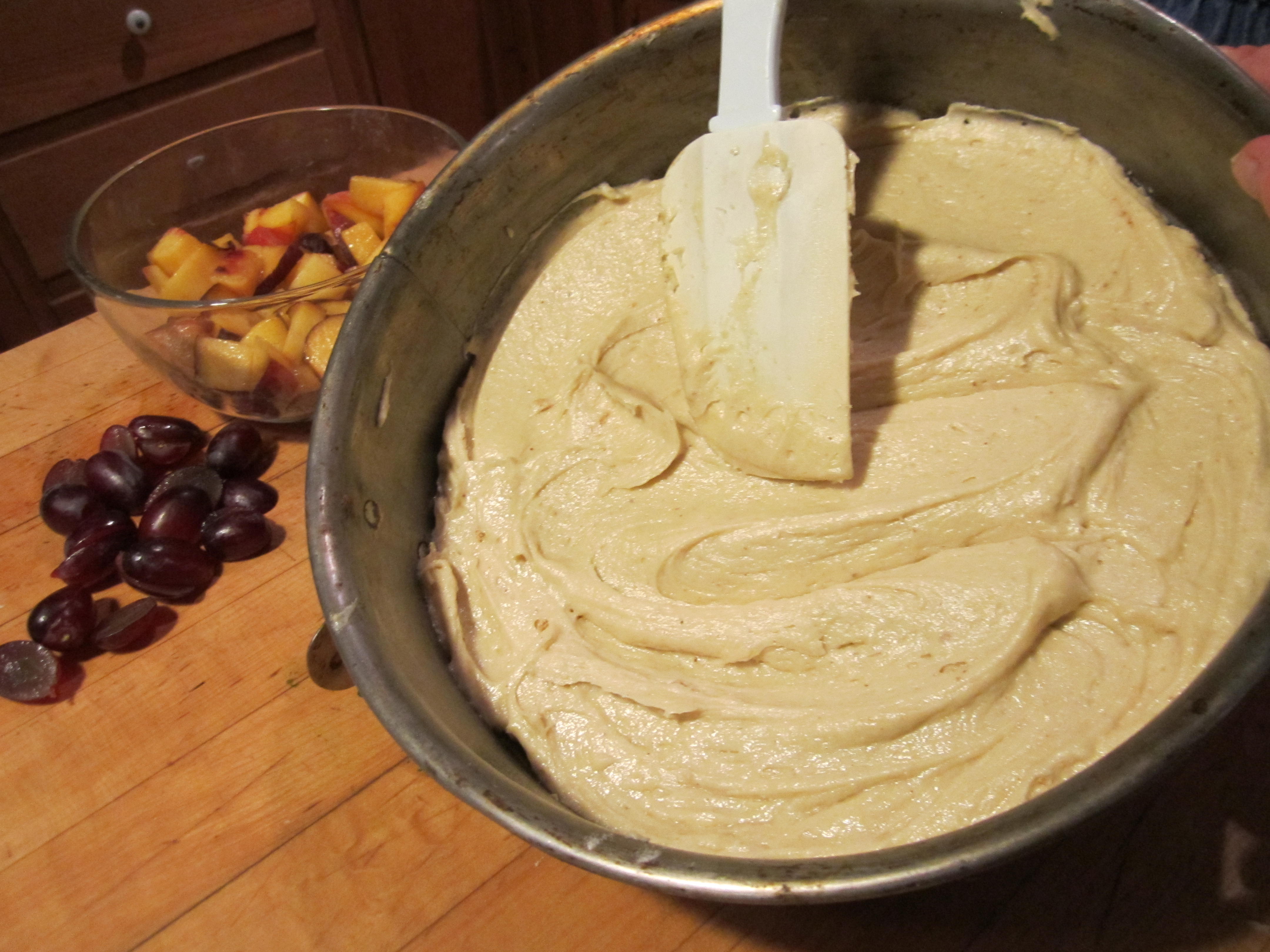
Preheat oven to 350 degrees F with rack in middle. Chop fruit. Lightly butter a springform pan. In a small bowl, whisk together flour, baking powder, salt and spice of choice. In medium bowl, beat butter and sugar with an electic mixer until pale and fluffy. Add eggs one at a time, beating well after each addiotn, then beat in vanilla. At low speed,  add flour mixture until ljust combined. Spread batter evenly in pan.

Spread batter evenly in springform pan.

Spread batter evenly in springform pan.

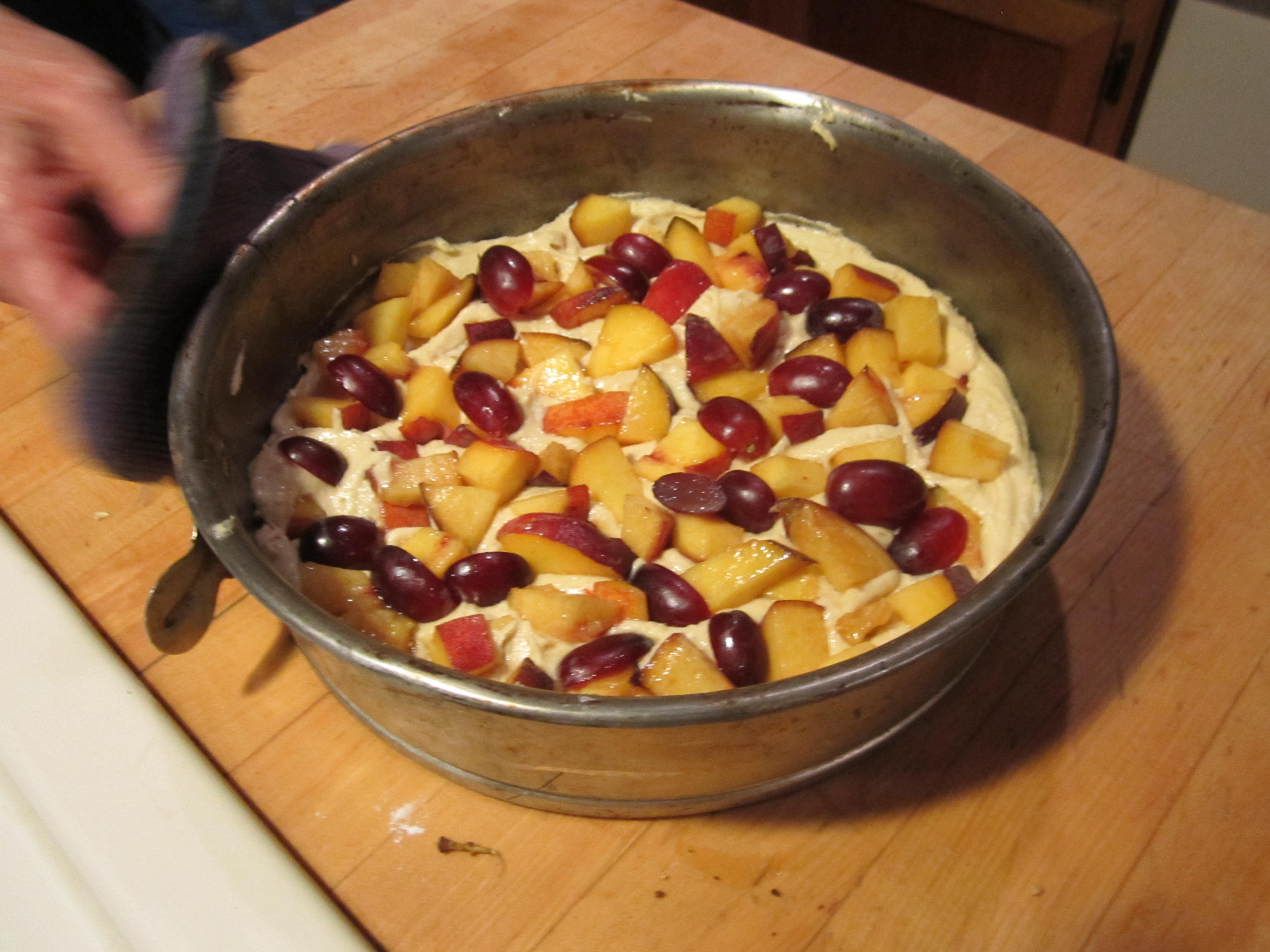
Scatter chopped fruit over top of batter.

Scatter chopped fruit over top of batter.

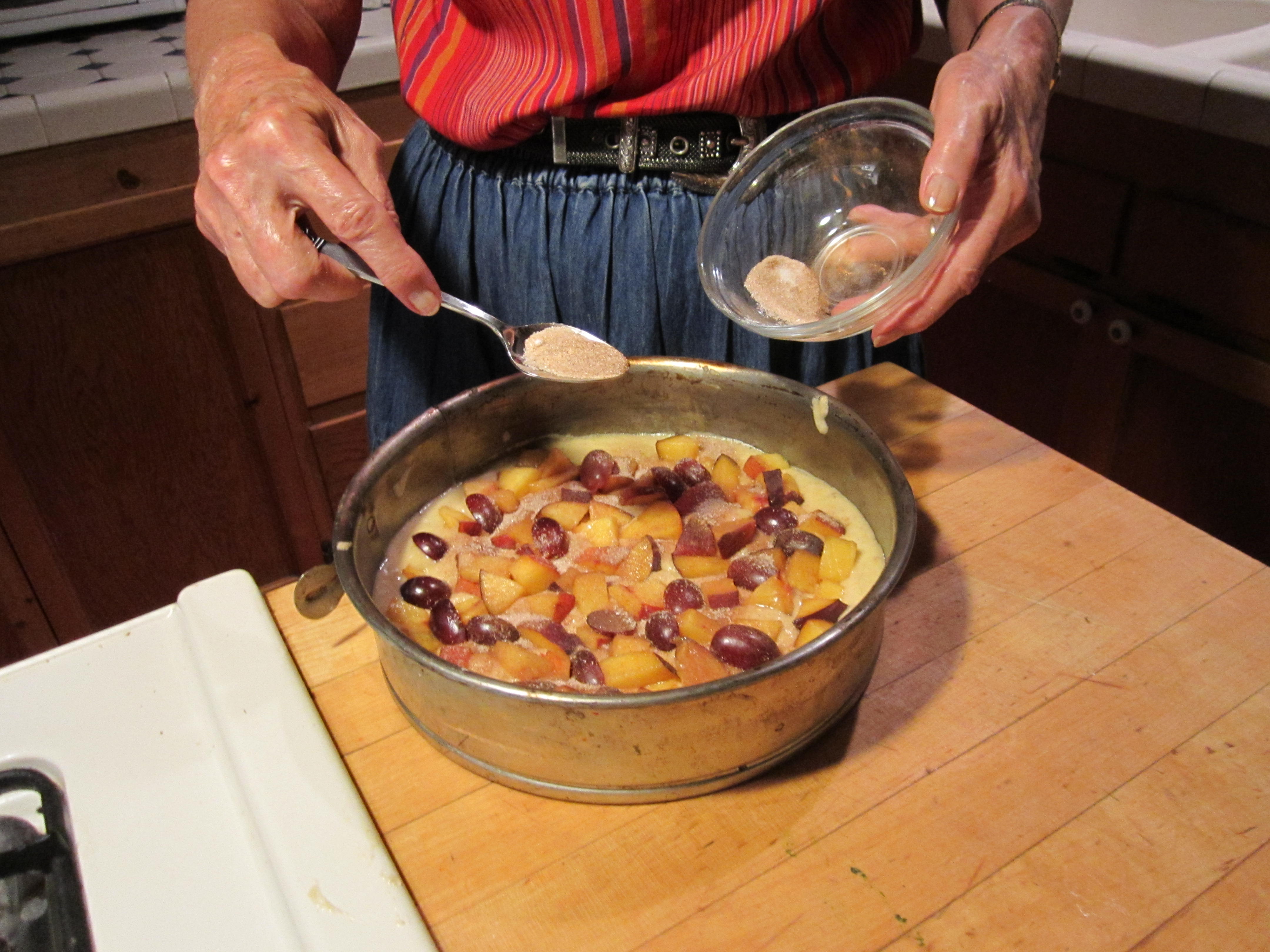
In a small bowl, stir together the topping mixture and sprinkle evenly over the cake.

Sprinkle sugar mixture evenly over cake.

Sprinkle sugar mixture evenly over cake.

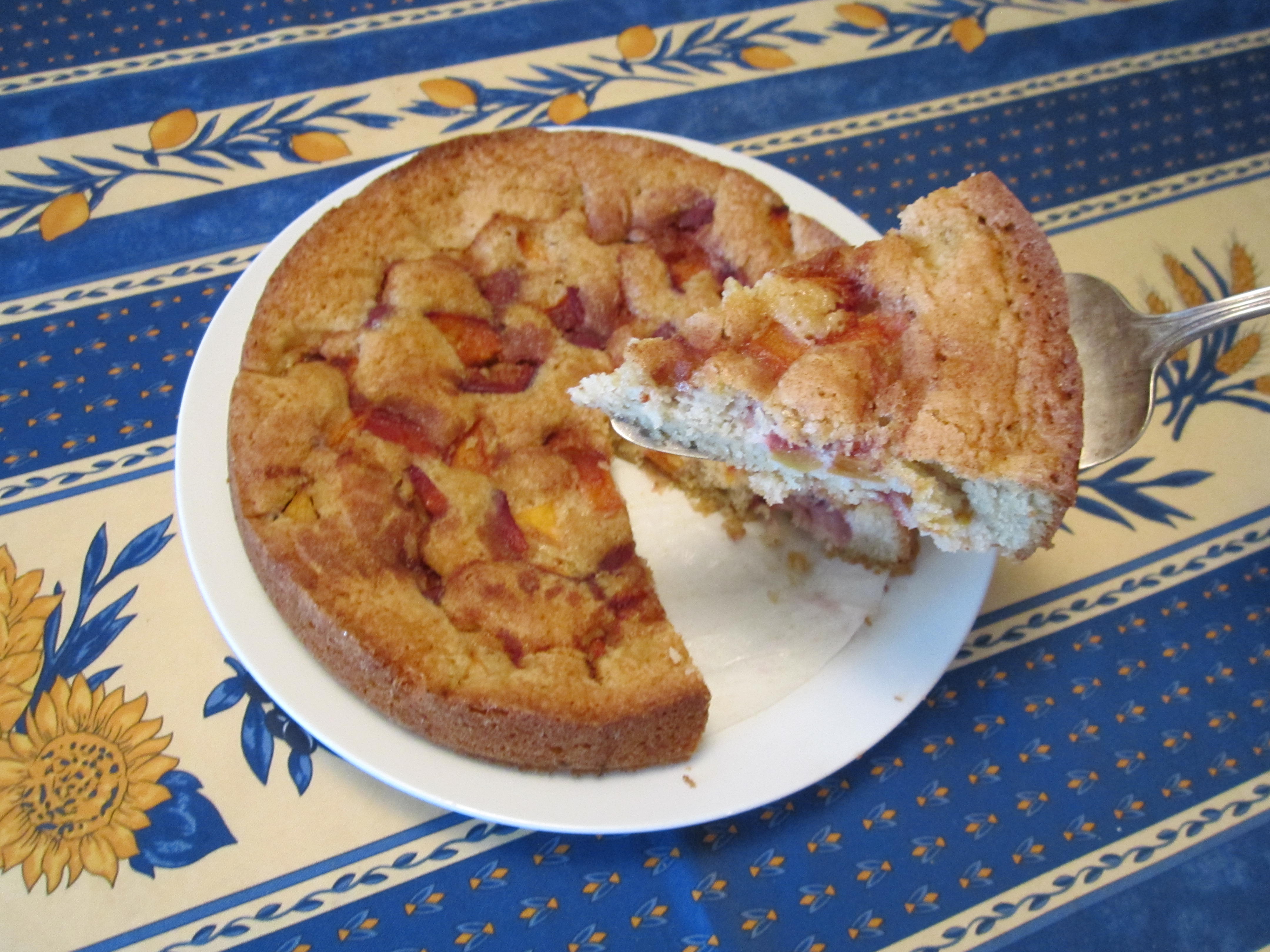
Put in preheated oven for 45 to 50 minutes. As the cake bakes it will rise over the fruit. Cake is done when it is golden brown and top is firm but tender when lightly touched. Cool in the pan for around 10 minutes and then remove the sides of the pan. Serve warm or at room temperature. A little whipped cream never hurt anything.

Yummm, warm and fragrant from the oven.

Yummm, warm and fragrant from the oven.

________________________________

Want more delicious recipes using ingredients from the Southwest?  I have lots of ideas for you. In Cooking the Wild Southwest, I introduce you to 23 easily identified and delicious wild plants of the arid Southwest. The Prickly Pear Cookbook is all about the fruits and leaves of the nopal plant. In The New Southwest Cookbook, you’ll meet some of the most innovative professional chefs in the Southwest and get to try the recipes they serve in their restaurants.


A Southwest Twist on Mac ‘n Cheese

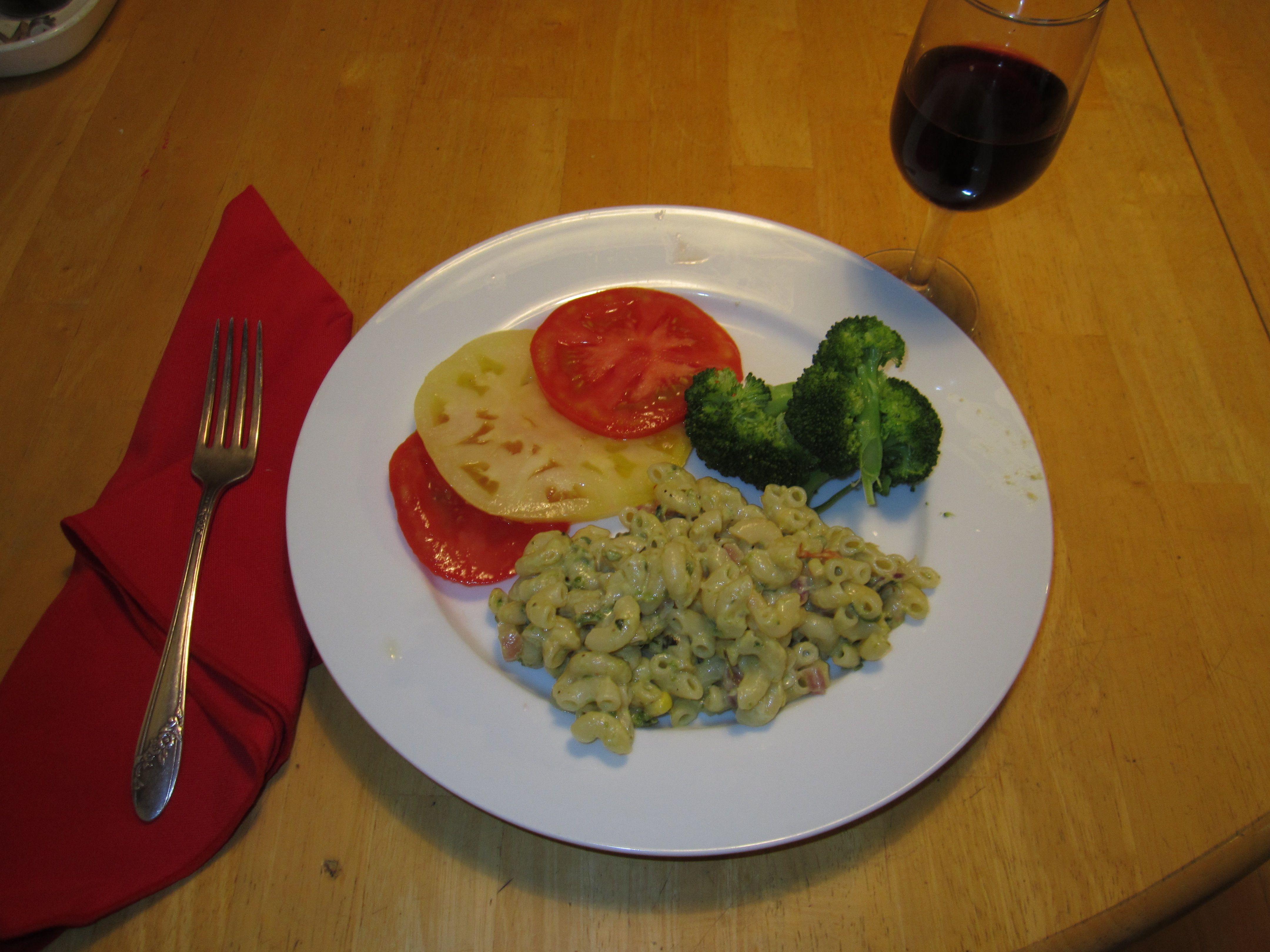
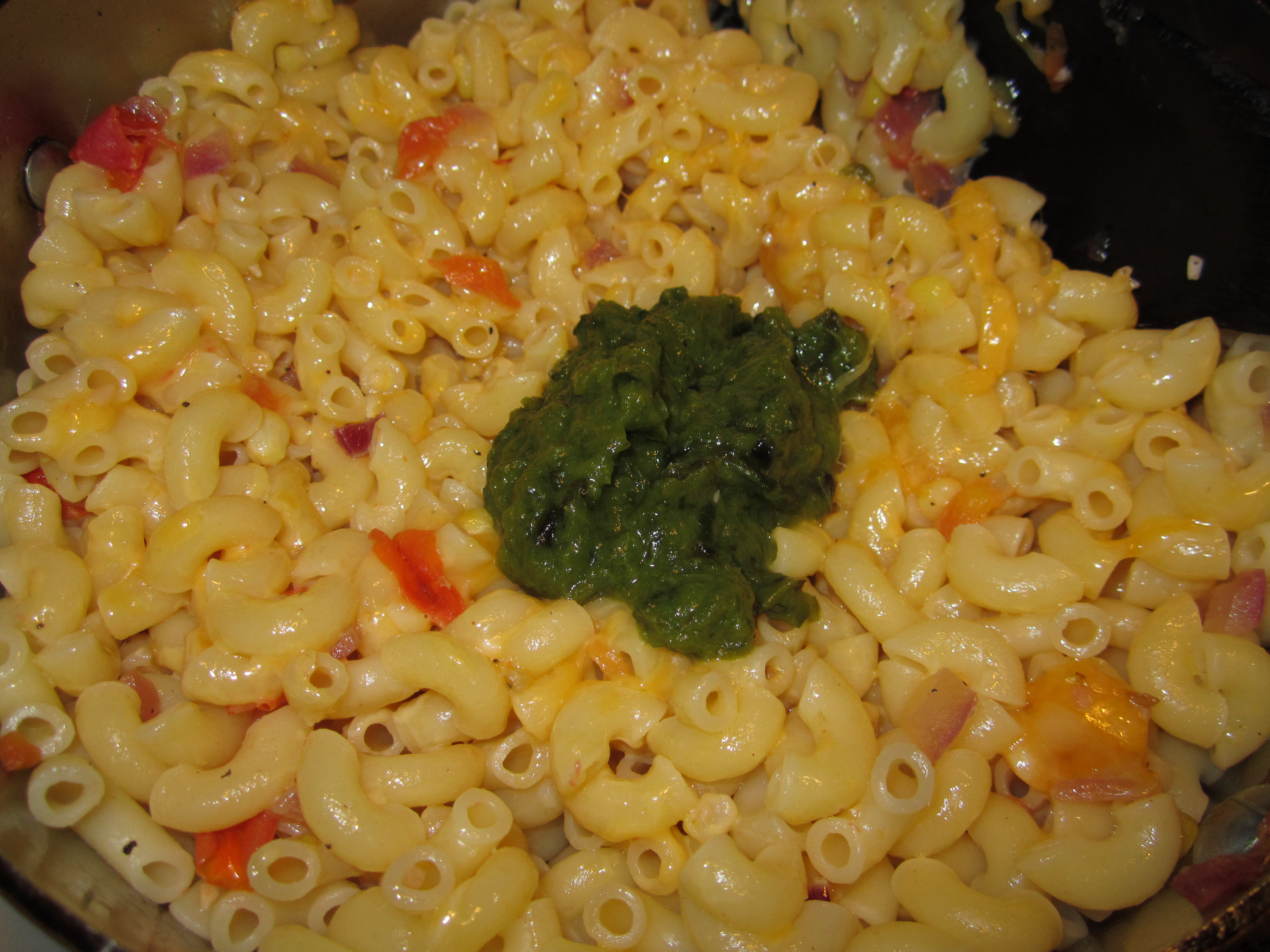
Green Chile Macaroni gives a Southwest twist to everybody's comfort food.

Green Chile Macaroni gives a Southwest twist to everybody’s comfort food.

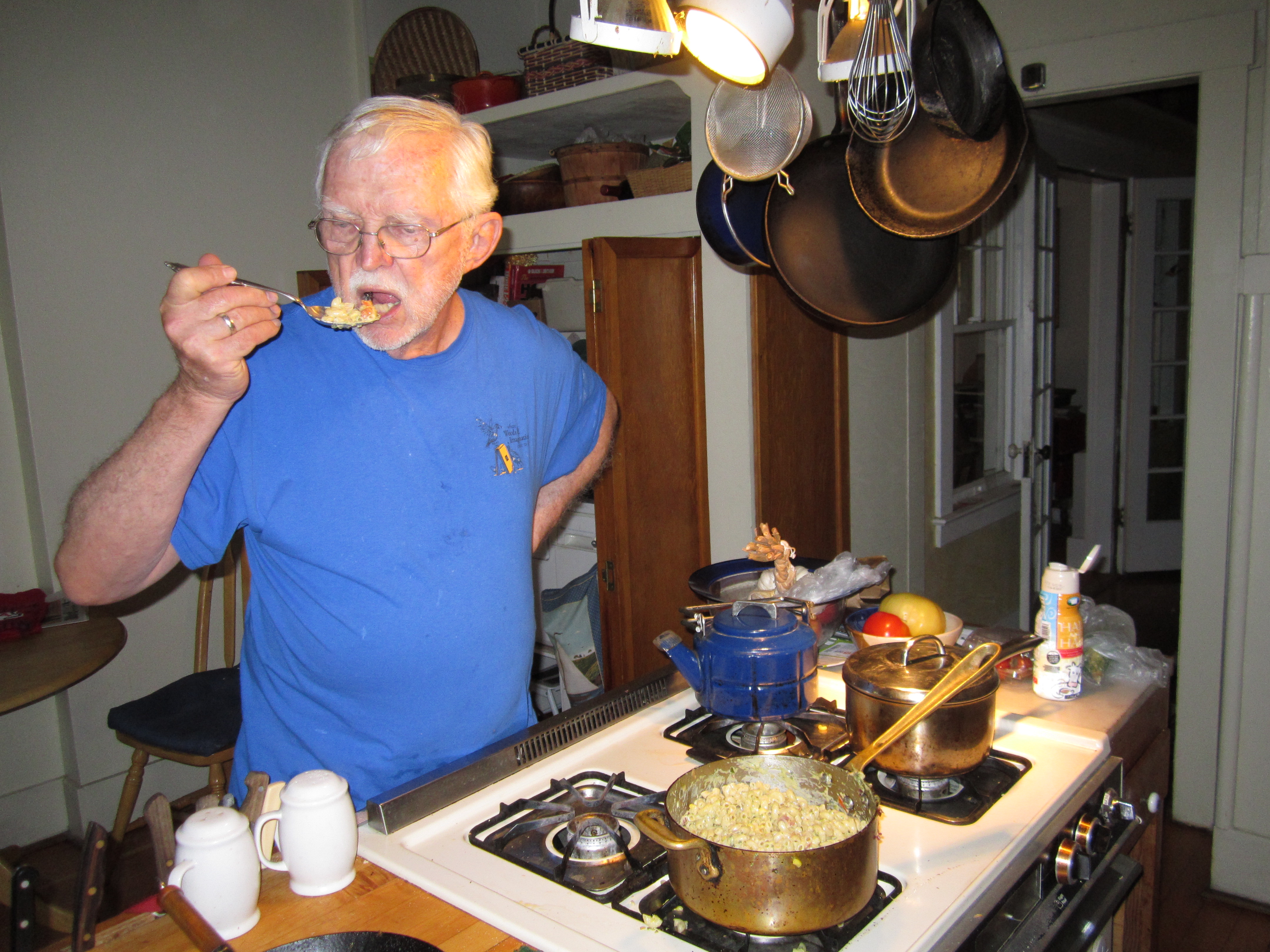
My husband is good at making breakfast — coffee, fruit, toast. And he can put together a salad if I have plenty of veggies in my garden or the fridge. But recently he decided he should learn how to actually cook something, and we decided on macaroni and cheese. From scratch, not out of a box. I looked in all my old standard cookbooks: The Joy of Cooking (both the 1964 and 1997  versions); How to Cook Everything, by Mark Bittman, and The New Basics by Rosso and Lukins. Ultimately, I decided the best recipe was in my own New Southwest Cookbook. I didn’t devise the recipe; it came from Chef Robert McGrath at the Roaring Forks Restaurant in Scottsdale.

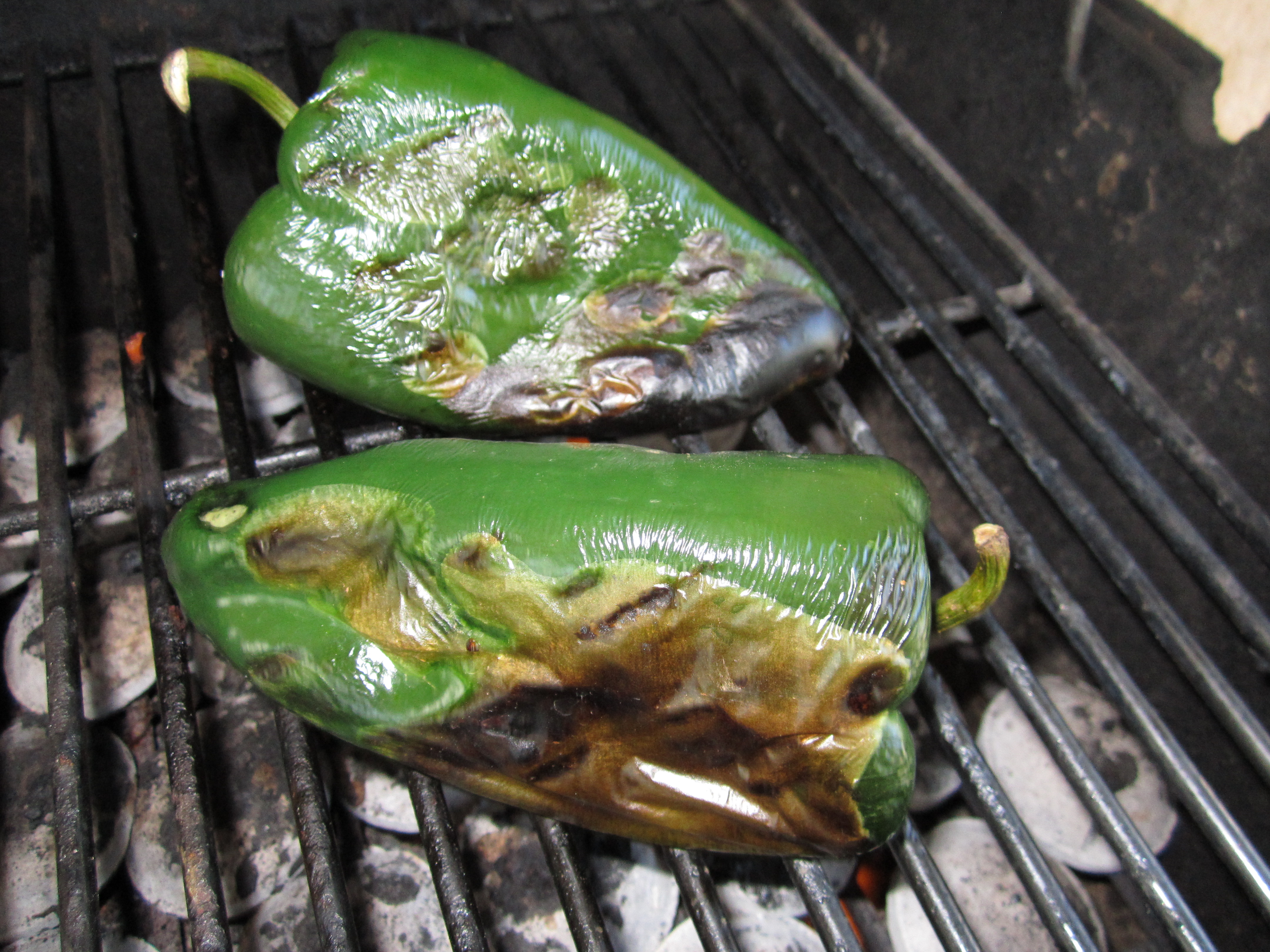
To me the special flavor comes from the poblano chiles. I think they have a better flavor than the typical Anaheims. Frequently, but not always, they are less hot while still giving a great chile flavor. You must roast and puree them first. If you have a grill, roast them there. Otherwise, the broiler on your oven will do. The trick is to the get the skin nicely charred but not to burn the thick juicy chile walls.

These chiles are charred on one side. I have turned them to blacken another side.

These chiles are charred on one side. I have turned them to blacken another side.

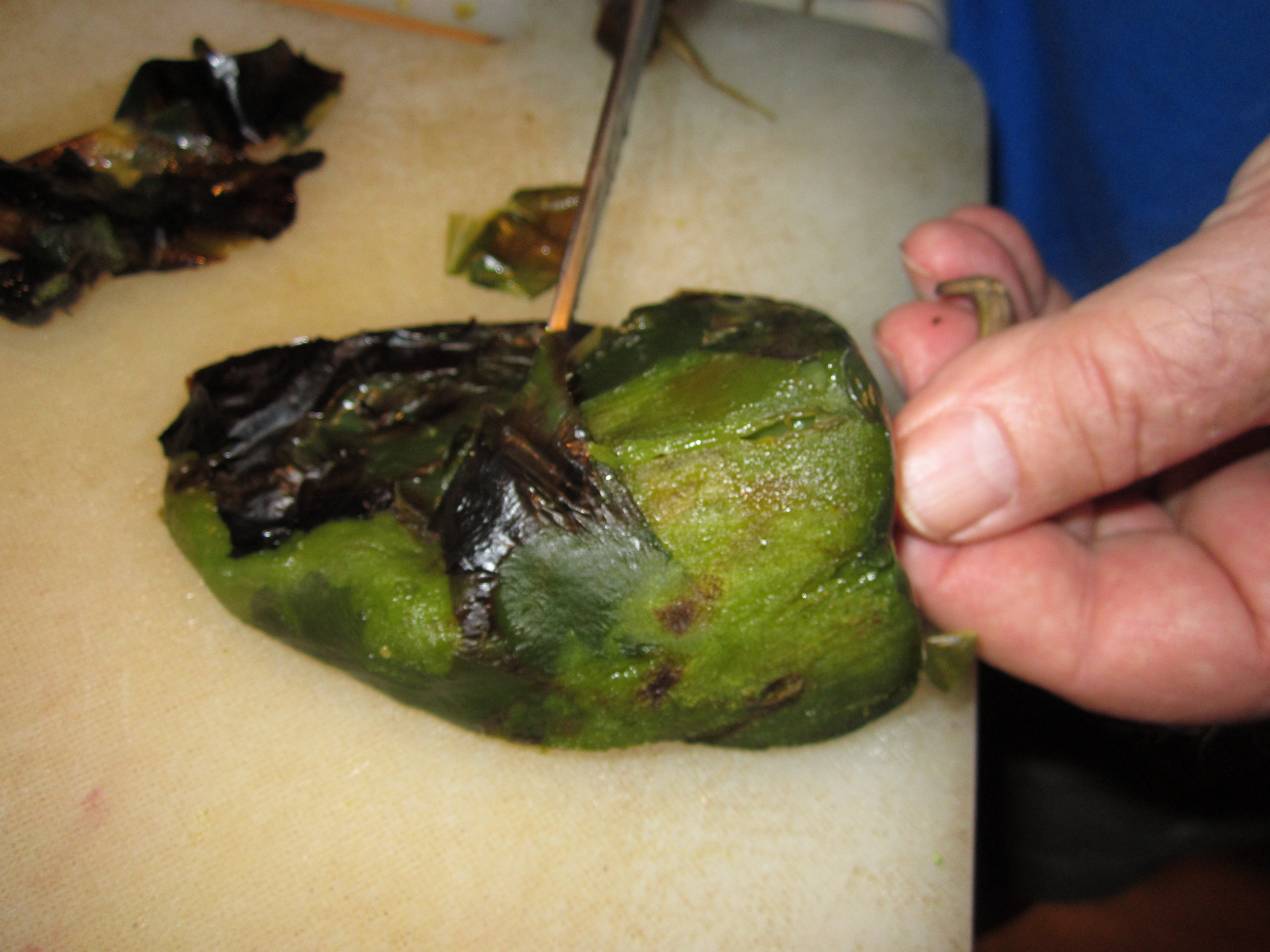
Skin is easily removed after steaming.

Skin is easily removed after steaming.

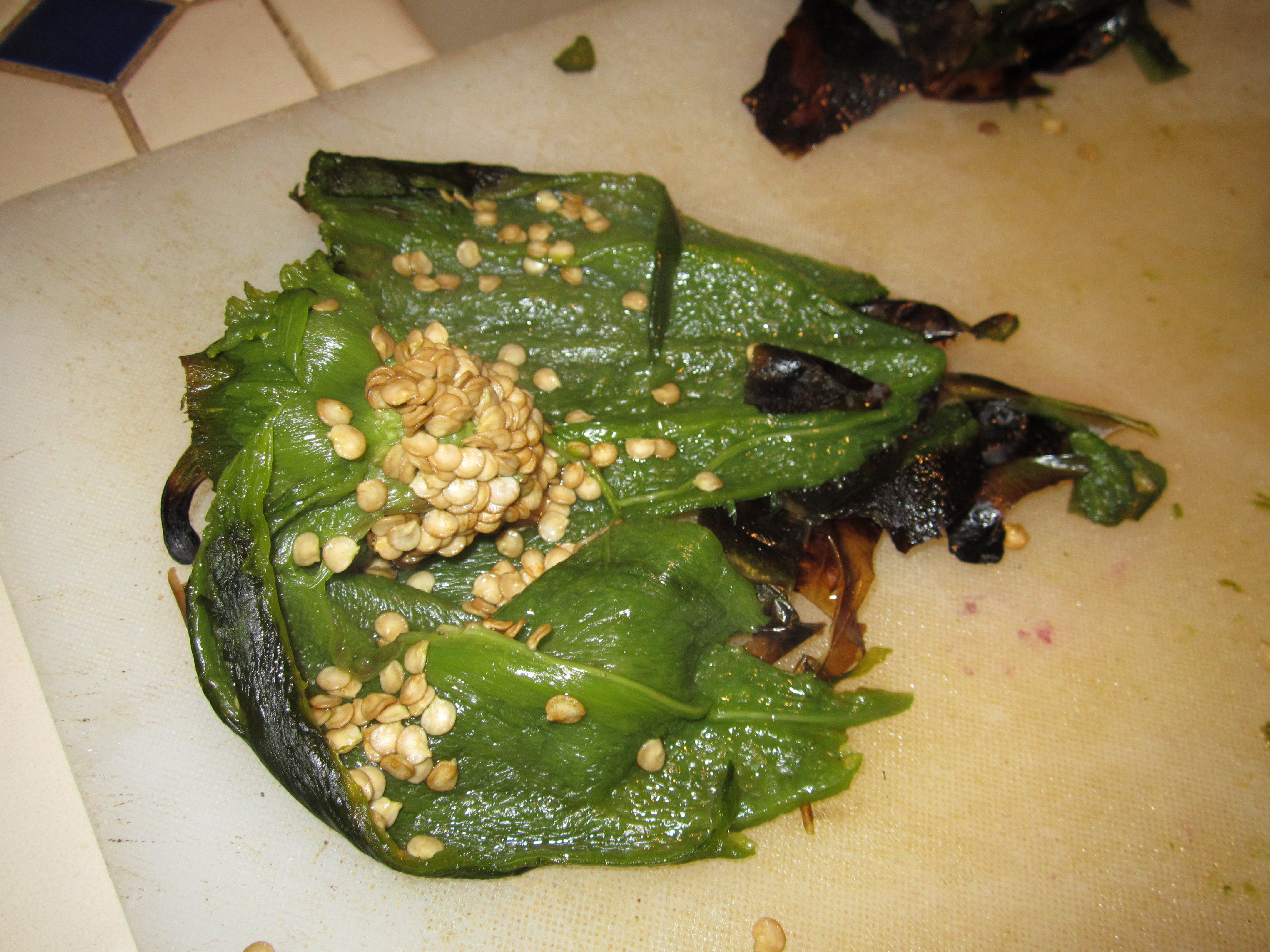
Open chiles and remove seeds.

Open chiles and remove seeds.

Once the seeds are removed, puree the poblanos in a blender or food processor and set them aside.

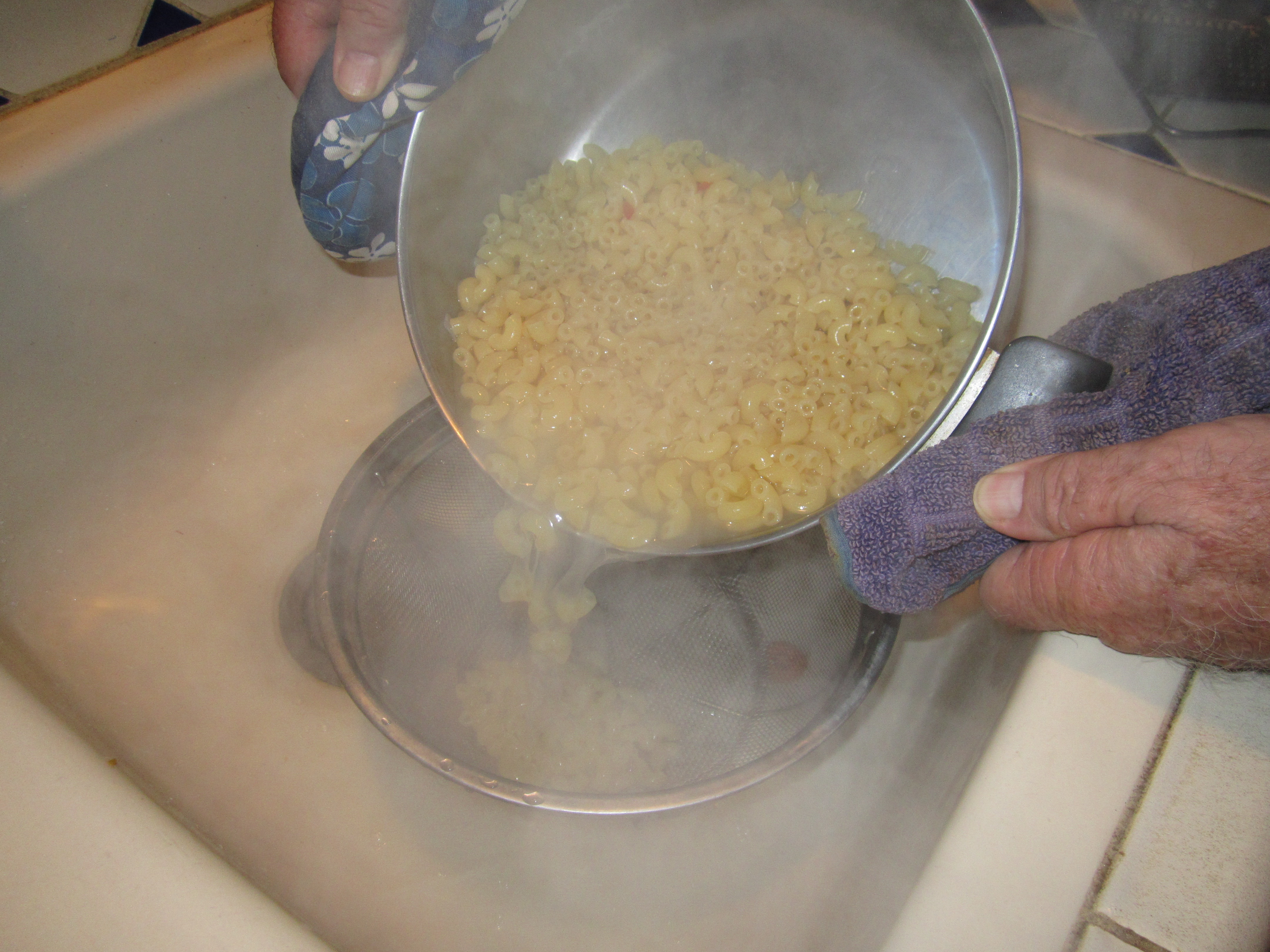
Put some water to boil for the macaroni. Any shape will do, but I used the classic elbow-shaped. While the water is boiling and then the macaroni is cooking, you will have time to grate the cheese, and chop and saute the red pepper, onion, garlic  and corn. Use can use fresh corn cut from the cob or just canned works also.

Drain the macaroni.

Drain the macaroni.

When the macaroni is tender, return it to the pot and stir in all the ingredients. Last will be the cream. The recipe calls for heavy cream, but I used half-and-half. When I was collecting recipes for The New Southwest Cookbook, I discovered that lots of butter and cream are the professional chefs’ secret ingredients. THAT is why everything they make tastes so good.

Stir in the chile and other vegetables.

Stir in the chile and other vegetables.

Ford tastes for seasoning. It might need salt.

Ford tastes for seasoning. It might need salt.

Here’s the recipe.  It is supposed to be four servings, and it is. But everybody usually wants seconds so doubling the recipe makes sense.

Green Chile Macaroni  (Makes 4 servings)

1/4 cup diced red bell pepper

1/2 cup sweet corn kernels

1/4 cup  diced red onion

2 teaspoons chopped garlic

1 teaspoon corn oil

2 cups  cooked macaroni

1/2  to 3/4 cup puree of roasted, peeled poblano chile

2/3 cup  grated cheese (hot pepper jack, cheddar or mixture)

1/4 cup heavy cream

Kosher salt and cracked black pepper to taste


Sauté the red bell pepper, corn, red onion, and garlic in the oil in a heavy pan.  Add the macaroni, poblano puree, and  cheese and stir until cheese is melted. Fold in the heavy cream.  Season with salt and pepper to taste.

_____________________________________

Find more great recipes with a Southwest flair in The New Southwest Cookbook, The Prickly Pear Cookbook, and Cooking the Wild Southwest

It’s Saguaro Season

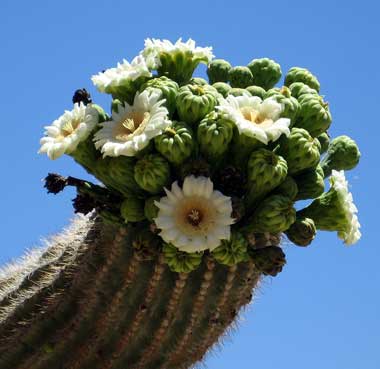
Saguaro flowers and unripe fruit. Photo by Rael B.

Saguaro flowers and unripe fruit. Photo by Rael B.

Our fire has burned and the sun has gone down;

Our fire has burned and the sun has gone down.

Come together, following our ancient custom.

Sing for the liquor,

Delightfully sing.

This was the song that called the people of the Tohono O’odham villages together for the saguaro wine ceremony that followed the  harvest. During the ceremony, they people invoked the intercession of a deity far away in a “rainhouse” full of wind, water and seeds in the hopes of hastening the storms.

This and many other songs were collected and translated by Ruth Murray Underhill, an early anthropologist who lived among what were then called the Papago in 1938. They appear in her book Singing for Power.

When I go saguaro gathering, I get up around 4:30 a.m. and aim to be out among the saguaros just at dawn.  I am always joined by doves and other birds looking for their breakfast. Alone on the desert, I occasionally find myself talking to the saguaros. “So what have you got for me?” I ask. I might worry about my sanity, but I know others have felt the same way. The late desert chronicler Edward Abbey agreed, calling saguaros “planted people.”

Dove getting breakfast

Dove getting breakfast

My harvest

My harvest


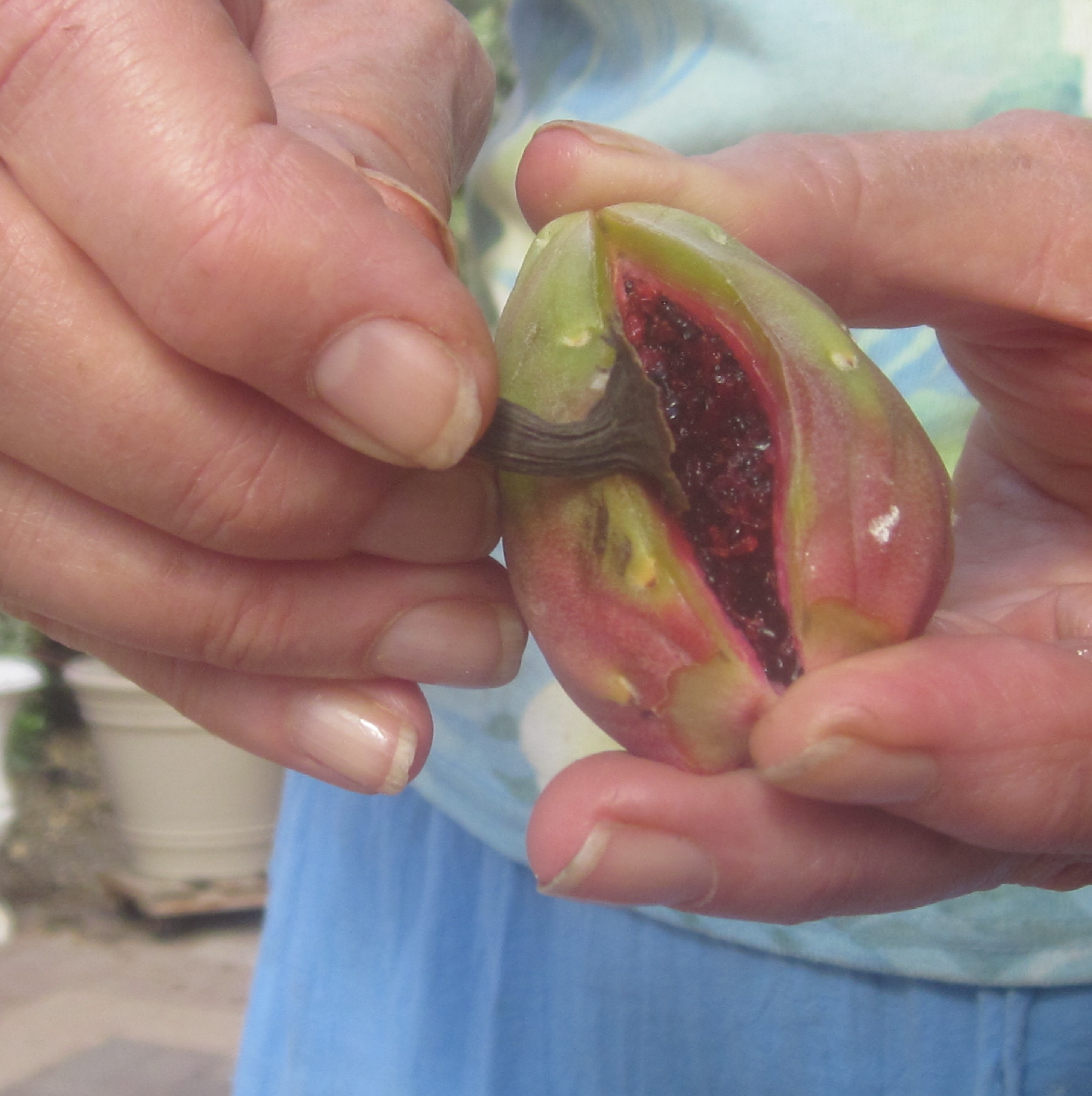
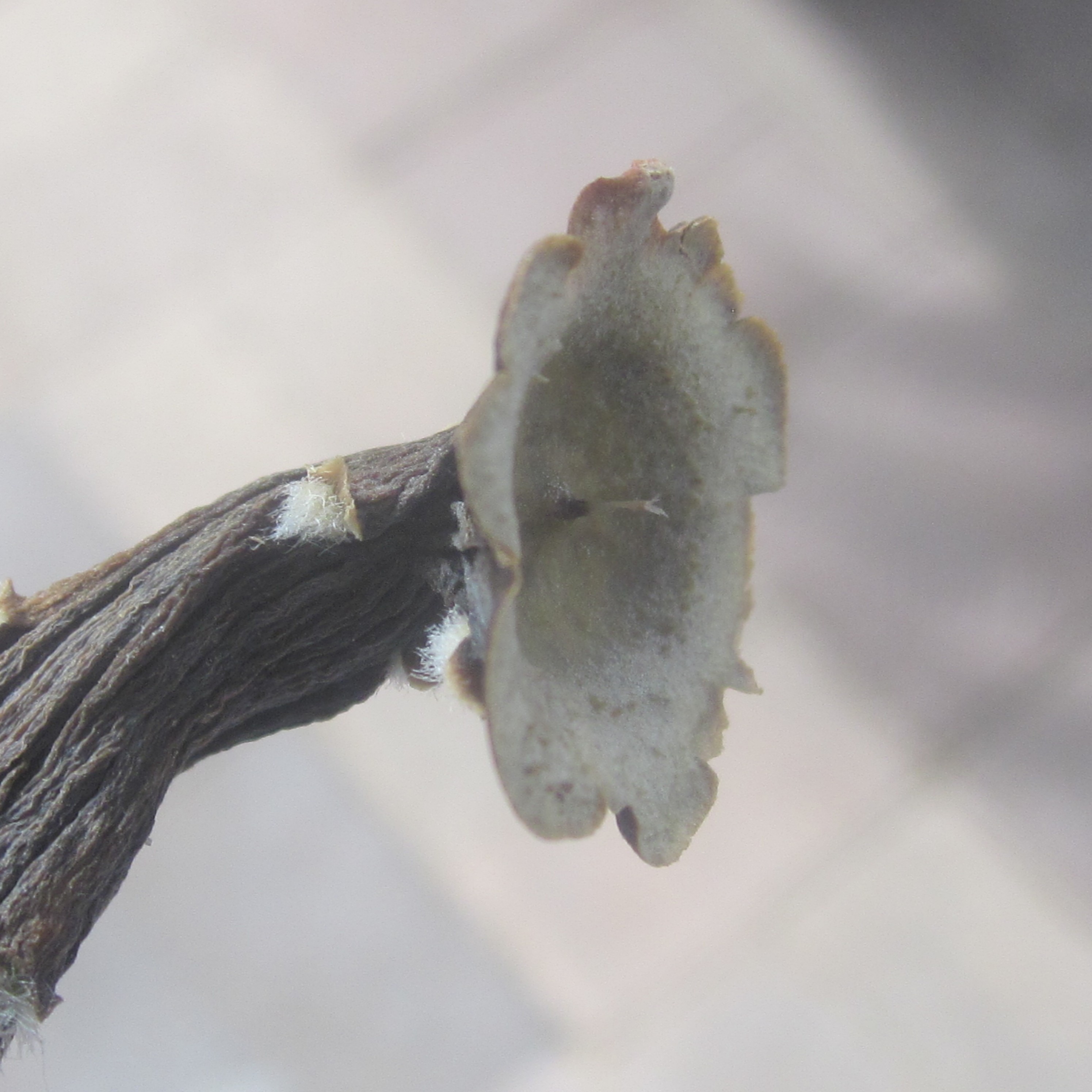
The orginal desert dwellers used a dead saguaro rib to push the fruits off the cactus. If you can’t find one, any long pole or a fruit picker will do. You can separate the fruit from the rind in the field or bring it home to clean. Each fruit comes with its own sharp-edged knife, like a natural can opener.


Opening a fruit with the calyx on the blossom end.

Opening a fruit with the calyx on the blossom end.


Sharp edge of the calyx can be used as a knife.

Sharp edge of the calyx can be used as a knife.


Once you have extracted the fruit, you can either dry it whole or separate it into the seeds and juice. This is a simple process. To your pan or bucket, add as much water as you have fruit. Let it sit, covered loosely for six to eight hours. Then plunge your hands in and break up the fruit. Strain off the juice. Boil to concentrate.  If you want to make syrup from the concentrated juice, add half as much sugar as you have juice and boil until clear. Store in a clean glass jar in the refrigerator. It will usually keep for months.
So what are the options for the seeds. You can put them in any baked good, make pilaf or porridge or cookie filling. But an easy use is homemade crackers. Spread the wet seeds on a cookie sheet in the sun. There will be some white material left from the juice, but either blow it off or ignore it.  I made these crackers in around a half hour. We are accustomed to eating commercial crackers that are very sweet and salty. So if you want a familiar flavor, use the higher amounts of salt and sugar.

Black Beauty Wafers

1/4 cup saguaro seeds

1 cup whole wheat flour

1/4 teaspoon baking powder

1/4 to 3/4 teaspoon salt

1-2 teasp0ons sugar

1/4 cup water

1 tablespooncider vinegar

1/4 cup vegetable oil

8 teaspoons whole saguaro seeds

Preheat oven to 400 degrees. Grind the 1/4 cup saguaro seeds in a blender or coffee grinder. In a large bowl, combine seeds, flour, baking powder, salt and sugar. Add water, vinegar and oil and mix, stirring and kneading until a stiff dough forms.

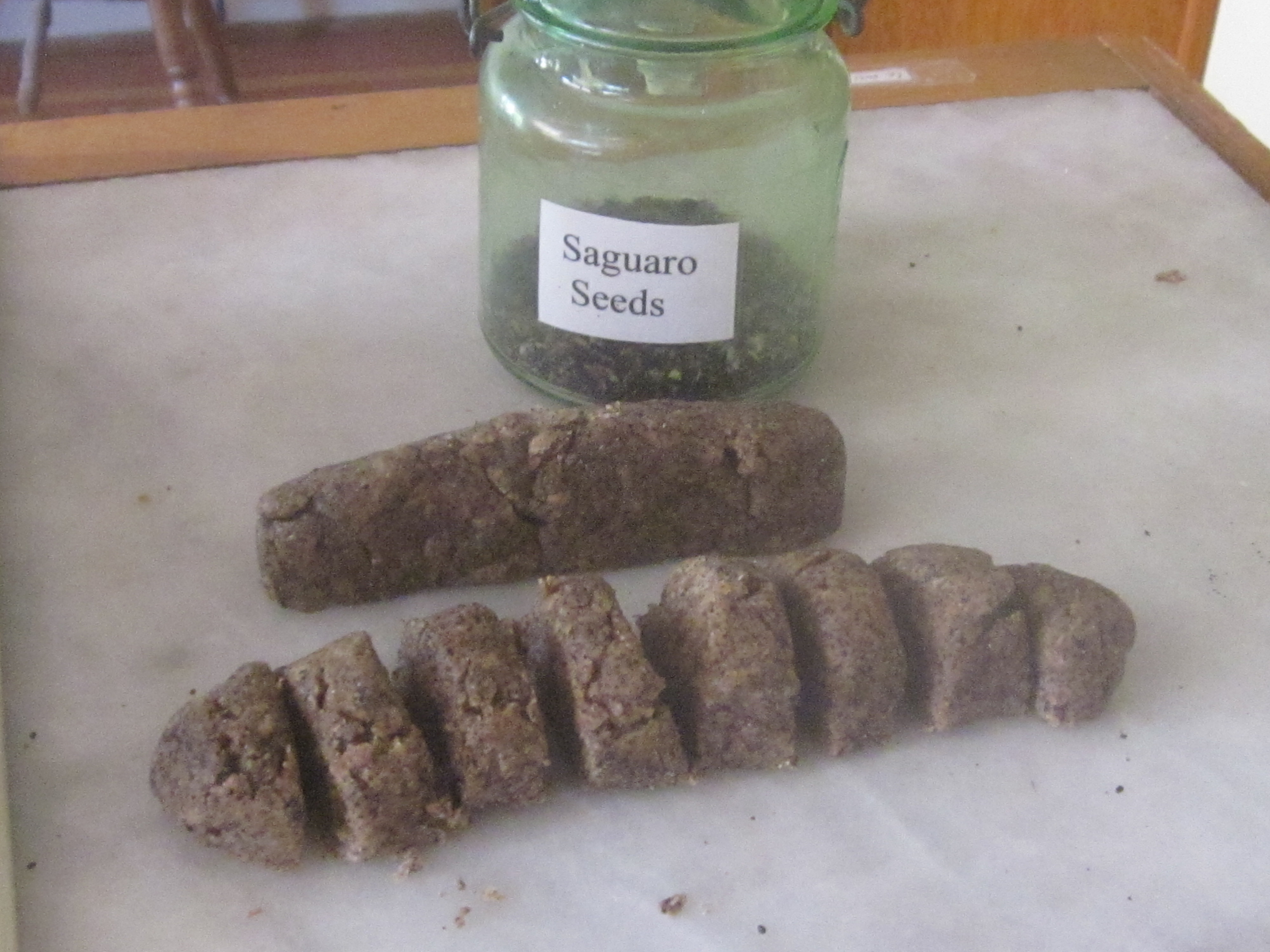
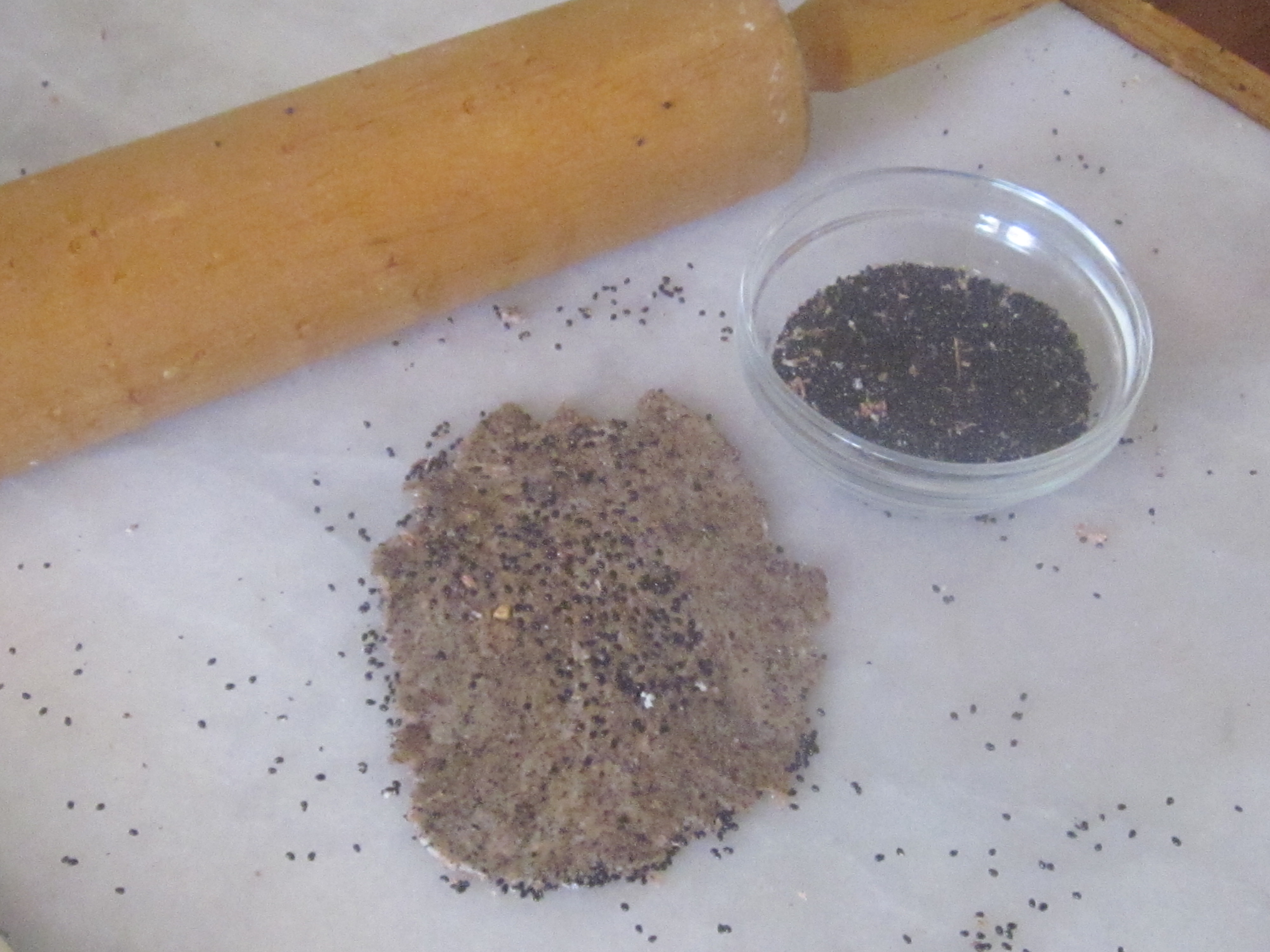
Shape dough into two rolls, 6 inches long and 1 inch in diameter. Then slice each roll into eight wafers.  Sprinkle some seeds on a flat surface, place one disk of dough on it, sprinkle some more seeds on top and roll with a rolling pin as thinly as you can. The thinner the cracker, the crisper they will be.  The shapes will be irregular.

Form dough into log and divide into eight portions.

Form dough into log and divide into eight portions.


Roll out each portion of dough.

Roll out each portion of dough.

Transfer the crackers to an ungreased nonstick cookie sheet. If you have a regular metal pan, use a sheet of parchment paper. Bake in the preheated oven for just 5 to 7 minutes. Watch closely to ensure they do not burn.

You can serve with soup or salad. Or spread with a soft cheese.


Serve your Black Beauty Wafers with a crisp salad.

Serve your Black Beauty Wafers with a crisp salad.


And when you eat your saguaro syrup or enjoy your Black Beauty Wafers, remember the words an elderly Tohono O’odham woman said to Ruth Underhill back in 1938:

“To you Whites, Elder brother gave wheat and peaches and grapes. To us, he gave the wild seeds and the cactus. Those are the good foods.”


____________________

For more recipes using both saguaro fruit and seeds, consult Cooking the Wild Southwest: Delicious Recipes for Desert Plants.  You can find a copy at Native Seeds SEARCH or order online here.


Mesquite–Ancient Food for the Future

Yes, we gotta admit it—Tucson and ALL OF BAJA ARIZONA is a FOOD-COLONY!  To feed ourselves here, we currently import over 96% of our foods from out of state or out of country. If there were to be a transportation stoppage or disaster (perish the thought), we have less than 4 days’ food supply in local groceries. (info from Fry’s managers and Pima Co Emergency Mgmt.) This is a scary and sobering reality, and we need to remedy it for the good of all.
When it comes to food security in the Desert Southwest, if we are smart we’d best turn to those whose ancestors not only survived but thrived here, before European food fads invaded, and long before bio-technology pretended to save us–Let us listen to Native People!  If we look to traditional O’odham cuisine, and to that of all low-desert Traditional People in the Southwest, we learn that one of their most important and consistent staple foods was MESQUITE. Meal ground from the whole, ripe, dry pods was prepared in diverse ways by every tribal group, and stored safely against lean times, providing them amazingly tasty nutrition.

Now….its up to “newer arrivals” to the desert to expand our cultural tastes–and enjoy lessons from local tradition….

Harvesting ripe velvet mesquite pods--an old Chuk-shon tradition (RodMondt photo)

Harvesting ripe velvet mesquite pods–an old Chuk-shon tradition (RodMondt photo)

Everyone enjoys mesquite’s shade, its smokey flavoring and fuelwood in BBQs. But what about mesquite as food and food-security? Sweet and yummy are first.  Culinary versatility is up there.  Nutrition is paramount.  Recent nutritional analyses show what Native People have ALWAYS known intuitively, that mesquite’s sweetness is healthy (complex) sugars, and that it gives sustained energy (from slow-release complex carbs.)

A major plus for arid-lands food-security is that mesquite trees grow plentifully in the desert WITHOUT ANY HELP from humans. Having evolved with large Pleistocene herbivores, mesquite’s survival strategy is to over-produce quantities of tasty pods to entice mammoths or (extinct) ungulates to eat them and spread their seeds, scarified and delivered in ready-made fertilizer packages. In more recent centuries, cattle have provided a similar service to spread mesquite.  Hungry bi-peds can benefit too from mesquite’s plentiful productivity. With global climate change and the promise of expanding deserts, mesquite offers us a healthy staple food and a fitting dry-lands crop for our stressed Planet.
Velvet mesquite pods (Prosopis velutina) in green phase (maburgess photo)

Velvet mesquite pods (Prosopis velutina) in green phase (maburgess photo)

[Mesquite pods are ripening as I write–so heads-up!]

A most timely gathering of mesquite experts—both traditional and innovative—is about to happen at  a MESQUITE CONFERENCE open to the public and not to be missed………Attention–Novice mesquite-harvesters, cooks and culinary artists, bakers and chefs, nutritionists and clinicians, ranchers, farmers, gardeners, athletes and fitness fans, survivalists, nature buffs, climate-change planners…. this conference is for you.

MESQUITE: NEW AGRICULTURAL TRADITIONS FOR AN ANCIENT FOOD  will be held in Benson, Arizona, all day Friday, June 13, 2014, at the Cochise College Campus, 8:30am-4pm.
There will be talks by leading Mesquiteros, including traditional Tohono O’odham harvester Clifford Pablo, new crops innovator Dr. Richard Felger, the one and only mesquite agronomist Mark Moody, wild-harvester Amy Valdes Schwemm, creative desert rancher Dennis Moroney, animal feed expert Dr. Howard Frederick, desert foods ethnobotanist Martha Ames Burgess, and Cooperative Extension outreach educator Mark Apel.

In addition, generously sharing their knowledge, techniques and recipes will be demonstrators, including desert foods writer Carolyn Niethammer, wild-food teacher Barbara Rose, solar cooking expert Valerie McCaffrey, mesquite millers from San Xavier Farm Coop and Tohono O’odham Community College, and children’s book author Laurie Melrood. This is the place to contact producers of mesquite meal for your home cooking, for nouvelle local-source eateries, and breweries. Get your tastebuds ready for samples of delectable new culinary mesquite delights!

Sponsored by Baja Arizona Sustainable Agriculture and University of Arizona Cooperative Extension, with extra support from USDA Western SARE, we have been able to keep the registration fees to a minimum– accessible to anyone. $30 covers the whole day conference including luncheon ($20 for students or members of BASA). Space is limited so register soon. Registration is online via the BASA website http://www.bajaaz.org. For further info call 520-331-9821.
Once registered, please group your travel plans in carpools. For carpooling ideas check out the Native Seeds/SEARCH or BASA facebook sites. Let’s not let anyone miss this conference who needs to be there!


Select sweet velvet mesquite pods dry and ready to grind (maburgess photo)

Select sweet velvet mesquite pods dry and ready to grind (maburgess photo)


Delicious honey mesquite (Prosopis glandulosa) with ripening pods.

Delicious honey mesquite (Prosopis glandulosa) with ripening pods.

ADDITIONAL MESQUITE HAPPENINGS–Plan to Harvest, Plant, and Celebrate Native Bean-Tree Abundance Before the Rains…

DESERT HARVESTERS is organizing events to help people dramatically enhance the quality of their mesquite pod harvests, what to make with them, and how to better sync with the Sonoran Desert’s seasonal cycles in a way that enhances our shared biome.
We are teaming up with local culinary businesses to increase offerings of native foods in their cuisine, and to encourage landscaping with native food plants in water-harvest earthworks beside their buildings.

Mark your calendar for Thursday June 19, 2014!

Guided Mesquite Harvests and Plantings
Hosted at the Santa Cruz River Farmers’ Market
100 S. Avenida del Convento, Tucson, AZ

5pm harvest on foot, 6pm harvest by bicycle
Led by Desert Harvesters including Amy Valdés Schwemm and Brad Lancaster
$5 to $10 per person (sliding scale)

These hands-on harvest tours show you how to:
• Identify and sample the best-tasting mesquite trees
Every tree is different, but some varieties are consistently much better than others. Taste the differences. (We will also likely harvest from desert ironwood and palo verde.)
• How to harvest safely, ethically, and responsibly
Harvesting pre-rains is best practice to avoid invisible toxic mold. Harvesting from the tree avoids fecal or fungal ground contamination. Check out http://www.ediblebajaarizona.com/calling-all-mesquiteros/ for more on why pre-rain harvests are the traditional practice, and so important.
• Use cool tricks such as the harvest cane.
• How and when to plant the best bean trees
Participants are encouraged to bring sun protection, reusable water bottle, and carry-bags for harvested pods.

Iskashitaa, an organization that helps resettled refugees integrate into the Tucson community, will be offering their beautiful hand-made harvest bags and fresh-squeezed juice from fruit they’ve gleaned. Also there will be AravaipaHeirlooms’ prickly pear pops and chiltepine-infused cold brews from Exo Roast Co.

Bean-Tree Processing Demonstrations
Before and/or after the Guided Harvests and Plantings
4pm to 7pm–FREE
Taught by Barbara Rose, desert foods farmer/fermenter/cook extraordinaire of Bean Tree Farm (see their website for more awesome workshops), will show you how to turn milled or whole desert ironwood seeds, palo verde seeds, and mesquite pods into tasty dishes. Native foods such as mesquite flour, cactus fruit pops, drinks, syrup, and cholla buds will be available for sale, along with seeds and seedlings of the best-tasting native bean-trees and chiltepines.

AND THEN DON’T MISS Sunday, June 22, 2014!

Pre-Monsoon Mesquite Milling
Sunday, June 22, (alert–in the event of rain, it will be moved to Sunday, June 29)
6am to 10am
Bring Your Own Pods!
Pods for milling must be clean, dry, and free of mold/fungus, stones, leaves, bugs and other debris. Cost: $3/gallon of whole pods, with a minimum of $10.

Also at the milling event:
• A native wild foods demonstration – highlighting what’s in the wild-harvest season now
• Exo’s mesquite-, mole-, and chiltepin-infused coffees
• Mesquite baked goods and cactus fruit popsicles
• Seeds and seedlings of select native bean trees and chiltepines — so you can plant yours in time for the rains.

Our thanks to hosts Exo Roast Co. and Tap & Bottle,
403 N. 6th Ave.,Tucson, AZ
Harvesters’ Happy Hour at Tap & Bottle
Come join fellow harvesters in fermented merriment. Tap & Bottle will have local brews on-hand, some infused with local native ingredients. And they will donate a percentage of all the sales to Desert Harvesters. Learn more online at: http://www.DesertHarvesters.org


Mesquite can help us into a food-secure future– fittingly, sustainably, healthily, and sweetly– as we face heating and drying of our desert home.  What a gift mesquite is, as we begin to declare our independence from being a FOOD-COLONY!