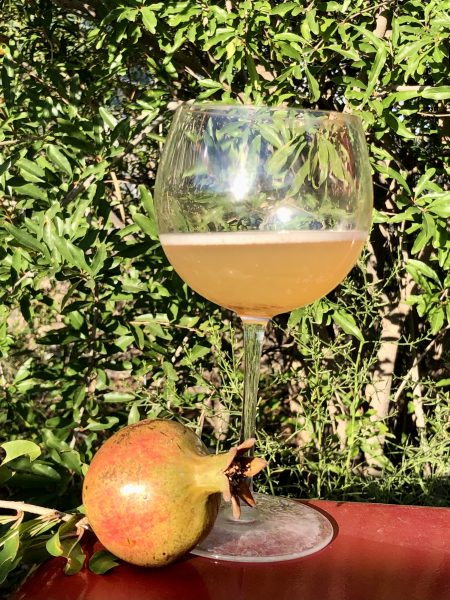
At the end of a year of simple steps, a refreshing glass of pomegranate wine.
(We are continuing our series of guest posts. Today it is Emily Rockey, who for many years was the garden supervisor at Mission Garden and in charge of the health of dozens of pomegranate trees. This post is a bit longer than we usually send, but if you’ve ever wanted to learn to make wine, Emily will take you on that journey.)
There’s something so sweetly satisfying about sitting down to enjoy a delicious treat that you made from scratch with your own hands. Better yet, something that you wild harvested or grew yourself. For some folks, that might be homemade sourdough bread, prickly pear jelly, or a meal prepared from the garden or desert. But have you ever tried making your own wine?
Perhaps you’re thinking that you need specialized, expensive equipment, or a degree in oenology (the study of winemaking). It’s possible you don’t have grapes with an impressive provenance which keeps you from crafting elegant fermented beverages. Or that you simply don’t have free time for long brewing processes, bottling, and years for aging wine to perfection. All these are misconceptions! The homebrewing process is quite fun–anticipation slowly building over many weeks as the bubbles of the beverage quietly gurgle away. It’s true that wine takes about a year before it’s ready to drink, but as they say, time flies, and before you know it, it’s time to pop the cork and gather friends to savor the moment. With regard to equipment or ingredients for winemaking, these things can come quite inexpensively, or DIY freely! Continue on for a basic step by step guide from me, guest contributor Emily Rockey. You, too, dear reader, can be a winemaker.
Winemaking, quite simply, is a natural process of live yeast consuming sugar, converting it to carbon dioxide (bubbles) and alcohol. This process is called fermentation, and with wine it takes place in two basic stages: the first fermentation occurs when fruit or plants are combined with water and yeast in an open container. Soon it becomes active and bubbly. When it slows, a second round of fermentation takes place in a closed container (less oxygen). After about eight weeks, the lively party is over and the wine shifts to a period of relative tranquility, resting in a cool dark spot such as a closet or interior room. After it settles, we’ll siphon the wine (called racking) to separate it from the yeast particles at the bottom, and let it sit for nine months. At last, your calendar will remind you that it’s time to bottle and finally taste your finished wine!
Ingredients:
To start, look around for what exists in abundance, or what’s in season. We can make wine from anything that contains sugar: fruits of all kinds, herbs, and even flowers. Prickly pear wine, elderberry, or wolfberry wine? Sure! I happened to have frozen pomegranate arils from Mission Garden.
Sugar. Organic cane sugar is the most versatile, but if you like you can experiment with other natural sweeteners (and their flavor profiles).
Brewing yeast: It is possible to make wine without adding packaged yeast, but for a home winemaker like you and me, yeast is easy to find and a reliable way to kickstart fermentation. Brewing yeast is sold at brew shops or online for $2-$3. Experiment a bit, or start with a neutral ale, cider, or champagne yeast.
For the recipe below, I used a neutral yeast strain called EC1118 which contributes very little flavor or aroma to the finished product. It is quite flexible, thriving in cool or warm temperatures (50-86°F). It also tolerates higher alcohol content.
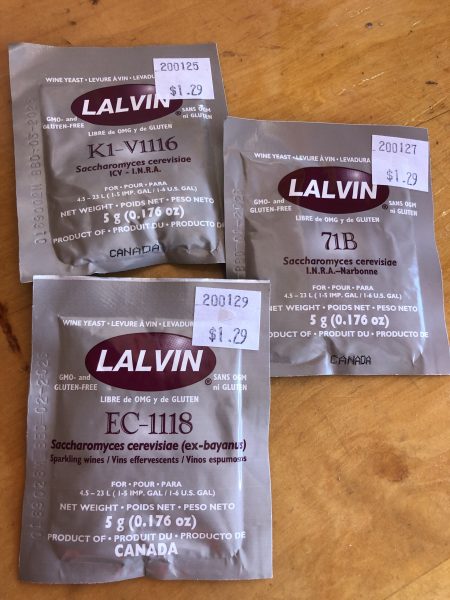
For easiest and most reliable results in making your wine, use commercial yeast.
Time to produce: Regarding the preconception that wine requires significant time to produce, it’s mostly waiting time. My actual hands-on time to make a batch of wine totaled only about four fun hours…spread out over 12 months! The vast majority of the winemaking time is the wine doin’ its thing by itself.
Supplies for a 3-gallon batch:
The good news is that you may already own or have easy access to the basic equipment. If not, everything is inexpensive or easy to make at home.
- A 3-5 gallon vessel for first fermentation. Non-reactive: preferably glass, stainless steel, but many folks use food-grade plastic. Also ceramic crocks in good condition work well.
- Two or three 1-gallon glass jugs (carboys). The glass jars containing commercial pressed apple juice with the handy little finger handle work perfectly.
- Airlock and rubber stopper. $5 from your local brew shop or online. Allows CO2 from the brew to be released, but prevents outside air from entering the vessel. (Here’s how airlocks work.)
- Siphon. Purpose-made ones go for $15, or make your own for cheap! How-to videos (and siphoning tips) are helpful.
- Sanitizer. Please use well-cleaned hands, surfaces, and tools, but don’t worry too much about sterilization–I’ve never had a problem. (There were no sanitizers 6000+ years ago in the Mediterranean region where wine was first made.) However, this is an often discussed topic for brewers. I do use inexpensive sanitizer (such as Star San brand) because it’s quite easy, quick, and safe to use.
- Optional: bottles for finished wine. Or just drink it when ready with a group of friends.
Now you’re ready to make wine!
The basic recipe is inspired mostly by Sandor Elix Katz in his book Wild Fermentation.
This batch was made with Sonora White Pomegranate (Punica granatum), but I’ve successfully made Elderberry-Blueberry Wine (from Sambucas mexicana), Wolfberry Wine (Lycium pallidum), Fig Wine (Ficus carica), Mission Grape Wine (Vitis vinifera), and a funky Quince Wine (Cydonia oblonga) which we quickly transformed into brandy…
Instructions:
*Note: The ultimate ratio of fruit volume to water is approximately 1:1, so for ~3 gallons of fruit (fresh or frozen, defrosted), add ~3 gallons of water. The finished wine will be about 5 gallons. You can make smaller or larger batches by keeping the same basic ratio.
1. Place 1.5 gallons pomegranate arils into a clean container or crock (at least 3 gallons/11+ liters in size), followed by 1.75 gallons boiling water. Cover with a clean towel. Set the container on the counter at room temperature on a cookie sheet to catch drips.
2. The next day, ladle out about 1 cup of liquid in a glass and add to it 3 grams of yeast. I used strain EC1118; see above). Allow it to dissolve and get bubby and active for a few minutes.
Then add it to the main fermentation vessel, also known as the wine must. Stir well and recover with towel.
Note: A 5g yeast packet will satisfy a 5 gallon batch. For a 1 gallon batch, use only about 1/4 of the packet, and so on.
3. Within hours, the must will be bubbling vigorously! Use a ladle or spoon to “punch down” the fruit and stir it from the bottom. Recover with towel.
4. The next day, the brew will be bubbling excitedly (audibly!) as the yeast devours the fruit sugar. Each morning, midday, and night (or up to 5 times daily), punch down and stir. Keep covered with towel.
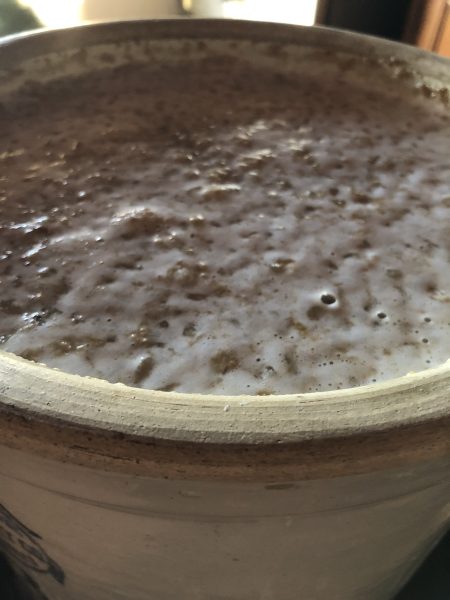
Here is the yeast bubbling vigorously devouring the fruit and water mixture.
5. On Day 3, the yeast have consumed much of the natural fruit sugar, and we need to feed them more. Heat 5-6 pounds pure cane sugar with just enough water to dissolve, cover and cool completely. Add this sugar/water mixture to the wine must, stir well, and cover. (If this seems like a lot of sugar, don’t worry, the yeast will consume most of it.)
6. Continue stirring 3-5 times daily as it continues to bubble and froth. A taste of the liquid will be sweet with a little alcohol detectable, and some zingy fruity flavors.
7. On Day 5-6 (or when bubbles are less vigorous upon stirring), it’s time to strain the fruit from the liquid and compost the spent fermented fruit. Using clean hands and tools (strainer, funnel, airlock, carboys), strain the wine to fill 2-3 carboys, avoiding empty space (oxygen) if you can; a few inches headspace is ideal. Properly fill airlocks with water (or vodka) and install.
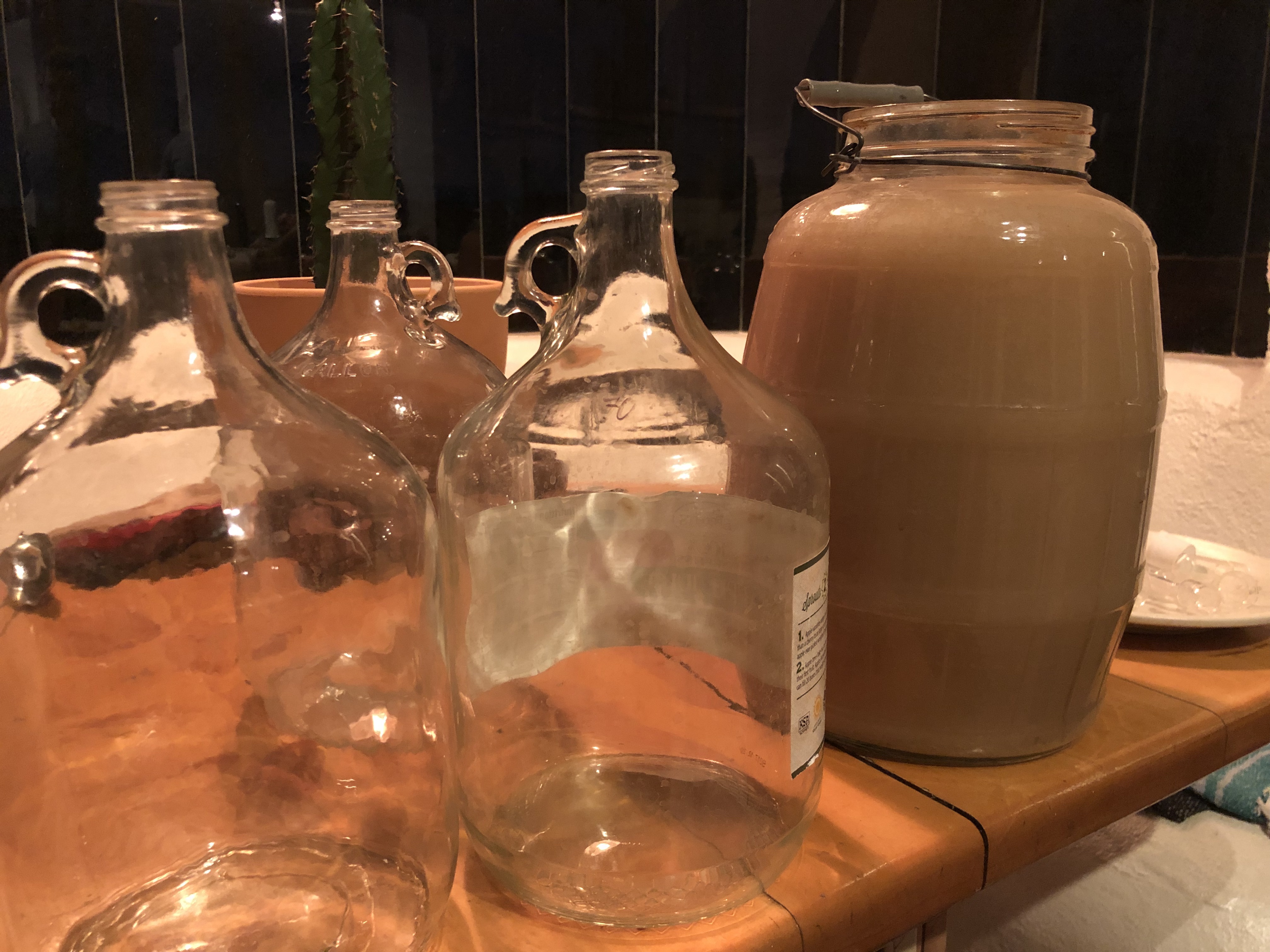
8. Keep in a cool spot for one month. I use my laundry room which stays fairly cool (~70F). Active bubbling resumes and the airlocks gurgle happily, letting carbon dioxide escape.
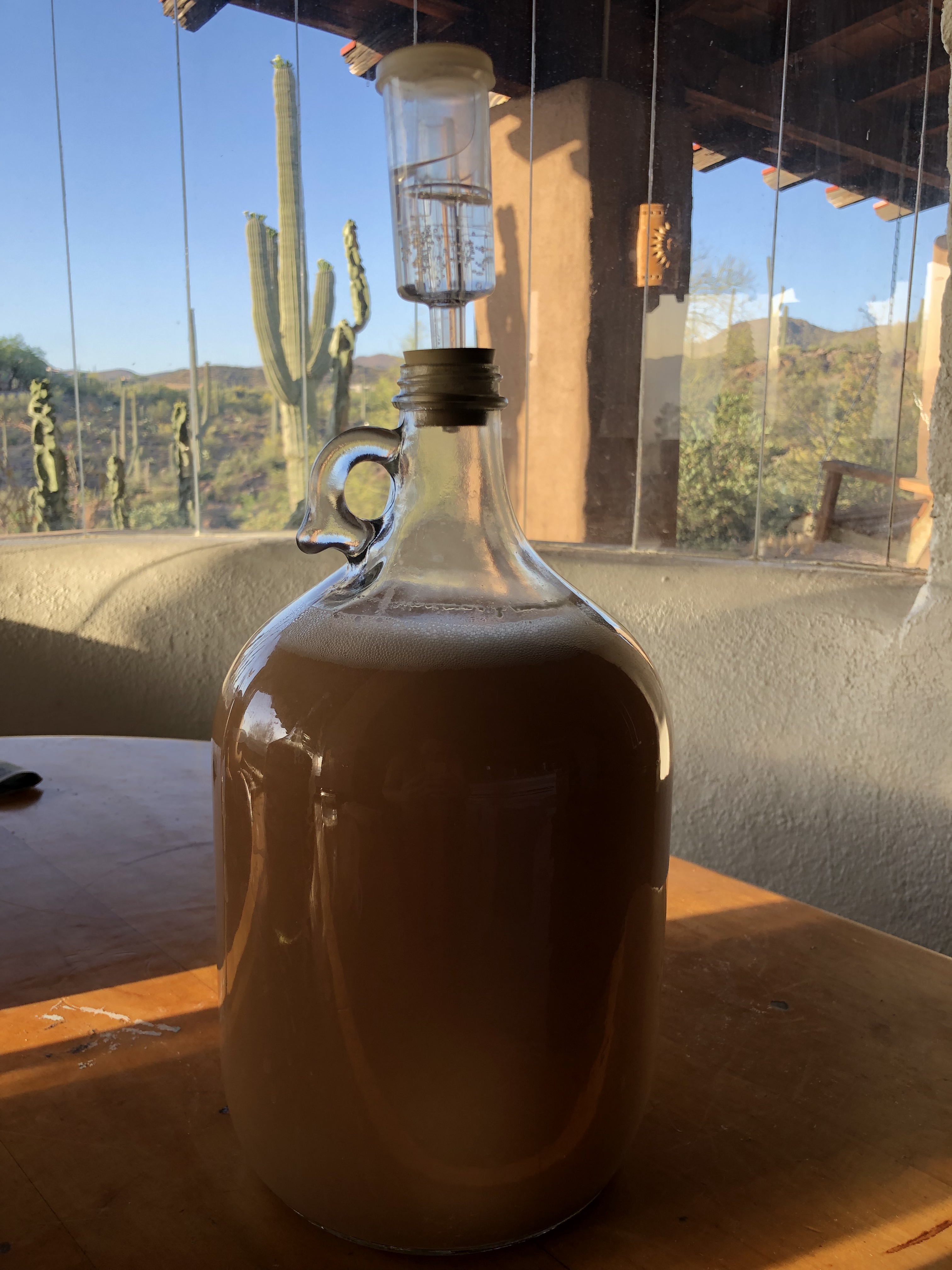
Carboy with an airlock. This will sit undisturbed for a month.
9. After a month, check the sugar content by carefully adding a spoonful of sugar onto the surface of the wine. If it doesn’t immediately respond with active bubbling, the sugar content is just right–replace airlock and wait another month.
If the wine does react excitedly, add ½ cup sugar, and recheck in a few days (totaling no more than 2 cups). Then, wait another month.
10. After these two months, clean supplies again because it’s time for the second and final siphon/rack! We’ll separate the yeast sediment on the bottom (called lees) from the finished wine. My batch made a little over 2.5 finished gallons, so I used pint sized flip-top bottles (Grolsch) for the partial gallon–just take care when opening these later due to possible pressurization.
11. Now go do something else for nine months. Periodically check that the airlock liquid hasn’t evaporated. When it’s time to sample the wine, try it both chilled or at room temp, and savor the complex and subtle flavors of the fruits of the desert.
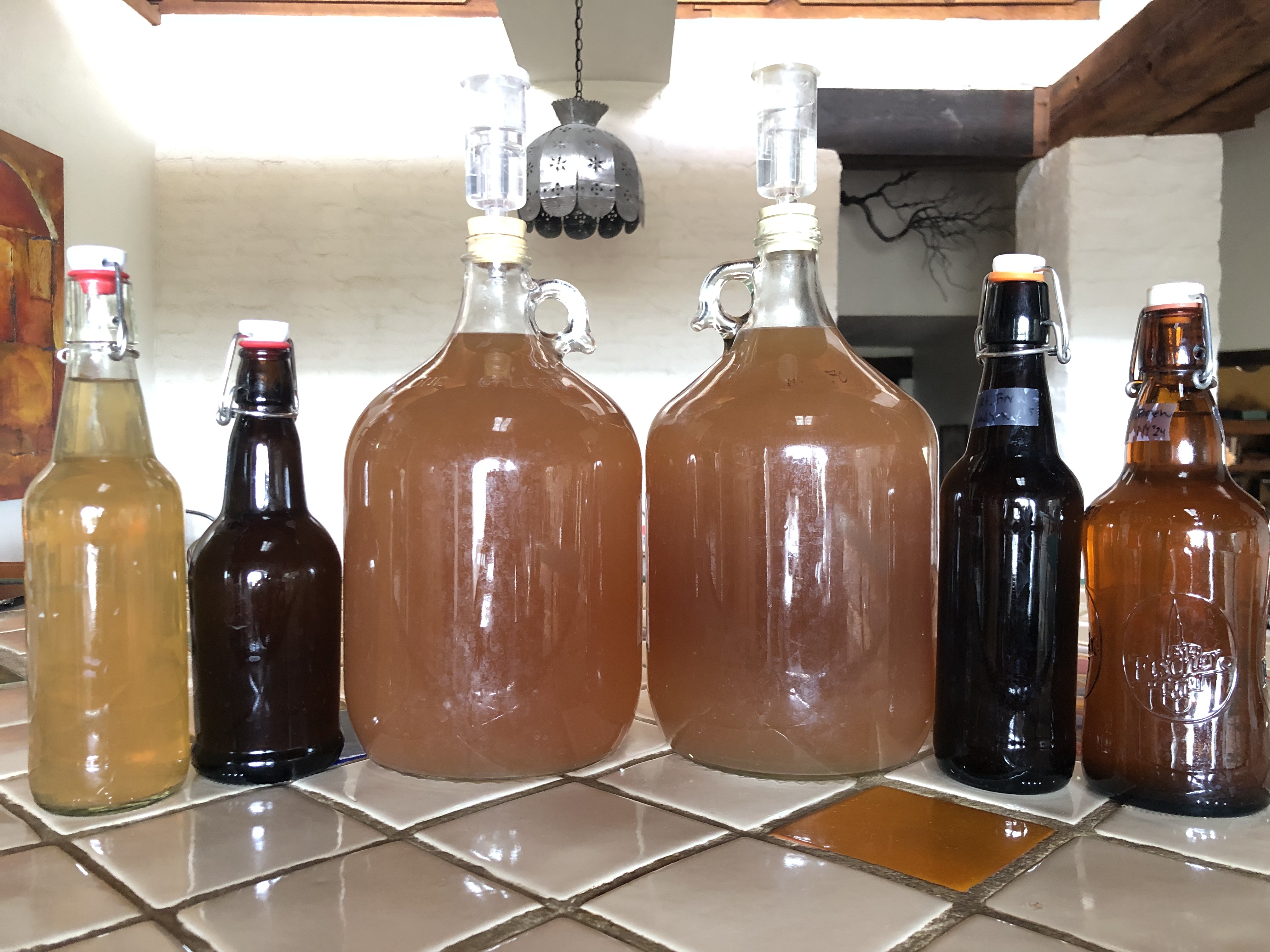
Gallons of delicious finished wine!
Congratulations, winemaker! If the process is fun and you want to try more, there are wonderful books on home winemaking and fermentation. I am partial to Sandor Elix Katz’s guides because of their simplicity and use of natural ingredients. Sometimes I hesitate to embark on a new endeavor because I worry I’ll mess it up. I then remember that wine is a very forgiving process, and I have little to lose if anything goes truly awry. If wine gets exposed to too much oxygen, it will become vinegar (acetic acid), so the worst case scenario is you have some really interesting vinegar with which to cook. Salud!
(Please share below in the comments any wine adventures and experiences you embark upon.)
 Savor the Southwest: