Marvelous Mulberries–garden dessert in a desert garden

Yummmmm. If you have never tasted a mulberry–or maybe you remember browsing them as a kid back east or in the Midwest–you will be blown away by the glorious mulberry harvest happening right now at Mission Garden!

Tia Marta here tempting your tastebuds for a gentle, natural sweet treat–but…you have to take action SOON. If you’re in southern Arizona, find a hole in your schedule, and a way to get to the base of Tucson’s A-Mountain this week for a mulberry taste-thrill. It will inspire a new planting in your desert home landscape. Three different mulberries await you in Mission Garden’s beautiful and diverse orchards. Come early–summer hours are Wednesday thru Saturday, 8am-noon.

A sumptuous harvest after this wet winter! Look for trees on the Mission Garden grounds that have a big white fabric tarp underneath, and voila! Shake a branch and dive in for a dark, delicious, delicate mulberry, fresh from the tree. The elongated fruit shown here is Pakistani mulberry (Morus alba x rubra), producing like mad even in Tucson’s heat.

Female trees produce fruit. Male, pollen-producing, trees are controversial in Tucson due to allergenic affects. Somewhere out there, there must be male mulberries; none are growing at Mission Garden, yet we have no dearth of fruit.
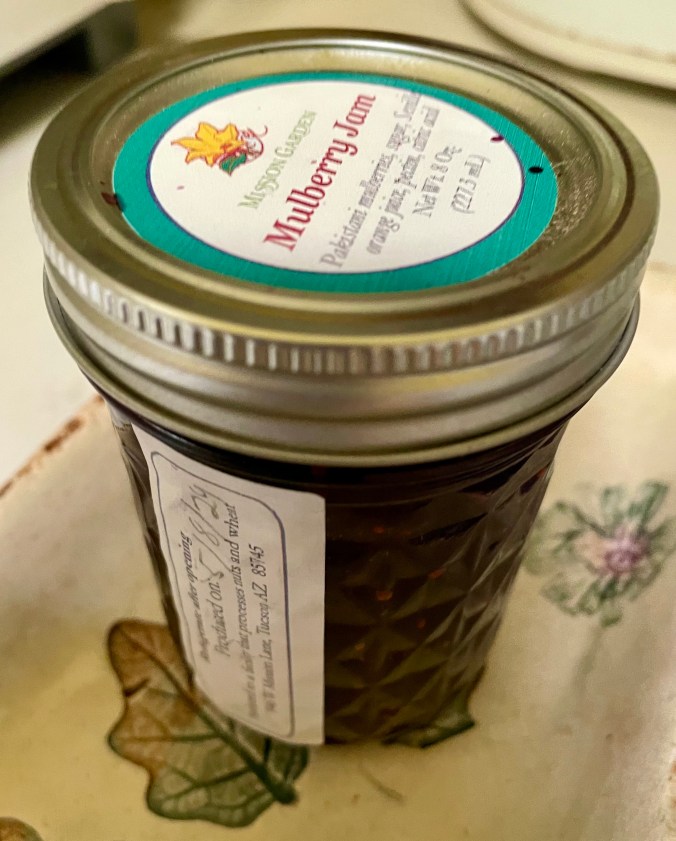
Handmade mulberry jams are going fast at the Mission Garden entrance shop! It’s the best jam you ever tasted, made with love by Mission Garden volunteers in their health-department-certified kitchen. You can’t find local gourmet delicacies like this commercially. The closest thing (like frozen raspberries at a grocer’s freezer?) can’t hold a candle to Mission Garden mulberry jam or sauce! ($8 for the 8oz. jar)
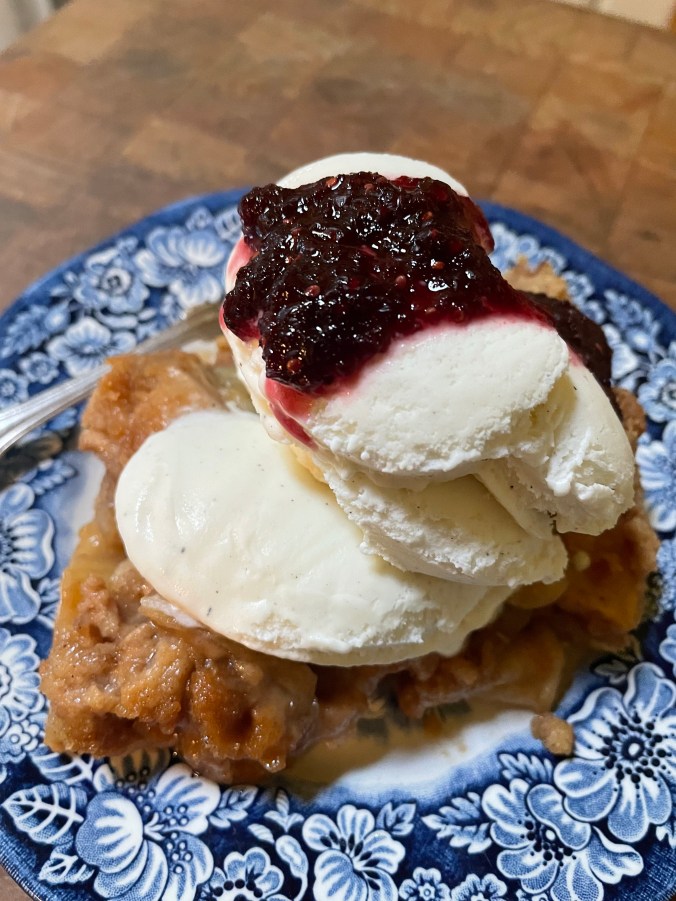
Mulberry jam doubles as a gourmet sauce. My pedestrian apple-brown-betty morphed into a fancy dessert with ala mode topped by a dollup o’ Mission Garden’s mulberry jam. (Mulberry seeds in the sauce are minimal and add a tiny crunch texture.)

As you explore further through the Mission Period huerta (orchard) you’ll find yet another gorgeous green mulberry tree with a totally different color and shape of fruit. (Above, looking up into the foliage, and ripe fruit adjacent) This is white mulberry (Morus alba) with a pale pink or lavender color, and a flavor some people describe as “watermelon” or “lingonberry” or “cloud berry.” So juicy you can’t stop….

A big surprise is to learn that we have a NATIVE mulberry “bush” in the arid Southwest–the wild, small-leafed mulberry tree (Morus microphylla). It’s inspiring to know it is adapted to our Sonoran Desert, only needing a little extra water; it grows close to arroyos out in Nature. This may be one of those amazing plants that may help provide food for us in a hotter, drier future…

Each little wild mulberry is a zap of sweet nutrition, packed with healthy complex sugars, dietary fiber, beta carotines, vitamin C and iron.

I can hardly wait until Mission Garden is propagating cuttings of all these several amazing mulberry species. Already I’m figuring where I can plant them in my yard. Whatever we can’t harvest each season will be a gift for the birds!

This coming SATURDAY, MAY 18, is SAN YSIDRO FIESTA, Mission Garden’s celebration of the traditional pilkan harvest (heirloom wheat harvest). I’ve been playing with recipes using these heirloom grains pairing them with mulberries, but I HAD to relay this timely mulberry story for you ASAP, so you could get to Mission Garden this week to jump through this narrow “mulberry window” of opportunity.

Tia Marta hoping to see you at San Ysidro Fiesta Saturday–or sooner, browsing a mulberry tree this week!
Celebrating la Fiesta de San Ysidro Labrador

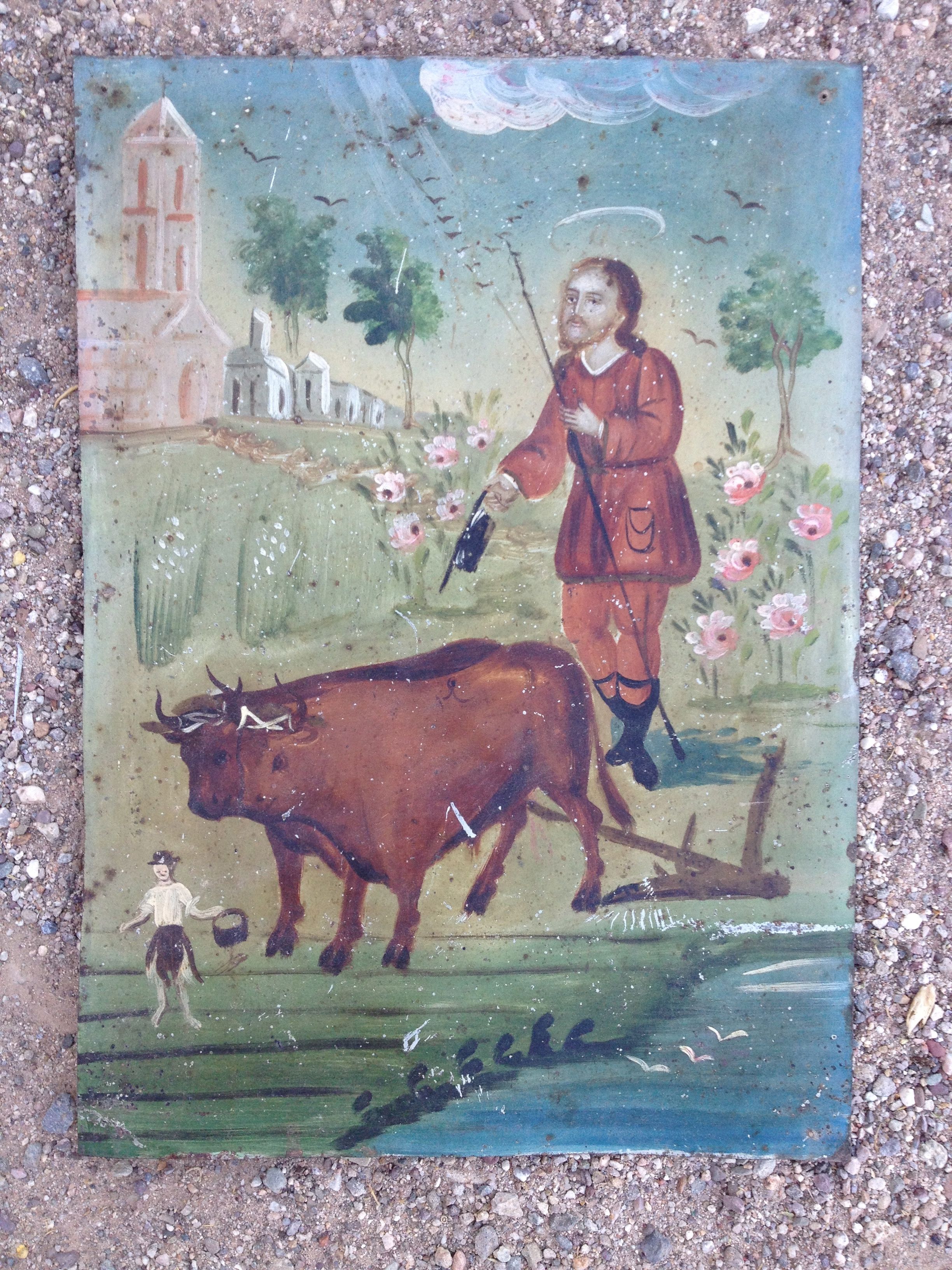
Tia Marta here to tell you about a beautiful and legendary soul, San Ysidro Labrador, Saint Isidore the Farmer, Patron Saint of Farmers and Laborers – whose feast day is May 15. A major celebration is planned in his honor this Saturday, May 17, in Tucson.

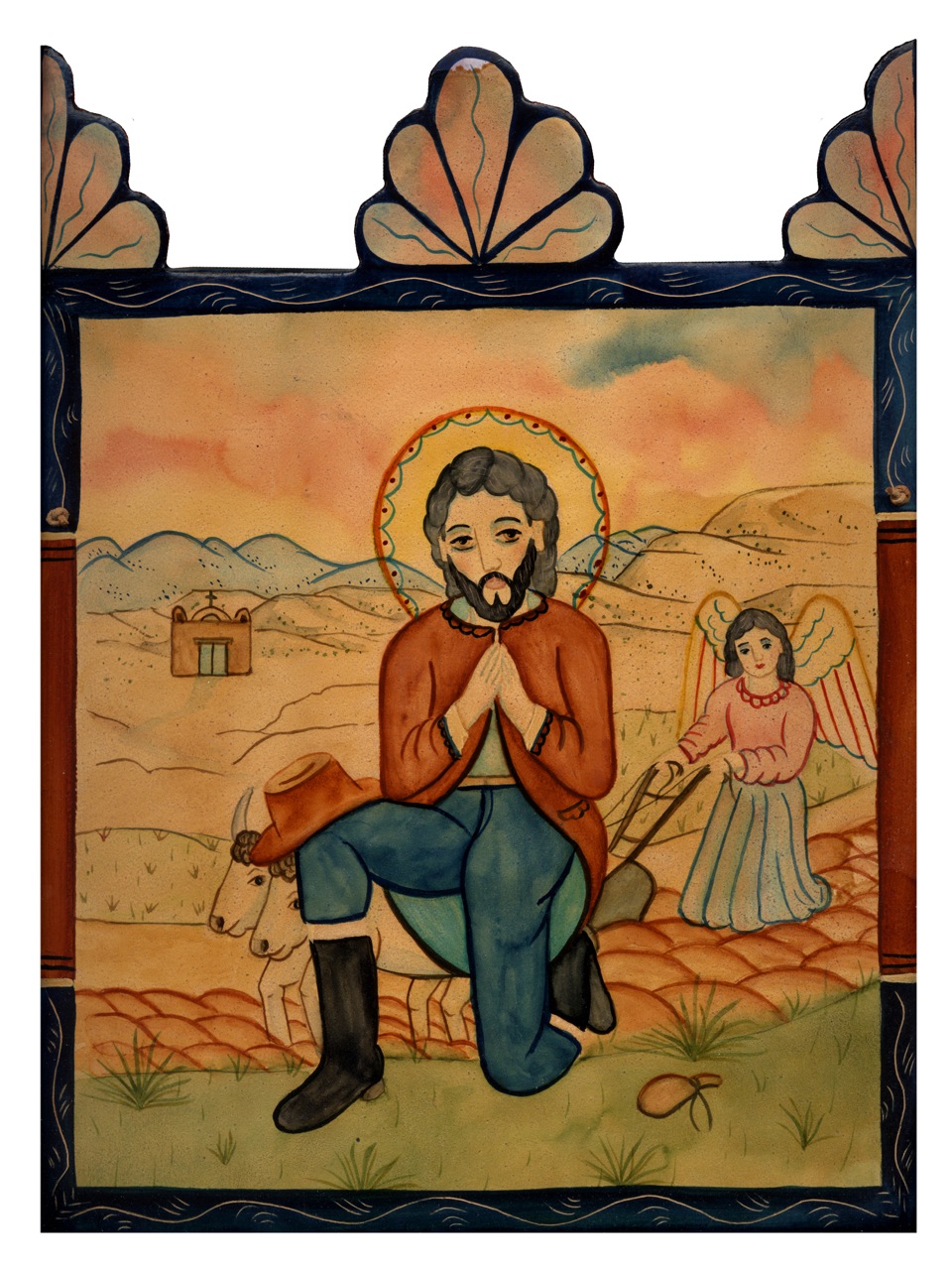
Retablo, painting on metal of San Ysidro plowing with angel, in style of traditional New Mexico folk arts.  From Burns/Drees Collection (Photo MABurgess)

Retablo, painting on metal of San Ysidro plowing with angel, in style of traditional New Mexico folk arts. From Burns/Drees Collection (Photo MABurgess)

San Ysidro (a poor Spanish peasant farmer who lived from around AD1070 to 1130) is revered traditionally, along with his good wife Santa Maria Torribia, for generously sharing bounty from their fields and hearth to those in need—hungry animals and fellow peasants. Legend tells us that San Ysidro, at prayer every morning, was often late to labor in his master’s fields, but the angels, seeing his devotion, would already be plowing for him. Another legend records him with an angel plowing on both sides his oxen so that his labor yielded three times that of his neighbors. Yet another tells how, as he carried corn to be milled, he took pity on poor birds in the snow and gave them half his grain; when his leftover corn was ground, it yielded twice what he had brought. His generosity produced miracles.

San Ysidro retablo art, courtesy of Friends of Tucson's Birthplace

San Ysidro retablo art, courtesy of Friends of Tucson’s Birthplace

Residents of Madrid, Spain, go all out in celebrating San Ysidro’s feast day, as he is the city’s patron saint. In Tucson, it is customary in traditional Hispanic families to celebrate San Ysidro with prayers for rain as his day falls usually in our most arid fore-summer. According to Jim Griffith’s Saints of the Southwest, images of San Ysidro were taken from the church to observe the fields or even buried in the fields until rains came.  Here he has become patron of ranchers and crops–even gardeners. Dia de San Ysidro Labrador is a perfect occasion for us to become mindfully aware of where our food really comes from—the Earth, the soil—and also to fully appreciate the labor, the human care, human energy and other forms of energy that all go into bringing good food to our mouths and bodies. (I guess now we shouldn’t say “food to our tables” anymore, as that is unfortunately kinda passé. I hope some families still sit together at table to eat. We do and it is always a joy. Gosh imagine, we learn so much when we actually prepare and sit over a good meal and converse with each other!) So San Isidro Labrador reminds us of what is critically important with food—its origins in good earth and honorable labor!

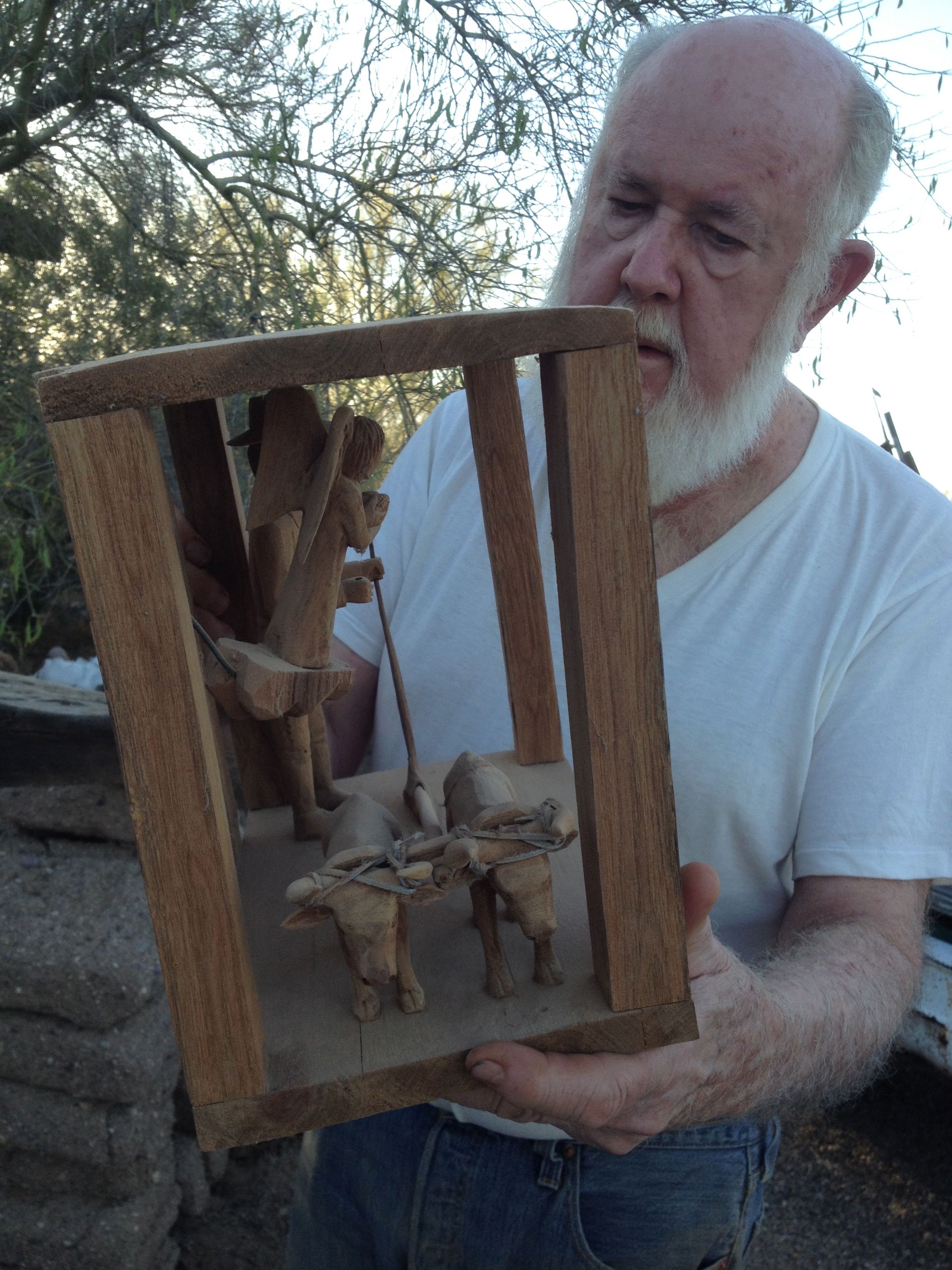
NW Mexico craft-arts collector and expert Dr.Barney T.Burns with santo of SanYsidro showing the oxen and angels.

NW Mexico craft-arts collector and expert Dr.Barney T.Burns with santo of SanYsidro showing the oxen and angels. (photo MABurgess)


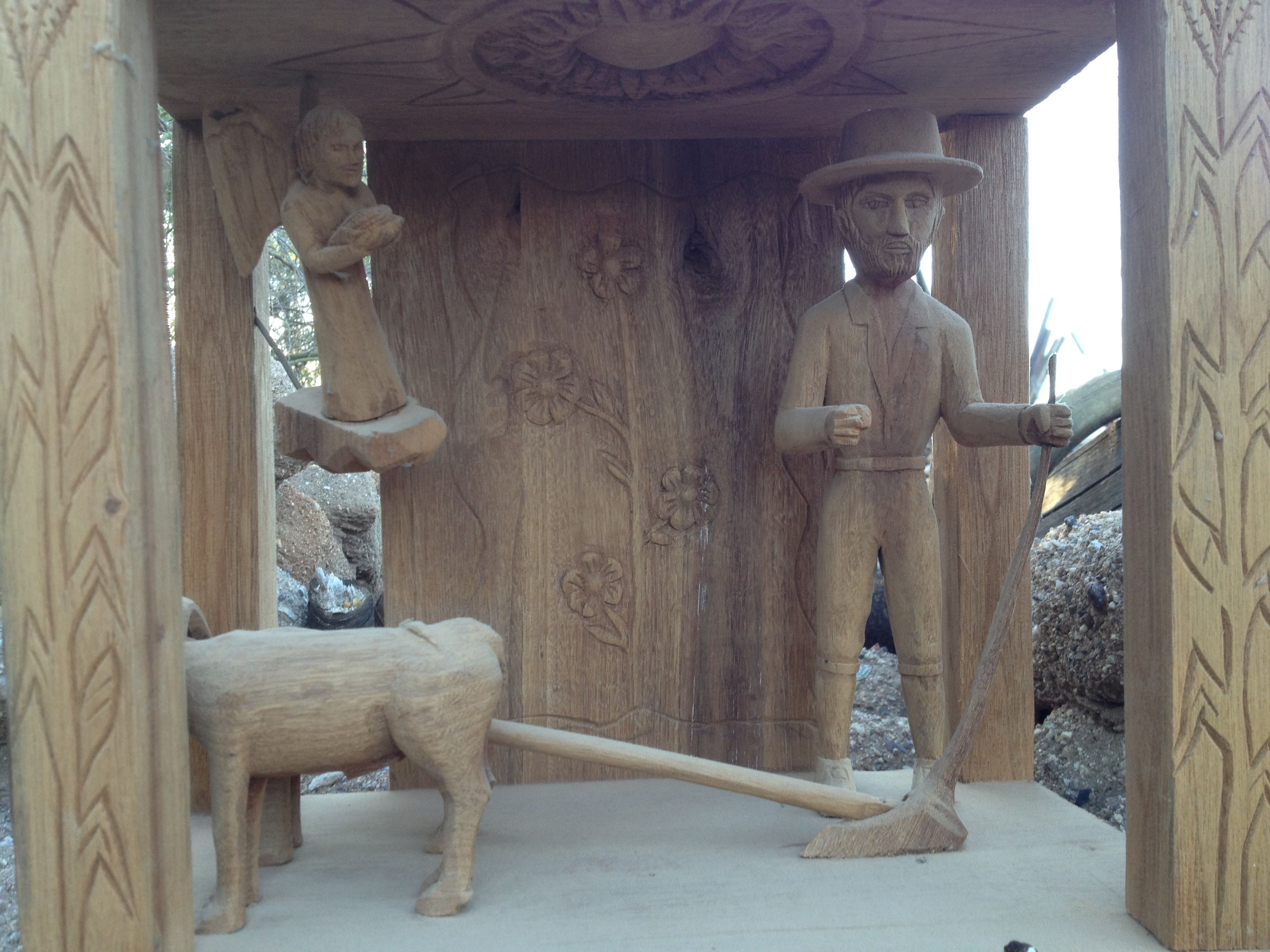
Cottonwood root carving by Mayo Indian, Sinaloa, Mexico, depicting San Ysidro with ox, plow, corn motif, and angel watching him.  From Burns...Drees Collection (photo MABurgess)

Cottonwood root carving by Mayo Indian, Sinaloa, Mexico, depicting San Ysidro with ox, plow, corn motif, and angel watching him. From Burns…Drees Collection (photo MABurgess)

This year the Friends of Tucson’s Birthplace has arranged a public celebration of San Ysidro not to be missed, where this tradition is revived in a most appropriate setting—in the new Mission Garden, a living history orchard and garden on the very site of Padre Kino’s original Mission San Augustin de Cukson, at the base of Sentinel Peak. Plan to get there early— procession starts from the Santa Cruz River at 9:00am (May 17) going west to enter the adobe-walled Mission Garden. There, near the living orchard of Mission Period fruit trees and the productive winter vegetable garden coming to fruition, will first be the blessings. A Native American spiritual guide will bless in the four directions, followed by a Christian blessing of the fields, food and animals. Heirloom White Sonora Wheat grown in this living-history vegetable garden is getting ripe and will be ceremonially harvested. There will be tastes of Pozole de San Ysidro, the traditional pozole de trigo. Mariachi music by Las Aguilitas from Davis Elementary will fill the air; the Desert Indian Dancers from San Xavier will bless the earth; and Hispanic historian Bobby Benton will sing. A highlight will be a talk by none other than “Big Jim” Griffith reminding us of our roots in Tucson traditions of San Ysidro. Info tents will have volunteers on hand to answer questions. Native Seeds/SEARCH has donated varieties of heirloom seeds known from the Mission Period and earlier, planted in vegetable and timeline gardens to demo the prehistory of plants used by ancient people of the Tucson area. NSS volunteers will provide info for contemporary gardens. Tucson Herbalist Collective shares medicinal plant knowledge for Mission Garden and will have volunteers available for herbal questions. Baja Arizona Sustainable Agriculture will be selling heirloom White Sonora Wheat (grown organically by BKWFarms in Marana) and demonstrating how to cook the delicious ancient grain in a modern solar oven! (Great recipes for White Sonora Wheat are available by scrolling back in this blog.) It will be hot– come prepared with hat, sun protection, and water. The celebration is over at 11:30am. What a wonderful way to rejoice in local food, local tradition, and neighbors to share it, on this little piece of floodplain where agriculture has been happening for over 4100 years!

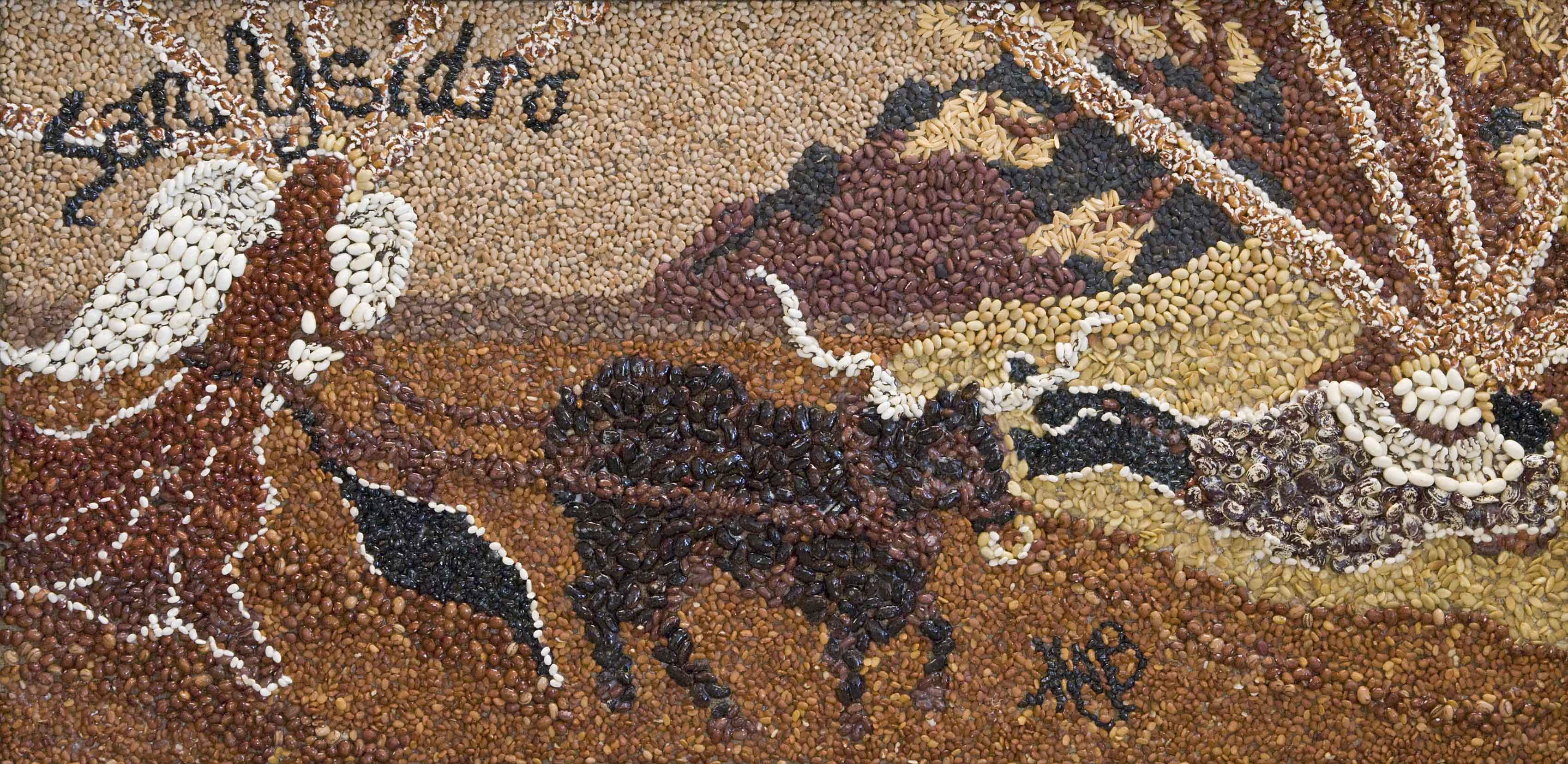
A mosaic of 21 heirloom beans and seeds by artist MABurgess, depicting the angel plowing for San Ysidro Labrador. (photo PeterKresanPhotography.com)  Notecards available at NativeSeeds/SEARCH and www.flordemayoarts.com

A mosaic of 21 heirloom beans and seeds by artist MABurgess, depicting the angel plowing for San Ysidro Labrador. (photo PeterKresanPhotography.com) Notecards available at NativeSeeds/SEARCH and http://www.flordemayoarts.com

Inspired by San Ysidro, I spent several months composing this mosaic of heirloom seeds, depicting an exhausted San Ysidro asleep under a tree while the angel finishes his plowing. See if you can identify any varieties. You can purchase the heirloom beans–and notecards of this image now printed handsomely by Spectrum–at Native Seeds/SEARCH store or at the Flor de Mayo table at Sunday St Phiillips Farmers Market.

San Ysidro is helping us find our way back to connection with the land that can feed us again!