Jacqueline Soule here today to discuss a edible “weed.” Most people associate mistletoe it with kisses and winter holidays. Sad to say, here in the desert southwest, many homeowners think of our local mistletoe as a weed to be eliminated from their trees. In reality, they should be thinking of it as a crop to be harvested!

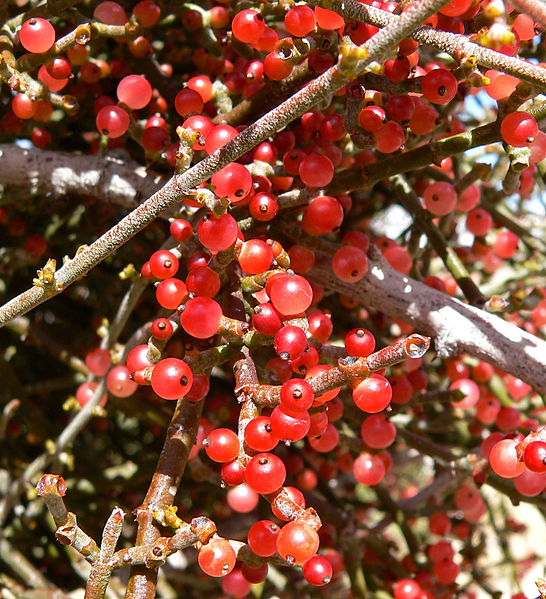
Desert mistletoe fruit is the only mistletoe fruit that is edible. Photo by S. Shebs.
There are many species of mistletoes around the world. The mistletoe plants themselves are all toxic. The berries of most species are toxic. The one exception is our local desert mistletoe, Phoradendron californicum, bearing not only edible but highly palatable white to reddish translucent berries. Native peoples ate only the fruits of mistletoes growing on mesquite, ironwood or catclaw acacia. Found growing on palo verdes or Condalia (desert buckthorn) the fruits are considered inedible.
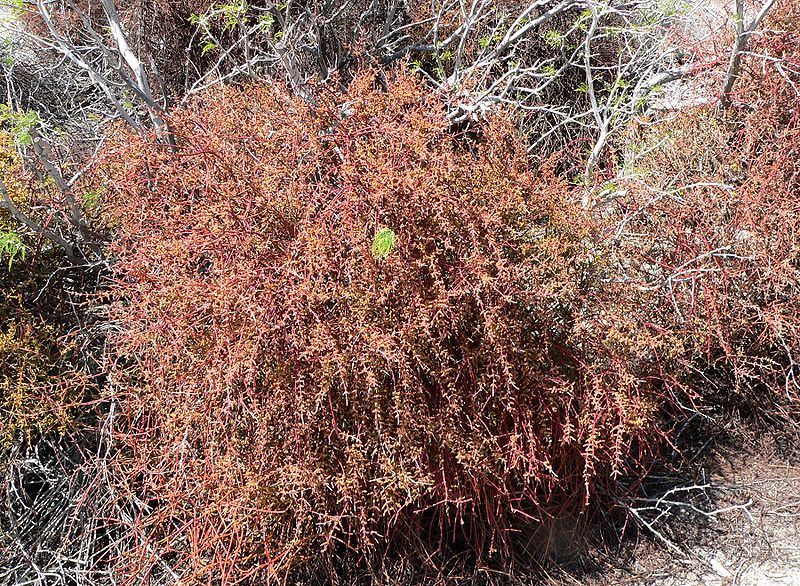
Plants of desert mistletoe can become quite large and offer a bountiful harvest of berries. Photo by S. Shebs.
According to literature, the Seri consider mistletoe fruit ripe and harvestable once it turns translucent. Harvest is done by spreading a blanket below the plant and hitting it with sticks to release the fruit. Seri consumed the fruit raw. The Tohono O’odham also consumed the fruit raw. River Pima ate the fruit boiled and mashed, which made it the consistency of a pudding. The Cahilla gathered the fruits November through April and boiled them into a paste with a sprinkle of wood ash added to the pot. (Bibliography at the end of this article.)
Some desert mistletoe are more red and less translucent. This is just normal variation within the species. Photo by S. Shebs.
By the way, desert mistletoe plants (not the fruit) contain phoratoxins which can easily lead to death via slowed heart rate, increased blood pressure, convulsions, or cardiac collapse. Some of these compounds can cause hallucinations, but there is no way to judge dosage. People seeking a “high” from mistletoe still turn up in morgues each year. Native peoples used plants other than mistletoe to seek visions, and if one desires visions, one would be wise to follow their example. Although toxic, if used in a well-ventilated place, the foliage of desert mistletoe can be used in crafts and as a dye, producing a pale beige to dark sienna.
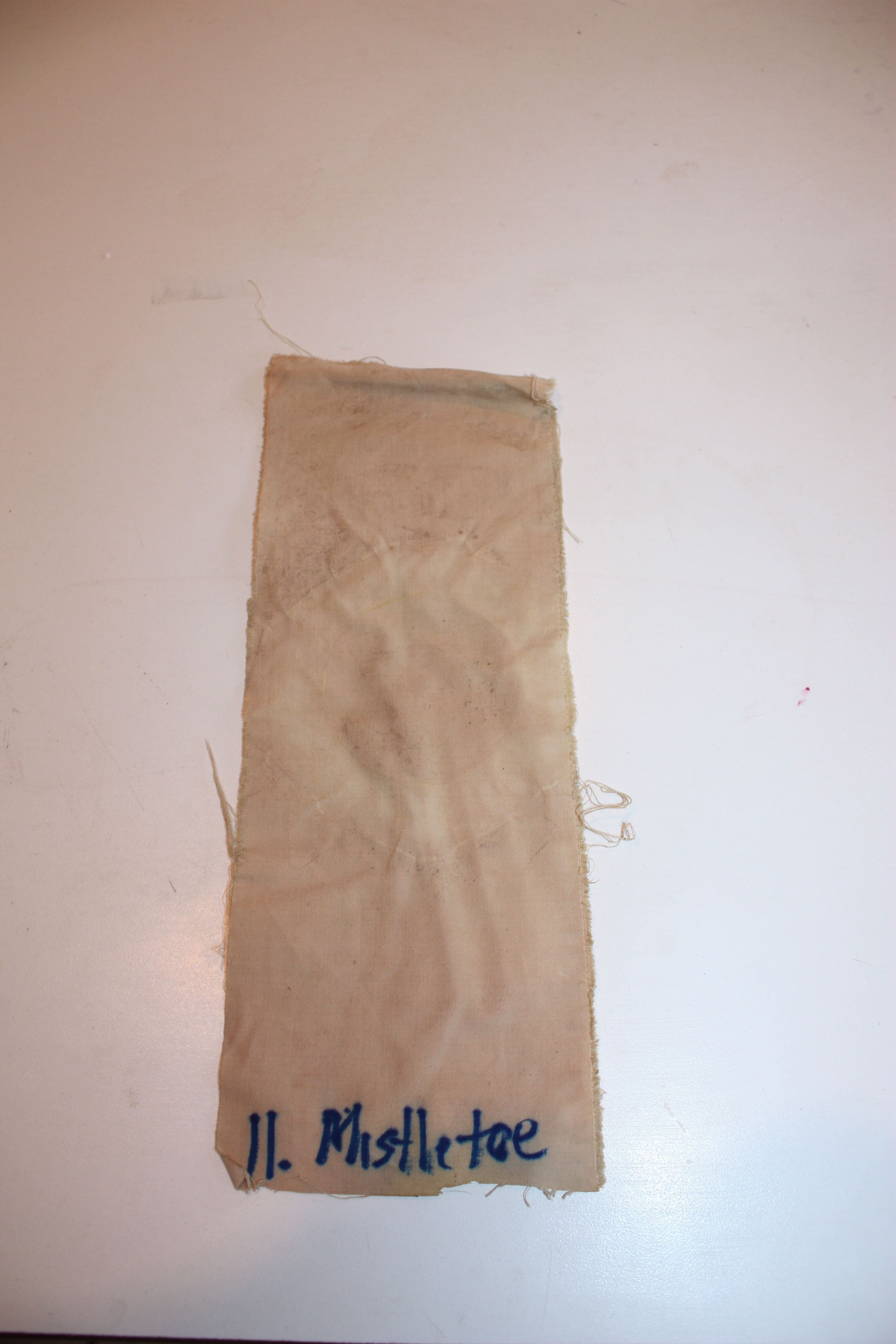
Mistletoe dye on cotton. Photo by J. A. Soule
Harvesting and Use.
Mistletoe berries are ripe once they turn translucent and you can generally see the red seed inside. They also become soft and squishy, losing their hardness. Watch the phainopeplas, when they start devouring berries, then the fruit is ripe! I have only eaten the berries fresh, and find them reminiscent of elderberry in flavor. I was going to experiment with making a jelly this year, but missed my window of opportunity.
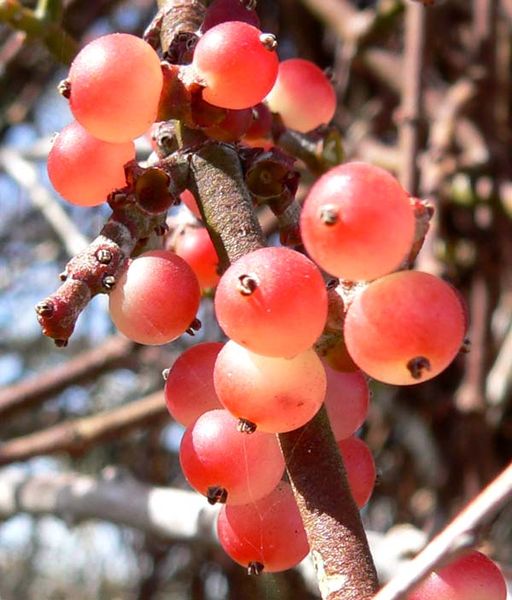
When ripe, the berries turn translucent and fall off the plant easily. Photo by S. Shebs.
As a dye, mistletoe plants themselves are used. They can be fresh or dried. Place the herbage in the pot, cover with water, bring to a boil, strain. Add an alkalizing agent (ammonia) to intensify the color. You can dye both protein fibers (wool, silk) and plant fibers (cotton) with this solution. Ideally mordant with alum prior to dyeing, but post-mordant baths also work.
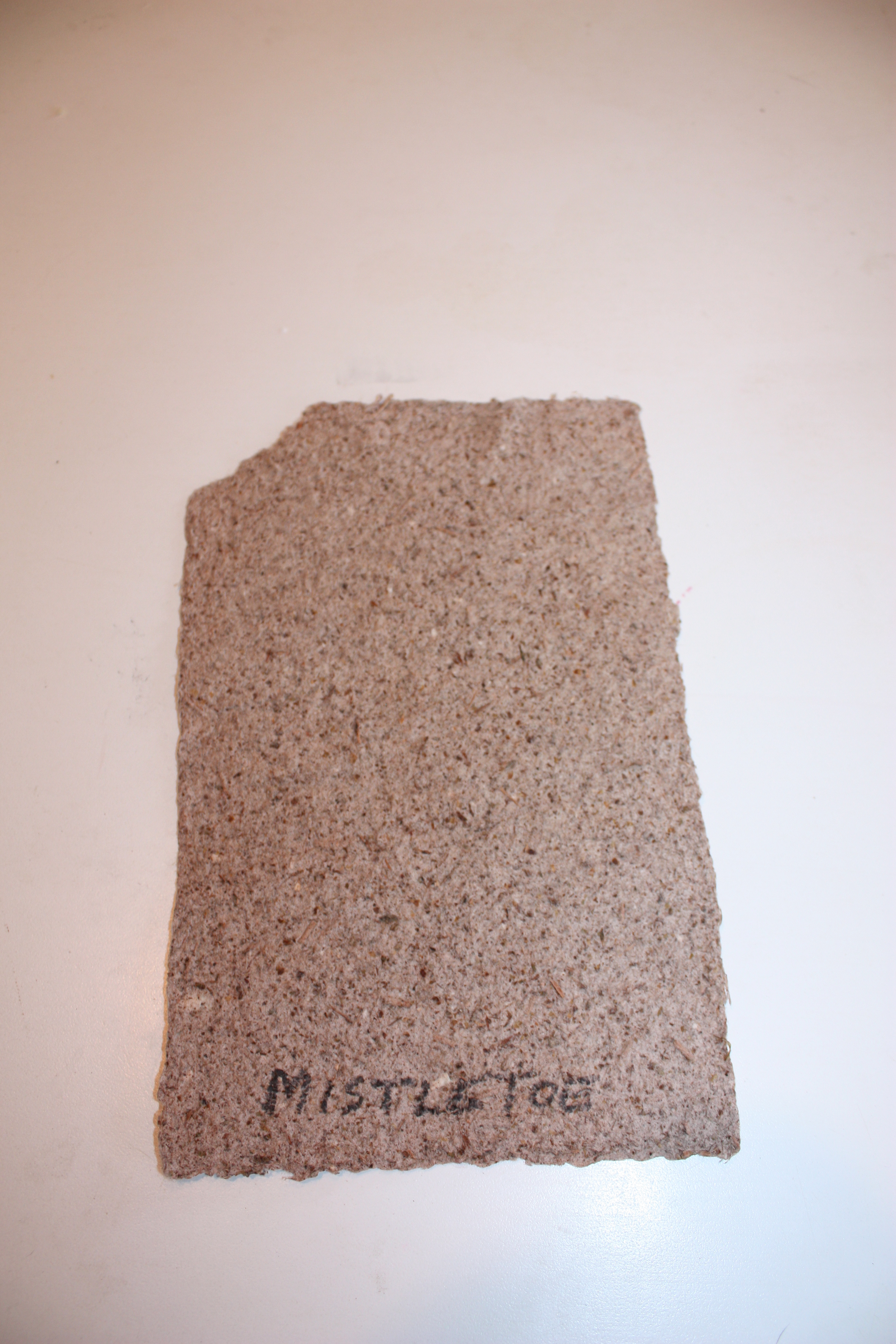
A blend of half paper pulp and half mistletoe plant material yields a nicely textured craft paper. Photo by J. A. Soule.
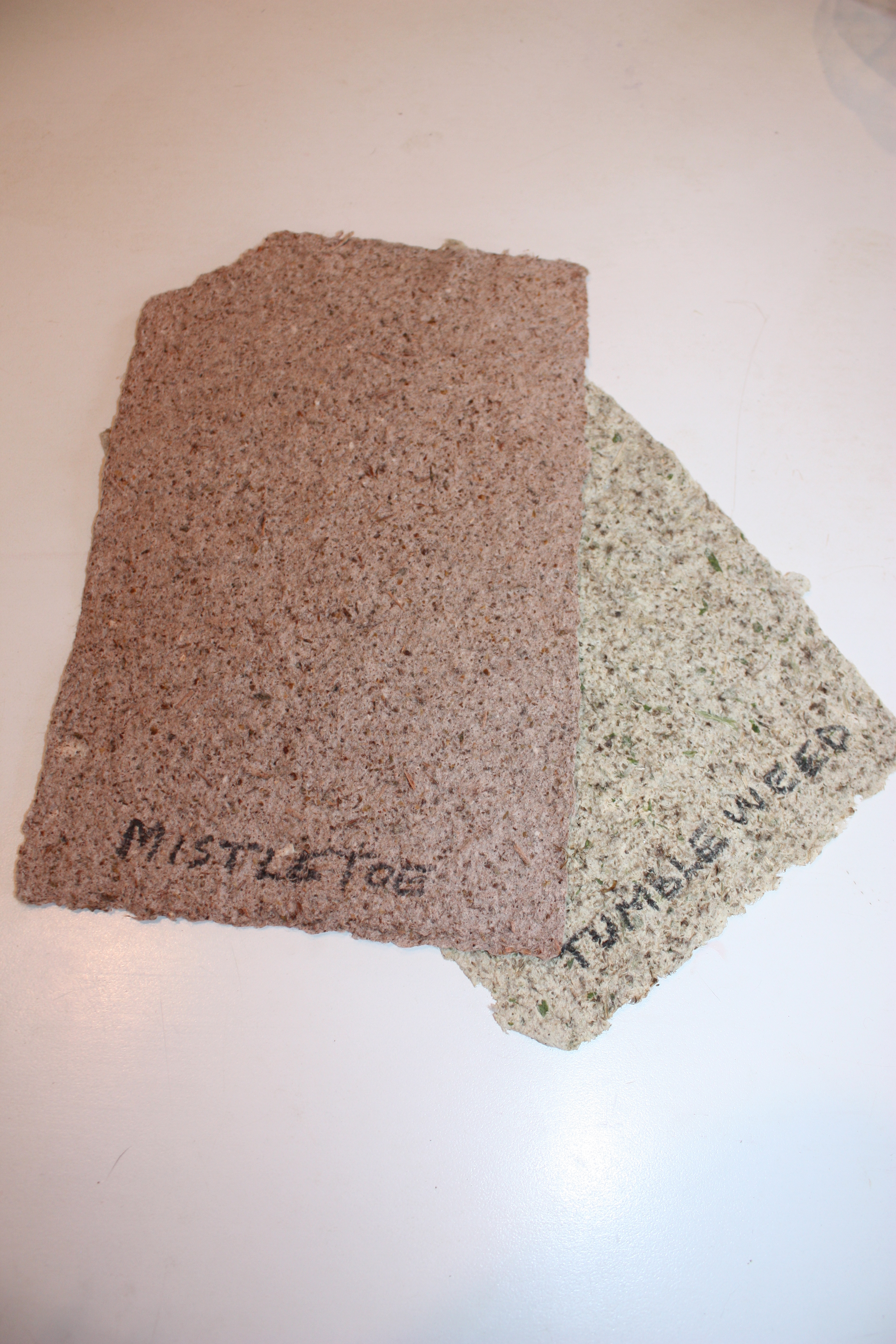
All manner of desert plants can be used in papermaking. Photo by J. A. Soule
Rather than discarding the spent mistletoe herbage from making dye, I have frozen it for later use in papermaking. Grind the cooked mistletoe in a blender and mix it half and half with paper pulp to create a lovely, rough-textured, craft paper with a warm brown hue.
Note: This month I have been looking at desert mistletoe in some of my other online articles.
Desert mistletoe and human use is presented here, the third in a series on the topic.
Desert mistletoe and wildlife can be read at: http://www.beautifulwildlifegarden.com/?s=mistletoe
Desert mistletoe as part of a native garden caan be read at: http://nativeplantwildlifegarden.com/?s=mistletoe
This article copyright Jacqueline A. Soule, 2014. The topic is covered more extensively in my book “Father Kino’s Herbs: Growing and Using Them Today” (2011, Tierra del Sol Press, $15). If you live in Tucson, I hope you will consider purchasing a copy locally at Antigone Books, Arizona Experience Store, Magic Garden, Mostly Books, or Rillito Nursery.
For the last eight months, Savor the Southwest has been brought to you every week by four Savor Sisters, me (Jacqueline), Tia Marta, Aunt Linda and Carolyn. Look for our fifth Savor sister, Amy Valdes Schwemm will make her first appearance in June, otherwise she will return to post whenever a month has five Fridays.
Bibliography for this article
Felger, R. S. and M. B. Moser. 1985. People of the Desert and Sea. University of Arizona Press, Tucson, AZ.
Hodgson, W. C. 2001. Food Plants of the Sonoran Desert. University of Arizona Press, Tucson, AZ.
Kearny T. H. and Peebles R. H., et al. 1960. Arizona Flora. University of California Press, Berkeley, CA.
Rea, A. M. 1997. At the Desert’s Green Edge. University of Arizona Press, Tucson, AZ.
Tohono O’odham Nation (s.d.). When Everything Was Real: An Introduction to Papago Desert Foods. Tohono O’odham Nation, Sells, AZ.
© 2014, Jacqueline Soule. All rights reserved. I have received many requests to reprint my work. My policy is that you are free to use a very short excerpt which must give proper credit to the author, and must include a link back to the original post on our site. Please use the contact me if you have any questions. 



 Savor the Southwest: