Gathering the Desert, and Gathering Around Honey Wine

Honey, the golden elixir of the bees, is famous for its impressive shelf stability, or resistance to spoiling. By its nature, it can remain edible for an extraordinarily long time. In grade school, I remember delighting in the fact that archaeologists found honey in King Tutankhamun’s 3,000 year old tomb. Cave paintings in Africa dated to thousands of years ago depict honey hunters who braved a defensive colony of bees (Hollmann 2015) to access the calorically valuable, medicinal, and tantalizing substance which could be consumed or stored long term. 

I love to think about the early honey harvesters of Africa and imagine the first time someone combined honey with water, and fermentation soon began–an exciting transformation took place! This is thanks to the action of microbes (as is commonly the case, at least with fermented foods). While humans crave the complex sweetness of honey, it turns out that honey is a favorite food of some microbes such as Saccharomyces cerevisiae, a species of yeast. The yeast consume the honey and convert it to alcohols and carbon dioxide. 
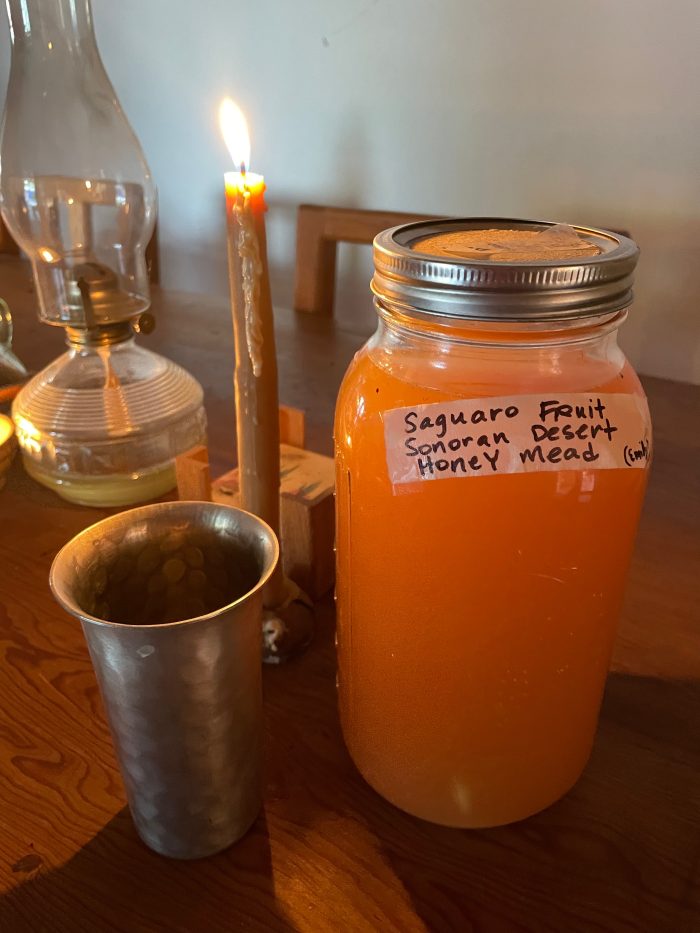
Honey wine, T’ej…sweet and warm like the solstice evening light.

It is thought that honey wine known as t’ej (say: “tedge”, with a soft d) originated in Ethiopia and Eritrea, and upwards of 5 million people consume t’ej on a daily basis (Belay n.d.). However honey wine variations are found in many parts of the world including Mexico and Poland (Katz 2012). You may know t’ej by its other name of mead, an alcoholic beverage made by fermenting honey with water. It is truly simple and fun to make t’ej at home by adding raw unpasteurized honey (which contains natural yeasts that kickstart fermentation) with pure water, but you can also add an endless variety of edible botanicals like herbs and fruit to create a unique or medicinal mead. While mead can be aged for months, you can drink it “young” after only a couple weeks of high-energy fermentation. What kinds of honey wine will you make to share with family and friends?

I was inspired to make t’ej for the first time by my friend Andrias Asnakew, a Tucsonan of Ethiopian descent who established Brillé Mead Company here in 2023. I was honored to share homemade t’ej with him and his welcoming friends who hosted us on Easter, clinking glasses as they described the traditional recipe. They taught me that East African t’ej is traditionally made with honey, water, and the leaves of gesho (Latin name Rhamnus prinoides, a plant native to southern and eastern Africa) which adds a distinct bitter flavor and wild yeast to start the brew (Belay, n.d.). I am grateful for the family’s hospitality and generosity, and to Andrias whose knowledge guided me through the process.
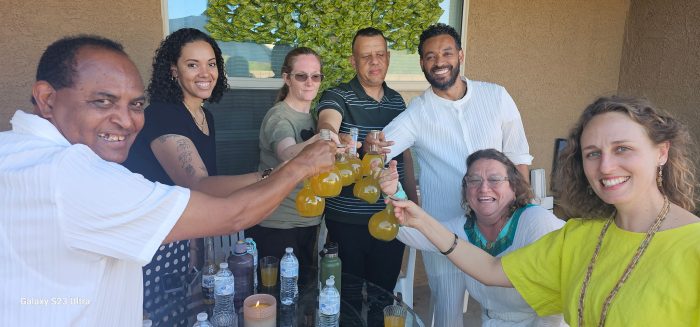
Friends gathering with traditional t’ej (Ethiopean honey wine).

Around the time I was pondering which ingredient to include in my first mead, I was marveling at the crowns of white trumpeting blossoms on the haan (Tohono O’odham name for the native saguaro cacti). I wondered what saguaro fruit honey wine would taste like? It seemed that using fresh red bahidaj saguaro fruit would be a perfect way to celebrate the solstice on June 20th, and to harken for rain on Dia de San Juan on June 24th. (For more on saguaro traditions, enjoy reading about the Tohono O’odham’s beloved bahidaj saguaro fruit from teacher Muffin, known as Sister Marta here at Savor the Southwest blog: Summer Solstice, and Sister Carolyn’s It’s Saguaro Season.). This mead would be fully Sonoran desert, made from local honey and saguaro fruit…
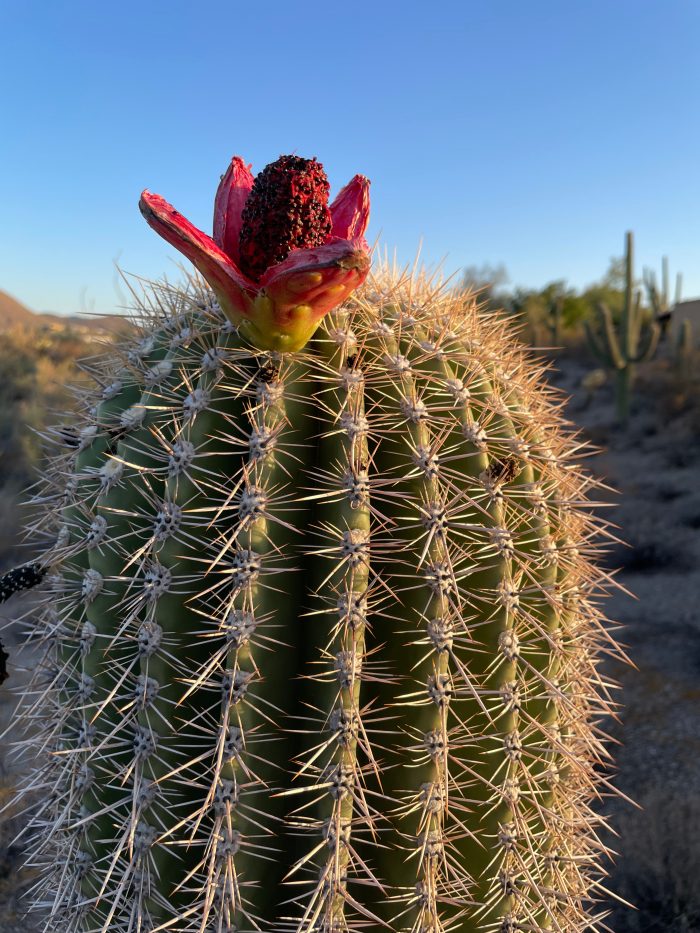
Bahidaj (Tohono O’odham for saguaro fruit), June 2025

I am glad to report that my first batch of honey wine/mead/t’ej was a happy success (recipe to follow) with very little cost and effort. The tasters gave feedback that the flavor is more dynamic than they expected, with real body and interest. There’s a bit of liveliness, but it’s not bubbly. Many folks commented on its balance: a little citrusy, and not too sweet; a light fruitiness, and warmth from the honey. There is a pleasant yeastiness like fresh bread, though it doesn’t taste strongly of alcohol. We all noted the way it gently, pleasantly nudges you toward relaxation (I estimate the percent alcohol of my brew 4.5-5% ABV). If you prefer a stronger t’ej, you can increase the amount of honey, or a lighter less alcoholic brew can be made using less honey. 

The recipe is so flexible and invites endless experimentation. The ratio of honey to water is anywhere from 1:4 (one part honey added to four parts water) to 1:16 (for a very light mead, or if you’re adding a lot of sweet fruit also). The variety of creative optional additions is endless: fresh or dried fruit (berries, native fruits encouraged), herbs (lemon balm, rose, mint) or spices (ginger, cardamom, cloves, or cinnamon). Take notes of your selection, process, and quantities. Andrias started experimenting with different flavors: strawberry, carkeda (hibiscus), habañero. It is a natural beverage; you know exactly what went into it when you make it yourself.

Recipe for Honey Wine (T’ej or Mead)

This recipe was adapted from Sandor Elix Katz’s excellent book, The Art of Fermentation, with inspiration and guidance from Ethiopian t’ej maker Andrias Asnakew (Tucson, Arizona). 

This recipe yields about 2+ gallons mead (can be scaled), potentially 4-5% alcohol, approximately (a hydrometer can measure this precisely if you wish)

1 quart local raw honey (32 ounces)– my personal favorite is Tucson Honey Company from Tucson local farmer’s markets.  
2 gallons+ pure, filtered water (~260 ounces) (if tap water is the only option, see below**) 
~1 cup raisins, optional but recommended to feed the yeast–added a little at a time.
Optional ½ teaspoon mead yeast (such as strain EC-1118. Check your local brew shop or find online).
Optional fresh or dried fruit (local and native fruits encouraged), herbs or spices. Experiment with quantity: a few cups of fresh fruit, or maybe around one cup if of dried herbs. For spices, try a handful or so and see how it goes. 
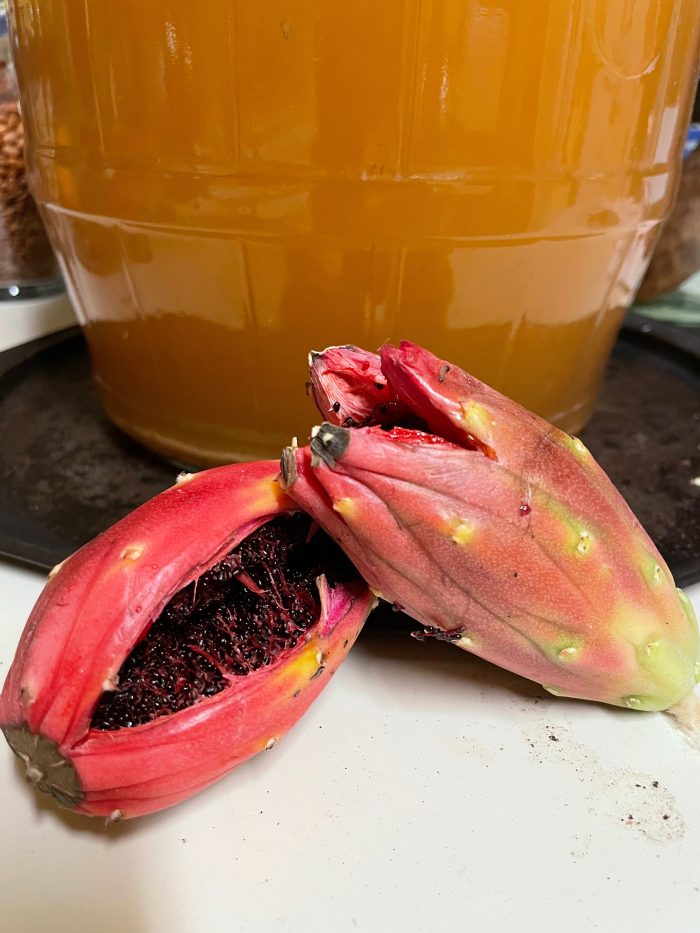
Ripe saguaro fruit

1. Clean a ~2.5 gallon fermentation vessel (ideally glass or stainless steel, but food grade plastic works). Wide mouth is best. 

2. Pour the honey into the vessel, and add about half the water. Stir stir stir till it dissolves, then add the rest of the water, leaving just a few inches at the top for bubbles and stirring. Cover with a cloth or loose lid, and place on a baking sheet to catch any drips. Add optional yeast, and optional fruit or herbs/spices.
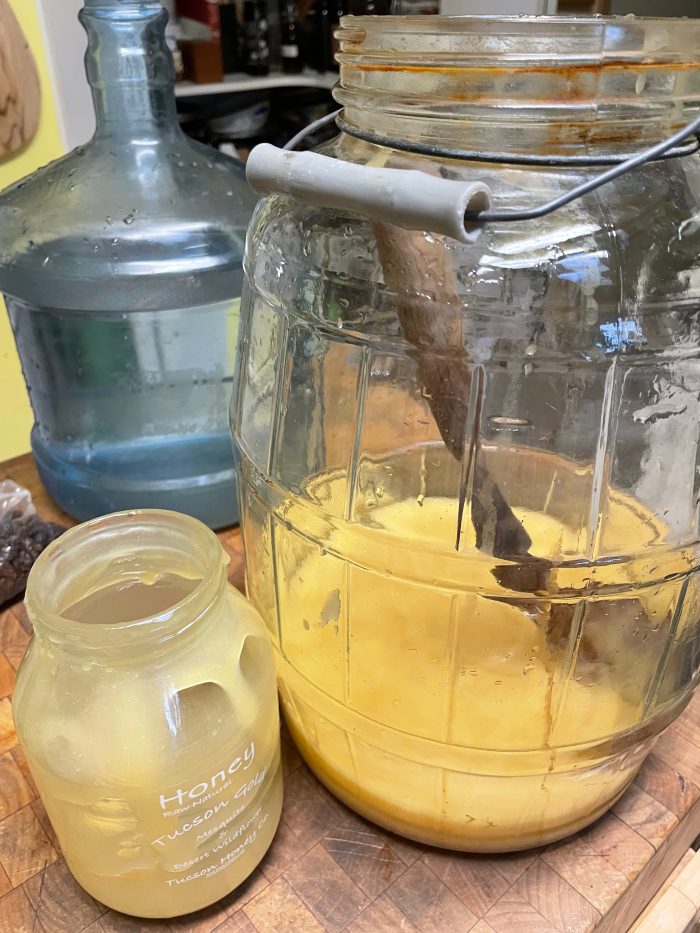
Dissolve honey in pure water to start the fermentation process.

3. This is Day 0. Leave in a cool spot in the house where you’ll walk by frequently. I keep a long stirring spoon next to the vessel and stir it often, daily (at least two or three times+ daily). This introduces air for the yeast. Sandor Katz recommends we stir a few revolutions, then reverse the stir quickly to introduce air (biodynamic style!). Delight in the bubbles and give your greetings to the millions of hungry microbes hard at work! 
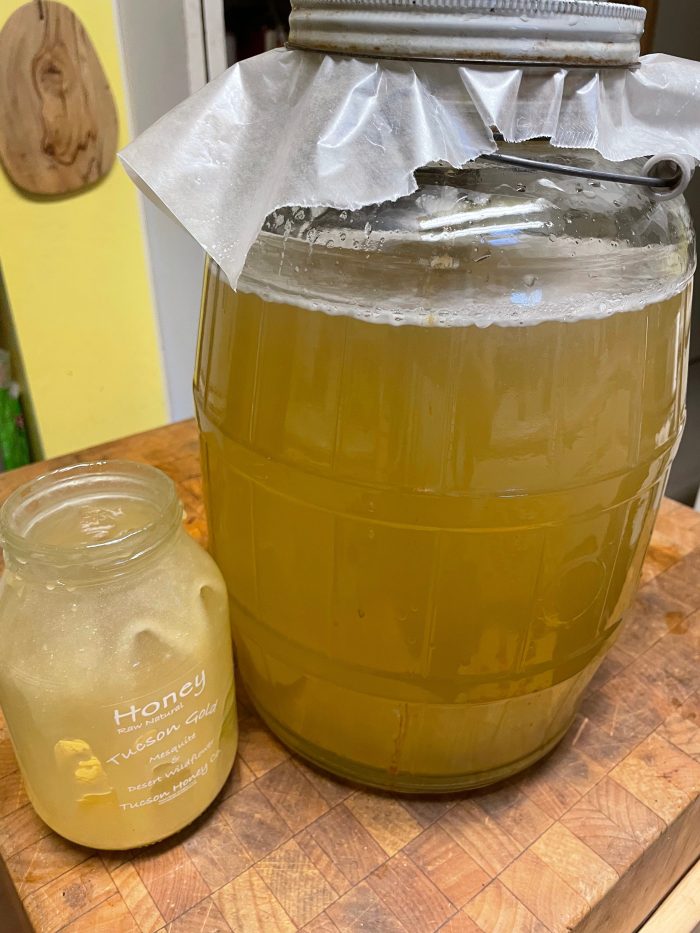
Full quantity of water mixed with honey. Ready to ferment!

4. After a few days of frequent stirring, you should start to see more and more bubbles when you stir. The yeast is waking up. This is Day 3. Add a palmful of raisins (a special ingredient by Andrias- he says it provides food to the yeast!) (This is the point when I harvested and added ripe fresh saguaro fruit, but it can be added at the beginning, too.)
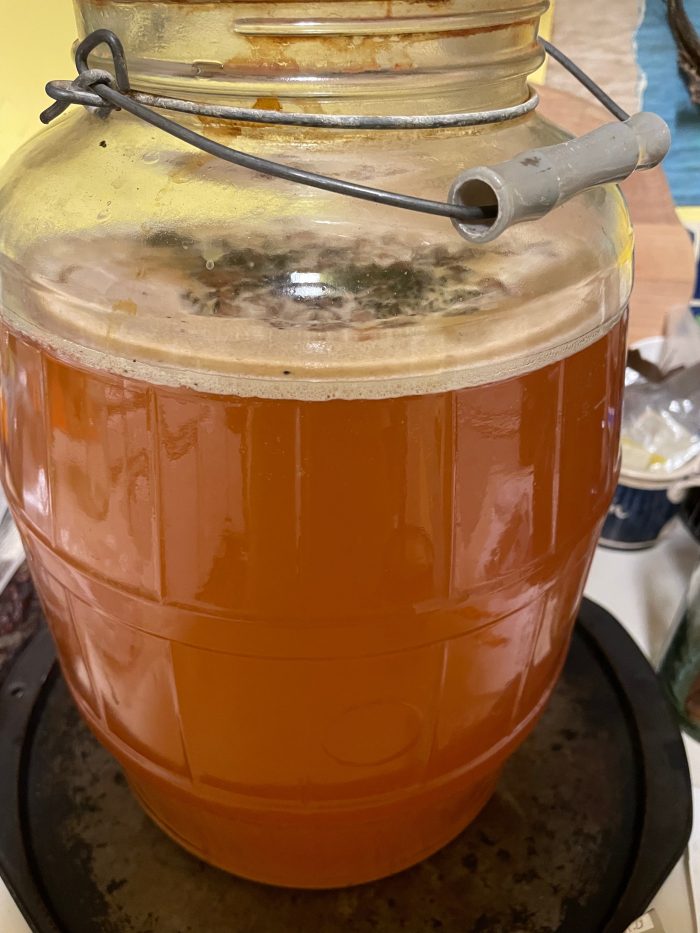
Red saguaro fruit has been added to the bubbling brew.

5. Continue stirring multiple times per day. On Day 5 or 6, add another palmful of raisins, and again at Day 8-9. 

6. At about Day 10-12, the bubbles will begin to reduce in number and fervor. The yeast quickly consume and ferment most of the natural glucose in the honey, producing the alcohol and delicious brew. (The natural fructose takes longer to ferment and only does so if you age your mead for weeks and months.)
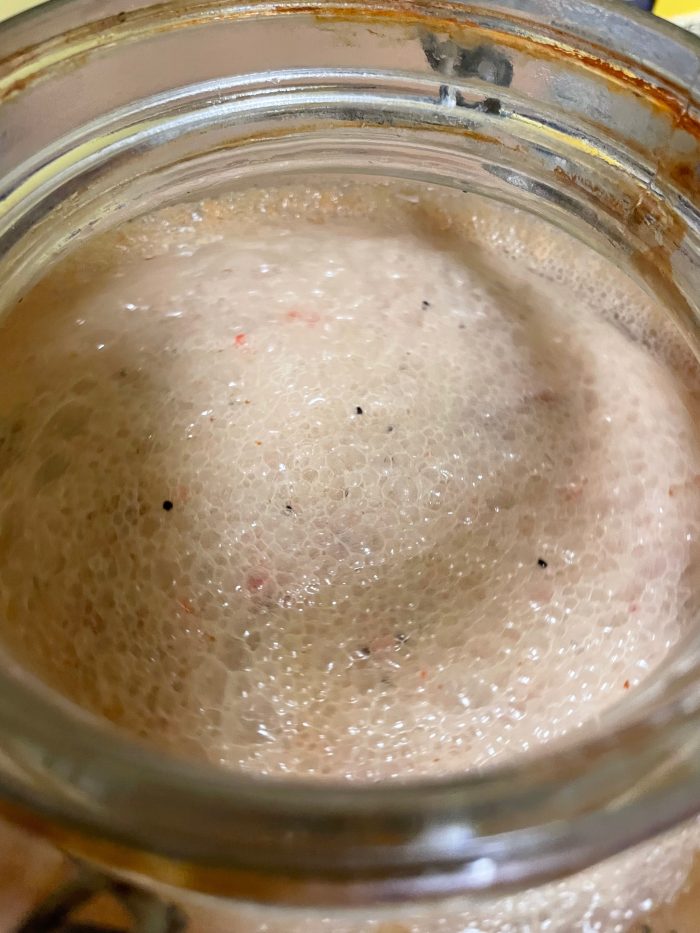
Frothy bubbles of active yeast activity!

7. Taste the mead. If it is too sweet for your liking, you can continue to stir and ferment a bit longer to “dry it out”. If you prefer more sweetness, Andras suggests you can “back sweeten” (add a bit of honey) to taste if desired, ideally a day prior to drinking it. 

8. Strain out any fruit, and serve at room temperature or chilled. Try both! The typical serving vessel for t’ej is a narrow-necked bottle called a berele.

The best way to enjoy your homemade honey wine is with friends, of course. I bet that you’ll pique curiosities about your brewing methods and newfound skill, and bring smiles to everyone’s face. Andrias thoughtfully shared that “you can tell from the smile that the food or drink is good”.

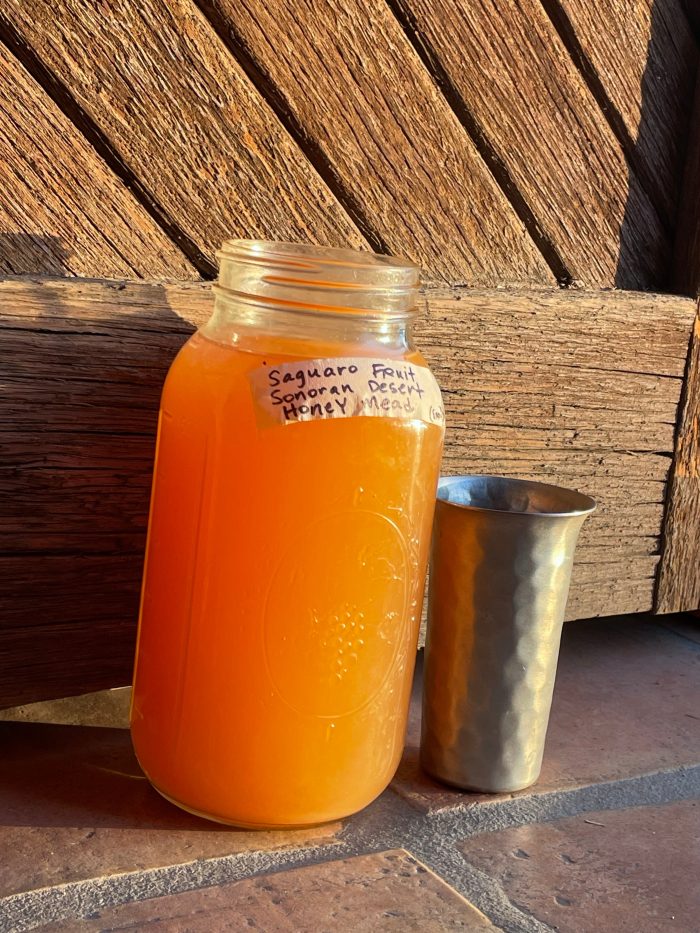
Honey Wine with Saguaro Fruit, Summer Solstice 2025

In Appreciation: 

Thank you to my teachers, including the bahidaj (saguaros), for their ongoing generosity and cultivation of our minds and hearts. 

Thanks to my new friends Andrias and incredible hosts Tilahun and his wife Kidist who are sharing their culture from Ethiopia with all of us in Tucson, Arizona.

Thanks to my mother Judith for kindly copy editing.

**To remove chlorine from the water simply draw the necessary amount of water and leave it out overnight. The chlorine will naturally evaporate from the open vessel. 


Bibliography

Belay, T. B. (n.d.). Call for access and benefit sharing of Rhamnus prinoides (Gesho). Ethiopian Biodiversity Institute, Genetic Resource Access and Benefit Sharing Directorate.

Jeremy C. Hollmann (2015): Bees, honey and brood: southern African hunter-gatherer rock paintings of bees and bees’ nests, uKhahlamba- Drakensberg, KwaZulu-Natal, South Africa, Azania: Archaeological Research in Africa, DOI: 10.1080/0067270X.2015.1079378

Katz, S. E., The Art of Fermentation: An In-depth Exploration of Essential Concepts and Processes from Around the World. Chelsea Green Publishing, 2012.

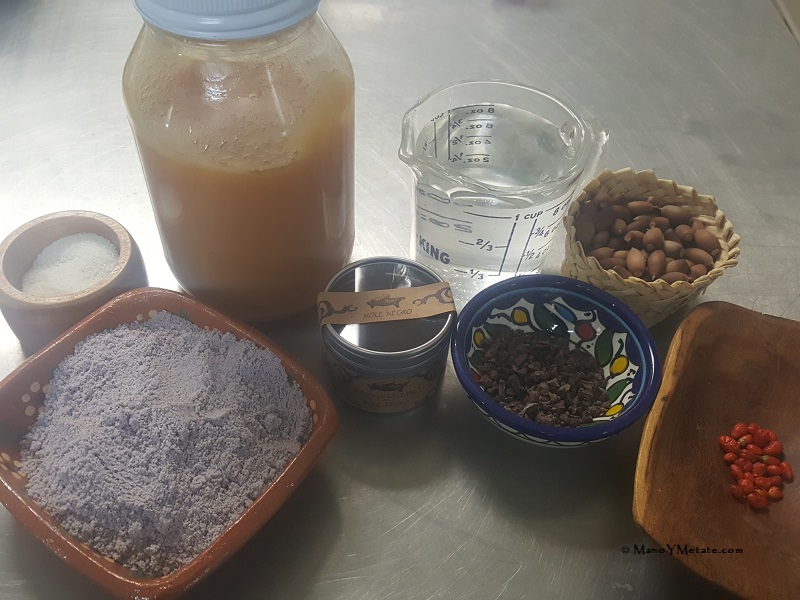
Atole, a mug of warm comfort

Hi friends, Amy here with a hot drink way more satisfying and nourishing than hot cocoa for a quiet, cold night. Atole is a drinkable porridge that can be flavored to suit your taste and whim. Of course, fond family memories of making and enjoying it this time of year make it all the sweeter.

The ingredients are flexible and it is a great way to showcase a small amount of wild harvested or specialty food items.

Corn tortilla meal, in this case from a very starchy blue corn, was treated with lime, dried and ground for making tortillas or tamales. Of course it also comes in white and yellow varieties, but all colors are much starchier than grocery store corn meal. There are also toasted starchy corn meals specifically for making atole. If you don’t have of these on hand, you can substitute corn starch or a mix of corn starch and regular corn meal.

I used water but milk of any sort (cow, coconut, almond, rice) is great. Local honey is delicious, but any sweetener, including granulated sugar, is fine. Or the drink can be left unsweetened.

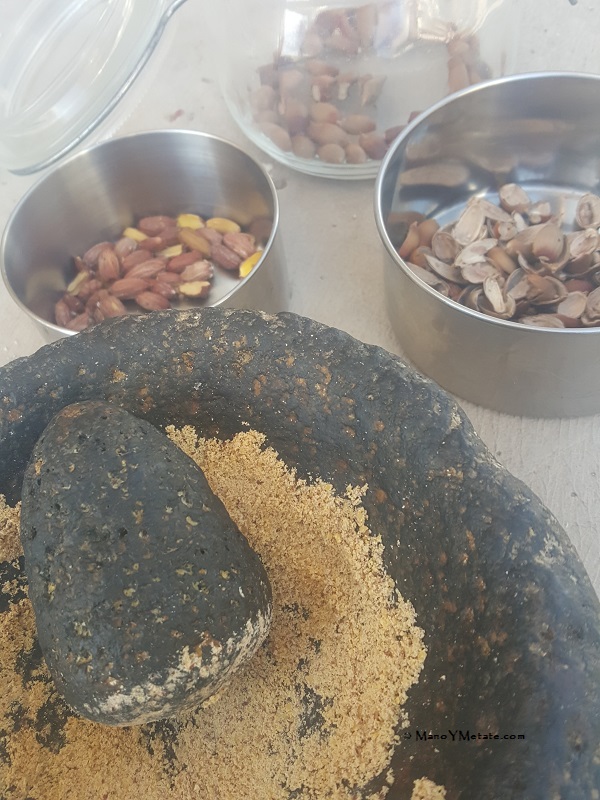
I shelled and ground acorns from Emory Oak trees (Quercus emoryi), that are mild and edible as is. Other species of acorns are more bitter but can be leached by putting the shelled acorns, whole or ground, in cold water for a few minutes and draining. Repeat the leaching of tannins this way until they are not bitter, to your taste. Mesquite meal is excellent in place of, or in addition to, the acorn meal.

Atole is great with or without chocolate. Cocoa powder works perfectly, but instead I toasted raw cacao nibs in a dry pan until shiny and fragrant, then ground them. For spice, I added a chiltepin to the molcajete with the nibs. A coffee grinder is also a excellent way to grind the acorns and nibs.

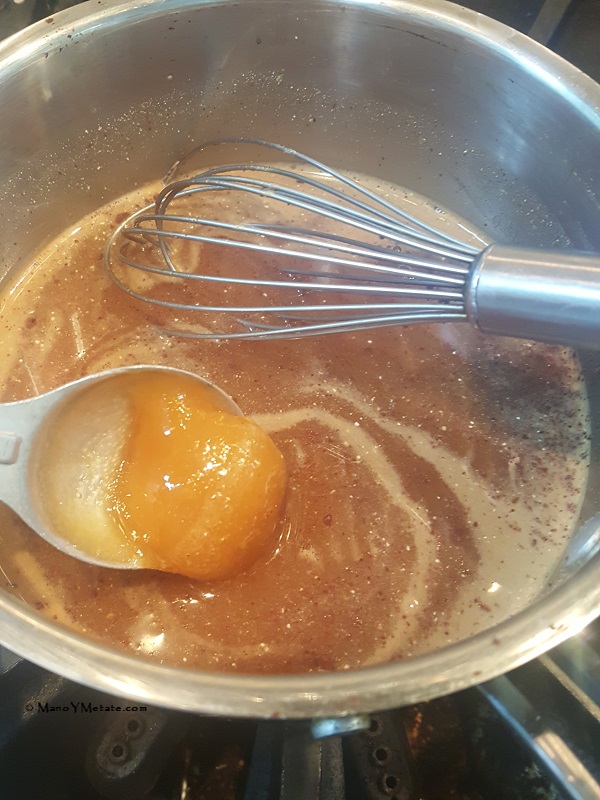
I also added a spoon of Mano Y Metate Mole Negro powder for spice. Cinnamon or vanilla would also be welcome additions. Everything goes together cold in a pan and thickens as it comes to a simmer.

Due to ingredient variation, more liquid may be needed to make drinkable. Adjust the seasonings and add a pinch of salt to taste.

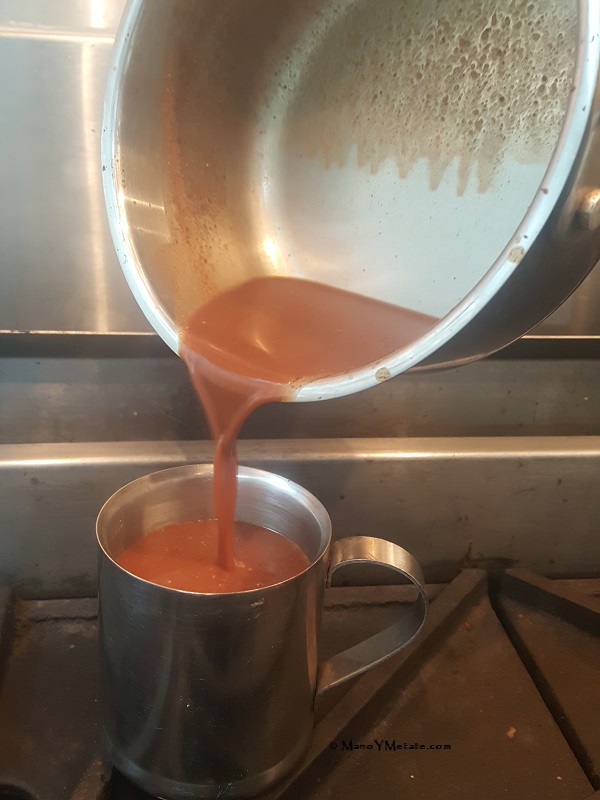
Enjoy, stirring often to keep everything suspended. Mmmmm… Stay safe and warm!

Atole de bellota
From Amy Valdés Schwemm of Mano Y Metate

Per serving:

1 cup water or milk (cow, coconut, nut, grain, etc)
1 tablespoon corn masa meal (or corn starch)
1 tablespoon acorn meal (or mesquite meal or more corn)

To taste:
1 tablespoon cacao nibs (or cocoa powder)
1 tablespoon Mano Y Metate Mole Negro powder (see ManoYMetate.com)
1 tablespoon honey
1 chiltepin
A dash of salt

If stating from whole acorns, shell and grind. If bitter, cover with water, soak for 30 minutes and drain. Repeat as necessary for your taste.

Toast the cacao nibs until shiny and fragrant, then grind with the chiltepin.

Put the water in a small pan and whisk in the acorn and corn meals. Heat, stirring often, until slightly thick. Add the rest of the seasonings and stir until well combined. Drink in mugs, stirring with a spoon to suspend the coarser parts as you enjoy.

Bees: Tears of the Sun God Re

honey 352205_1280.jpgMonica King here to kick off National Honey Month since I’m a beekeeper.  This awareness month was initiated by the National Honey Board in 1989 to promote American beekeepers and honey. But just how long have humans recognized the importance of honeybees? Archaeological evidence says 8,000 years. The bond between humans and bee is documented on cave paintings in Spain that depict a man harvesting honey from a wild colony.
Over 2000 years ago in Egypt, they not only worshiped cats, but also the honeybee. They believed bees were the tears of the Sun God Re. On a papyrus written around 300 BCE, it reads, “The God Re wept, and the tears from his eyes fell on the ground and turned into a bee. The bee made his honeycomb and busied himself the the flowers of plants and so wax was made and also honey out of the tears of Re.”

honey bee 831843_1280

Temples kept bees in order to satisfy the desire of the gods (and people) for honey. In medical papyri, 900 odd prescriptions were found and close to 500 of those listed honey as an ingredient. Not everyone in Ancient Egypt was allowed honey! Evidence suggests only those that worked with the Kings were allowed a ration of honey, while regular laborers were not privy to such a delicacy.

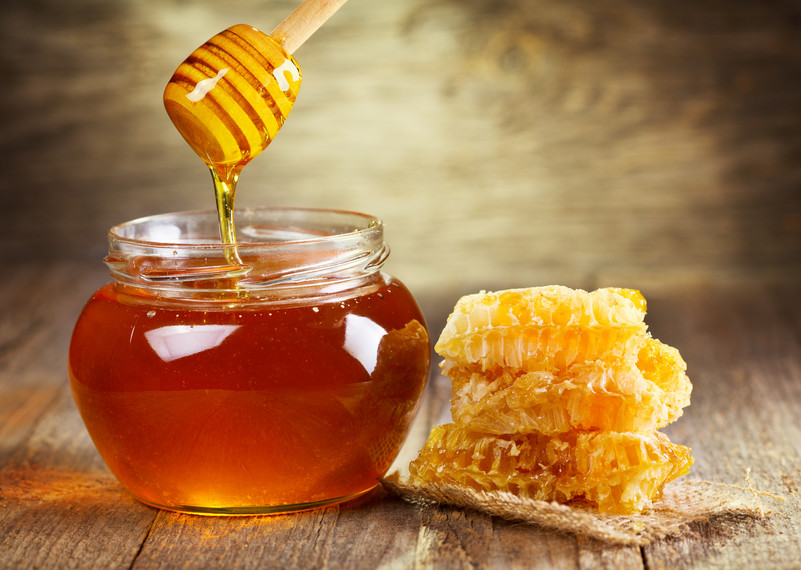
jar of honey with honeycomb

Titles such as “Keeper of the Bees” and “Sealer of the Honey” are found on ancient hieroglyphics. Honey, stored in earthen clay jars was stamped with this important information, including location of where the honey was harvested. With such detailed records, the quality of the honey had accountability. No evidence has yet to be found suggesting what may have happened to the “Keeper” or the “Sealer” should something have gone wrong with the precious, sacred commodity. King Tut’s tomb included several containers of honey, thousands of years old, yet still preserved, a remarkable testament to the eternal shelf-life of honey.

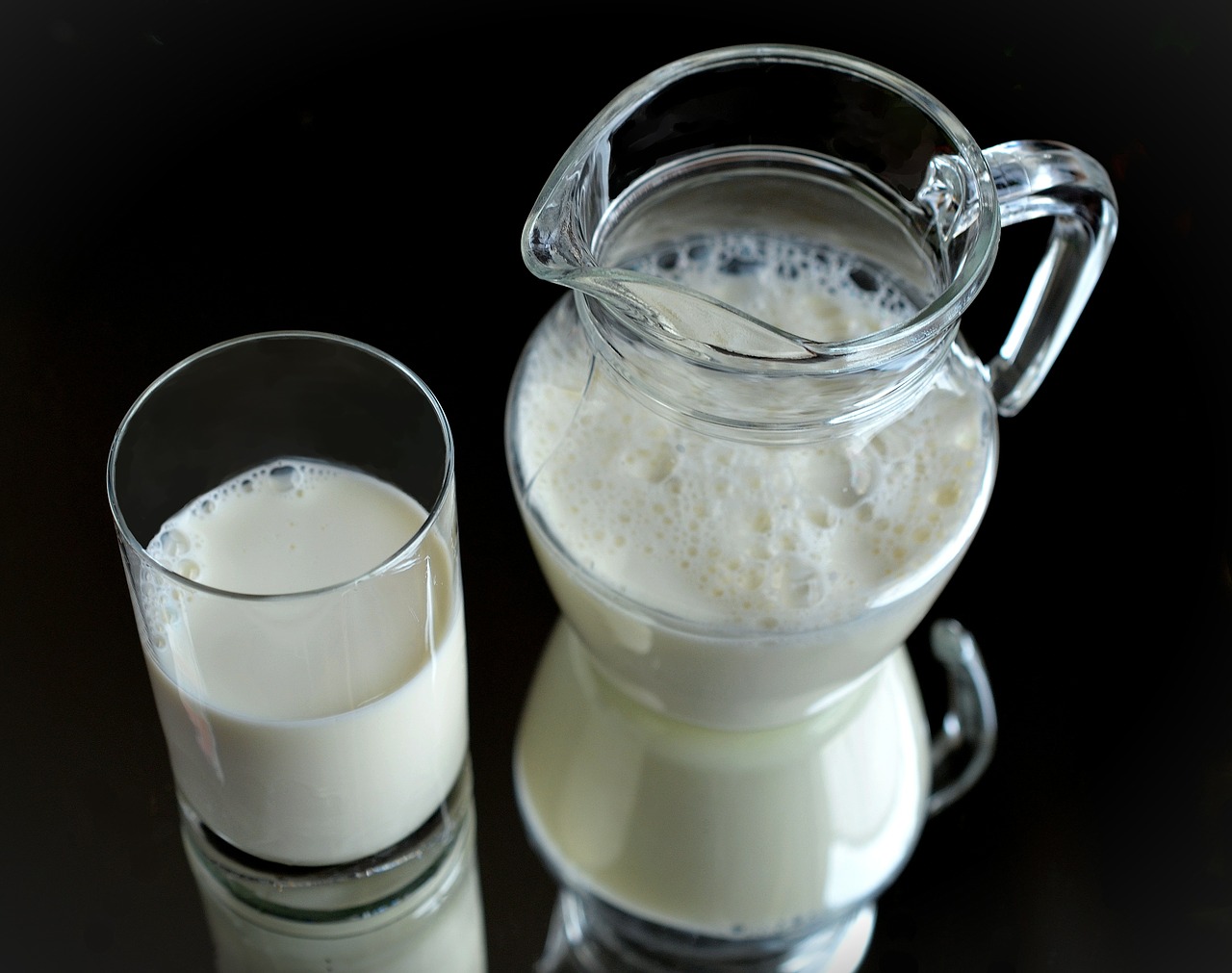
milk 518067_1280

One pharoah, Cleopatra, used honey in her beauty regime. One of Cleopatra’s secrets, and her most famous, was her ritual bathing in milk and honey. Both of these ingredients naturally soften the skin, exfoliate, and leave a fresh, sweet scent. You can do this yourself by adding two cups milk and half cup honey to your bath water.

Personally, it is Cleopatra’s sweet tooth that I can relate to. Cleopatra’s favorite treat was a sweet honey ball called “Dulcis Coccora” also known as “Tiger Nut Sweets.” A recipe was reported to have been found on a broken piece of Egyptian pottery dating from 1600 BCE. This recipe was adapted from www.antiquitynow.org:

“Dulcis Coccora”
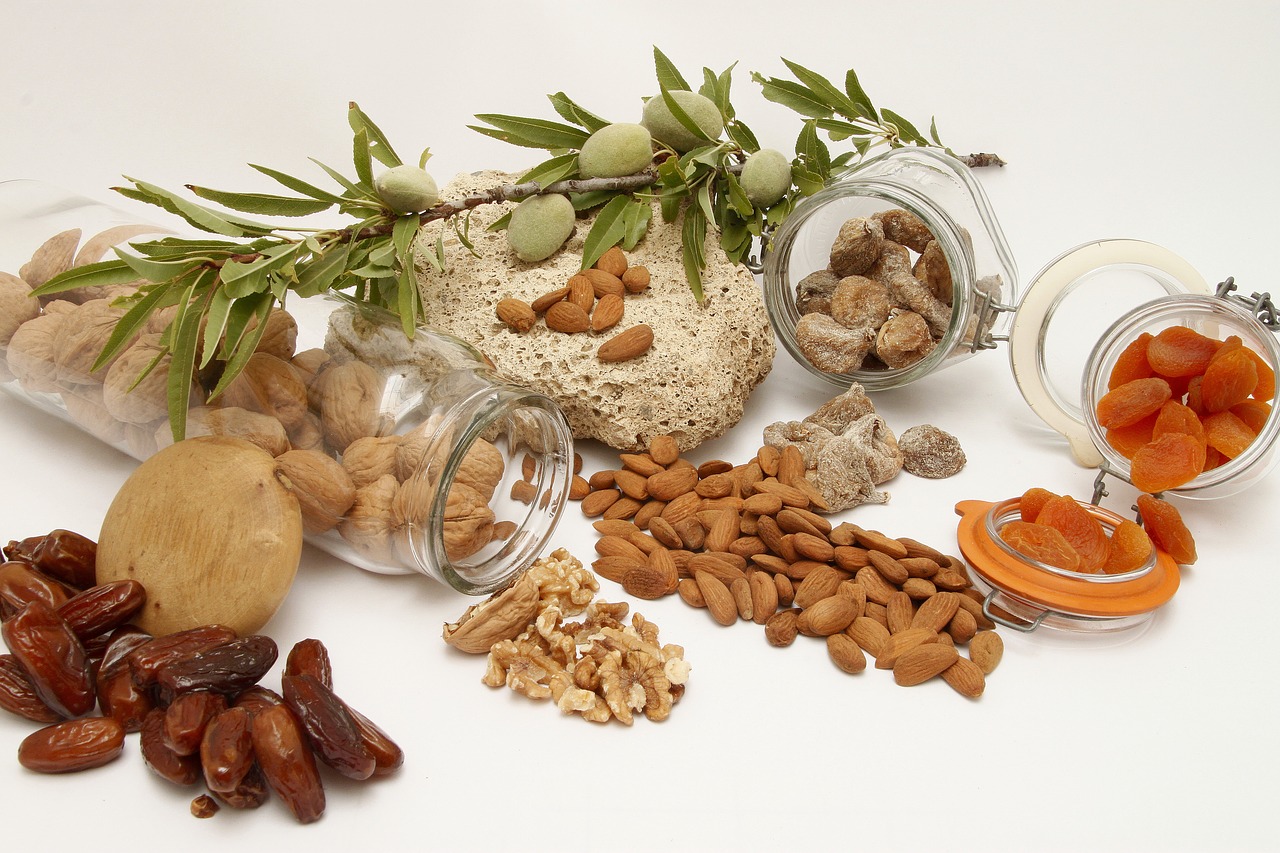
1 pound pitted dates
water
2 Tablespoons ground cinnamon
1/2 Teaspoon fresh ground cardamon
4 tablespoons chopped walnuts
honey – to coat
ground almonds and/or pomegranate seeds

Mash dates with enough water to form a rough paste.
Add cinnamon, cardamon, and walnuts.
Blend well.
Roll into walnut sized balls.
Coat in honey.
Then roll in finely chopped almonds and/or pomegranate seeds.
Set on a parchment paper to air dry for several hours before sealing in a container.

dates 3324097_1280

Why not put a local spin on Cleopatra’s recipe and make a Southwestern Dulcis Coccora with other variations such as:

saguaro seeds
barrel cactus seeds
chia seeds
chopped dried prickly pear fruit
wolfberries (related to gogi berries)
hackberries
or how about a hot kick with a touch of crushed chiltepin?

Don’t forget, using different honeys such as mesquite or a catclaw acacia will also give different flavor to the honey ball.

About the author: This is Monica King’s second blog on Savor the Southwest.  She introduced us to her bees in July (read more here), and we hope to hear more from her in the future!

Monica King 001

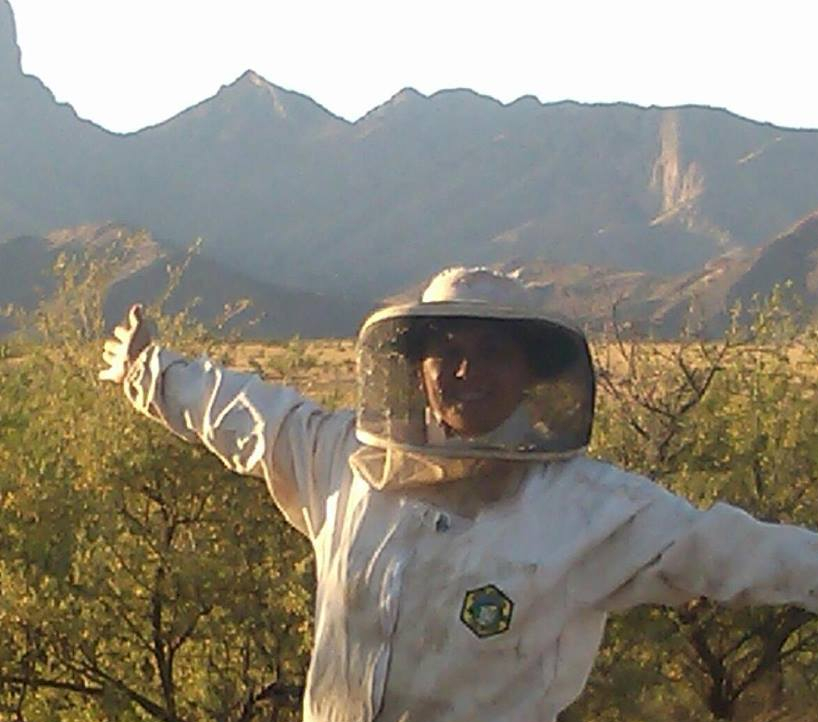
Monica King is a rancher near Tucson.

Sweet Desert Nectars

We start July with guest blogger Monica King, a rancher near Tucson Arizona, here to tell us about the product of her littlest, and busiest, “livestock.”

mesquite Monica King 605

With help from our friend, the honeybee, we can explore the palate of desert flora riches in a different way. These pollinators are beneficial to agriculture and two out of three bites you take you owe to honeybees! There would be little to no melons, strawberries, almonds, coffee or chocolate, just to name a few, if it were not for these busy tiny creatures.

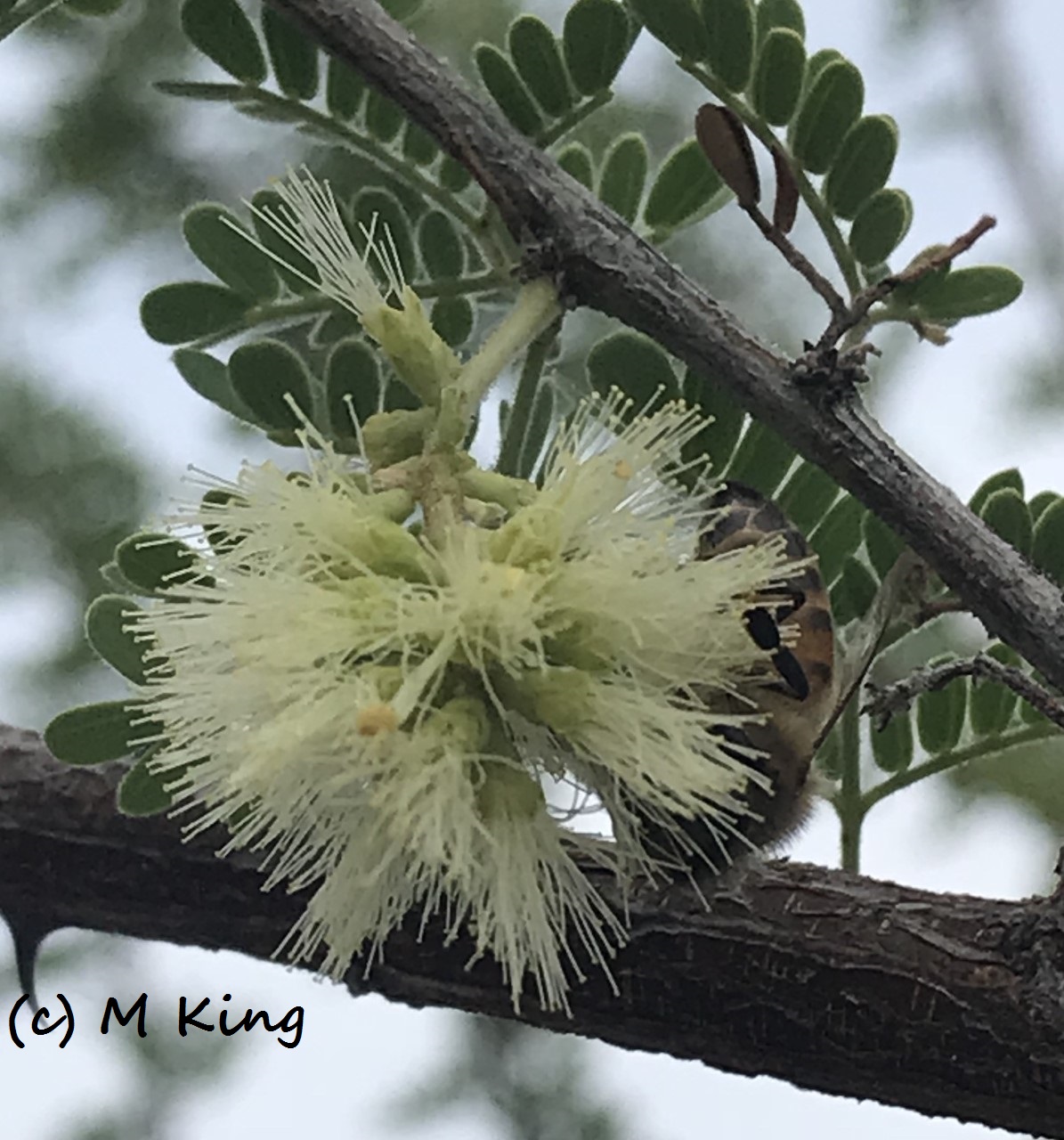
As a worker honeybee heads out foraging, at around twenty-one days of age, they are not only pollinating, but also gathering many different flowers nectars.  But not all at once!  A foraging bee will visit the same kind of flower repeatedly on each excursion. This behavior is called flower fidelity. This is how pure honey is produced. I will get back to this.

honey monica king 005

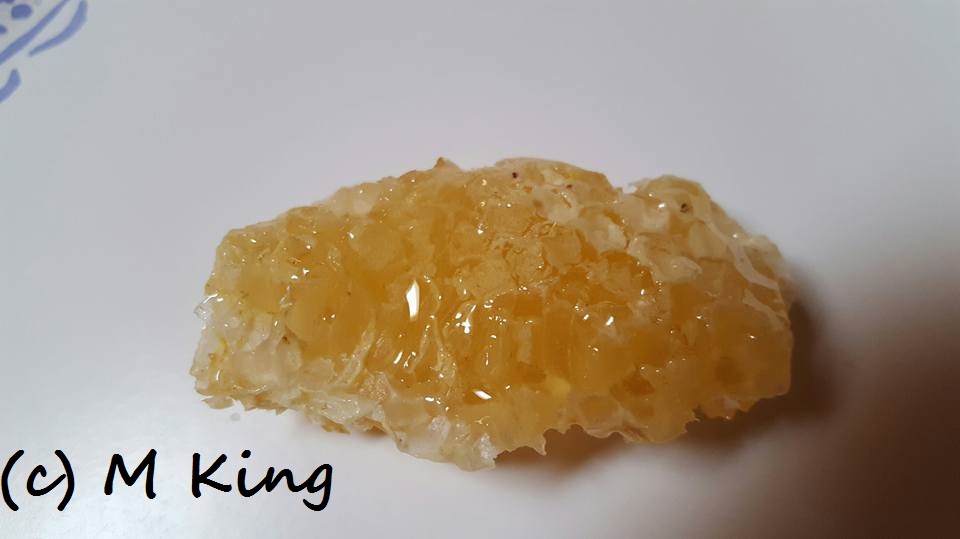
A chunk of comb full of honey.

A worker bee’s tiny body can carry more than her own weight in nectar. As she is on her way home with her bounty the nectar is mixed inside her honey sac with an enzyme called invertase, which begins the nectar to honey transformation. Upon return to the hive she then transfers her load to her sisters which continue the process. These workers manipulate it in their mouthparts exposing it to try air and add even more enzymes. They then put it into a honey cell and the bees fan their wings producing a breeze, which mixed with the warm air of the hive, continues to reduce the water content. When it is dehydrated to 17-18% moisture it becomes pure honey. Our moisture content in Southern Arizona is more like 10% due to our arid environment. Once the bees fill a cell they cap it with wax for storage. It is at this time a beekeeper may harvest the excess.

cat claw monica king 055

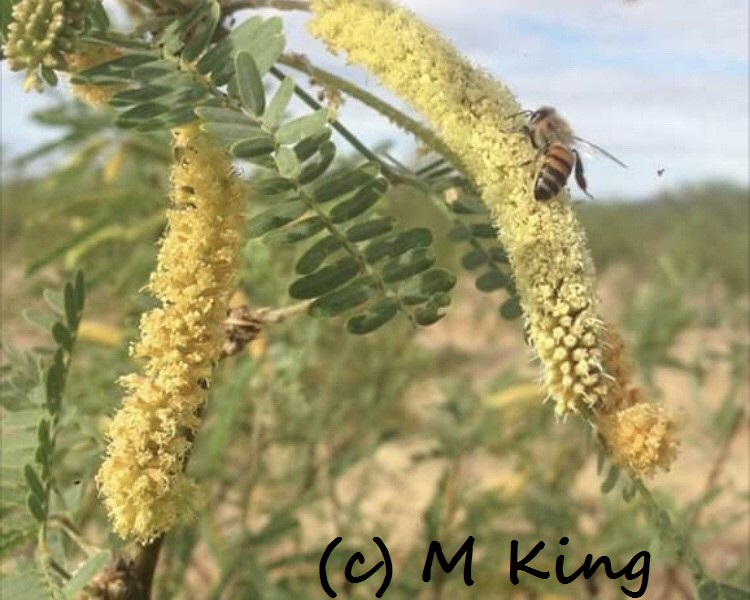
Honey bee on cat claw acacia.


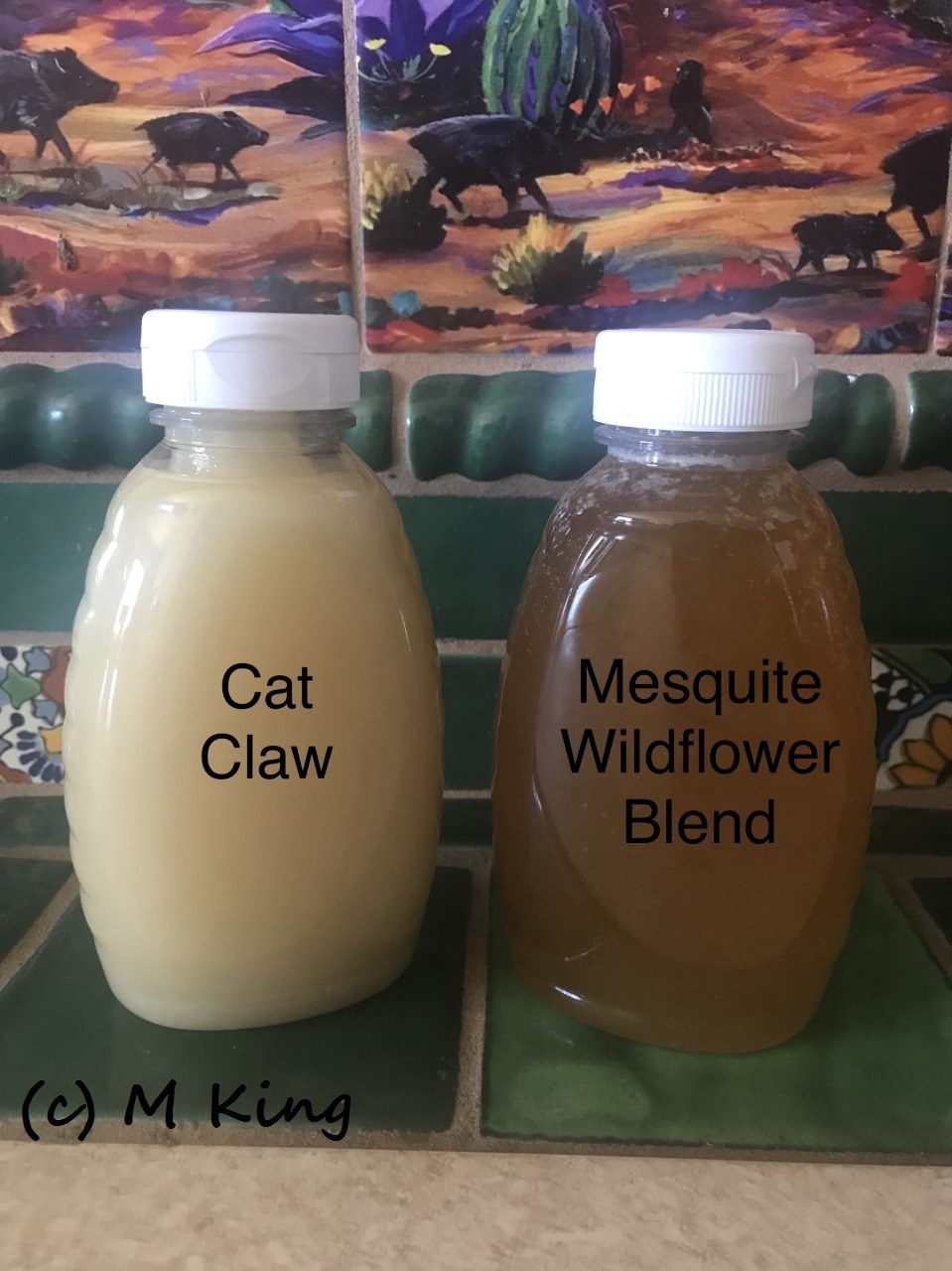
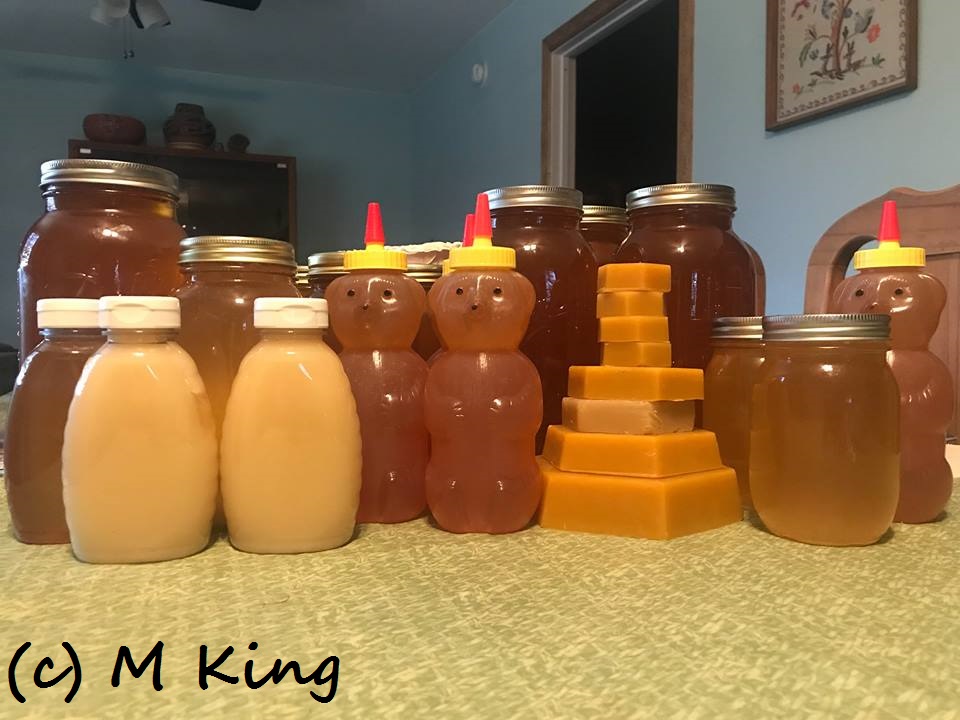
When it comes to honey from Sonoran Desert plants – there are two, local, well known spring harvests – mesquite and cat claw acacia.  In general, most local beekeepers will wait until the honey box is full and extract all the honey from one bee yard in one trip.  This is the less labor intensive way, and thus more economical. This honey is correctly called a Sonoran Desert blend. With each season being slightly different, no two harvests will be the same.

honey Monica King 001

But sometimes, you can find a beekeeper that doesn’t do things the simple, economical way – and they may have a pure cat claw acacia honey.  Cat claw acacia honey has a very light to almost white color and exquisite sweetness. This honey also has a heavy, thick texture and it will naturally granulate quickly.  My favorite way to savor this honey is spread like butter on toast or slightly warmed served drizzled over vanilla ice cream with fresh chopped local pecans.  Honey that granulates has not gone bad, and is just fine to use.

mesquite Monica king 607

Honeybee on mesquite.

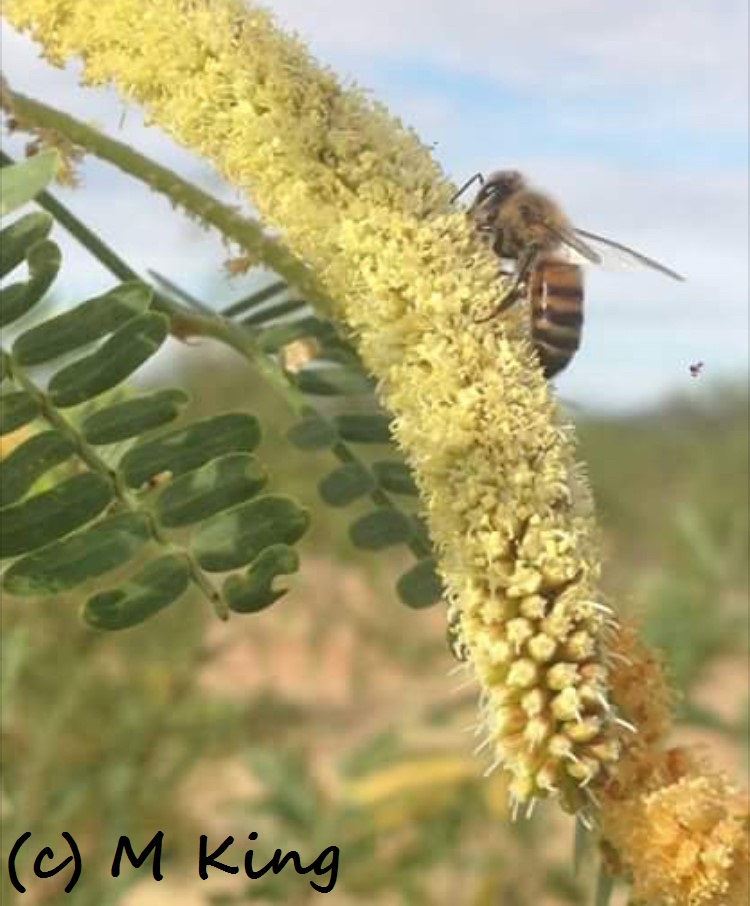
Another specialty honey is mesquite.   Honey from the light colored mesquite flowers is transformed into a dark rich honey, smooth on the tongue, and may remind you of brown sugar or maple syrup. This honey pairs nicely with cheeses, especially Gouda, and makes wonderful BBQ sauces. When drizzled on blue corn pancakes you will think you are in heaven.

honey M King 002

Many beekeepers have their bees near agricultural or residential neighborhoods where the bees just don’t forage on native plants. I like to call this honey a desert urban blend and again it is very unique. The taste varies as the honey from some locations may have more clover in the area and other locations may have more citrus, etc.. Honey contains over 600 volatile organic compounds or plant-based essential oils, and these make it possible to have honey tested for pureness and provide the botanical and geographical origin. But the best way to know if your honey is pure, is to buy it from a local, respected, beekeeper.  And then you can taste the sweet desert nectars.

Monica King 001

Monica King is a rancher near Tucson.


Brick and Mortar Brownies

IMG_3914

Linda here. It’s  ranged from breezy to downright windy here in the Old Pueblo this spring, affecting the moods of humans and non humans alike.  Bees, for example,  do not “like” wind, and on windy days I do not check Apis hives.  Red eyed and sneezing humans and are affected by the dust and pollen. Like so much in life, winds have a  mixed effect on things, both negative and positive.

One of the positives of pollen on the wind is that it can reveal a lot about older ecosystems. I recently learned about this in an article I came across on the science of archeobotany – which is basically the archeology of Things Botanical.

On a windy spring day such as we have experienced here – but in the early 18th century in Colonial Williamsburg  – masons were at work laying brick.  A mason “slather(s) mortar as he buil(ds) row after row of the buildings foundation”. Unbeknownst to him, he is also building an archeological record of the trees and plants growing at that time.  As pollen rode the waves of the winds it came to rest on/in the the mortar and  became encapsulated in the building itself.

The mortar acts like a kind of time machine where the pollen of old is extracted and analyzed by archeologists, revealing what plants lived and thrived at the time, in that town: trees, for example, were abundant –  (pine oak maple and hornbeam) revealing a tree filled ecosystem in Williamsburg in the early 18th century. Contrasted to pollen from the same town in the later in the 18th century/early 19th where/when the mortar reveals that the trees had been cut down – and mostly ragweed and goosefoot pollen are found in that time-frames pollen-mortar revelations. Pretty interesting.

In a similar way  Zander (1941) describes honey comb from Apis mellifera (found in a tomb from the Nineteenth Dynasty in Egypt), that was dissolved in water and found to contain mostly pollen from Egyptian avocado and desert dates  “which indicate that the plants of Egypt have changes considerably since the time of the pharaohs.”


IMG_0473

RECIPE INGREDIETNS: (inspired and amended from  the cook book NOURISHING)

-2 medium sized sweet potatoes

– 11-12 fresh dates (pitted)

– ¾ cup cup ground almonds

– 2/3 cup buckweat flour

– 3 tablespoons cacao nibs

– ¼ cup raw cacao powder

– at least 3 tablespoons honey

– zest of one orange – plus the juice

– ½ teaspoon ground cinnamon

– ¼ t salt

– 1 tablespoon oil of your choice (olive oil/coconut oil)

– 1 tablespoon almond milk/ or coconut milk if you feel it needs moisture

– Optional 1-2 teaspoons ground chiltepin – seeds and all

HOW TO:

Steam peeled sweet potatoes until soft (approximately 18 minutes) and blend in food processor with the dates and honey.

IMG_0411

IMG_0418

Mix the dry ingredients together and fold in the sweet potato/date/honey mixture.


IMG_0423

IMG_0420

Add the juice of the orange whose peel you just “zested”. If the batter is still a little dry you might add a little milk and/or oil.

IMG_0431

Add this super power batter to a parchment paper lined baking pan – and cook at 350 degrees for about 20 minutes. Let cool. Sprinkle with cacao powder, or honey, or chiltepin. Refrigerate – the cold brownie has a wonderful taste (whereas the warm are not so flavorful. )


Within & Without: WILDFLOWER Honey Facial Mask (DIY)

Aunt Linda here, on this breezy Tucson morning. IMG_7283 As I write, the full moon shines powerfully in the west, as it sets. The bee yard is aglow. The beams of moonlight bounce off the hives;  alight upon the honey house roof;  shine through west facing doors and windows. The bees are hunkered down in their hives this morning. They will not launch into their foraging flights as early as they did in the summer. They are solar beings, and navigate with the sun. Being past the equinox , and with less sunlight available, their first flight begin later and their return home in the evening, earlier. They are also affected by cooler temperatures,  and are not partial to the winds we have been having. We are all, bee and human, between night and day; between summer and winter. As the cycles of flow and blossoming  constantly change, so do the stores of nectar, pollen and honey within the hive. The “inside” of a hive here in Tucson reflects the light yellow color/light aroma of Mesquite Flows from earlier in season, to the darker, stronger tasting and smelling honey of desert wildflowers of late summer and fall. The pollen comes in different colors as well. So it is that bees, in the process of their practicality, create mosaics of pollen and canvases of honey, depending on what is available to them regionally and seasonally. Below: you can see the variation of color and texture of pollen both on the bees’s “pollen baskets” on their hind legs, as well as in their “mosaic” of pollen stores within the hive. IMG_2744

IMG_7186

See how this desert wildflower yields a bight orange colored pollen (back legs of bee) as compared to the lighter yellow in the above photo.

By now you may be reveling in all the colors and tastes (and smells!)  of honey. Visit your local beekeeper at a farmers market  or health food store this weekend, and see how real and raw honey differs from the “honey bear honey” sold on many grocery store shelves. Bees have “honey stomachs” that they use to carry nectar back from the flowers, and into the hives to produce honey. The variation in plant nectars account for the variation on types of honey.

DSC_7013

Note the difference in color of the  very light Mesquite Honey (in the exquisite photo ABOVE – taken by Ben Johnson; you can learn more about this talented man at ben@benjohnsonart.com) as compared with the deeper colored Cactus Flower honey (photo below).

IMG_7793 True Fall Wildflower honey is usually an even deeper brown (bottom photo) and has higher antioxidant levels, which may be better for our skin! IMG_7218  Within and Without:  WILDFLOWER Honey Facial Mask (DIY)

Ingredients: raw honey and time How To:

This simple facial mask takes us from our own pores to the pores of plants.  As you can see in the photos,  the honey produced inside the hive literally reflects the environment around it. When we plant a garden or keep a hive, we move from being being a food consumer, to a participant in our food production. So, too, with our health products. It is wildly fun, and often more economical,  to use your own honey (or to purchase directly from a local beekeeper!!! That is a powerful act which moves you closer the “source”), than to purchase a  prepared product.

Honey has been used for skin repair and nourishment for thousands of years. Literally.  It is a humectant,  an anti-oxidant (darker, fall wildflower honey shows higher anti-oxidant levels than other types of honey,  in scientific studies),  and aroma “therapy” (is smells so, well, sweet!).

The idea here is as much about the Ritual as the Result.  Enjoy the smells and sensations WHILE applying the honey. Place the attention we so easily abdicate to the external world within once again. Our attention is rarely our own anymore, and a ritual as simple and everyday as washing our faces, can be a vehicle to practice enjoying the moment.

1) Exfoliate, however you like. This allows the properties of the honey to do their magic, without the barriers of dirt and oils.  Rinse. (Facials are not for everyday … at least not in my world.   I like to do the facial mask in the shower, on days when I wash my hair (which is not everyday) in order to utilize the humidity that the shower provides to open pores. (Water is a precious element in the desert, and I like to use Permaculture wisdom of “stacking functions” in order to lessen my water use.)    Truthfully, I do this facial mask less frequently than I should.

2) Right as you apply your conditioner, apply the honey to your face. Then wrap up your conditioning hair in a towel and step out of the shower  for about 20 minutes.  Who knows … during those magical twenty minutes you might even the feel the flights of the worker bees,  the “waggle dance” as specific foraging information is passed along,  the way the flowers tip and bend in the breeze, the smell of flower,  the sacred offering of pollen at dawn.  Once you have soaked up both the tangible and intangible properties of the fall facial mask, rinse (both face and hair, if you are doing a duo) and apply your favorite facial cream. Your skin will GLOW.

More Wild-Flower Foraging Fotos IMG_7193 The photo above shows how the hairs on a bees body gather pollen; note head on left bee. The photos  below show honey bees (and native bees) foraging in a variety of desert plants; and what “uncapped” honey looks like.   IMG_0748 IMG_1293 IMG_7804 IMG_1886 IMG_2173 IMG_7071