Where Monsoon Melons Reign….


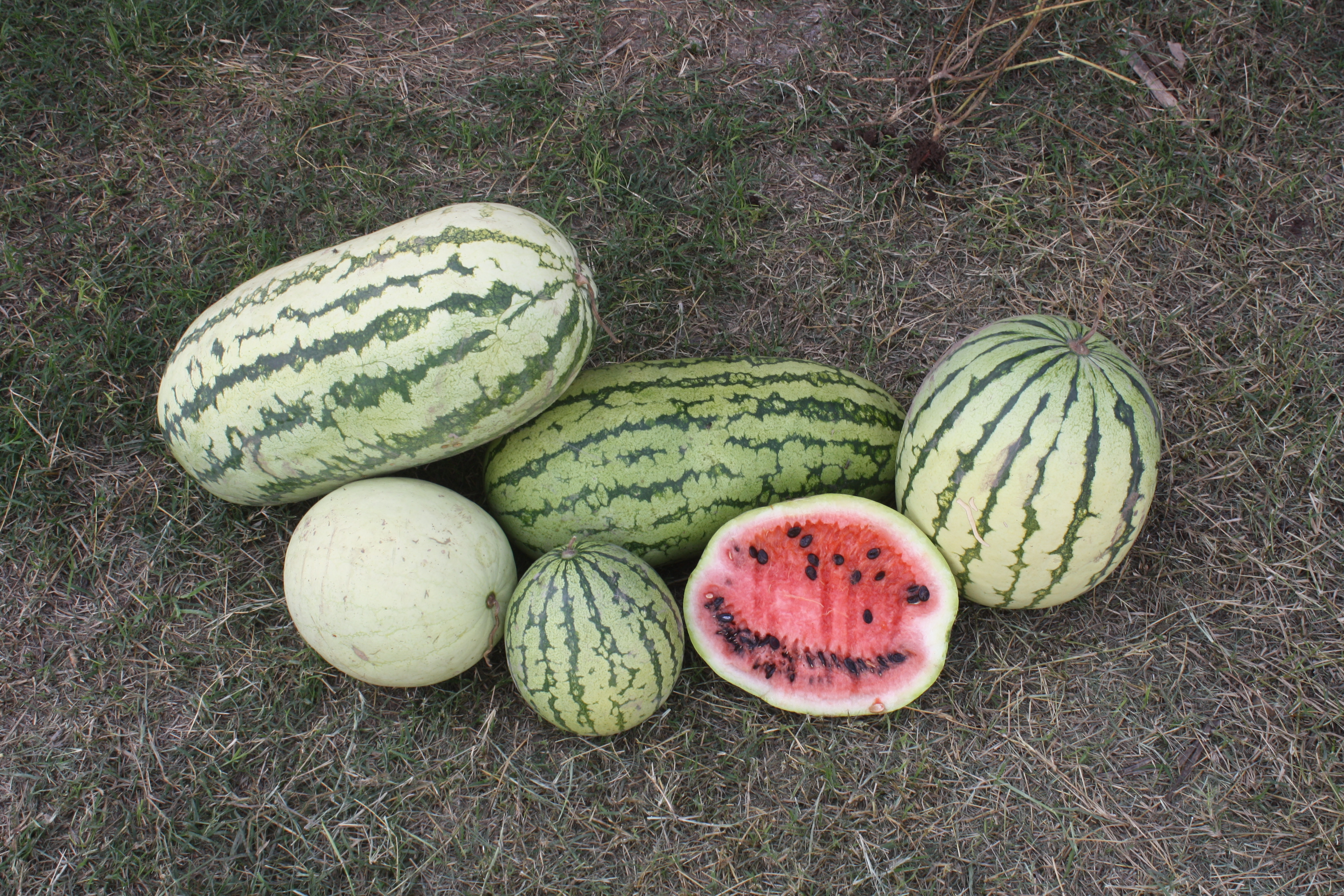
Native Mayo watermelon from the hot coastal plains of Sonora (seed from NativeSeeds/SEARCH)

Native Mayo watermelon from the hot coastal plains of Sonora (seed from NativeSeeds/SEARCH)

I see them peeking up out of the moist soil and spreading their many-fingered leaves out, inviting sunlight……there in the secluded orchard behind adobe walls at the base of A-Mountain. Hooray, the Tohono O’odham watermelons are rising again in the living history huerta at Mission Garden!…….
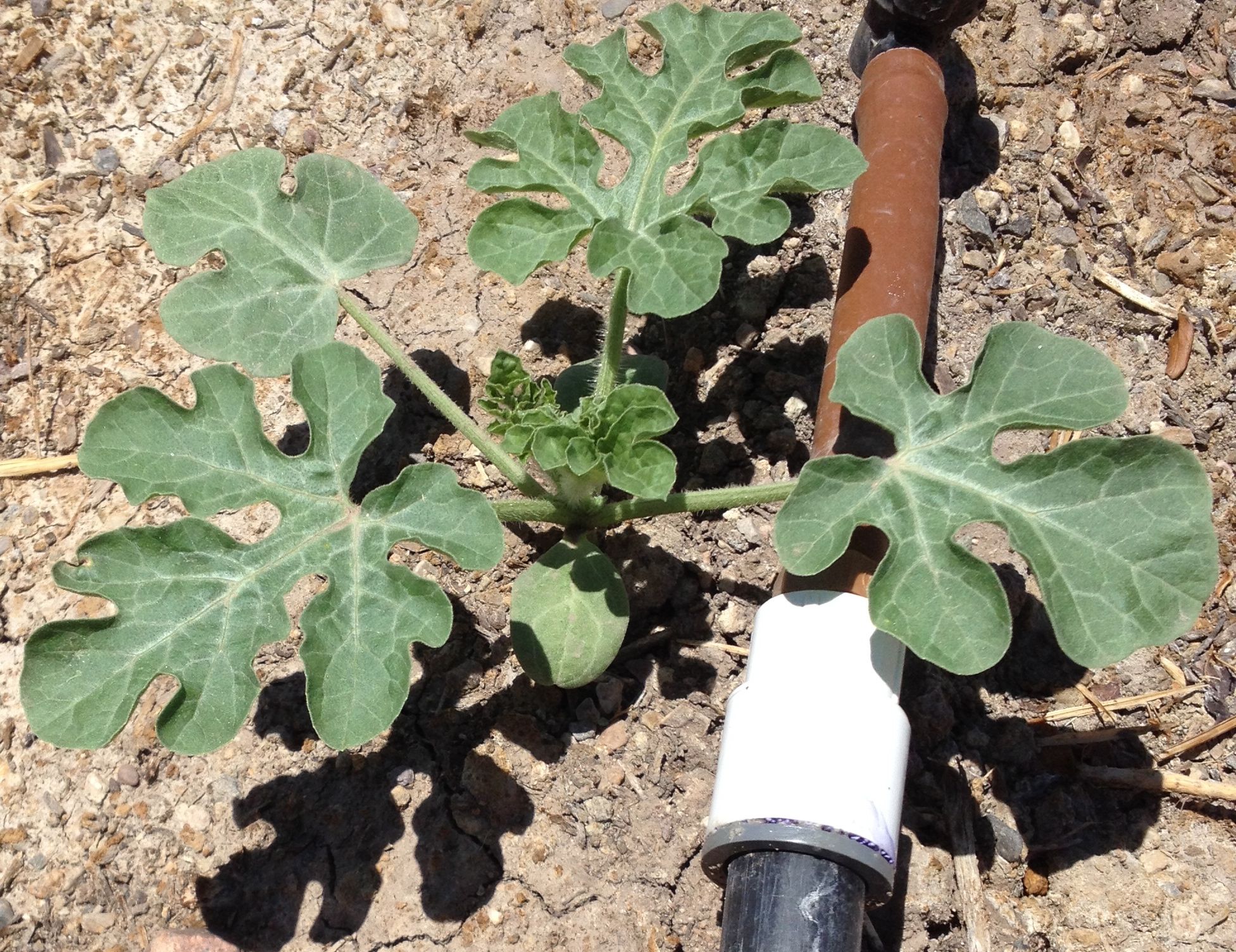
Seedling Tohono O'odham watermelon emerges with a water-assist

Seedling Tohono O’odham watermelon emerges with a water-assist

Ah, these monsoon rains have made it happen again—they thrill soul and body, triggering seeds to sprout and bringing the desert to life all around us. I can hear all the little stomates letting out their, “Whoopee! Whoopee at last! We didn’t know if we could hang in there much longer!”

Tia Marta here, wishing you joy with the renewing humidity and moisture blessing the earth—mat o sha ju:–when it rains. It seems all people know deep in their hearts that we need to, and want to, be singing in the rain. In the poetry of wordsmith Ofelia Zepeda, “Wa nt o m-ne’i g ju:kĭ ne’i. I would sing for you rain songs….” What higher compliment or loving expression could one hear in the desert than that? [For more tastes of her poetry, find Zepeda’s book Ocean Power (1995) and other works at University of Arizona Press.]

One of my most admired traditional Tohono O’odham gardening mentors, Laura Kerman, used to watch the southeastern sky as the clouds were building. When she knew rain was close and her skin was getting softer, that meant it was planting time again. To gardeners steeped in more temperate biomes, it’s a different yet palpable signal for planting time, the feeling of the sap rising. Here in the desert it is the reconstituting of our very integumen that we feel—then we know…(and yes some of us truly feel it in our bones too.) It brings a deep urge to plant seed in the ground, an urge imbedded in our physical being, deep in our psyche, somehow in our genetic memory.

At this very moment I can sense that the seed racks at every hardware store are getting lighter. The Native Seeds/SEARCH store and webstore are restocking seed packets at a fast pace to keep up with the monsoon pulse of gardeners.

My tastebuds think ahead as I scan the racks and webcatalogs. What flavorful squashes will I try this season? What fragrant and refreshing melons? What healthier grain, heirloom bean, ancient corn variety? Delicious and appropriate ideas are sprouting at the Mission Garden living history orchard. You can plan a tour any Saturday morning to inspire your own gardening bug. [www.tucsonsbirthplace.org]
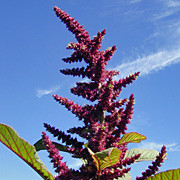
Guarijio Grain Amaranth for greens, high protein grain, and glorious summer color!

Guarijio Grain Amaranth for greens, high protein grain, and glorious summer color!

I think the plant that loves rain most is Amaranth.  (Such an insult to call our wild native amaranth a “careless weed” or “pigweed”! Better, the Tohono O’odham moniker which translates “rain spinach,” ju:hukia i:wagi. Within a week after a rain the tender young greens that pop up uninvited in your garden can be plucked to make a most healthy dish.)   For planting delightful color and beta-carotene-rich greens, try Guarijio Grain Amaranth, originally from the little-known tribe from southern Sonora and saved by Native Seeds/SEARCHers (Amaranthus hypochondriachus x A.hybridus or “guegui” in the Mayo and Guarijio tongue).  Guegui gives extra bonuses beyond greens: after showy red flower plumes grace your garden, you can bag seedheads to retrieve a plentiful grain that is 15-18% protein. Cooked amaranth seeds make a fine pilaf or rich hot cereal. Try popping amaranth seed in a hot dry skillet then add them to salads or to lighten up biscuit dough.
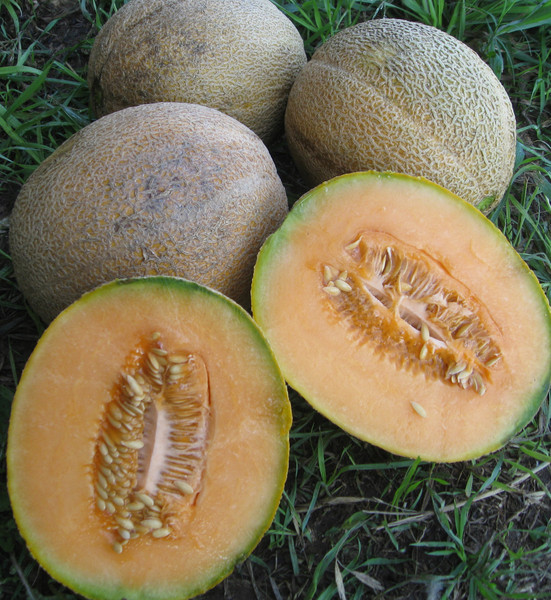
Delicious and well adapted, this Mayo Minol grande is perfect for Baja Arizona

Delicious and well adapted, this Mayo Minol grande is perfect for Baja Arizona

As I plant melon seeds I am thinking of the delectable future they promise.  Native Mayo People of coastal Sonora and Sinaloa have perfected Mayo Minol Grande , a canteloup-like melon adapted to the heat that can perform well in Baja Arizona gardens. It makes a beautiful breakfast complement or a summer dessert served à la mode on a generous wedge of the orange fruit.
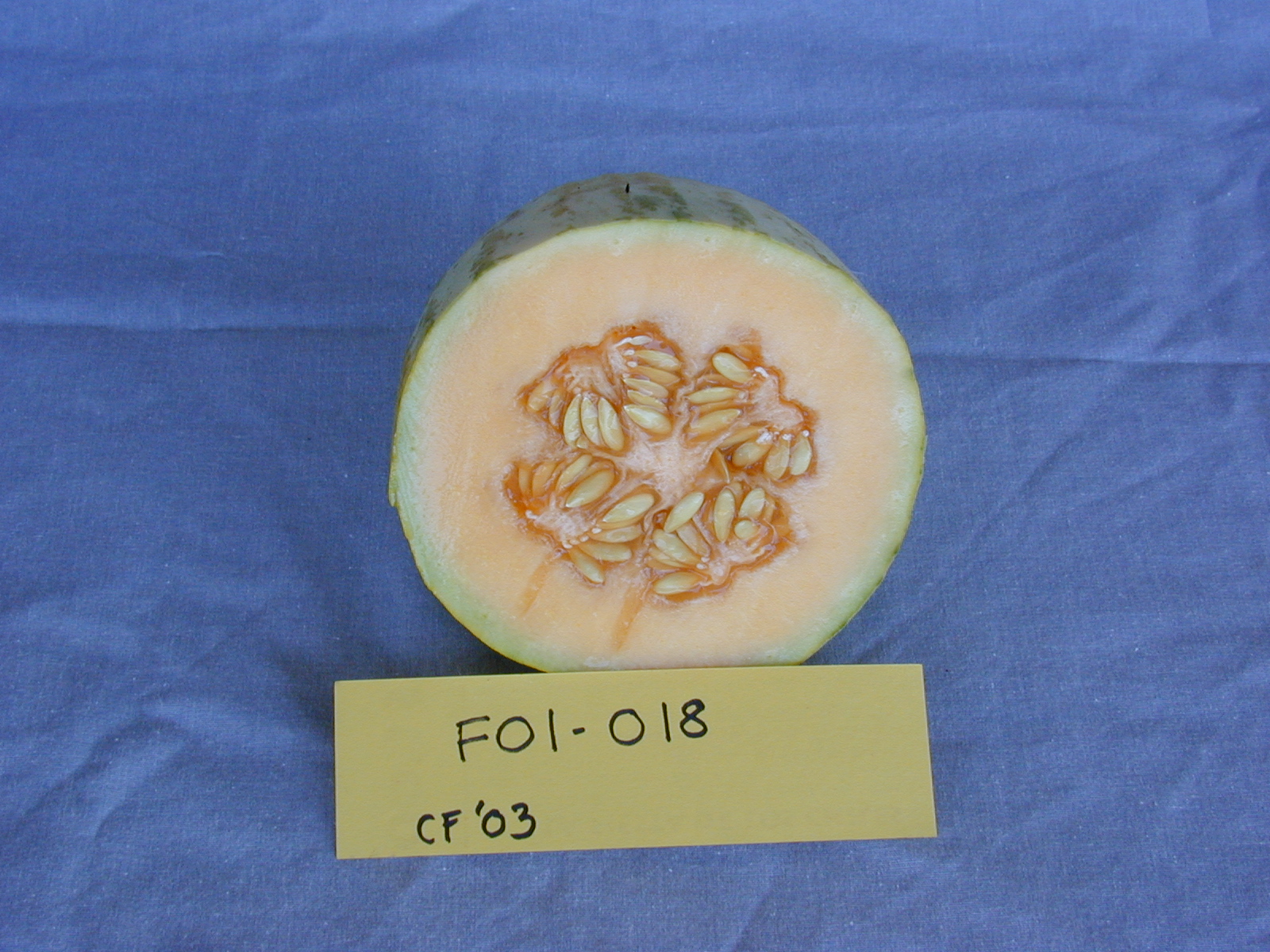
Melon de Castille from NativeSeeds/SEARCH--another summer treat

Melon de Castille from NativeSeeds/SEARCH–another summer treat

Similar in color to Mayo Minol but with smoother outer skin is the Melon de Castille which grew successfully in last summer’s Mission Garden. [Seeds of all of these can be found at the Native Seeds/SEARCH store or in the online catalog http://www.nativeseeds.org.]
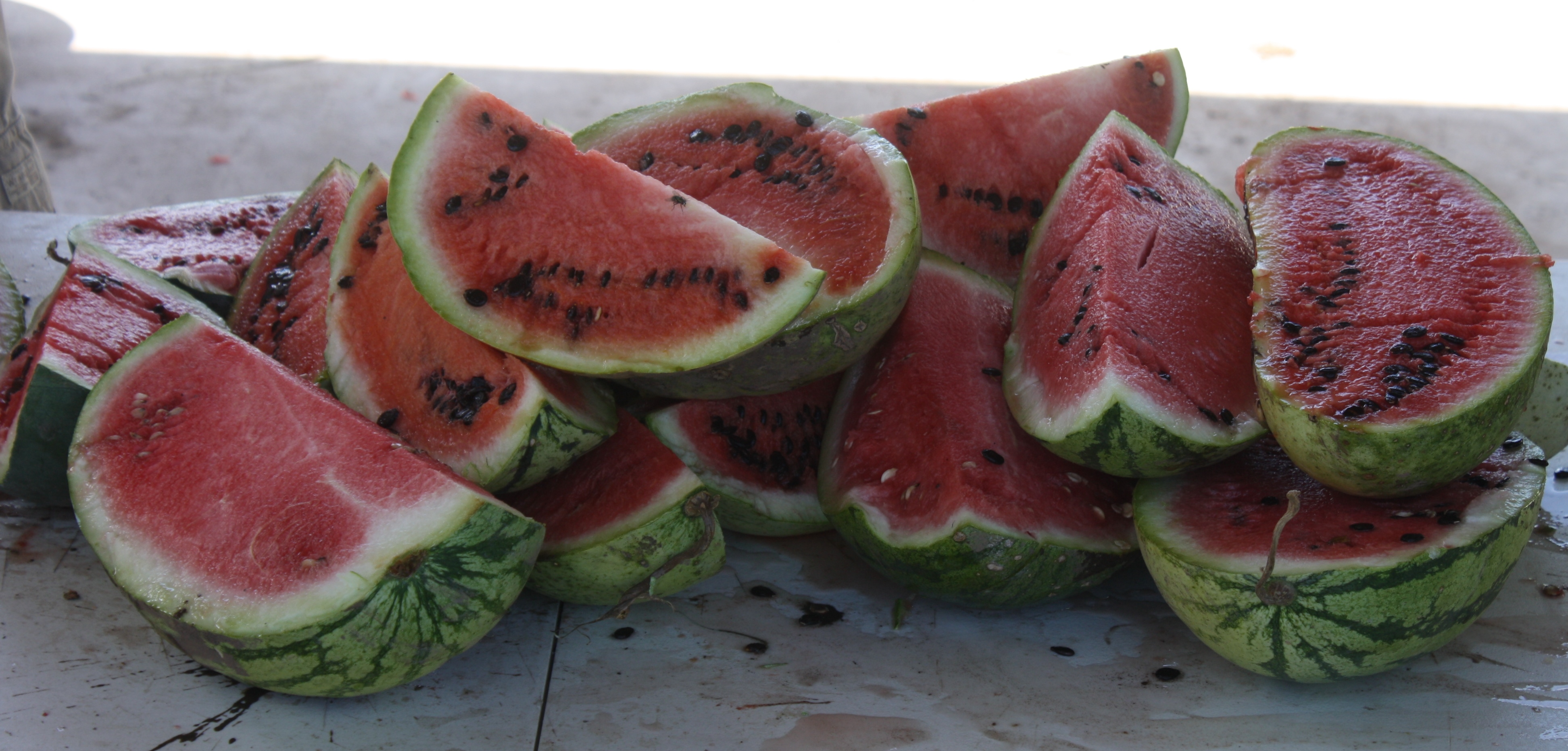
Refreshing and prolific are Mayo Indian watermelon (photo from Mission Garden)

Refreshing and prolific are Mayo Indian watermelon (photo from Mission Garden)

At harvest time last summer, Mission Garden volunteers enjoyed an orgy when the rich red-fleshed Mayo watermelons were ripe, in an effort to save seeds to return to NSS. Good duty—such a forward thinking and benevolent activity is seed saving—and someone’s gotta do it.
Melons in your garden will indeed need water so plan on a reliable drip system and some form of water-harvesting berms to direct any rainfall runoff. Plant your melon seeds at the lowest part of your garden where water tends to accumulate. Give the vines room to sprawl out, even over not-so-good ground, so long as the roots are in rich soil.
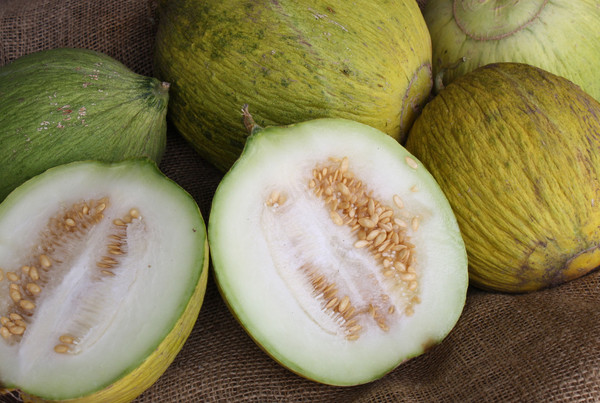
Tohono O'odham keli ba:so--by any name, a success for Baja Arizona gardens

Tohono O’odham keli ba:so–by any name, a success for Baja Arizona gardens

Traditions of Desert People—the Tohono O’odham—provide a model of truly sustainable living in the Sonoran Desert. From them we have been given seeds of two of the best-adapted and tasty melons of all: a honeydew-like cushaw melon known as keli ba:so (pronounced gurli-bahsho), and the Tohono O’odham yellow-meated watermelon.  Open up a keli ba:so for a sweet treat to use in a refreshing liquado or smoothie, or in a melon-ball salad perhaps laced with mint-agave nectar sauce. Translating the name keli ba:so opens up another dimension—the wonderful humor of the Desert People. The name (used especially by women) refers to the super-wrinkly texture of the outer melon skin and means “old man’s chest.” In retaliation, men have a different name for the same melon, “ohks tohn.” You might guess where this is going—it translates “old lady’s knees.”
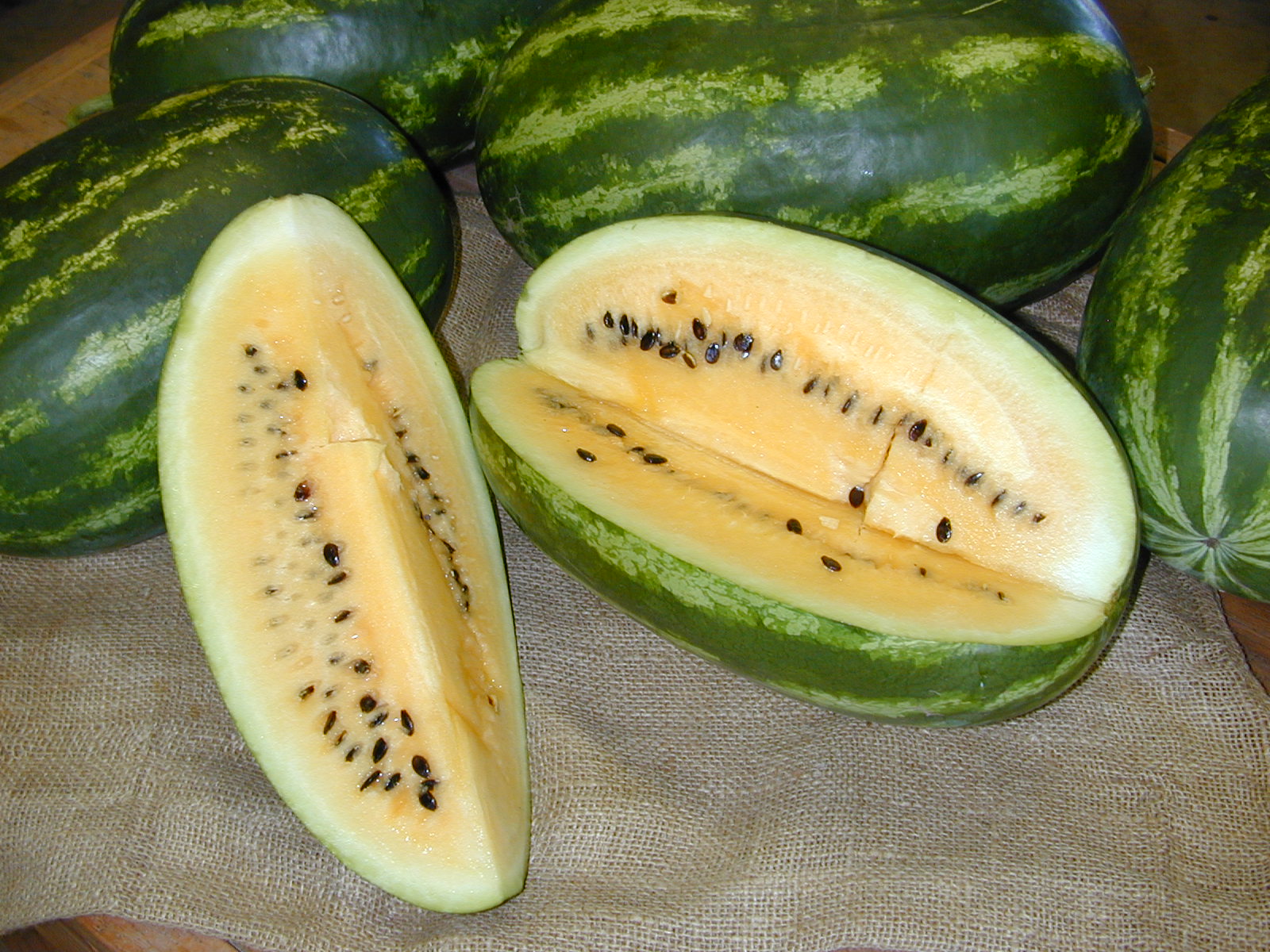
Unique rich flavor, color, and hot-weather-hardy--that's Tohono O'odham yellow watermelon

Unique rich flavor, color, and hot-weather-hardy–that’s Tohono O’odham yellow watermelon

Watermelons must have had an exciting ride to the New World some 400 years ago, arriving in what is now central Mexico from Africa with the first Europeans. Apparently the flavor and plant-ability of watermelon, and indeed its transport-ability, were so appealing to Native Peoples of Mexico that the fruit spread from its introductory source like wildfire. By the time the Spanish explorer Alarçon arrived at the northern end of El Mar de Cortes meeting Yuman people for the first time at the Colorado River’s mouth, watermelon was already part of their agriculture and diet! This fact stumped historians and ethnobotanists for years—(like how could the same watermelon have been cultivated in both hemispheres?)—until they finally figured out the speed with which a favored food can migrate. Watermelon–the original fast food.
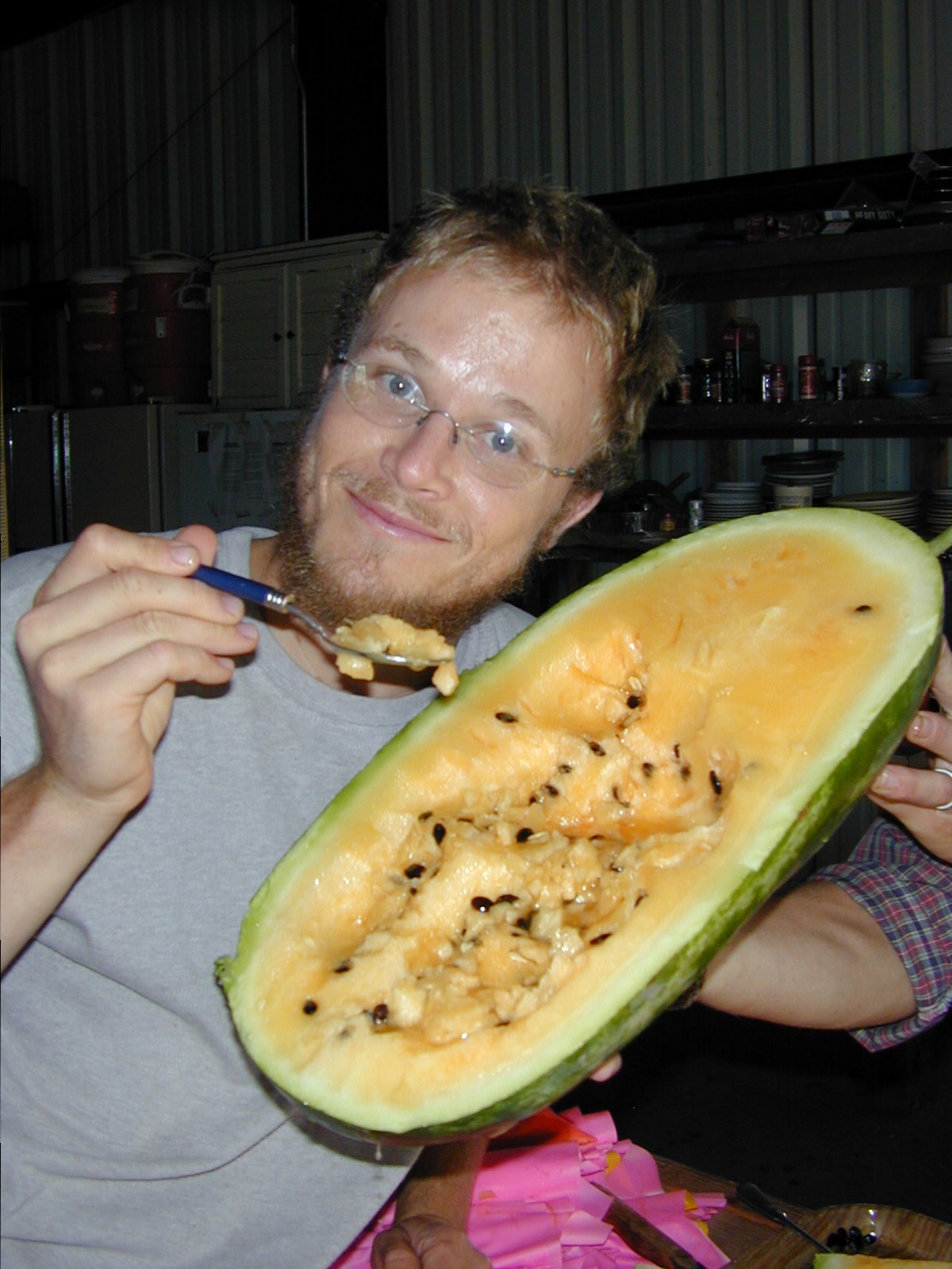
Tohono O'odham yellow-meated watermelon from NativeSeeds/SEARCH is a color and taste delight

Tohono O’odham yellow-meated watermelon from NativeSeeds/SEARCH is a color and taste delight

Prepare yourself for a whole new flavor experience with Tohono O’odham yellow-meated watermelon. Its sweetness is non-cloying and gentle with an almost musky rich bouquet—a different taste realm from any red watermelon you’ve ever tasted. Put slices of this luscious watermelon on an hors d’oeuvres tray, or slice it alternating with red watermelon for a colorful picnic buffet. Joining orange Mayo Minol, cubes of lime-green keli ba:ṣo, red Mayo watermelon, and T.O. yellow watermelon completes a rainbow of color and flavor to create the ultimate Southwest fruit salad.
Happy monsoon planting and gardening to you as you practice sustainable agriculture in your own backyard! With the term introduced by Wendall Berry, may your “slow knowledge” grow as you tend your melon vines and cheer on the pollinators in anticipation of summer’s sweet and nutritious bounty of melons and amaranths!
As the monsoon season progresses, watch for the San Xavier Coop Association’s T.O. yellow watermelons for sale at the Thursday Santa Cruz farmers’ market at Mercado San Augustin. For more ideas, advice and seeds for monsoon garden heirlooms, visit the NSS store on North Campbell Ave.  Also, come by our Flor de Mayo booth at the new St Phillips Sunday farmers’ market in its charming, refreshing oasis setting. Rod and Tia Marta of Flor de Mayo have experience, recommendations, and stories to share, and perfect monsoon seeds for the season. See you Sunday at St. Phillips!
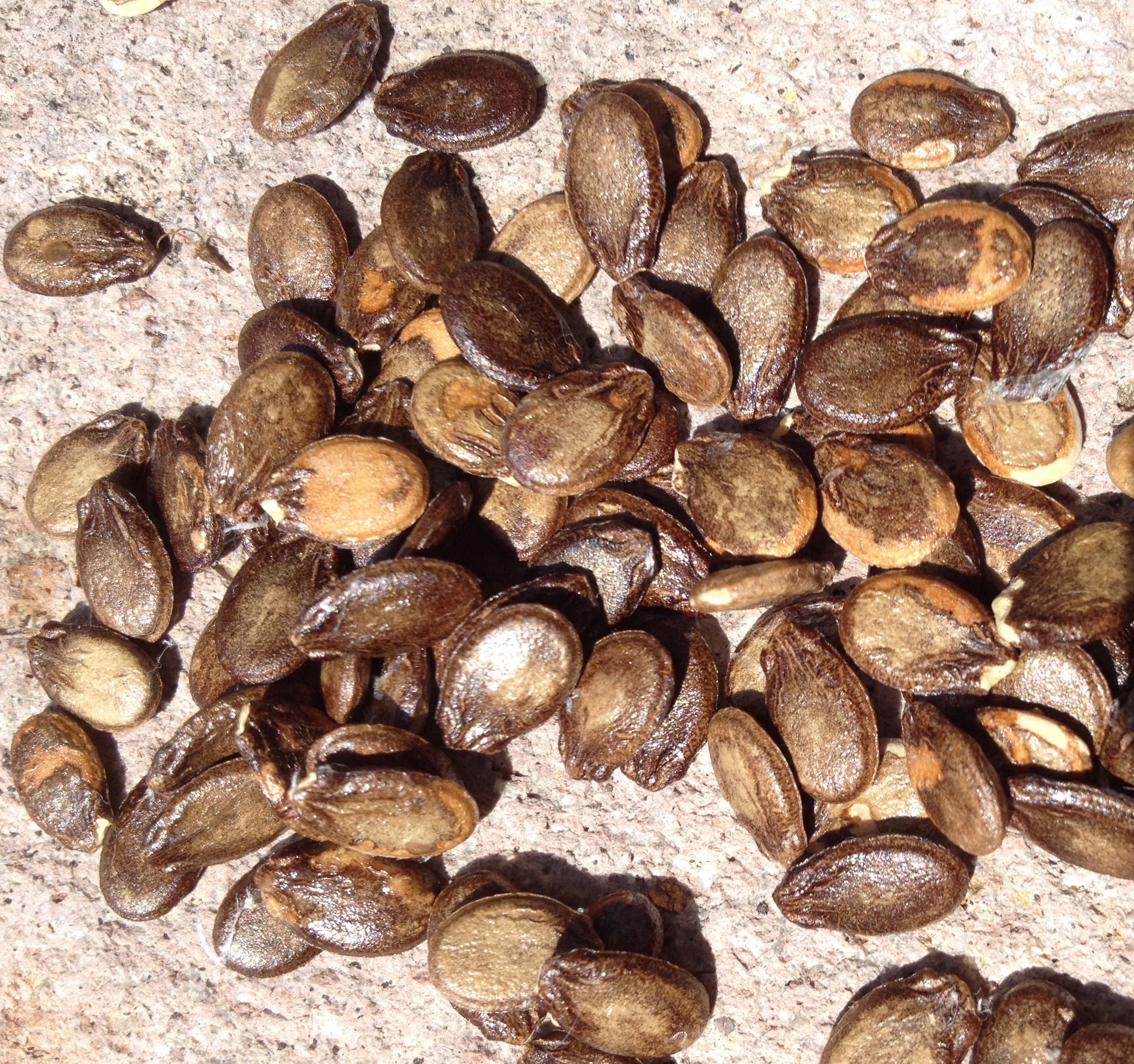
The seeds are READY to put in the ground!  All they need is a little help!
The seeds are READY to put in the ground! All they need is a little help!

 

Celebrating la Fiesta de San Ysidro Labrador

Tia Marta here to tell you about a beautiful and legendary soul, San Ysidro Labrador, Saint Isidore the Farmer, Patron Saint of Farmers and Laborers – whose feast day is May 15. A major celebration is planned in his honor this Saturday, May 17, in Tucson.

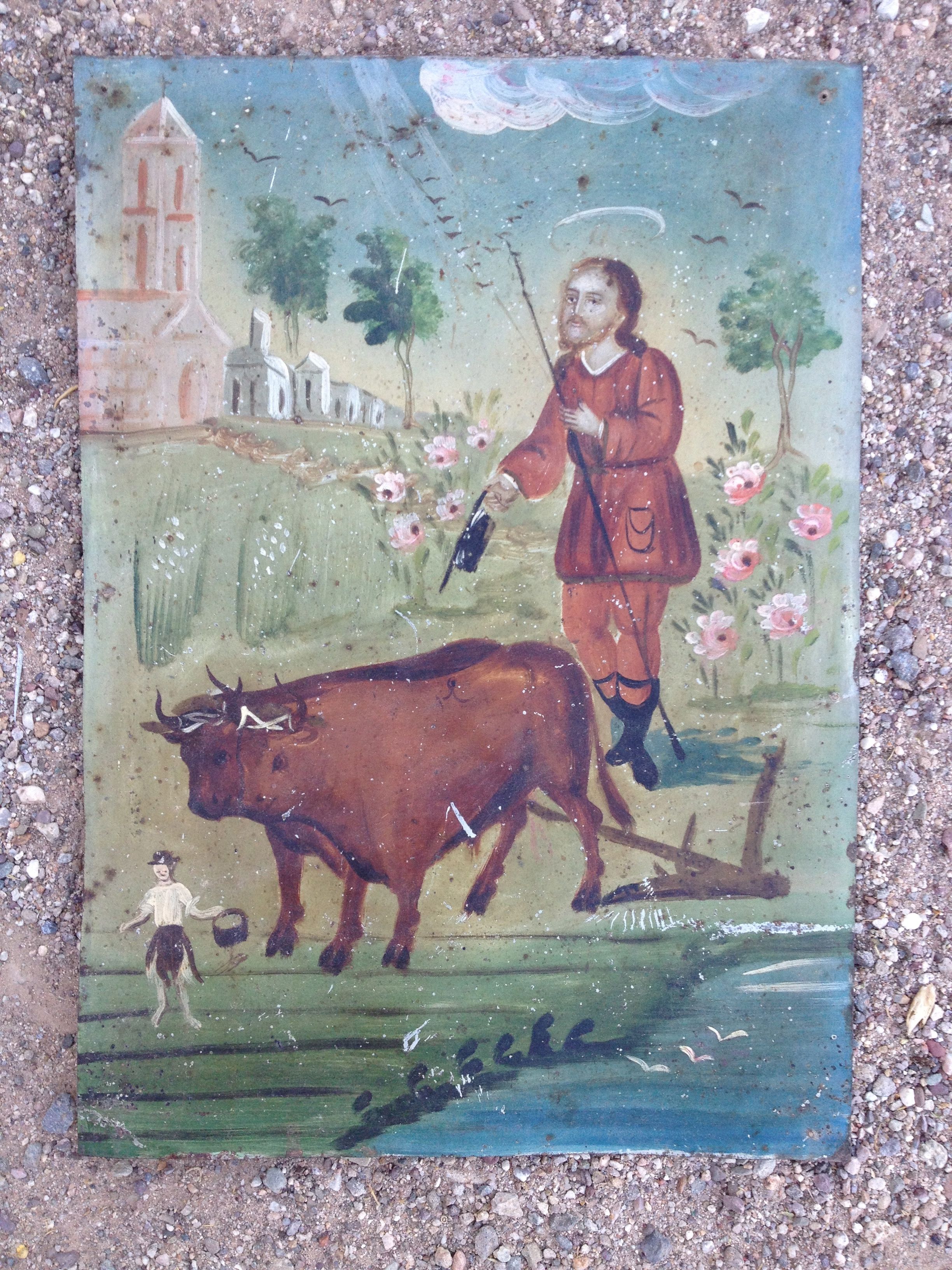
Retablo, painting on metal of San Ysidro plowing with angel, in style of traditional New Mexico folk arts.  From Burns/Drees Collection (Photo MABurgess)

Retablo, painting on metal of San Ysidro plowing with angel, in style of traditional New Mexico folk arts. From Burns/Drees Collection (Photo MABurgess)

San Ysidro (a poor Spanish peasant farmer who lived from around AD1070 to 1130) is revered traditionally, along with his good wife Santa Maria Torribia, for generously sharing bounty from their fields and hearth to those in need—hungry animals and fellow peasants. Legend tells us that San Ysidro, at prayer every morning, was often late to labor in his master’s fields, but the angels, seeing his devotion, would already be plowing for him. Another legend records him with an angel plowing on both sides his oxen so that his labor yielded three times that of his neighbors. Yet another tells how, as he carried corn to be milled, he took pity on poor birds in the snow and gave them half his grain; when his leftover corn was ground, it yielded twice what he had brought. His generosity produced miracles.

San Ysidro retablo art, courtesy of Friends of Tucson's Birthplace

San Ysidro retablo art, courtesy of Friends of Tucson’s Birthplace

Residents of Madrid, Spain, go all out in celebrating San Ysidro’s feast day, as he is the city’s patron saint. In Tucson, it is customary in traditional Hispanic families to celebrate San Ysidro with prayers for rain as his day falls usually in our most arid fore-summer. According to Jim Griffith’s Saints of the Southwest, images of San Ysidro were taken from the church to observe the fields or even buried in the fields until rains came.  Here he has become patron of ranchers and crops–even gardeners. Dia de San Ysidro Labrador is a perfect occasion for us to become mindfully aware of where our food really comes from—the Earth, the soil—and also to fully appreciate the labor, the human care, human energy and other forms of energy that all go into bringing good food to our mouths and bodies. (I guess now we shouldn’t say “food to our tables” anymore, as that is unfortunately kinda passé. I hope some families still sit together at table to eat. We do and it is always a joy. Gosh imagine, we learn so much when we actually prepare and sit over a good meal and converse with each other!) So San Isidro Labrador reminds us of what is critically important with food—its origins in good earth and honorable labor!

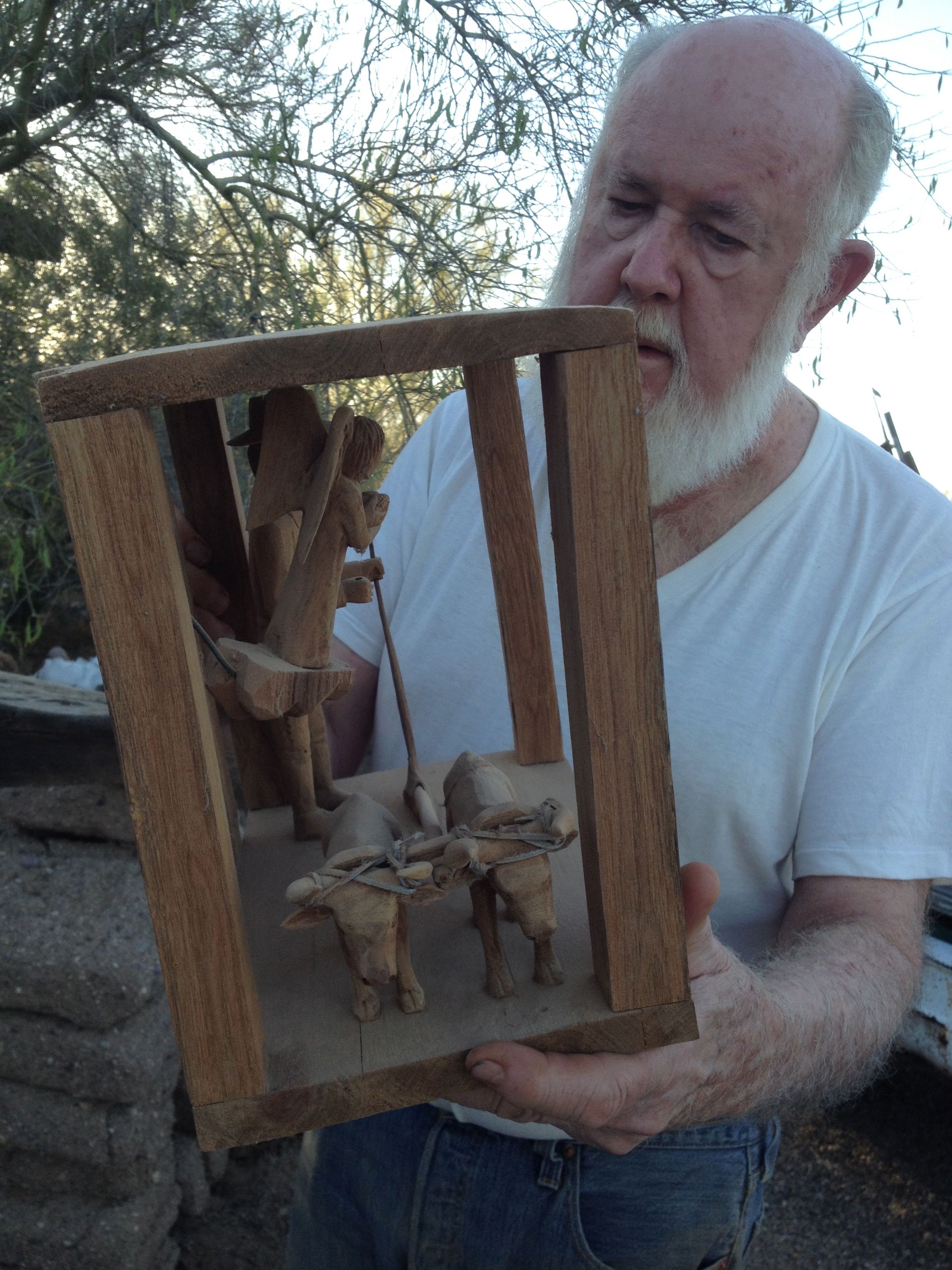
NW Mexico craft-arts collector and expert Dr.Barney T.Burns with santo of SanYsidro showing the oxen and angels.

NW Mexico craft-arts collector and expert Dr.Barney T.Burns with santo of SanYsidro showing the oxen and angels. (photo MABurgess)


Cottonwood root carving by Mayo Indian, Sinaloa, Mexico, depicting San Ysidro with ox, plow, corn motif, and angel watching him.  From Burns...Drees Collection (photo MABurgess)

Cottonwood root carving by Mayo Indian, Sinaloa, Mexico, depicting San Ysidro with ox, plow, corn motif, and angel watching him. From Burns…Drees Collection (photo MABurgess)

This year the Friends of Tucson’s Birthplace has arranged a public celebration of San Ysidro not to be missed, where this tradition is revived in a most appropriate setting—in the new Mission Garden, a living history orchard and garden on the very site of Padre Kino’s original Mission San Augustin de Cukson, at the base of Sentinel Peak. Plan to get there early— procession starts from the Santa Cruz River at 9:00am (May 17) going west to enter the adobe-walled Mission Garden. There, near the living orchard of Mission Period fruit trees and the productive winter vegetable garden coming to fruition, will first be the blessings. A Native American spiritual guide will bless in the four directions, followed by a Christian blessing of the fields, food and animals. Heirloom White Sonora Wheat grown in this living-history vegetable garden is getting ripe and will be ceremonially harvested. There will be tastes of Pozole de San Ysidro, the traditional pozole de trigo. Mariachi music by Las Aguilitas from Davis Elementary will fill the air; the Desert Indian Dancers from San Xavier will bless the earth; and Hispanic historian Bobby Benton will sing. A highlight will be a talk by none other than “Big Jim” Griffith reminding us of our roots in Tucson traditions of San Ysidro. Info tents will have volunteers on hand to answer questions. Native Seeds/SEARCH has donated varieties of heirloom seeds known from the Mission Period and earlier, planted in vegetable and timeline gardens to demo the prehistory of plants used by ancient people of the Tucson area. NSS volunteers will provide info for contemporary gardens. Tucson Herbalist Collective shares medicinal plant knowledge for Mission Garden and will have volunteers available for herbal questions. Baja Arizona Sustainable Agriculture will be selling heirloom White Sonora Wheat (grown organically by BKWFarms in Marana) and demonstrating how to cook the delicious ancient grain in a modern solar oven! (Great recipes for White Sonora Wheat are available by scrolling back in this blog.) It will be hot– come prepared with hat, sun protection, and water. The celebration is over at 11:30am. What a wonderful way to rejoice in local food, local tradition, and neighbors to share it, on this little piece of floodplain where agriculture has been happening for over 4100 years!

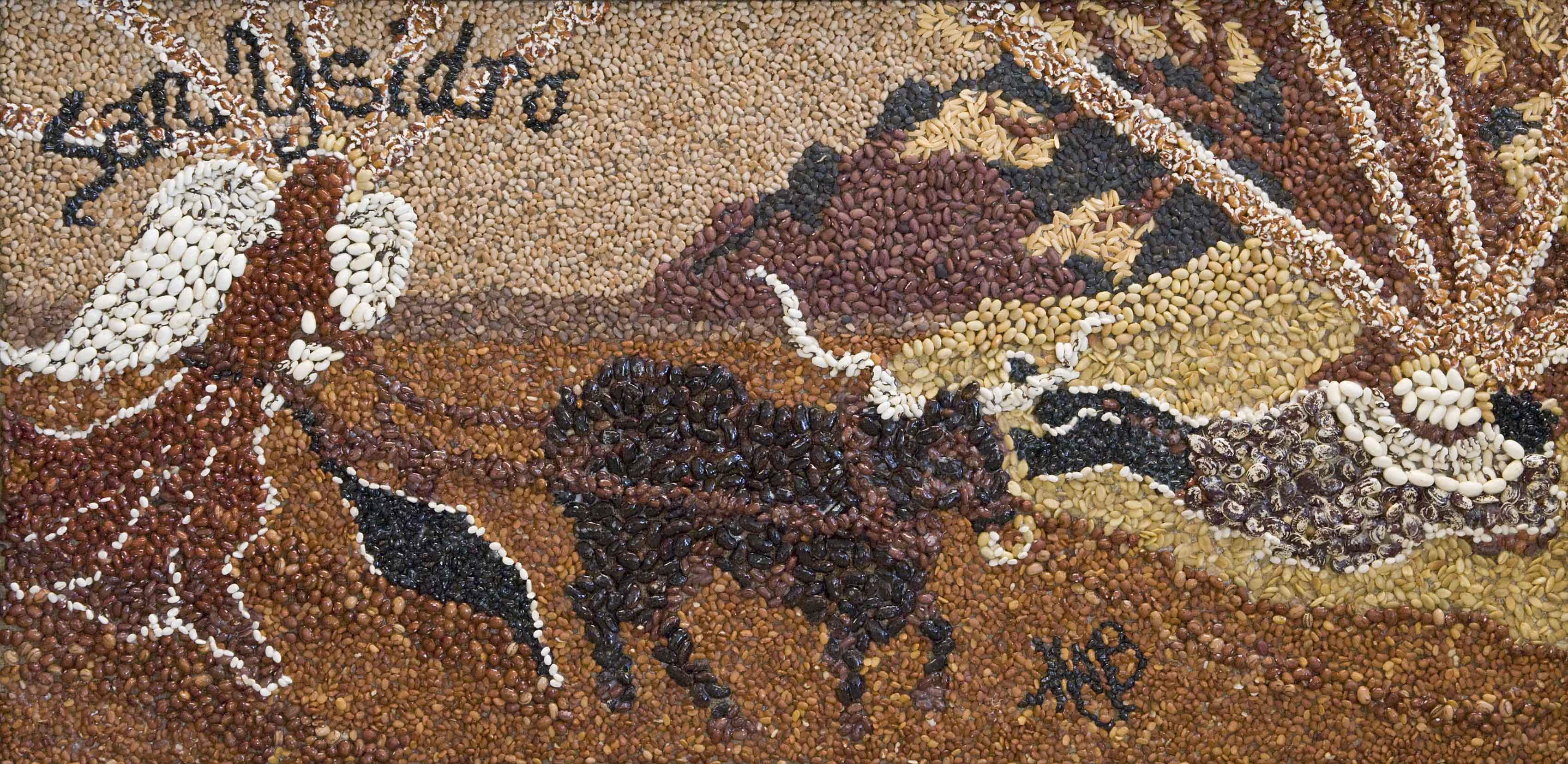
A mosaic of 21 heirloom beans and seeds by artist MABurgess, depicting the angel plowing for San Ysidro Labrador. (photo PeterKresanPhotography.com)  Notecards available at NativeSeeds/SEARCH and www.flordemayoarts.com

A mosaic of 21 heirloom beans and seeds by artist MABurgess, depicting the angel plowing for San Ysidro Labrador. (photo PeterKresanPhotography.com) Notecards available at NativeSeeds/SEARCH and http://www.flordemayoarts.com

Inspired by San Ysidro, I spent several months composing this mosaic of heirloom seeds, depicting an exhausted San Ysidro asleep under a tree while the angel finishes his plowing. See if you can identify any varieties. You can purchase the heirloom beans–and notecards of this image now printed handsomely by Spectrum–at Native Seeds/SEARCH store or at the Flor de Mayo table at Sunday St Phiillips Farmers Market.

San Ysidro is helping us find our way back to connection with the land that can feed us again!

In Praise of Seeds and Rebirth

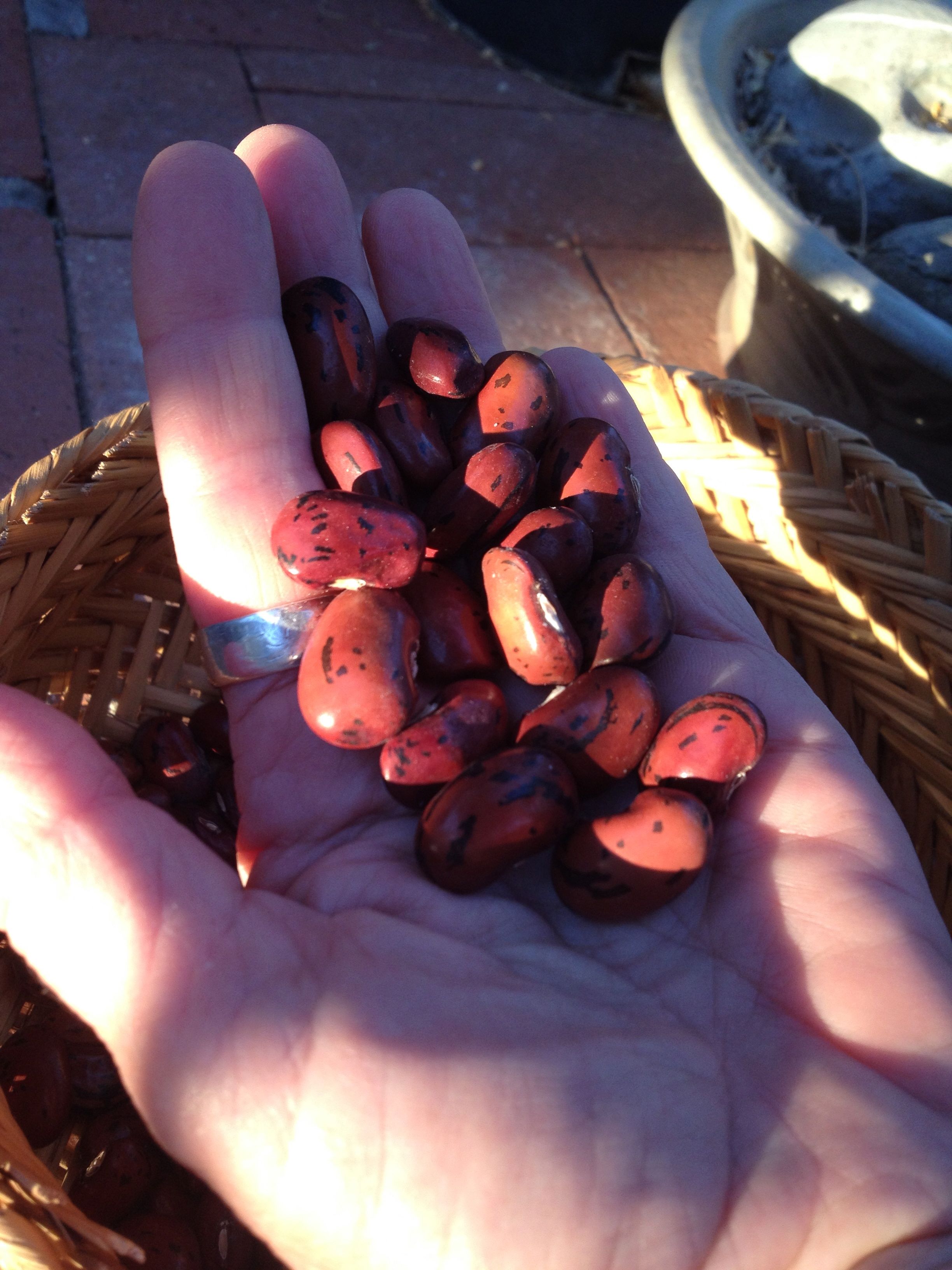
Scarlet runner beans grown by ace gardener T.S.Swain–good nutrition and beauty besides (MABurgess photo)

Tia Marta here this beautiful Easter week, singing the praises of seeds, with stories of rebirth to share! When I hold seeds in my hand, I am blown away by their significance. These little lightweight packages of starch and protein, exine skins and genetic chains, are weighty with potential for what they can do in the future, and truly weighty with messages from the past—genetic wisdom selected by the many forces of Nature through time, and in the case of agricultural seed, by caring humans—all encased in a holding pattern, a portal where time stretches. Seeds are life in abeyance. Each seed is a nexus, connecting the ways of the past with hopes for the future. To see life spring again from a seed is a miracle every time it happens—even for elders who have seen it happen a zillion times, and one worth sharing with children for their first.

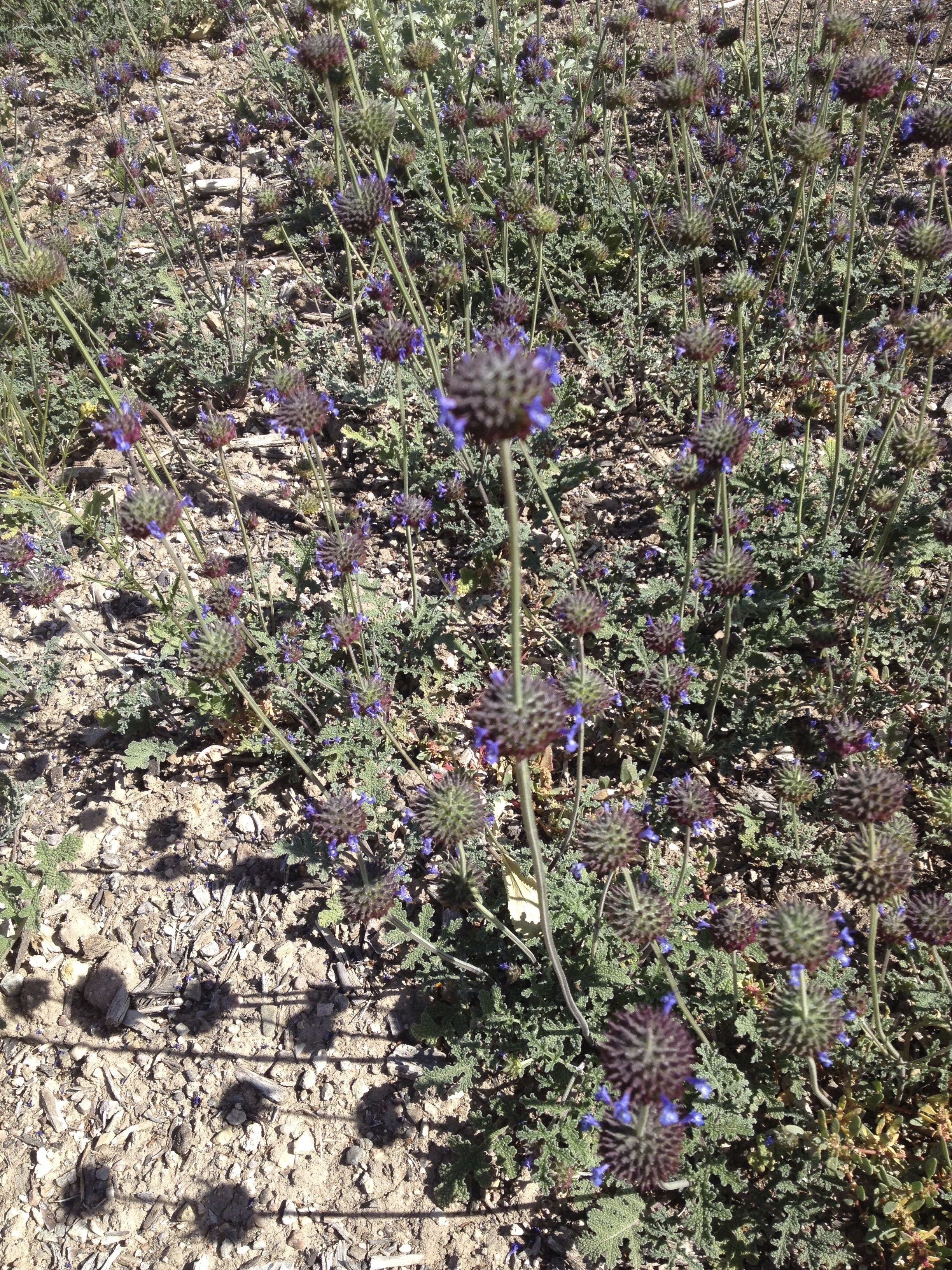
native chia (Salvia columbariae) in bloom at Mission Garden (MABurgess)

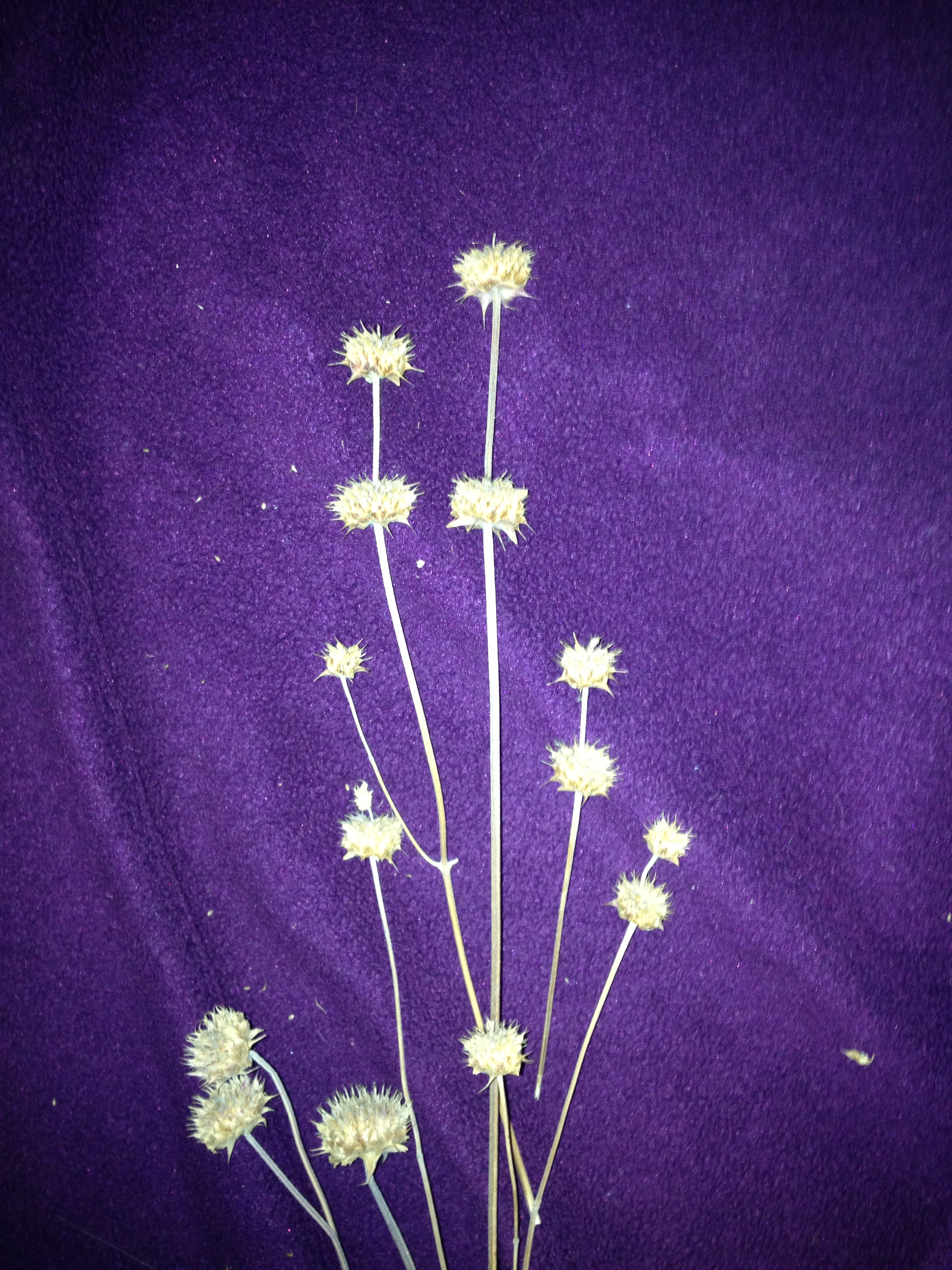
wild native chia seedheads (Salvia columbariae) ready to winnow (MABurgess photo)

wild native chia seedheads (Salvia columbariae) ready to winnow (MABurgess photo)

All of life celebrates spring re-energizing time with Nature’s renewal, Easter’s message of life out of death. In the Sonoran Desert we are celebrating not only new growth but also nourishment with the spring harvest, the results of winter rains. Here, our winter ephemerals (a totally different suite of plants than our hot-weather annuals) are completing their blooming and pollination cycles, their seedheads bulging and ready to be scattered, shattered, caught by wind, coyote legs, or human socks, to be spread to the next possible patch of desert soil in prep for this fall’s rainy season (or for feeding furry or feathered desert dwellers.) Chia seedheads will soon be ready to gather and winnow for their superfood nutrition. Don’t forget to thank the plant (and all the forces which brought those chia seeds to fruition) as you chow down on its high omega-3 fatty acids and its blood-sugar-balancing complex carbs in your smoothie or chia fruit salad!


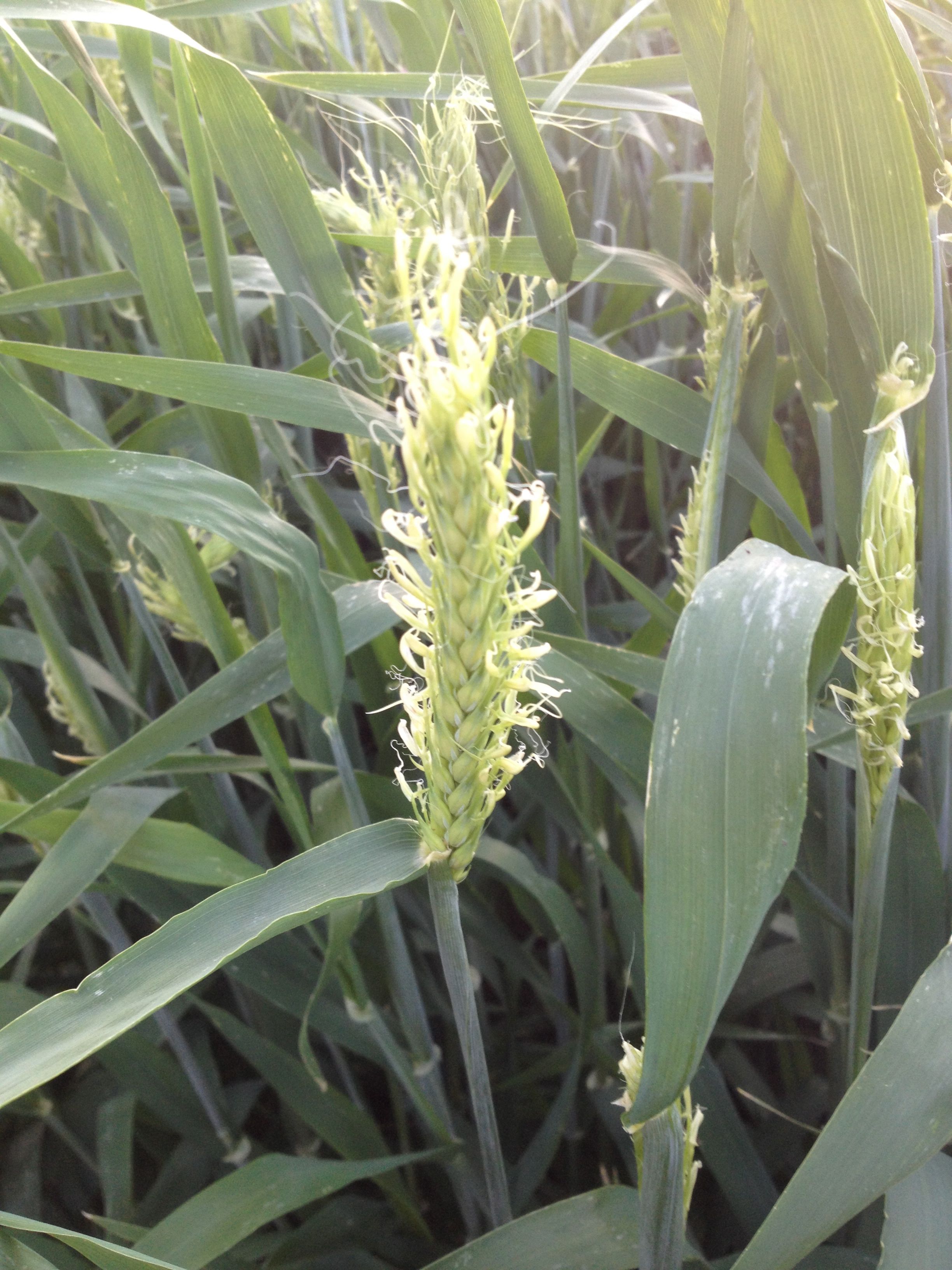
Heirloom barley in flower at Mission Garden (MABurgess photo)

Heirloom barley in flower at Mission Garden (MABurgess photo)

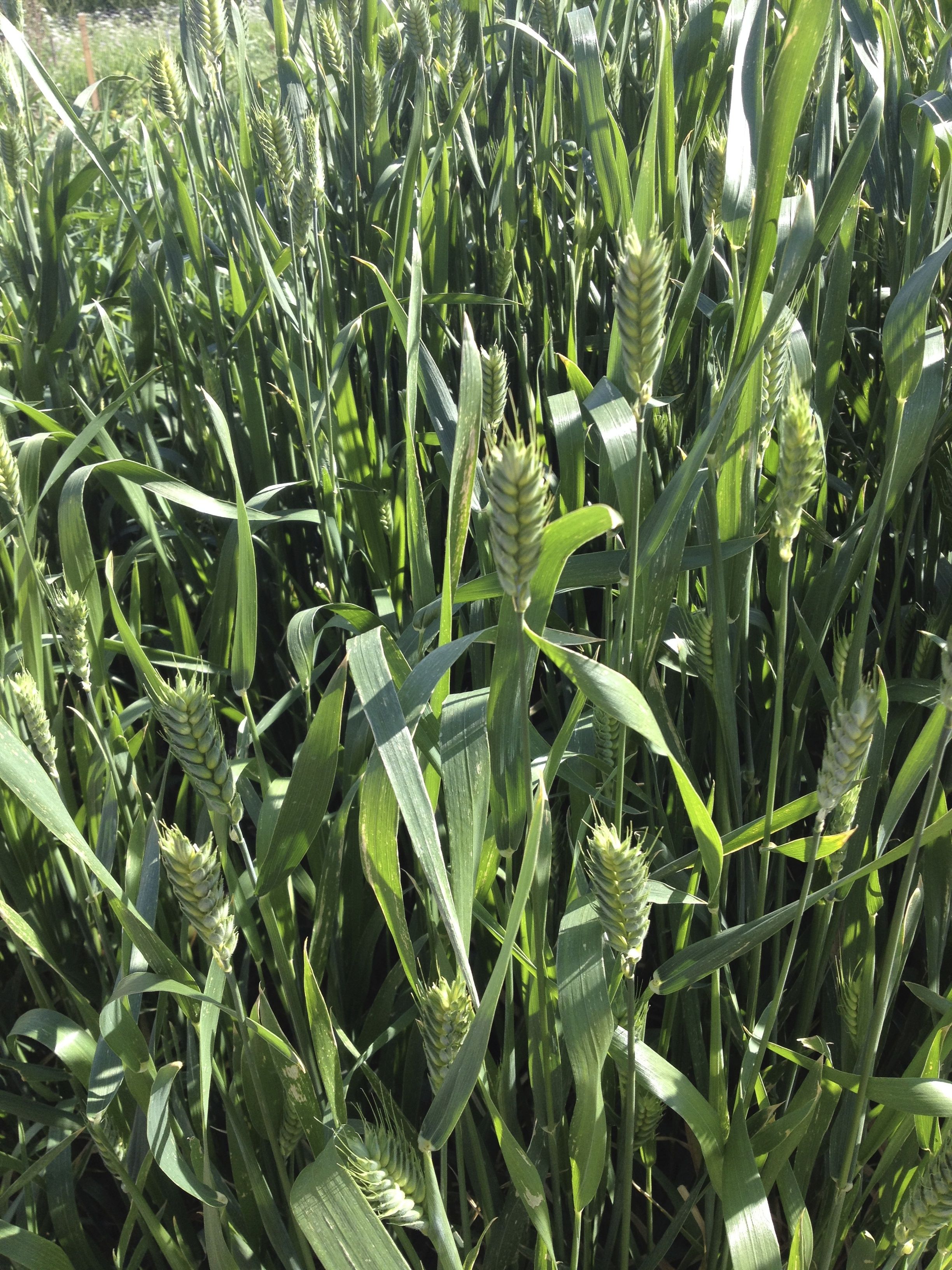
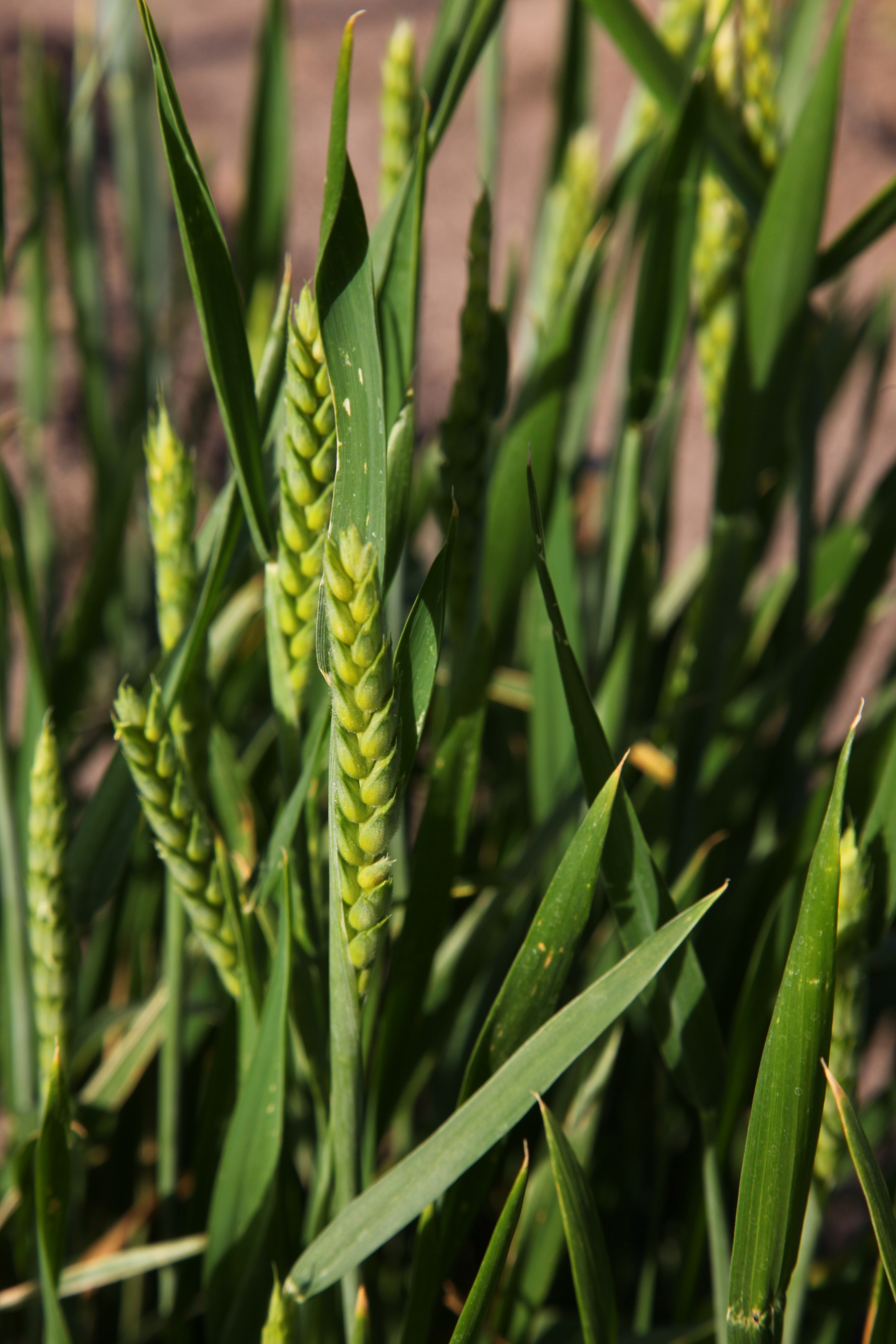
Heirloom White Sonoran Wheat seedheads filling out at Mission Garden (MABurgess photo)

Heirloom White Sonoran Wheat seedheads filling out at Mission Garden (MABurgess photo)

It is written that Passover (the roots of which began in a desert akin to our own with winter rainfall and grains grown as winter crops) cannot be celebrated until the barley is harvested. When Father Kino and other Padres brought Old World grains like wheat and barley to our corner of the Southwest, the same winter growing was observed. Now, at the Friends of Tucson’s Birthplace Mission Garden (at the foot of A-Mountain) direct descendants of those original heirloom grains are topping out where you can see them “in action” any Saturday for a tour (see http://www.tucsonsbirthplace.org).

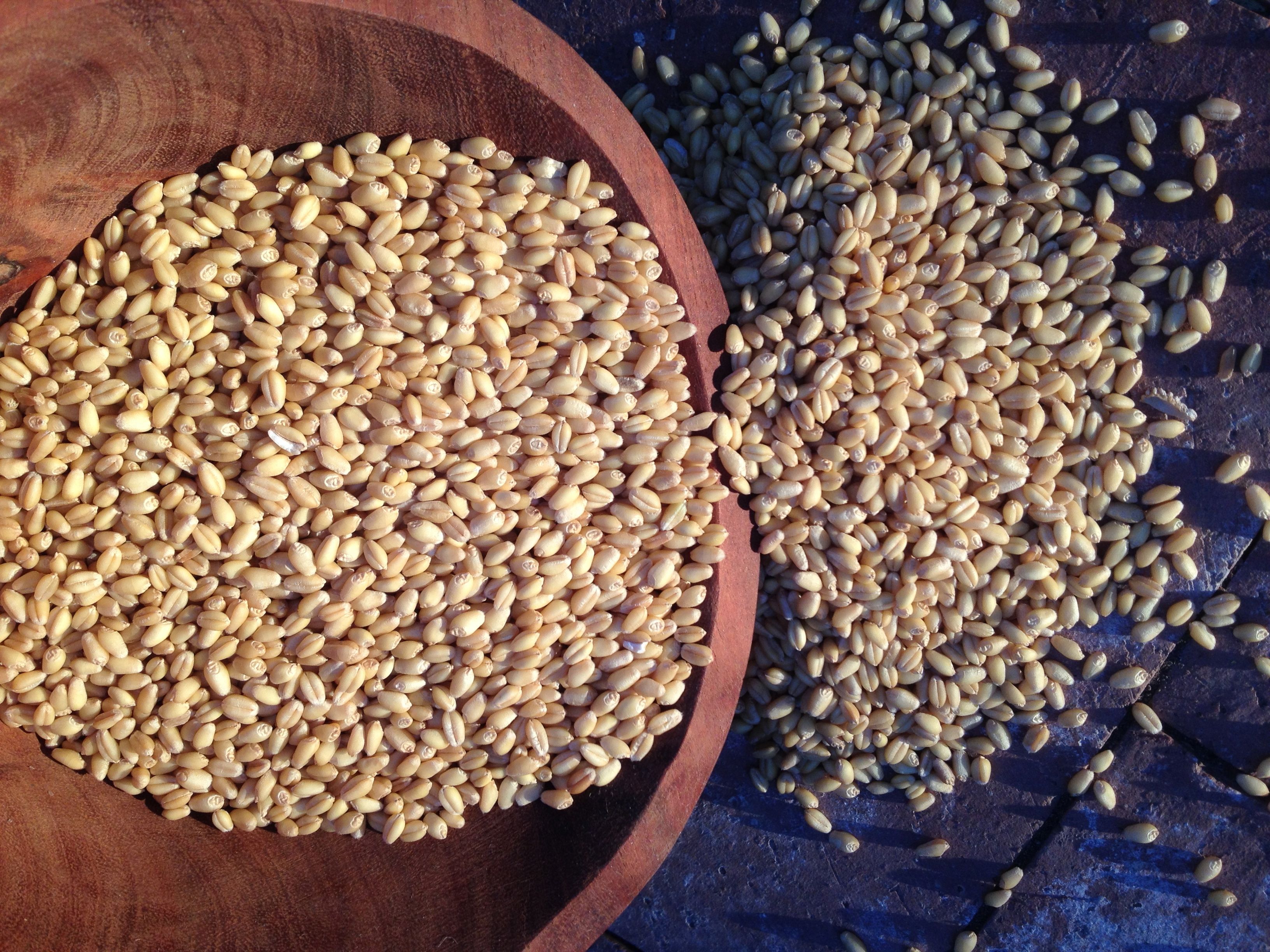
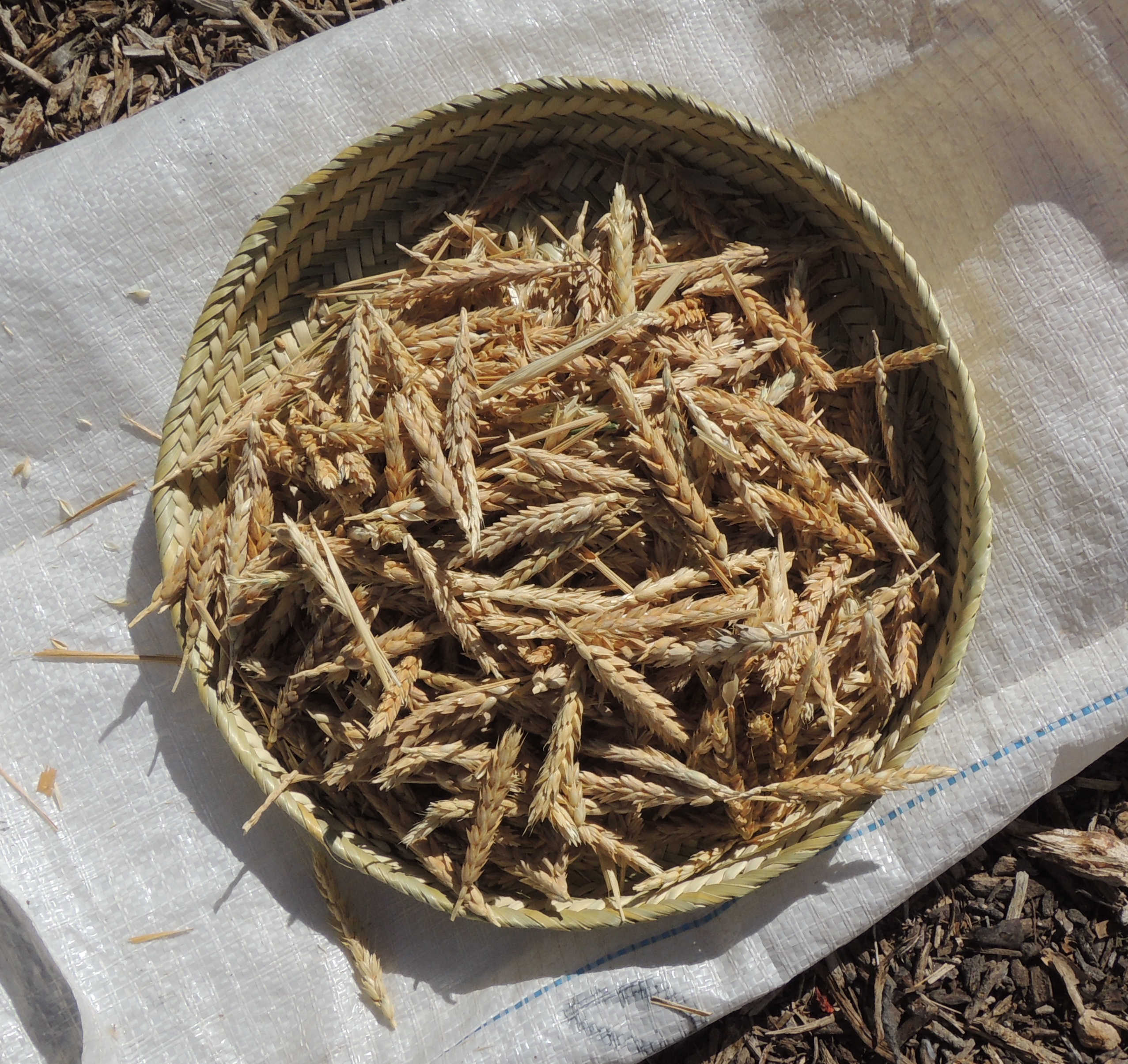
Heirloom White Sonoran Wheat berries, local, organic, traditional, from BKWFarms (MABurgess photo)

Heirloom White Sonoran Wheat berries, local, organic, traditional, from BKWFarms (MABurgess photo)

Scroll thru our savorthesouthwest posts to check out Tia Marta’s January blog for some enjoyable insights on the ancient White Sonoran Wheat and great recipe ideas, and a nutshell history –introduced by Kino, found again by Native Seeds/SEARCH, and now being grown with soil-enriching organic methods by the Wong Family in Marana.

Wheat is rich with symbolism as well as nutrition—full of life-giving energy, complex carbohydrates when the whole grain is eaten, and good protein. Irish farmers weave complex seedhead sculptures and hangings for good luck, representing protection, provender, and plenty. For traditional Italians especially, wheat symbolizes renewal and rebirth and has become an important Easter food.

Tucson Foodie-par-excellence Vanda Gerhardt located a most marvelous recipe for an Italian traditional Easter pie (judysculinaria.wordpress.com) made with wholesome wheat grain. She has served samples to delighted farmers market visitors at the Flor de Mayo booth at St Phillips Sunday market (www.heirloomfarmersmarkets.com).  With her inspiration I have modified it for a totally local treat, made with our own Padre Kino White Sonoran Wheat berries from BKWFarms!

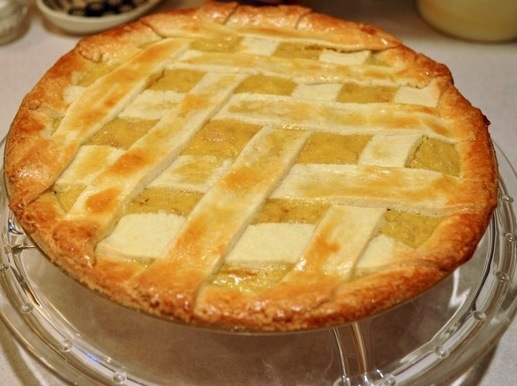
Luscious Easter Wheatberry pie, from judysculinaria.wordpress.com

Luscious Easter Wheatberry pie, from judysculinaria.wordpress.com

Here’s my version of this yummy custard Pastiera di Grano dessert for you to enjoy with its Sonoran Desert name:

Heirloom Wheat Berry Pie—Postre de TrigoEntero–Pastel Pascual de la Pimeria Alta!

Ingredients for pre-cooking wheat berries:
1 cup whole grain heirloom White Sonoran Wheat Berries (available from NSS or Flor de Mayo)
5 cups drinking water
2-4 narrow strips lemon peel, orange or tangerine peel
Pinch salt optional
Instructions for cooking wheat:
Rinse white Sonoran Wheat berries to remove chaff. (Overnight soak optional.)
In saucepan, bring to boil, cover, reduce heat and simmer an hour, then check doneness. Berries are best when they are al dente but done through. Allow more simmer time if need be.
[After wheat berries are cooked you can use them for many different delicious recipes.]

Sweet Pie Crust (Pasta Frolla)
(You can make this and the filling while your wheat berries are simmering!)
Ingredients for pie crust:
1 2/3 cups White Sonoran Wheat pastry flour or 00 (available from NSS, HaydenFlourMills)
1/3 cup organic sugar, OR ¼ cup sugar and 1 T mesquite pod flour
1 tsp lemon or orange zest (optional)
½ cup butter chilled and diced
1 large egg lightly beaten
1 tsp vanilla
1/8 tsp salt (if unsalted butter)
Instructions for pie crust:
Combine flour, sugar, zest, and salt. Mix thoroughly (in food processor if available). Cut in butter until breadcrumb texture. Whisk in wet ingredients—egg and vanilla. If needed (as in dry climates) add 1-3 T of ice water and mix. Form mixture into a ball, wrap in plastic and chill at least an hour.

Ingredients for Pastry Cream Filling:
2 T organic sugar
1 T White Sonoran Wheat flour
½ cup milk
1 large egg
1 tsp vanilla
Pinch of salt
Instructions for Pastry Cream:
Sift sugar, flour, salt together into saucepan. Whisk in egg and milk. Mix well. Cook on low heat stirring constantly until it boils and thickens (approx. 3 minutes). Place in bowl and cover with plastic wrap directly on top of cream mixture eliminating all air bubbles, and set in frig to chill.

Ingredients for Ricotta Cheese Filling:
1 cup ricotta cheese
¼ cup organic sugar
2 large eggs
½ cup finely chopped orange or tangerine peel candied (optional)
1 tsp orange flower water or rose water
½ tsp cinnamon
Instructions for making Ricotta Filling:
Preheat oven to 350 degreesF
In mixing bowl beat ricotta until creamy. Mix in sugar and eggs. Fold in candied citrus peel, flower water, and cinnamon. Next fold in the refrigerated pastry cream and 1 cup of the cooked White Sonoran Wheat berries. Mixture should feel thick.

Final steps–Cooking Wheat berry Custard Pie:
Roll out 2/3 of the pastry dough and spread on floor of 9-inch pie dish. Pour in the cream/ricotta/wheatberry mixture. For creating lattice top on pie, roll out remaining 1/3 dough. Cut in strips about ½ inch wide and place atop pie filling.
For a glistening egg wash, whisk 1 egg and pinch of salt and brush the pastry lattice.
Bake 50-60 minutes or until top and crust edges are golden brown and the custard filling is firm in the middle. Test with cake tester or toothpick in pie center. Cook additional minutes until tester comes out clean. Remove from oven and cool on wire rack. Best chilled for a few hours before serving.
Buon Appotito –y buen provecho!

Note: you can find organic White Sonoran Wheat Berries at Native Seeds/SEARCH store or online http://www.nativeseeds.org, also at Flor de Mayo’s booth at Sunday St Phillips Farmers’ Market, Tucson, http://www.flordemayoarts.com or 520-907-9471. Orange blossom water is available at Mid-Eastern groceries.


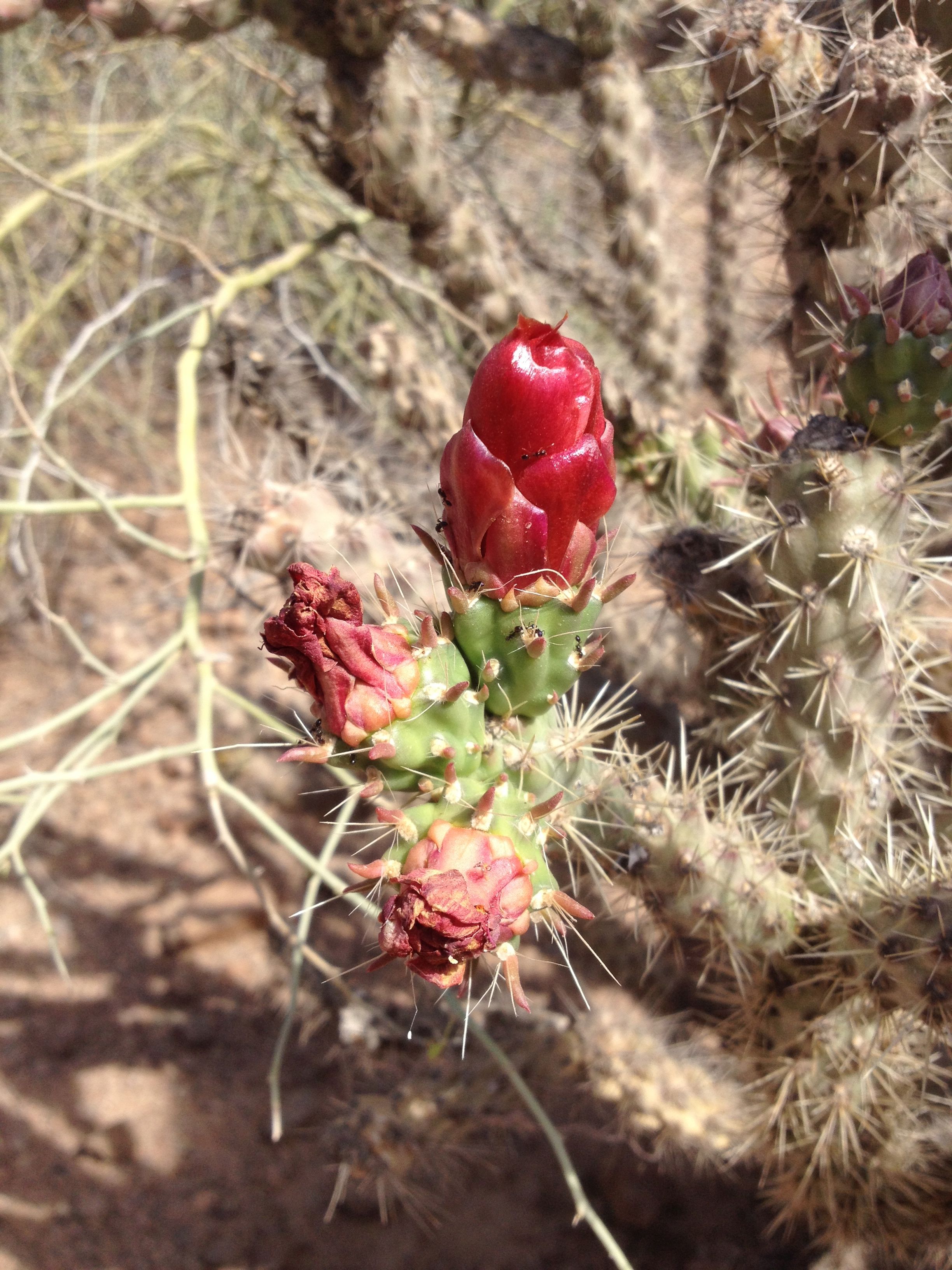
Staghorn cholla bud about to open, with ants enjoying extra-floral nectaries (MABurgess photo)

Staghorn cholla bud about to open, with ants enjoying extra-floral nectaries (MABurgess photo)


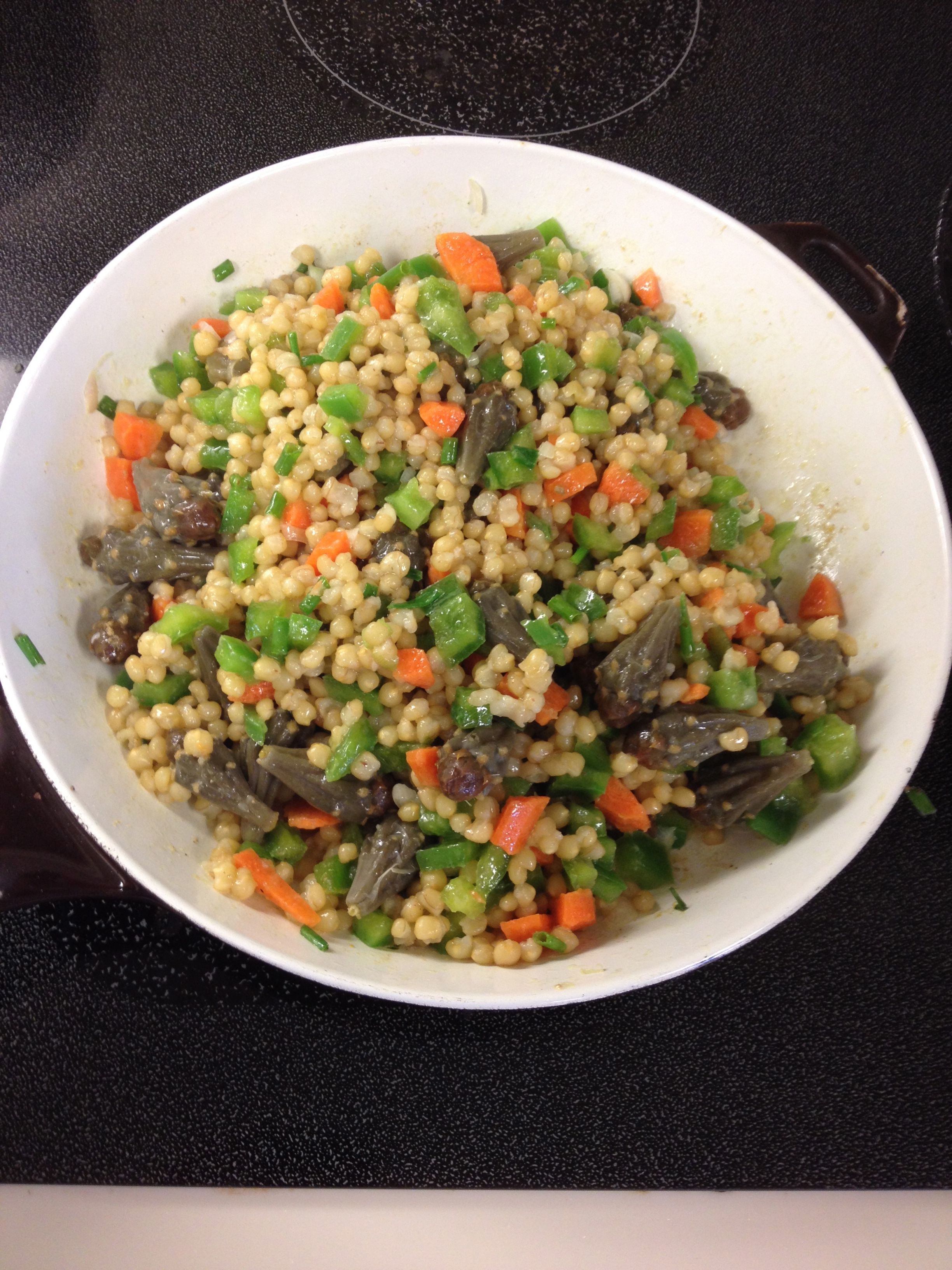
Wheatberry salad with cholla buds--an April delight (MABurgess photo)

Wheatberry salad with cholla buds–an April delight (MABurgess photo)

With cholla bud season in full swing, it’s a great time to make a marinated wheatberry and cholla bud salad for a refreshingly cool hot-weather dish. Marinate cooked wheatberries in your favorite dressing, chop fresh veggies and add cooked cholla buds—and voila you have flavor, fun, and nutrition!

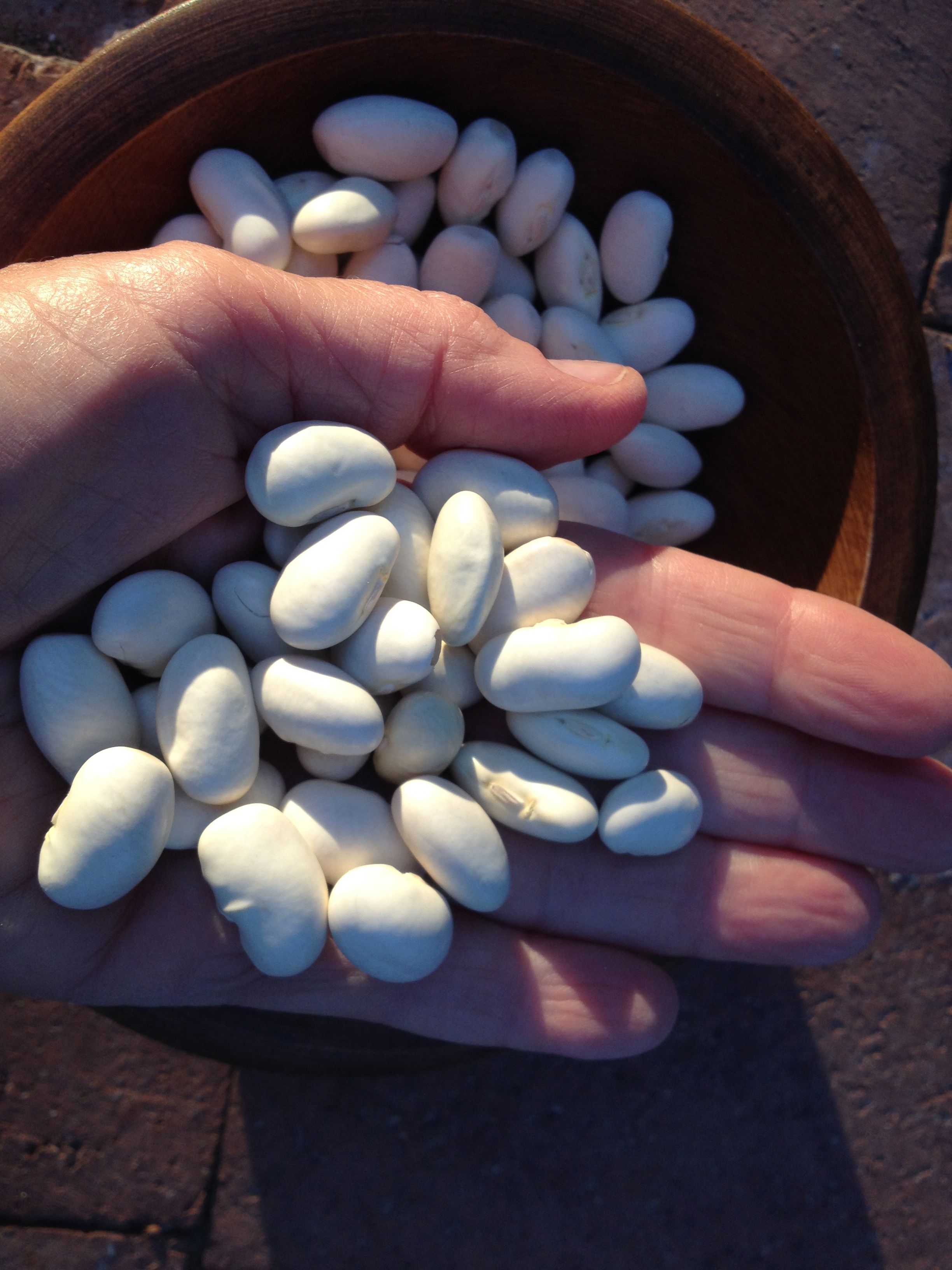
Giant Aztec white runner-beans, aka bordal and "mortgage lifter" (MABurgessphoto)

Giant Aztec white runner-beans, aka bordal and “mortgage lifter” (MABurgessphoto)

With the sap rising, and the gardening bug tugging at you, now is the perfect time to sew seeds of two very special long-season beans—the Tarahumara scarlet runner (see top of post) and the Aztec white runner (available at http://www.nativeseeds.org).   (Note: white runners looking like small Easter eggs are also referred to as “bordal” and, similar to the tomato by the same name, “mortgage lifter.”  If you can baby your young plants thru the heat and drought of May and June into monsoon growth, both of these beans will give you not only great food next fall but also glorious ornamental vines until then. Trellis them on the east side of your house or a wall for eastern light and protection from the blasting western sun. Hummingbirds will love you as they visit both the brilliant scarlet flowers and even the white flowers.

May your garden and your table be blessed with the fruits of the desert, bringing rebirth of good nutrition to the land and to our greater community of creatures and cultures!

Wondrous Weeds!

Tia Marta here to share ideas about our new neighbors—the weedy greens popping up all around us.  With those fall rains we had here in the low desert, there is a bloomin’ haze of green on the desert floor– not what you’d call a florid show—but wait—what is happening where November’s mud-puddles were collecting?  That may be real food lurking in your own backyard!  Now is prime time to take advantage of spontaneous tender mercies and phytonutrients.  Interesting tastes await us, to spice up our salads and bedeck our burritos.

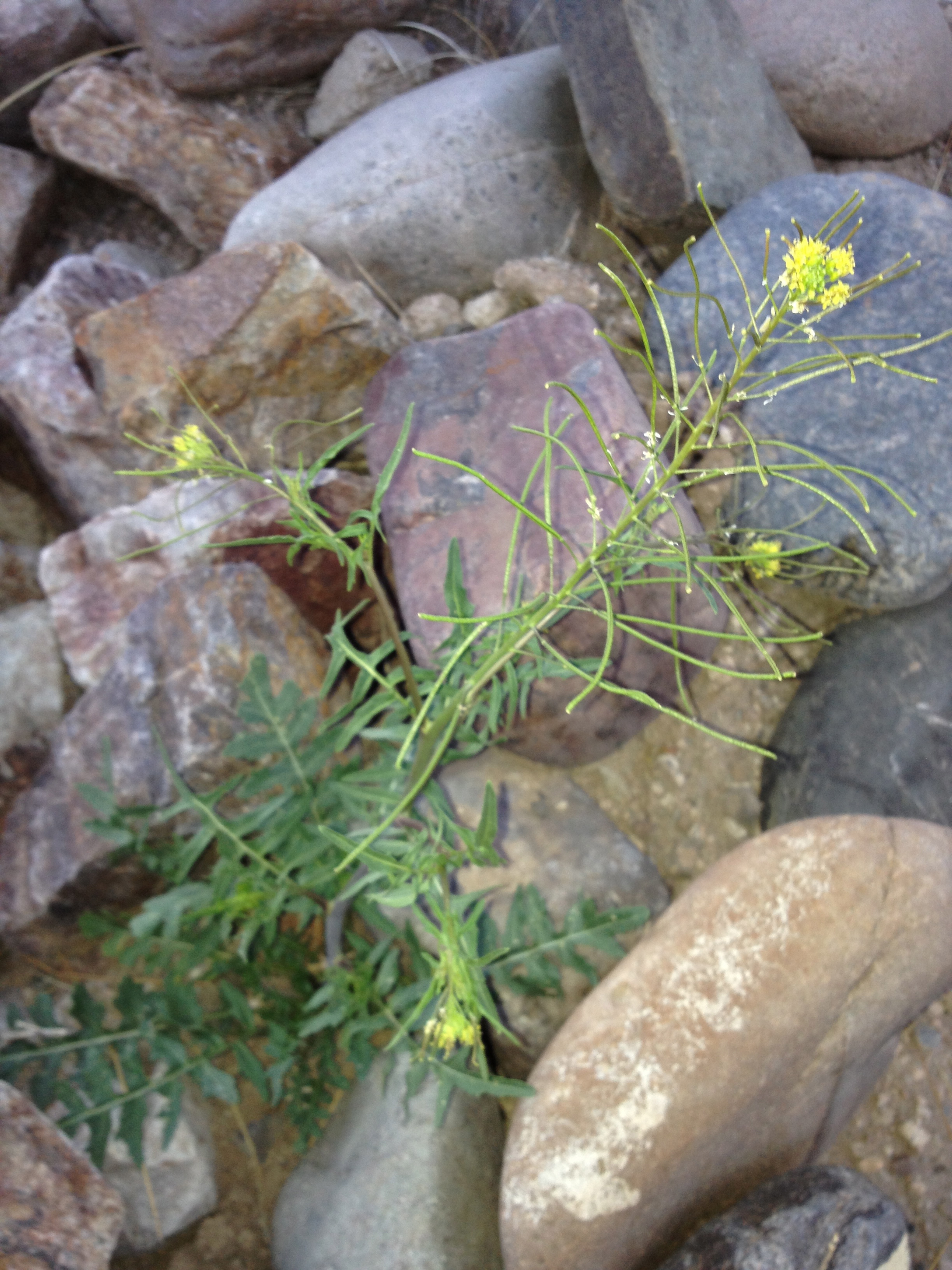
"Wild arugula” or London rocket (Sisymbrium irio) provides zesty greens, flower garnish, and later, mustard seeds when mature. (MABurgess photo)

“Wild arugula” or London rocket (Sisymbrium irio) provides zesty greens, flower garnish, and later, mustard seeds when mature. (MABurgess photo)

London rocket (read “wild arugula”) is everywhere, its greenery literally growing before our eyes in every low swale, rocky hillside, every ditch where water has run.  Sisymbrium irio is an introduced weed which we can enjoy with impunity—the more we eat of them the more we are removing competition for our beloved native plants.  So harvest away!  (A good rule of thumb is to collect at least 50’ from a road.  No need to ingest road dust and pollutants when there is so much to be found in friendly yards or out in the des.)

Prepare for a picante treat, sometimes a picante bite, from these wild mustards.  Toss a few wild arugula leaves with baby greens, or in a BLT to liven it up.  Try them steamed with your favorite garden greens or added to stir-fry.

Hot February weather is telling our wild mustards, “Summer’s coming.  Better go ahead and bloom fast!”  Already we see tiny 4-petaled yellow flowers rising from the rosettes of deeply lobed leaves.  Small erect spikelets of seedpods (called siliques) stand out from the central stem.  Whole flower heads with seedpods are edible, and zingingly picante.  Sooner than we think, seedheads will mature and you can harvest their tiny mustard seeds for dressings or salad sprinkles.

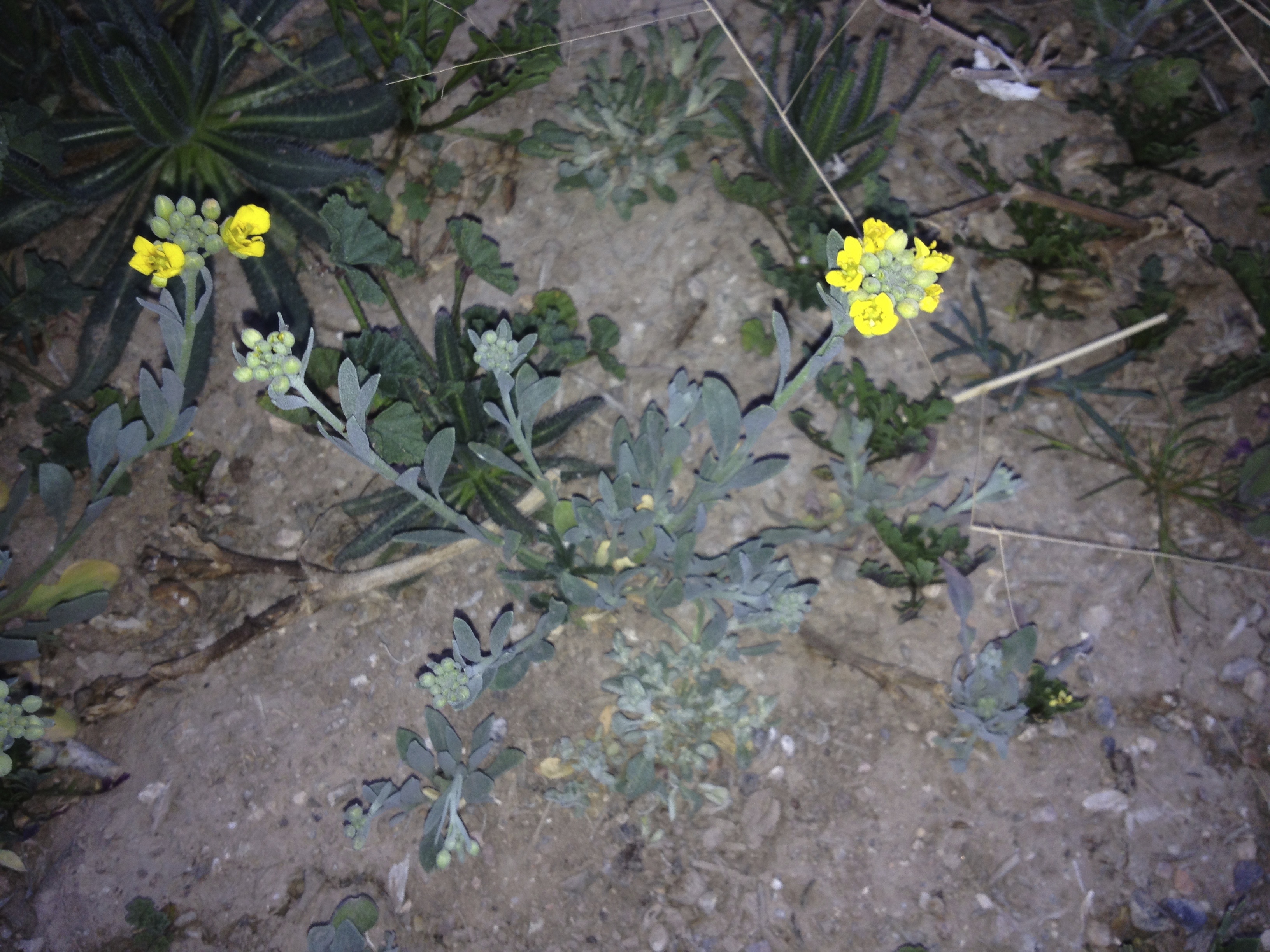
This year, if you spy Lesquerella gordoni (bladderpod), it will stand out like little yellow stars on the bare ground. (MABurgess photo)

This year, if you spy Lesquerella gordoni (bladderpod), it will stand out like little yellow stars on the bare ground. (MABurgess photo)

In some wet winters, a different native mustard known as bladderpod has made carpets of lemon-yellow flowers on the desert floor.  No such show this year.  Should you find a patch of blooming bladderpod, try a taste of its petals.  Their nice nip will add vivid color, nutrition, and excitement to any salad, garni, or burrito topping.

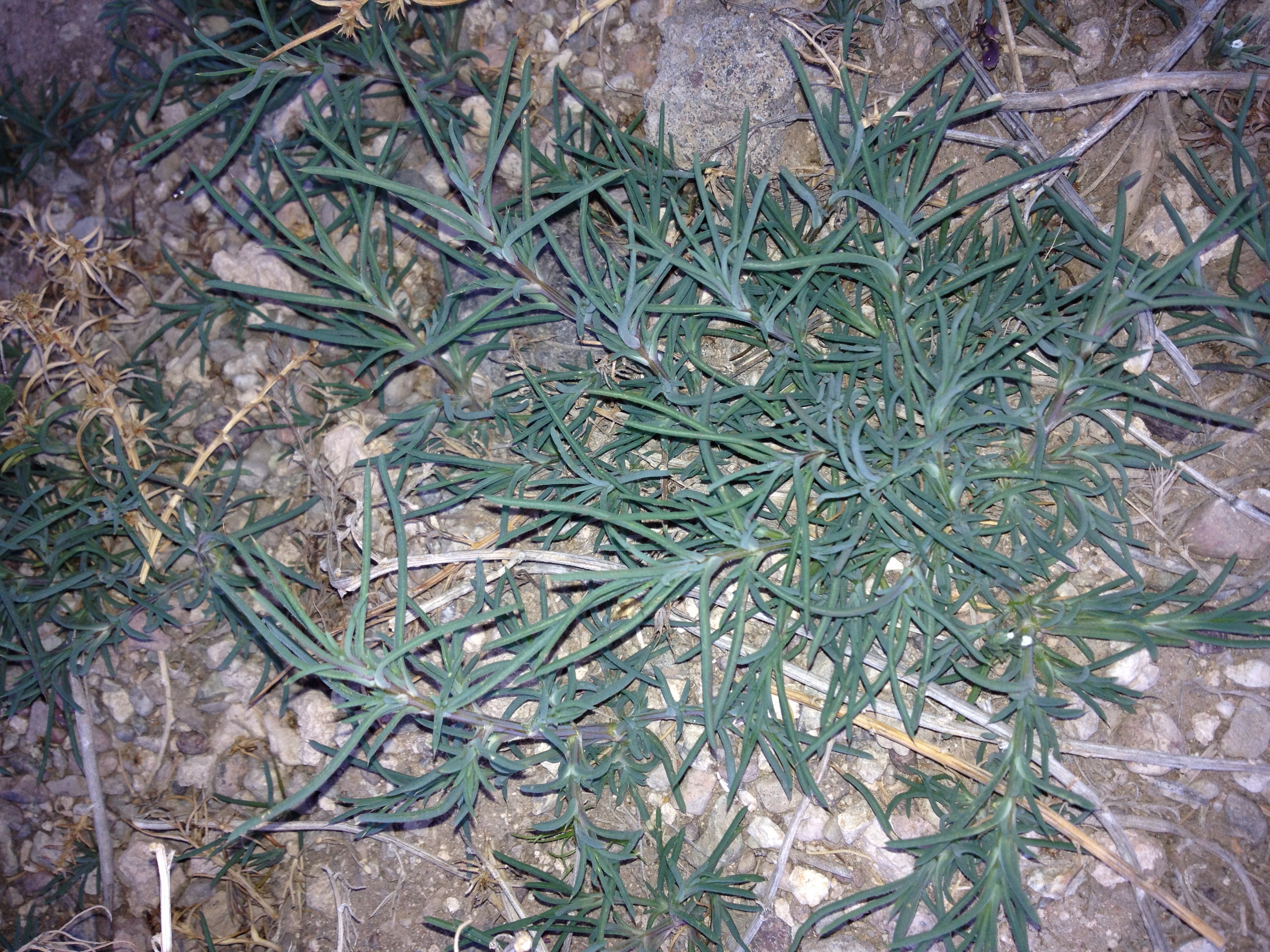
Better known as tumbleweed, Russian thistle (Salsola kali) is best harvested in this tender stage—and every rancher will thank you for your service! (MABurgess photo)

Better known as tumbleweed, Russian thistle (Salsola kali) is best harvested in this tender stage—and every rancher will thank you for your service! (MABurgess photo)

The most ubiquitous of weeds is the introduced Russian thistle which no one seems to notice until it dries, dislodges, tumbles across the road on a crosswind, and stacks up next to a fence or obstacle.  So now, while it is in its infancy, go out to that windbreak and find its progeny!  Have no compunction about snipping it at ground level while it is only inches high, young, and tender—before sharp stems develop making it unpalatable to humanoids.  You will be amazed at what it adds, snipped in short pieces fresh in a salad, steamed with butter and pepper, or stir-fried with other veggies.

Our many species of saltbush (Atriplex spp.) are tender and ready for picking in late winter into spring. (MABurgess photo)

Our many species of saltbush (Atriplex spp.) are tender and ready for picking in late winter into spring. (MABurgess photo)

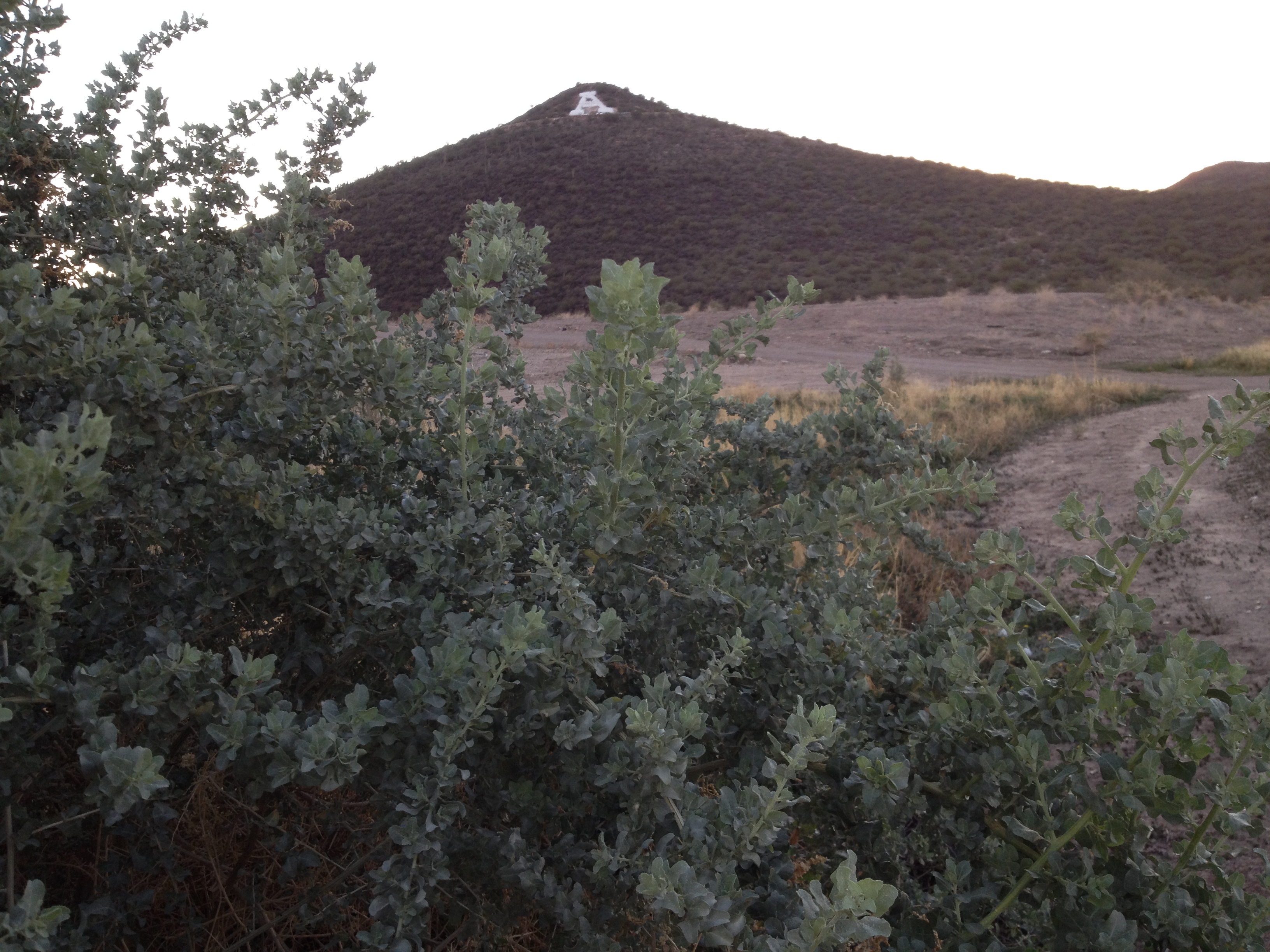
Find saltbush's gray greenery along the Santa Cruz floodplain--or plant it in your yard for wildlife habitat. (MABurgess photo)

Find saltbush’s gray greenery along the Santa Cruz floodplain–or plant it in your yard for wildlife habitat. (MABurgess photo)

Now is saltbush’s time to shine—in landscaping and in cuisine.  Here in Baja Arizona there are many species of Atriplex, and all are edible.  These tough shrubs are desert survivors for sure.  They tend to grow in “waste places” where hardly any other plants can make it.  The name saltbush indicates its habitat, where soil is salty,heavy, or full of caliche.  Quail and other creatures find refuge and forage in the dense shrubs.  If you want to attract birds into your yard, go to Desert Survivors Nursery, Tucson, and buy any saltbush to plant—then stand back.  We humans can join in the saltbush foraging guiltlessly, as saltbush is plentiful and our harvesting may even stimulate re- growth.

Nearly every Native nation in the Southwest has a tradition of using saltbush in multiple ways.   When its stiff salty leaves are youthful they can be picked for cooking with other greens, the style of traditional Akimel O’odham, the River Pima.  My Tohono O’odham teacher Juanita would steam saltbush with cholla buds, and told me how “the old people would roast their cholla buds in layered beds of ontk i:wagi [salt spinach].”  Hopi cooks make a kind of baking powder out of pulverized saltbush foliage.

Try young saltbush leaves cooked with heirloom cannelini beans or cranberry beans—for a flavorful variation on beans-and-greens.  You’ll find that the salts which the plants have sequestered from the soil will add a delicious desert flavoring.  Move over, Hawaiian sea-salt!  (After saltbushes have flowered, we will “talk seeds”—stay tuned….)

NativeSeeds/SEARCH (www.nativeseeds.org) and Mission Garden (www.tucsonsbirthplace.org) carry seed of a domestic relative of saltbush called “orache” which provides a purple-leafed “green” for a winter veggie garden.

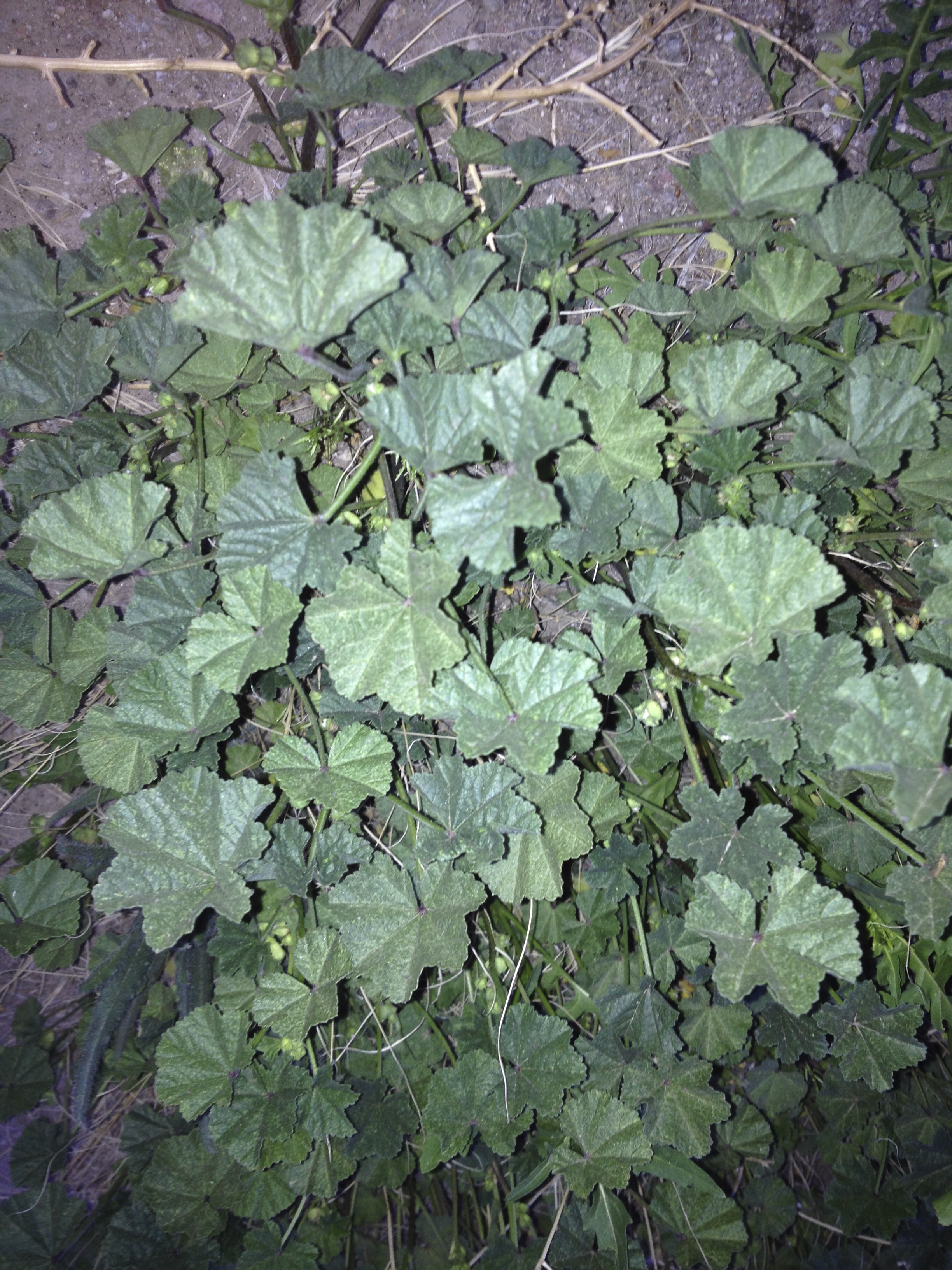
Did you ever contemplate cheeseweed thru the day? (Are you kidding?) Its palmate leaf is a sun-tracker!  I discovered these young Malva neglecta in late afternoon with each leaf bent westerly, cupped, facing the setting sun.(MABurgess photo)

Did you ever contemplate cheeseweed thru the day? (Are you kidding?) Its palmate leaf is a sun-tracker! I discovered these young Malva neglecta in late afternoon with each leaf bent westerly, cupped, facing the setting sun.(MABurgess photo)

Ah, cheeseweed—the “scourge” of gardeners, when it gets established.  Malva or cheeseweed, so called for its cheese-wheel shaped seed pod, is another one of those introduced weeds which tend to follow humans.  Only harvestable when young– get it while you can.  You’ll find it in disturbed flat areas where stock or off-roaders have churned up the natural soil, along fencelines or untended sidewalk margins.  Beware, cheeseweed seems to be sought-after by wandering dogs as a “marker plant” so wash your harvest well.

New Malva foliage can make a nutritious addition to steamed collards, kale, acelgas, or turnip tops; or stir-fried with peppers, onion, and slices of winter squash.  If you want to explore Malva’s medicinal qualities, try the foliage steeped as a tea for soothing tender digestive tract tissue or urinary tract.  It makes a healing topical poultice as well.

Life-giving weeds are all around us, especially now with their ju-ju rising.  Really no one need be hungry here.  We’d all be healthier if we were eating more of these spontaneous gifts brought by Nature and human mobility.  My respect for weeds and knowledge of their goodness outweighs my frustration as I pull them from my garden.  Here’s wishing you happy weed harvesting, a new way of enjoying the pulses of life in the desert!

If you are lucky enough to locate Carolyn Niethammer’s book Tumbleweed Gourmet, Univ. of AZ Press, 1987, grab it!  Find more info about traditional uses of saltbush in Food Plants of the Sonoran Desert by Wendy Hodgson, Univ. of AZ Press, 2001.  Find medicinal uses of Malva neglecta in Medicinal Plants of the Desert and Canyon West, Mus. of NewMexico Press, 1989.  Mission Garden is open on Saturday afternoons for guided tours, and NativeSeeds/SEARCH store at 3061 N Campbell Ave, Tucson, is open daily 10am-5pm.

Visit me, Tia Marta, for more weedy ideas and heirloom beans galore at the Flor de Mayo booth, St Phillips Farmers Market on Sundays 9am-1pm. (www.flordemayoarts.com).

Wonders of White Sonora Wheat Berries

Heirlooom White Sonora Wheat growing at Mission Garden April 2013--Rod Mondt photo

Heirlooom White Sonora Wheat growing at Mission Garden April 2013–Rod Mondt photo

Tia Marta here from Flor de Mayo to share news of an ancient grain newly emerging from its historic quietude as a flavorful and nutritious gift to Southwestern cuisine—a real boon to desert agriculture and health!   I’m talking about the White Sonora Wheat, introduced by Padre Kino, kept alive and well in a Sonoran village for 300 years, “rediscovered” and propagated by Native Seeds/SEARCH plant-sleuths, and at last being grown commercially by a few caring farmers in Baja Arizona.

Fresh harvest of White Sonora Wheat Mission Garden May 2013--Bill O'Malley photo

Fresh harvest of White Sonora Wheat Mission Garden May 2013–Bill O’Malley photo

This particular Triticum aestivum variety is a winter wheat for the desert.  Now is the time to plant it in your own garden plot through February for a later harvest into May and June.

Precious White Sonoran Wheat grain was provided by Native Seeds/SEARCH as a start-up ag experiment to a local grower, BKW Farms, and it has really taken off.  Tohono O’odham Elders may likely remember the Wong family of Marana who provided fresh produce out to the res in the early-mid 1900s.  Now in their 5th generation of attuned farming, the Wong family (as BKW Farms www.bkwazgrown.com ) have turned their attention to growing heirloom wheat—USDA Certified Organic.  Bravo for feeding us well AND improving the soil, air and water!  With their first crop a real bumper, BKW Farms is returning more than twice the wheat seed back to NativeSeeds/SEARCH than the original “starter kit” quantity loaned to them.  Kneaded by the skilled hands of Barrio Bread and BigSkye bakers, their White Sonoran Wheat’s flavor is spreading and exciting many a Tucson palate.  Check out www.barriobread.com and www.bigskyebakers.com .

At our Flor de Mayo farmers market booth, a few wheat-sensitive consumers have reported they are actually not affected by this heirloom wheat.  (Hey, scientists, there is information in its genes and constituents we need to know more about!)

BKWFarms' White Sonoran wheat berries cleaned and ready--MABurgess photo

BKWFarms’ White Sonoran wheat berries cleaned and ready–MABurgess photo

Using whole kernals of wheat in cooking seems to be almost an unknown in modern culinary culture, but health benefits are significant.  For one thing wheat berries are “live food” truly sharing life energy.  Vitamins in the bran and germ are super-active.  In commercial so-called “whole wheat bread” the vibrant living constituents have been removed for transport and storage then added back artificially when baked to make it “whole” again.  By eating the wheat berries whole from the git-go, we can enjoy their full nutrition.   [For local, fresh, the only truly whole flour (no parts removed) milled from White Sonora Wheat commercially available, we are blessed with the new Hayden Flour Mills in Phoenix (www.haydenflourmills.com) providing packaged flour to the NSS store and to Flor de Mayo LLC.] 

Providers of other heirloom wheat berry varieties locally are Ramona Farms (www.ramonafarms.com)  and San Xavier Farm Coop (www.sanxaviercoop.org) with Pima Club wheat, and the NSS Store with faro also known as emmer (www.nativeseeds.org).

I made mini “greenhouses” of recycled clear plastic boxes.  Try rice bowls, berry or hamburger boxes for sprouting. MABurgess photo

I made mini “greenhouses” of recycled clear plastic boxes. Try rice bowls, berry or hamburger boxes for sprouting. MABurgess photo

I’ve been having a wheat-berry “hay-day” in the kitchen with White Sonoran Wheat berries.  Here are a few appetizing ideas to introduce wheat berries into your culinary repertoire:

Sprouted White Sonora Wheat Berries:

Sprouts will take about 3-4 days until ready.  Plan on rinsing them daily.  Soak 1 tablespoon of wheat berries overnight in a jar.  Prep “greenhouse” box with coffee filter or paper towel cut to size to prevent grains from passing thru any holes as a strainer.  Pour wheat berries into “greenhouse” box, wash and drain.  Place box on a dishtowel out of direct sunlight.  Rinse and drain them twice a day to keep them from getting sour.  Within 2 days you will see rootlets like tiny white spiders forming.  By the third day greenish stems will rise.  That’s when they are ready to eat.  Try sprouts as a surprise snack—you won’t believe how its relatively blah starch can change with the magic of living enzymes into the sweetest pleasant sweet you ever tasted!  To slow down growth of young wheat sprouts put “greenhouse” box in frig.  You can snip or “mow” elongating wheatgrass and add it to green drinks or smoothies.  Separate wheat sprouts and toss them in salads.  With a hand-crank masa-grinder (such as the one sold at Native Seeds/SEARCH store) grind them fresh to add flavor and texture to bread-baking.  [I will be interested you hear your wheat sprout ideas too!]

White Sonora Wheat berry sprouts at 5 days

White Sonora Wheat berry sprouts at 5 days

Cracked Wheat Berries–Speaking of grinders—a masa grinder or meat grinder can be used to crack dry wheat berries for cooking bulgar dishes.  If you have a stone-burr hand mill, White Sonoran Wheat berries mill to a beautiful flour for baking.  Keep your ear to the ground about upcoming wheat-berry milling events to be announced with my new WonderMill…..

Basic cooking directions for Whole Wheat Berries:  (Simply cooking wheat berries ahead makes some tasty recipes a breeze!)

1) Rinse 1 cup dry White Sonoran Wheat berries to remove any chaff or grit.  Drain.

2) In saucepan cook washed wheat berries with 3 cups drinking water and ¼ tsp sea salt.  Bring to a boil then reduce to low simmer.

3) Check berries after 30 minutes, adding more water if necessary to cover.  Taste for doneness every 5-10 minutes thereafter.   When done, berries should be round, fully plump, softly chewy (beyond al dente) with no white starch remaining.  It may take 45 minutes to an hour to finish taking up water, i.e. to be fully cooked.  One cup dry wheat berries yields about 4 cups of cooked wheat berries.

Then…you can eat hot wheat berries right away (or zap them later) as a hot cereal.  Or, refrigerate them for up to a week for use in pilaf or marinated salads—recipes follow….

wheat berry cereal makes a wonderful hot breakfast

wheat berry cereal makes a wonderful hot breakfast

Berry-Delish Hot Wheat Berry Cereal

1 cup hot white Sonora wheat berries cooked

2 T dry blueberries and/or dry cranberries

1 T chopped walnuts or pecans (optional)

Pinch of sea salt

½ cup warmed milk, rice milk or almond milk

1 pat of butter on top (optional)

Serve hot and enjoy the soft crunchiness.  My elderly mother got a nostalgic look of bliss after tasting this hot wheat berry cereal, saying that it reminded her of what her mother served her as a young child.

hot and tasty White Sonora Wheat berry pilaf-MABurgess photo

hot and tasty White Sonora Wheat berry pilaf-MABurgess photo

Perfect Wheat Berry Pilaf

In  2+ Tablespoons flavored olive oil, sautee 1-2 cups chopped fresh vegetables, such as red onion, yellow or winter squash, red sweet pepper, carrots, celery, greens (optional).

When veggies are al dente in the pan, add 2 cups cooked wheat berries to the mix and 2 more tablespoons flavored olive oil.  Stir-fry until hot through.

Add 2 T pine nuts (optional—they won’t show) and 1 T chopped tops of I’itoi’s Onion (or chives)

Dress with salt, pepper, and spices, such as Santa Cruz Chile and Spice Company’s “zapp.”  Serves 3-4 generously.  Enjoy!

[A cool idea is to make extra pilaf (more than recipe) and chill it to use later as a flavorful salad.]

Wheat Berry Salad Supreme

Marinate 2 cups cooked wheat berries in your favorite Italian, balsamic, or Asian dressing overnight (8-12 hours) then toss with fresh chopped romaine, carrots, celery, sweet peppers, olives.  Serves  4.  As Mom says, “It’s so chewy—you know you’ve eaten something!”

*                                                                 *                                                                    *                                                                     *

Three cheers –for our local seed-savers and growers bringing this ancient grain afresh to our tables!  For our local bakers helping it rise again!  And for our creative Baja Arizona chefs honoring pre-industrial wheat with their culinary alchemy!

Local, heirloom, organic—wow, what more could we ask?  That is White Sonora Wheat.  Come taste a White Sonora wheat berry sprout.  Stop by and see me, Tia Marta, at the St. Phillip’s Sunday Farmer’s Market where I’ll have the BKW organic White Sonoran Wheat berries for sale in 6oz and 1 kilo size packages ready to use.   Or you can find them packaged at the Native Seeds/SEARCH Store, 3061 N Campbell, Tucson.  Order online at www.nativeseeds.org.  Please visit my website for other desert food products and scheduled events at www.flordemayoarts.com.