The Best Mesquite Brownies

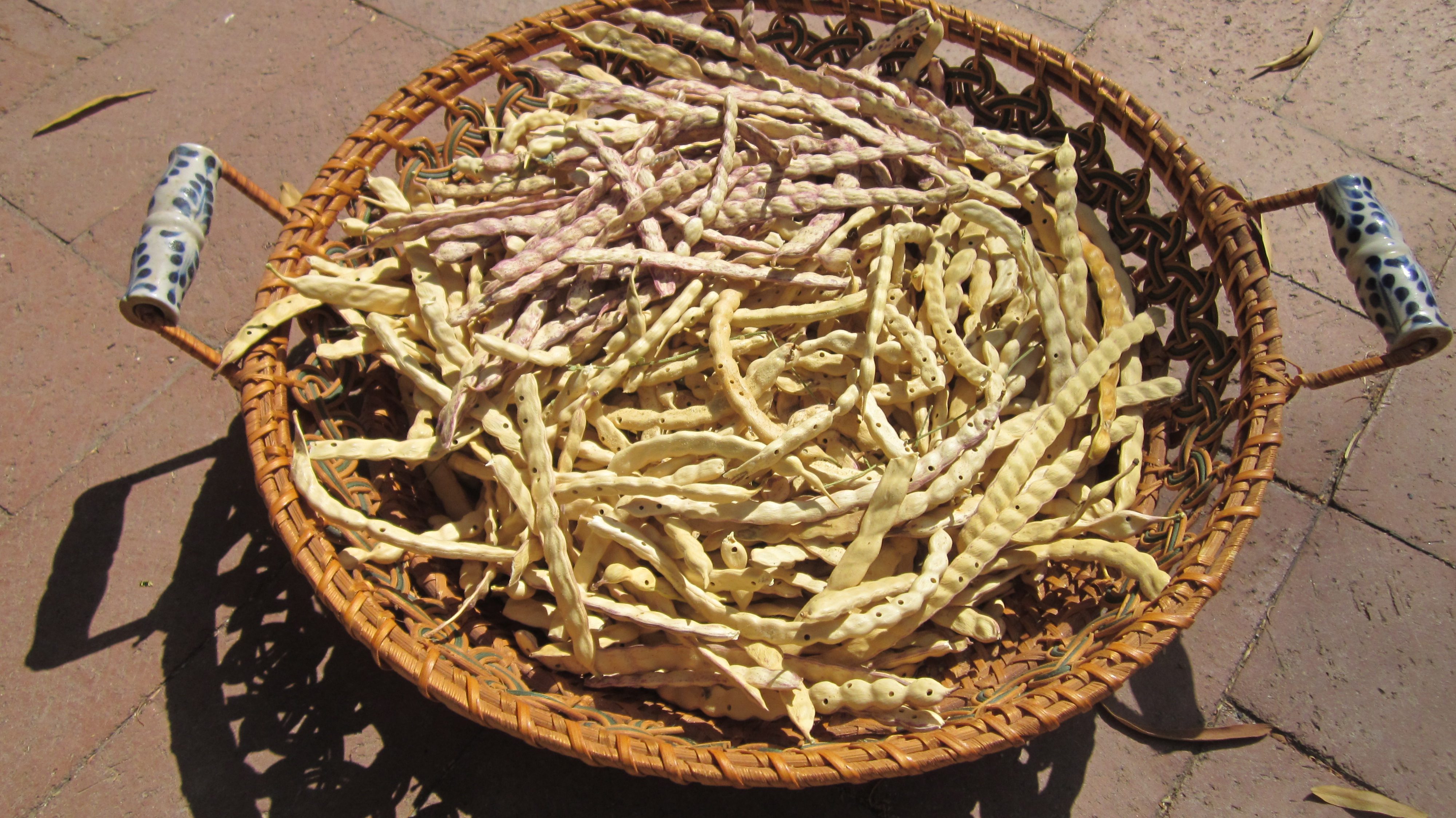
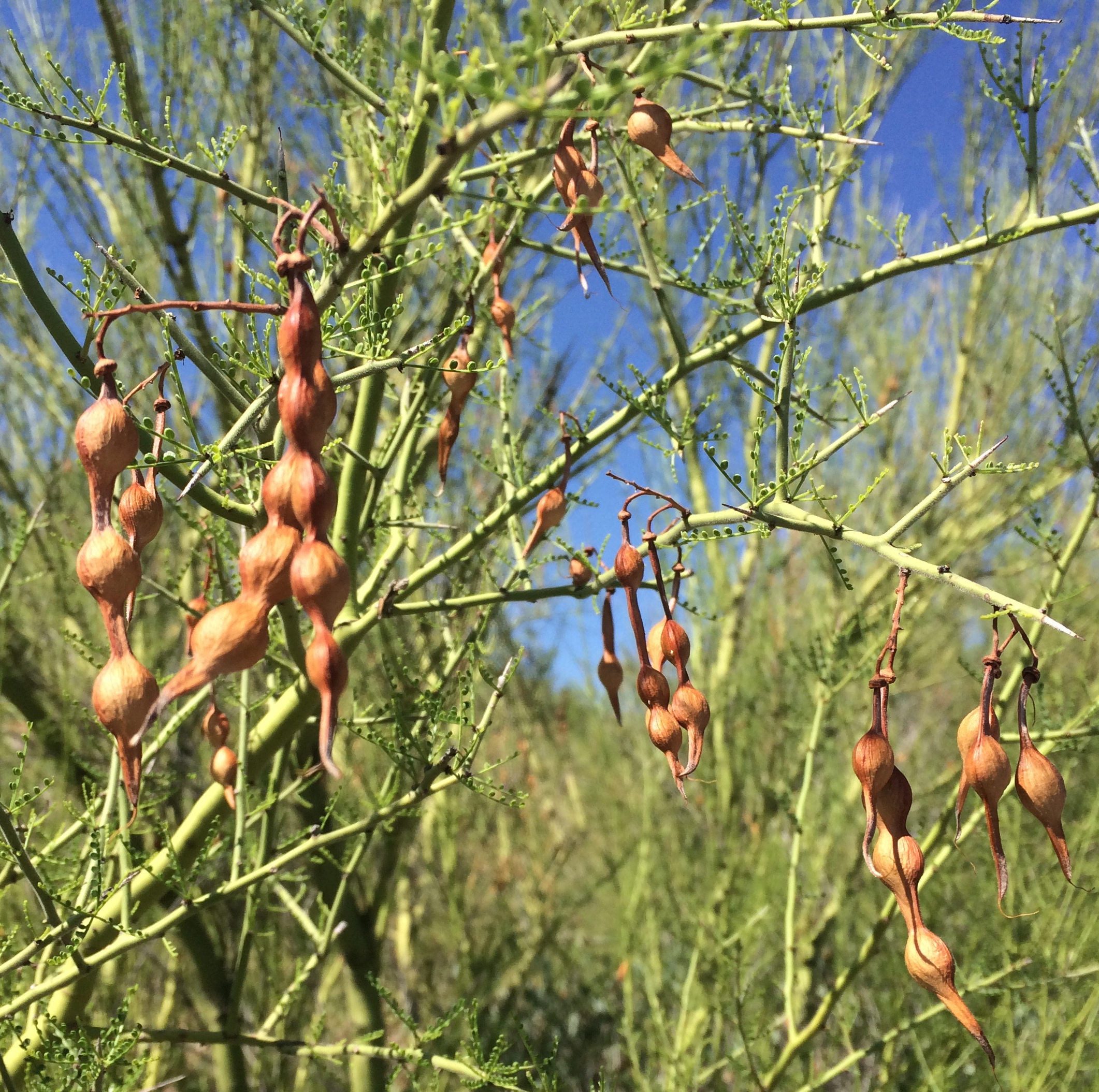
Carolyn Niethammer with you here today talking about one of my favorite subjects, mesquite meal. The first crop of mesquite pods ripened early this year on the lower desert. Here in Tucson, Desert Harvesters sponsored a milling in June. (A milling is this miraculous process of putting whole pods in a hammermill and getting lovely, silky flour at the end.) Because of the early summer rains, there is a huge second crop of pods ripening on the trees now(see the photo above). If you missed the first round, there will be opportunities to get your pods ground in communities throughout Arizona later in the fall after the weather has dried out.

Dry mesquite pods ready for milling.

Dry mesquite pods ready for milling.

So what to do with all that mesquite meal after you have had your fill of pancakes?

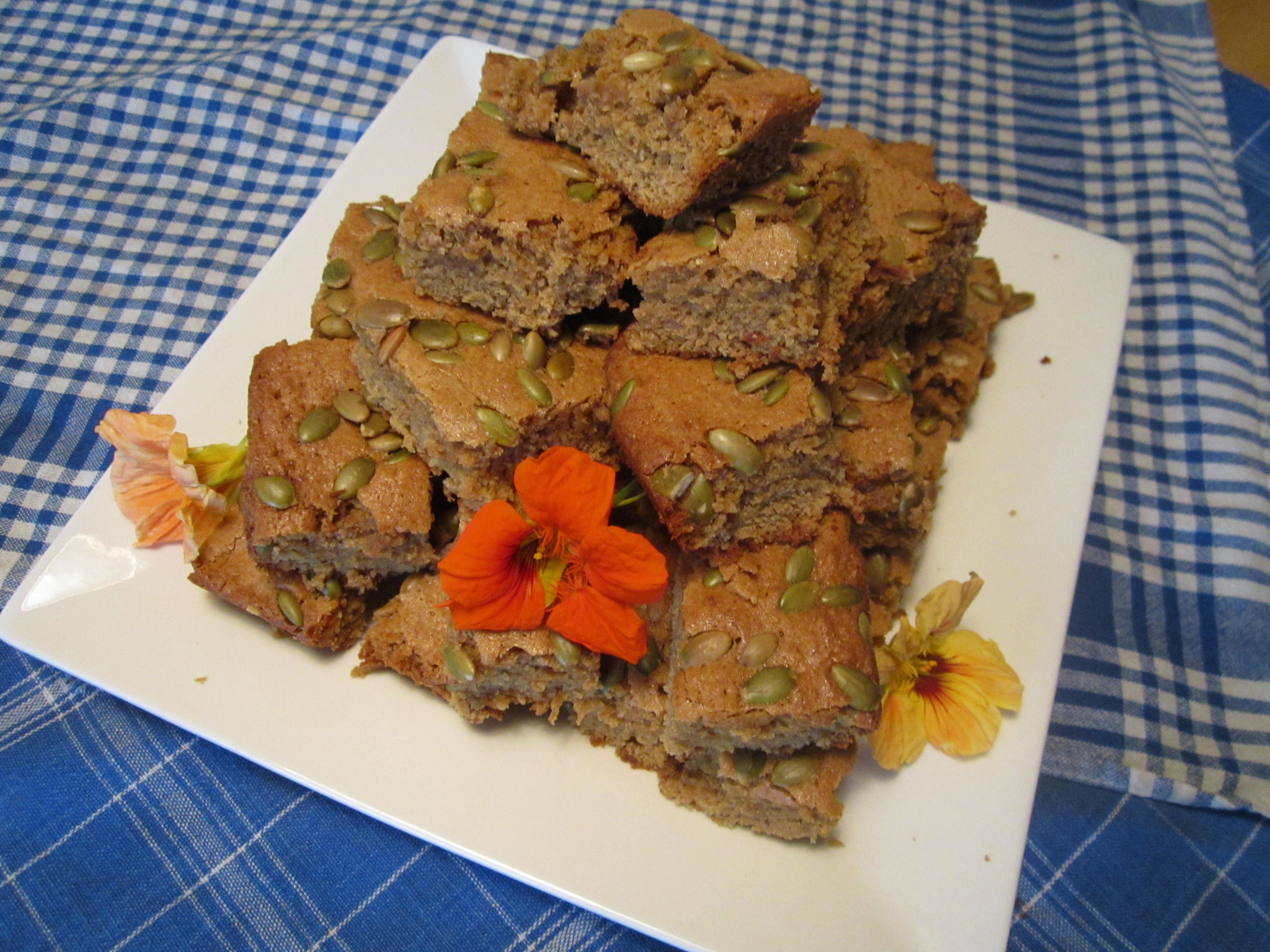
I have been cooking with mesquite pods since the early 1970s and have published in my cookbooks lots of recipes using the ground pods. But until now, I’ve never been completely satisfied with a mesquite brownie recipe. But this one that I made for a potluck at Native Seeds/SEARCH earlier this summer is close to perfect. I used pepitas (hulled pumpkin seeds) because I think the flavor goes well with mesquite, but pecans would work too. If you cannot bear to bake anything without chocolate, feel free to toss in some chocolate chips and maybe a little cocoa powder as well. The familiar warm flavor of mesquite will still come through.

The recipe has a considerable amount of fat and sugar, but those are the ingredients that make up what we consider a proper brownie. Just go easy on how many you eat.

If you aren’t up to making your own mesquite meal, you can purchase it from the Native Seeds/SEARCH retail store or order on-line from NS/S or Flor de Mayo. Mesquite meal is also available at farmers’ markets throughout Arizona.

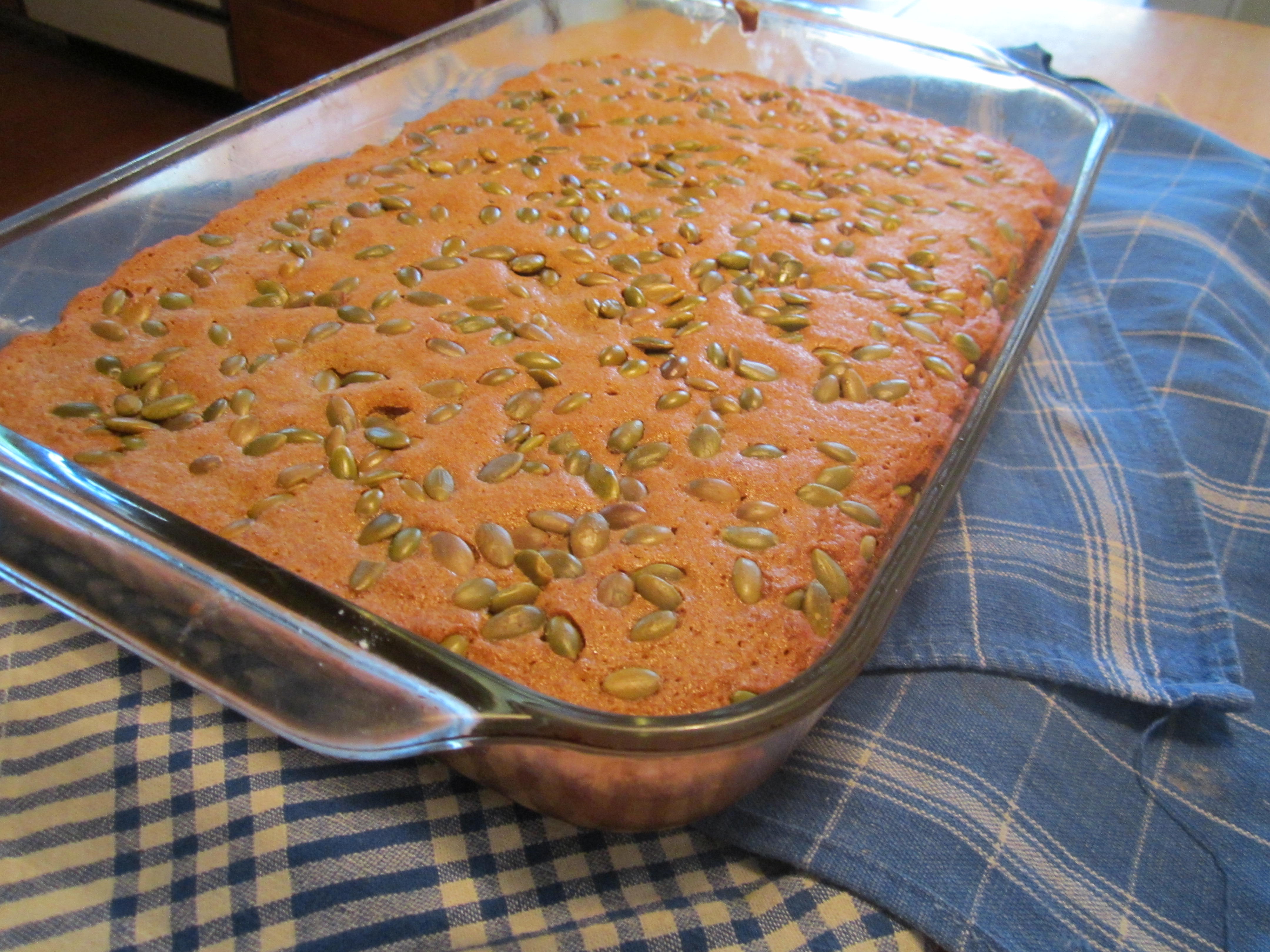
Ummm, don't these look good?

Ummm, don’t these look good?

Best Mesquite Brownies

2/3 cup melted butter

1/4 cup vegetable oil

3/4 cup mesquite meal

2 cups brown sugar

4 eggs

2 teaspoons vanilla extract

1- 1/2 cups all-purpose flour

1 teaspoon baking powder

1 teaspoon salt (if using unsalted butter)

1/2 cup pepitas or chopped pecans

2/3 cup semisweet chocolate chips (optional)

  1. Preheat oven to 350 degrees and grease a 9×13-inch baking pan. Set aside.
  2. In a medium bowl, combine mesquite meal, flour, baking powder and salt if using. Set aside.
  3. Combine melted butter and oil in a large bowl. Stir in sugar and add eggs, one at a time, combining well after each addition. Stir in vanilla.
  4. Stir in mesquite and flour mixture. Add chocolate chips if using.
  5. Spread batter into the prepared pan. Bake at 350 degrees for 25 to 30 minutes or until a toothpick inserted near the center comes out clean. When cool, cut into squares.

__

Cooling in the pan, ready to cut into squares.

Mesquite brownies cooling in the pan, ready to cut into squares.

____________________________

Want more recipes for mesquite meal? Check out my cookbook Cooking the Wild Southwest: Delicious Recipes for Desert Plants available at Native Seeds/SEARCH or from Amazon or B&N.  There you’ll find my favorite recipes for Apple-Mesquite Coffee Cake and a killer Banana Mesquite layer cake.

Promise, Preparedness, Present Fulfillment–with Fruits of the Desert

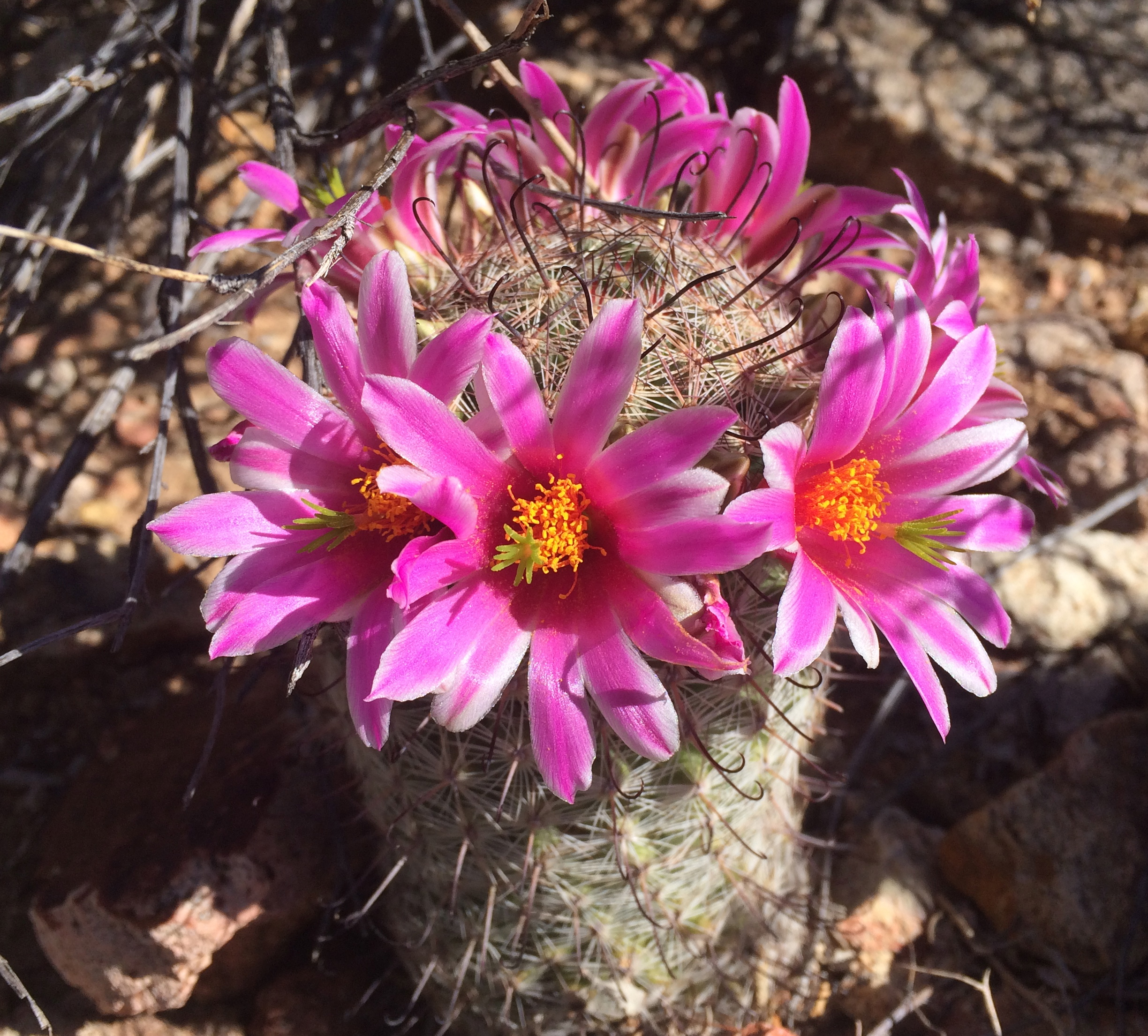
small fishhook Mammillaria microcarpa celebration the monsoon with a promise of future fruitlets (MABurgess photo)

Fishhook Mammillaria microcarpa celebrating the monsoon with a promise of future fruitlets (MABurgess photo)

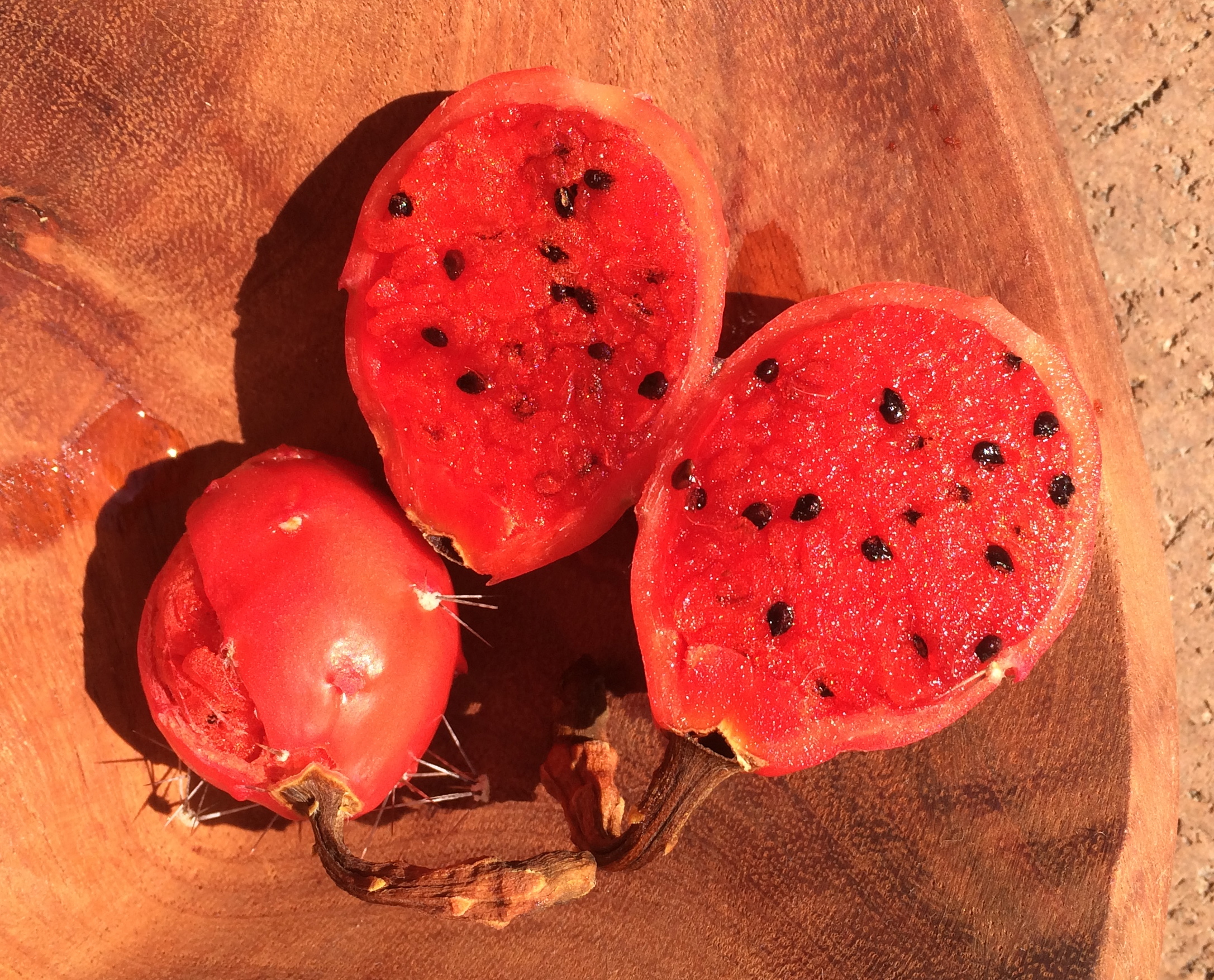
Crowns of Mammillaria flowers make pink arches like miniature 4th of July fireworks now suddenly visible among desert rocks and under greening bursage.  They are rain celebrations–the PROMISES of fruits to come!  In a few weeks the little fishhook pincushions will sport a crown of shiny red fruitlets.  Keep watch for them.  Known in Sonora as pitayita de raton (little mouse’s pitaya), each long red droplet will give you a sweet tangy zing– like a mini-organpipe-cactus fruit.  Tia Marta here to share ways of enjoying the cornucopia that is beginning to spill out flavorfully all around us in town and out in the desert in this monsoon time.

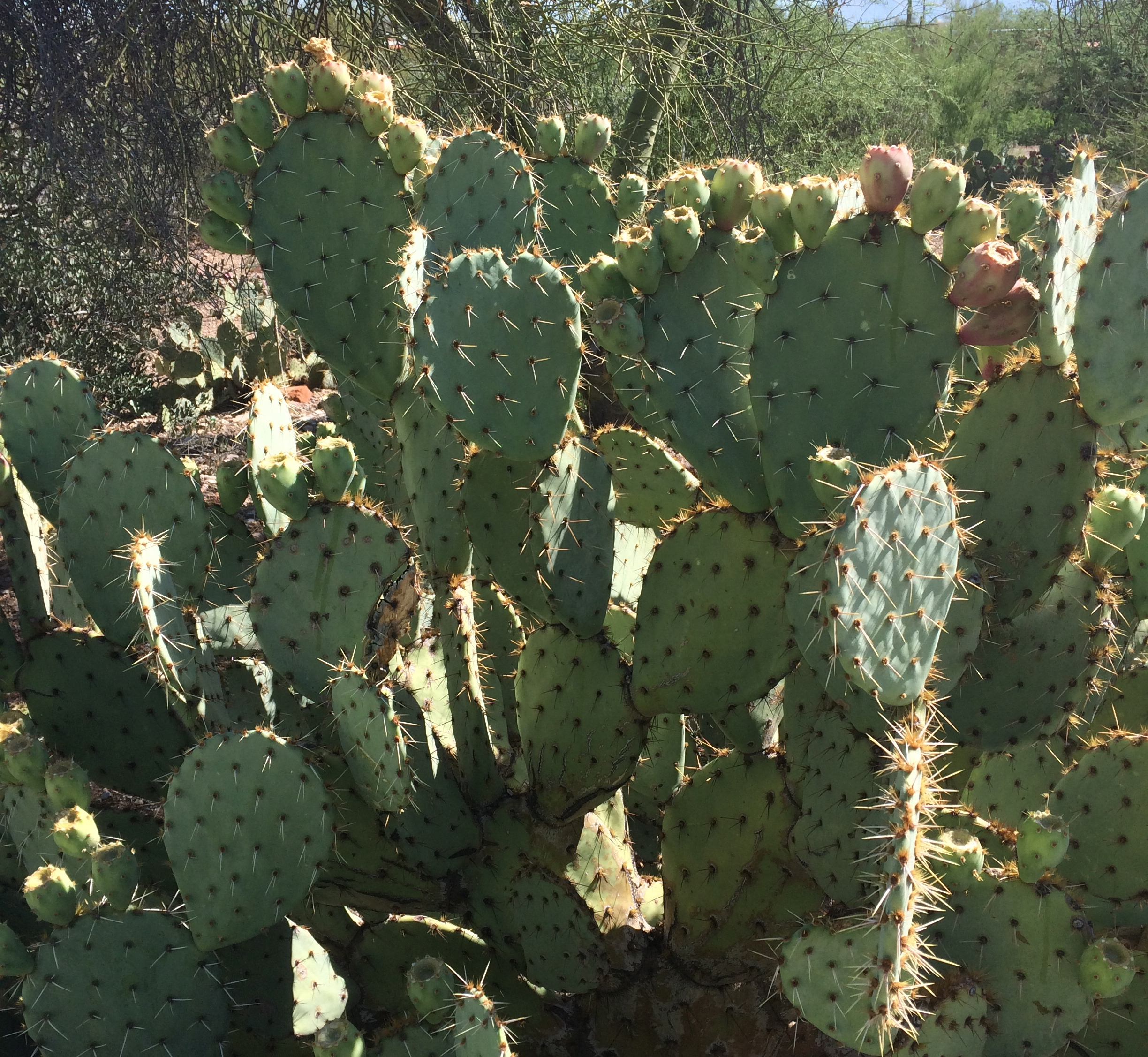
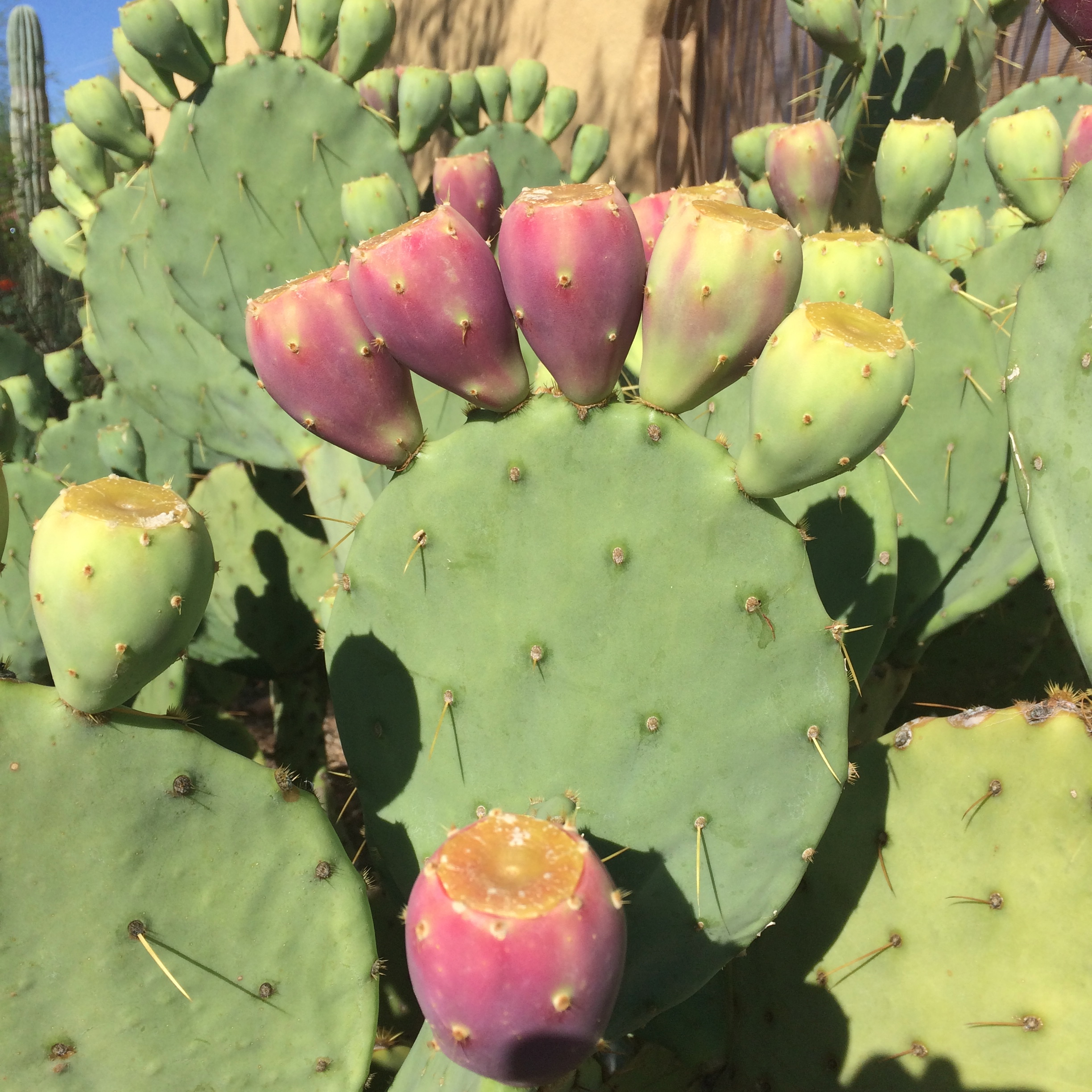
Late fruiting prickly pear--still green and full of promise

Late fruiting prickly pear–unripe green but full of promise this week (July 8)

Opuntia lendheimeri alba barely turning pink--more promises...

Opuntia lindheimeri alba barely turning pink this week–more promises…(July 8)

Opuntia engelmannii in first stages of ripening...

Opuntia engelmannii in first stages of ripening…not yet (week of July 8)

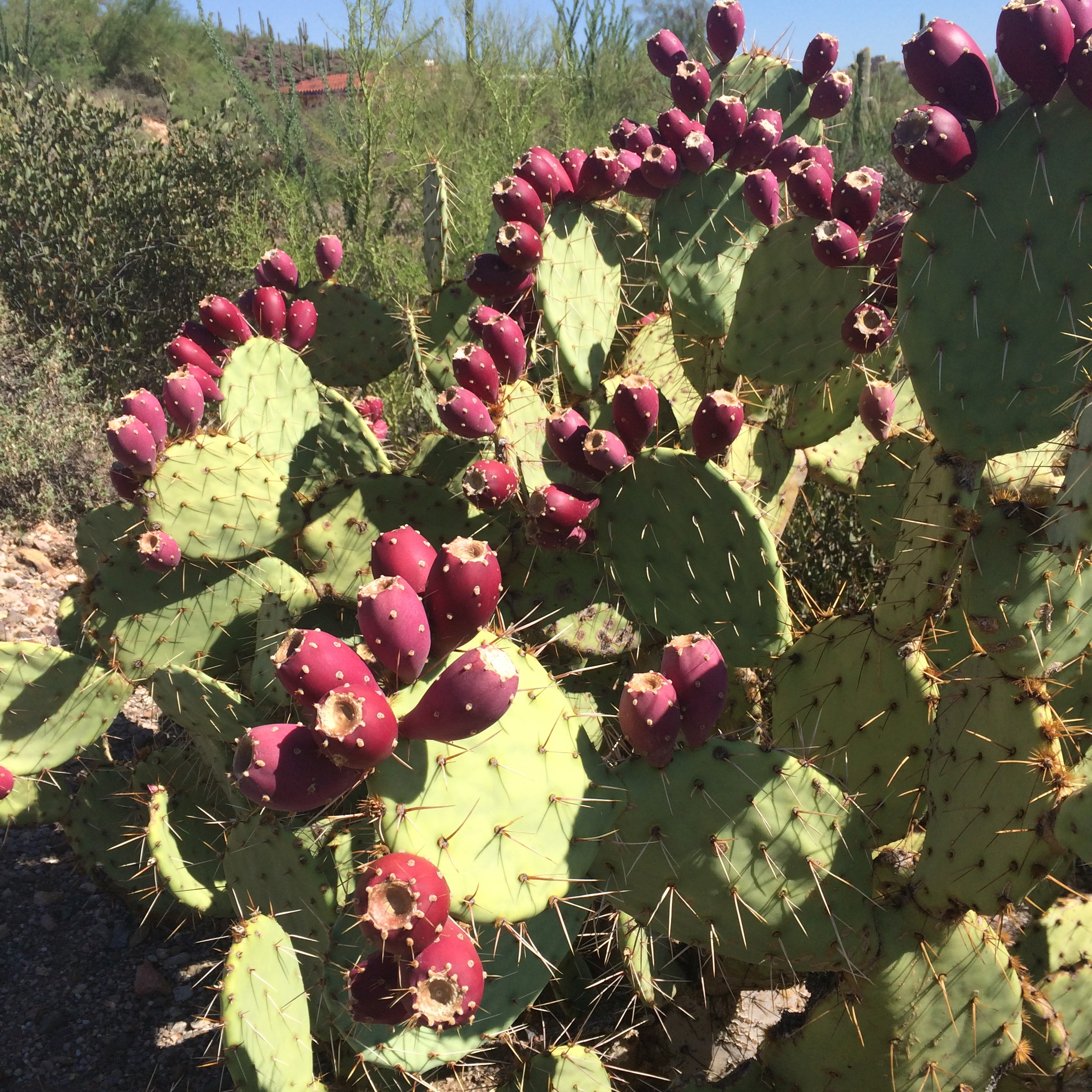
All around the desert and through every neighborhood, I see the promise of a good prickly pear harvest, inspired by our elongated spring and nurtured by good monsoon rain.  Each prickly pear seems to march to a different drummer.  Right now you can see every shade of color–unripe to ripening tunas–very green, to rosy, to deepening red.  These are PROMISES so don’t jump the gun!  They are not ready quite yet–but this is the signal to get your kitchen PREPARED.  Stay tuned–There will be more blog posts to detail prickly pear ideas in coming weeks.  Make space now in your freezer, and make time on your calendar for the August TUNA HARVEST.


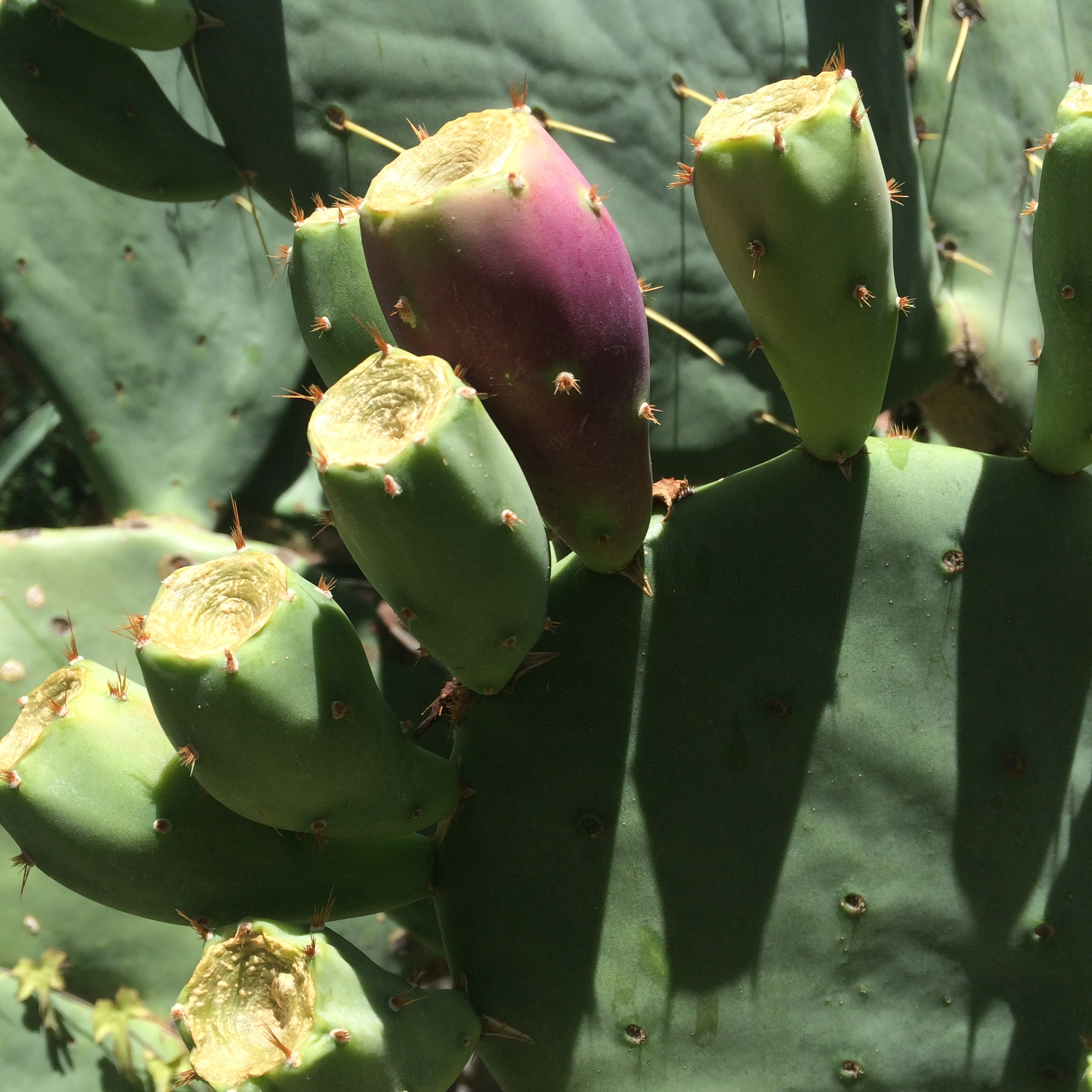
Opuntia engelmannii in full ripening fruit--but not ready yet!

Opuntia engelmannii full of ripening fruit–But don’t salivate yet (week of July 8)!  Wait for a dark maroon color to extend all the way to the bottom attachment of the tuna AND through the tuna‘s entire interior before they are fully ripe and ready to eat or cook.

What a glorious monsoon our Sonoran Desert has enjoyed over the last couple of weeks!  The explosion of life in such a short time is astounding on the heels of record-breaking heat and drought.  This is when the desert shows its tropical heritage with a surge of energy, fecundity, productivity.  Isn’t it interesting that the “outsider’s” view of the desert is of hazardous scarcity?  More interesting instead is to understand and appreciate the waves of nutritious plenty that can erupt suddenly here in the Sonoran Desert.  Native People know how to rally, to harvest in the times of plenty and to store short-lived fruits of the desert against lean times–lessons worth exercising.   Plentiful foothills palo verde seeds (Parkinsonia microphylla) are a case in point.

Mature dry pods of foothills paloverde--They have potential for making flour!

Mature dry pods of foothills paloverde–with potential for making nutritious flour!

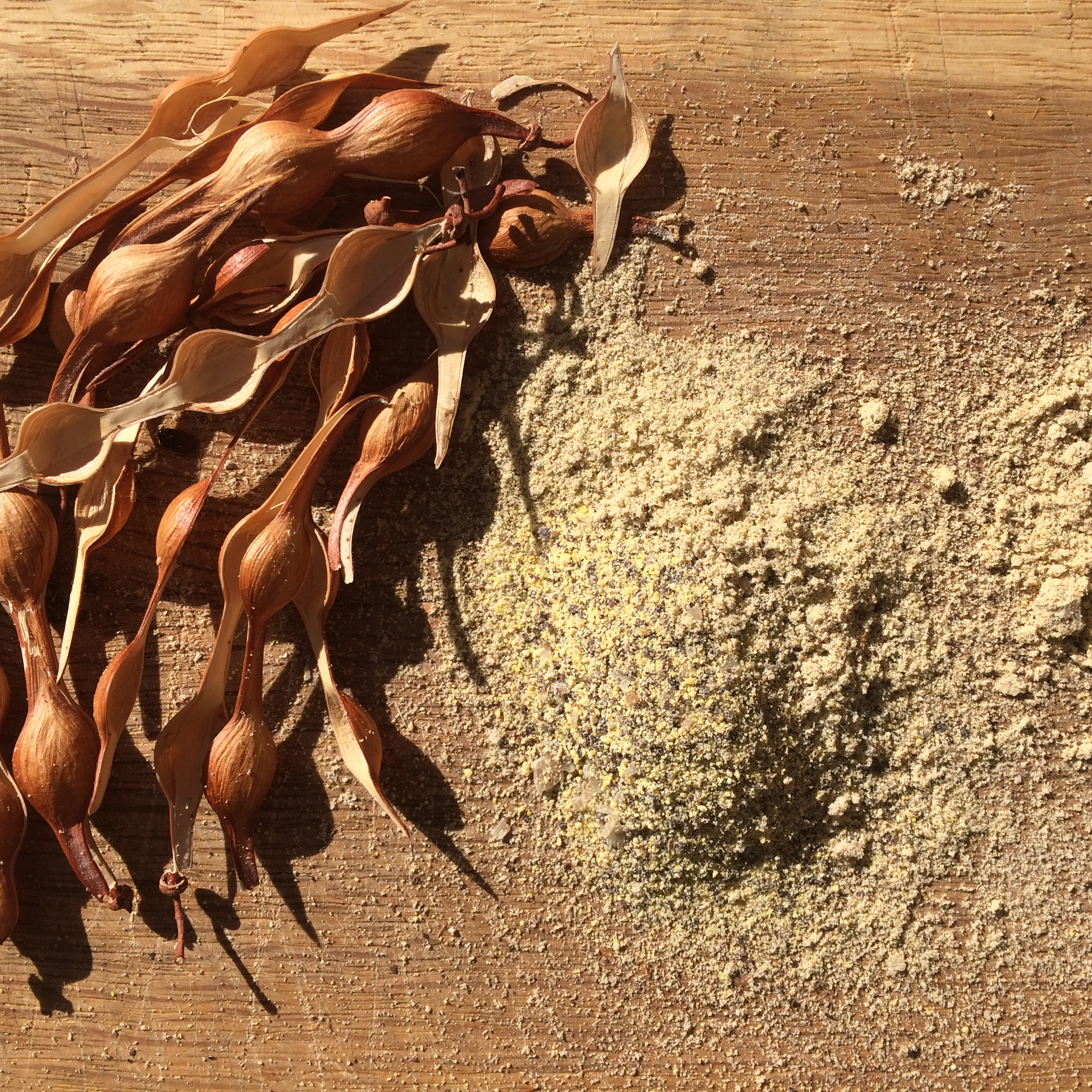
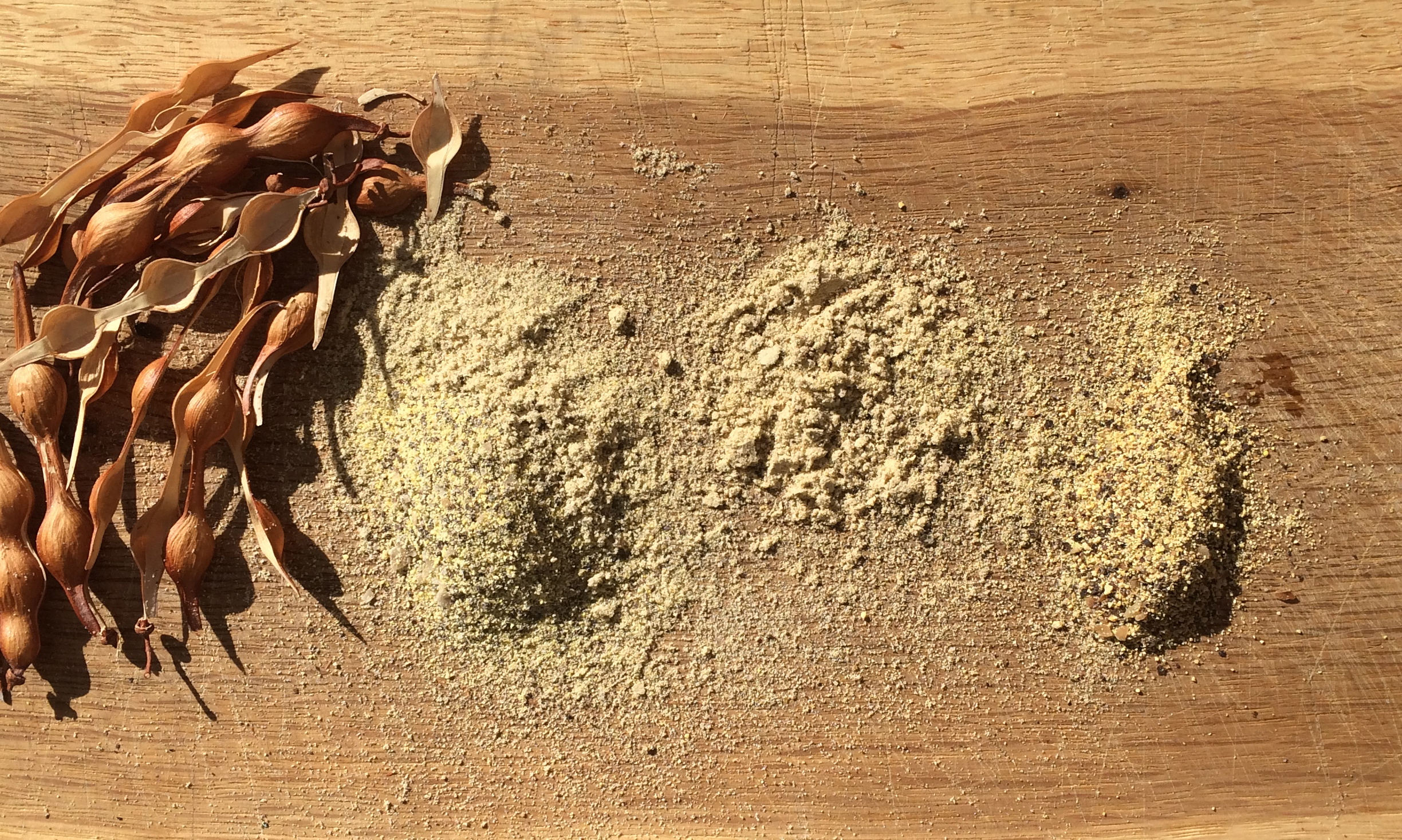
Foothills palo verde seed milled raw for baking

Foothills palo verde seed milled raw for baking

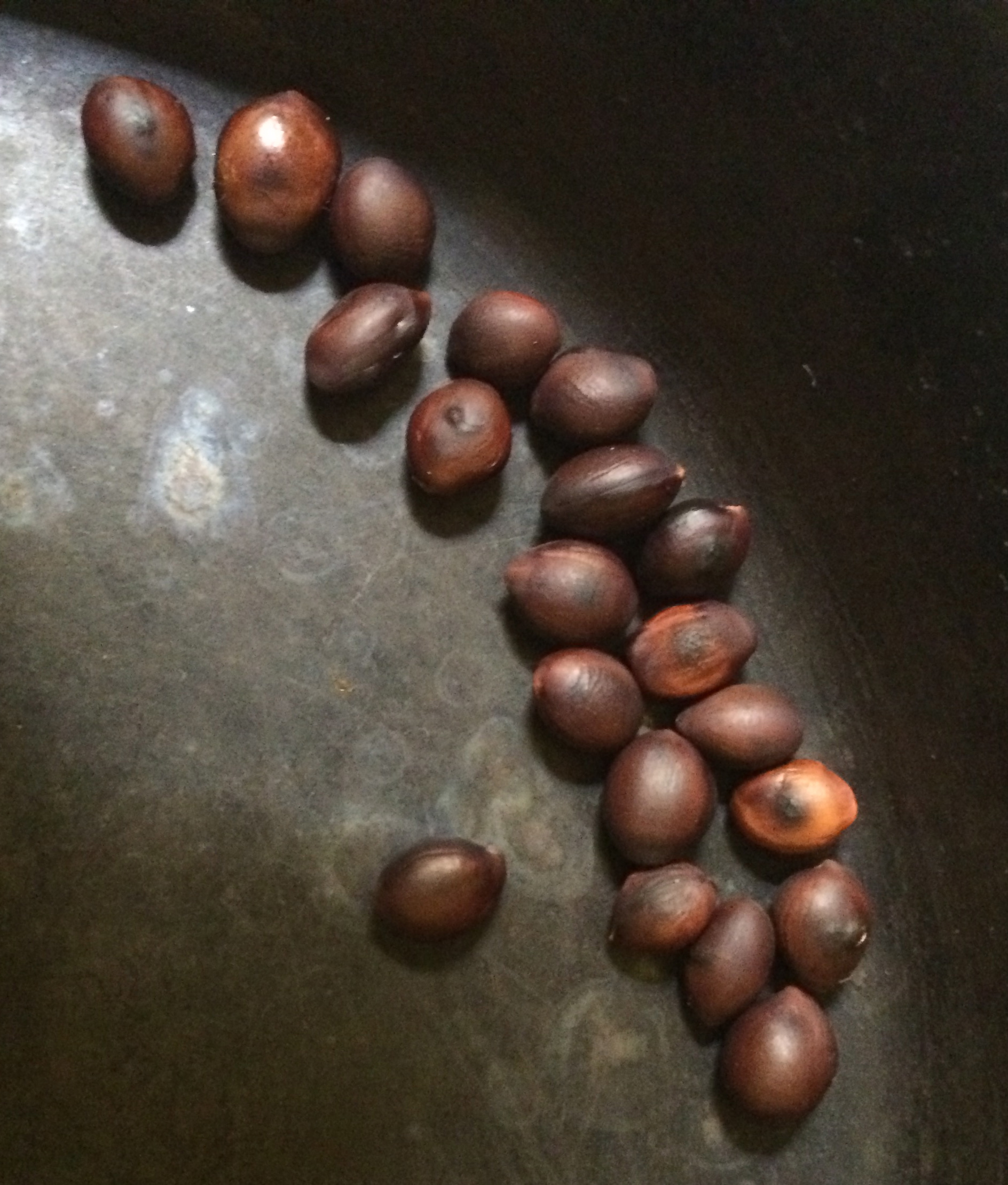
Seeds of foothills palo verde dry and hard as little stones

Seeds of foothills palo verde– dry and hard as little stones


At PRESENT, lasting perhaps through July, there are copious “fruits-of-the-desert” hanging on foothills palo verde trees (aka little-leaf paloverde) covering desert hillsides.  In early June, palo verde pods were offering soft sweetpeas for fresh picking (described in the June13,2015 Savor blog on this site).   Now in July, palo verde pods are rattling with shrunken stone-hard seeds.  When ground, or when toasted and milled, these little dry seeds can produce two fabulous gluten-free flours for adding to baked goods, hot cereal, gravies etc.

Dry foothills palo verde seed milled raw on L, toasted and milled fine in center, toasted coarse-milled on R

Dry foothills palo verde seeds:  milled raw-Left; toasted and milled fine-Center; toasted & coarse-milled-Right

Foothills palo verde seed toasting in a dry iron skillet

Foothills palo verde seed toasting in a dry iron skillet

Oh how I wish that technology could keep up with our needs for scratch, sniff, and taste in this blog!!  The distinctly different flavors and textures of these two flours are so pleasant.  Desert People traditionally parched and ground these seeds in bedrock mortars.  I used a coffee mill to grind them.  The raw flour has a wonderful bean-i-ness bouquet coming through.  Then I toasted (parched) a separate batch of seeds in an un-greased skillet before milling, and WOW the roasty aroma of this gluten-free flour is rich.  I am using it to add flavor –not to mention high protein and complex carbs–to multigrain breads and biscuits.  So FULFILLING!  A friend who tried these different preparations for palo verde flour even wants to use it as a spice or seasoning!

With the monsoon (and with the help of many hummingbird pollinators) has come another edible surprise to my desert garden–octopus cactus fruit–that I just have to share with you:

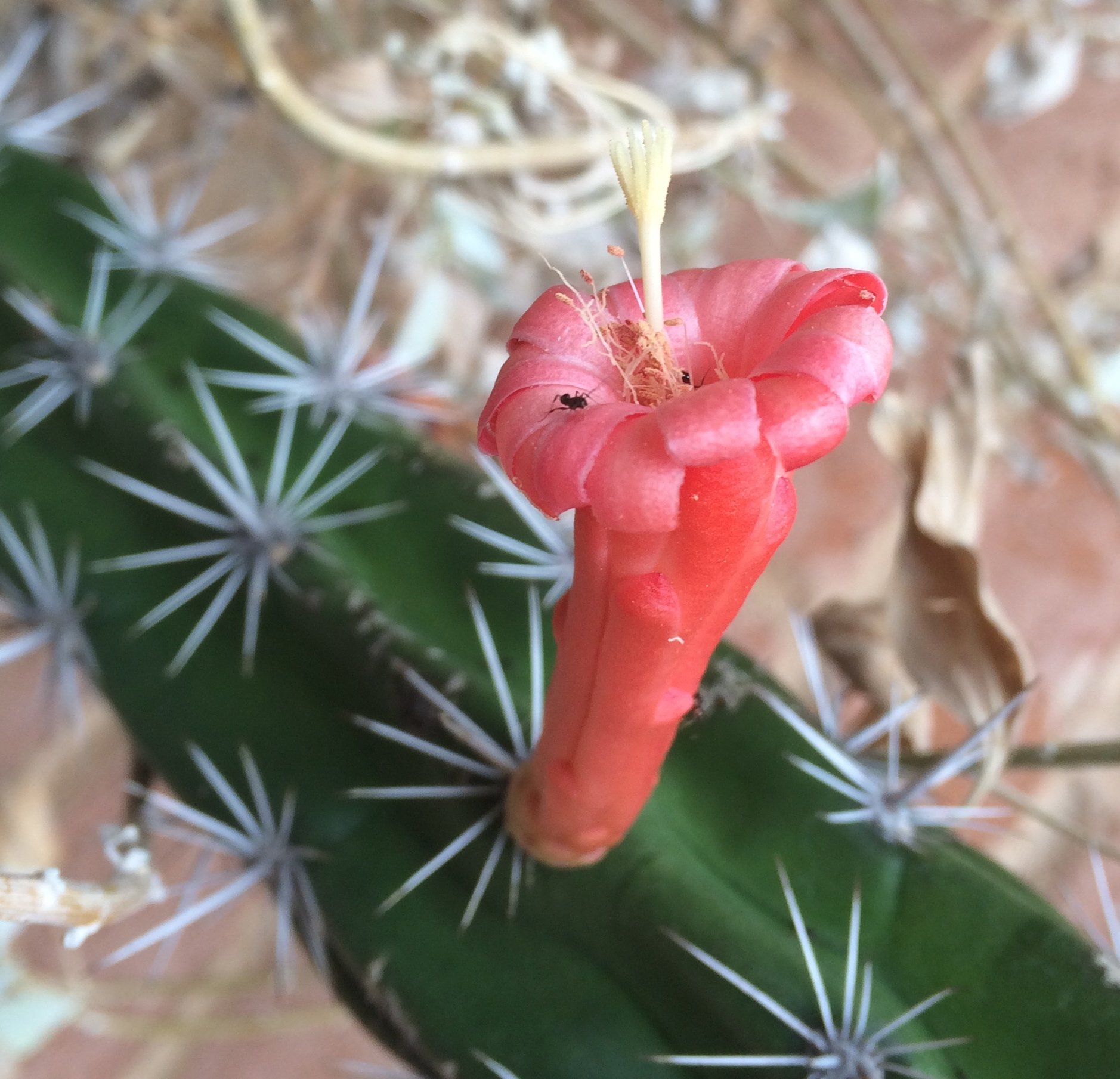
Stenocereus alamosensis with hummer- and perhaps ant-pollinated flower, June26,2016 (MABurgess photo)

Stenocereus alamosensis with hummer- and perhaps ant-pollinated flower, June26,2016.  Note happy ant on petal.  (MABurgess photo)

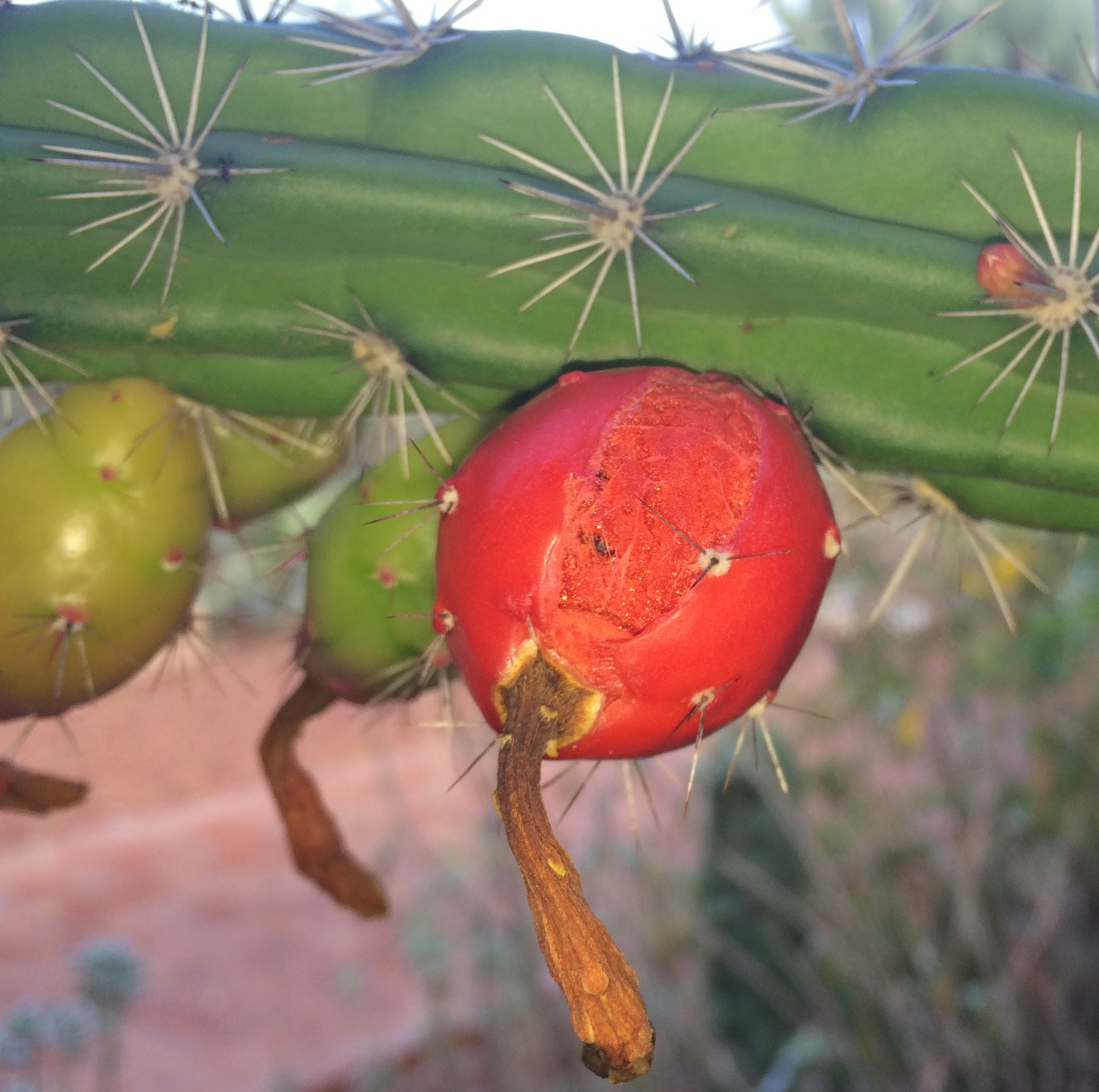
Fruit of octopus cactus Stenocereus alamosensis, ripe and splitting July 4, 2016

Fruit of octopus cactus Stenocereus alamosensis, ripe and splitting July 4, 2016 (MABurgess photo)

Sliced octopus cactus fruit on palo chino bowl (MABurgess photo)

Juicy sliced octopus cactus fruit (Stenocereus alamosensis) on palo chino bowl (MABurgess photo)

Years ago I collected seed for it near Alamos, Sonora, and grew it out in Tucson.  Surviving frosty winters, and flowering in previous years, it never bore fruit before.  This year, fertilization happened at last, and voila–there are sensational, gently sweet delicacies to eat right off the cactus.  The fruit’s fresh crispy texture is like watermelon and its seeds are tiny protein crunches.  [Light bulb idea]–With climate change, this flavorful cactus fruit–and others like it–could become an appropriate specialty food to grow locally.

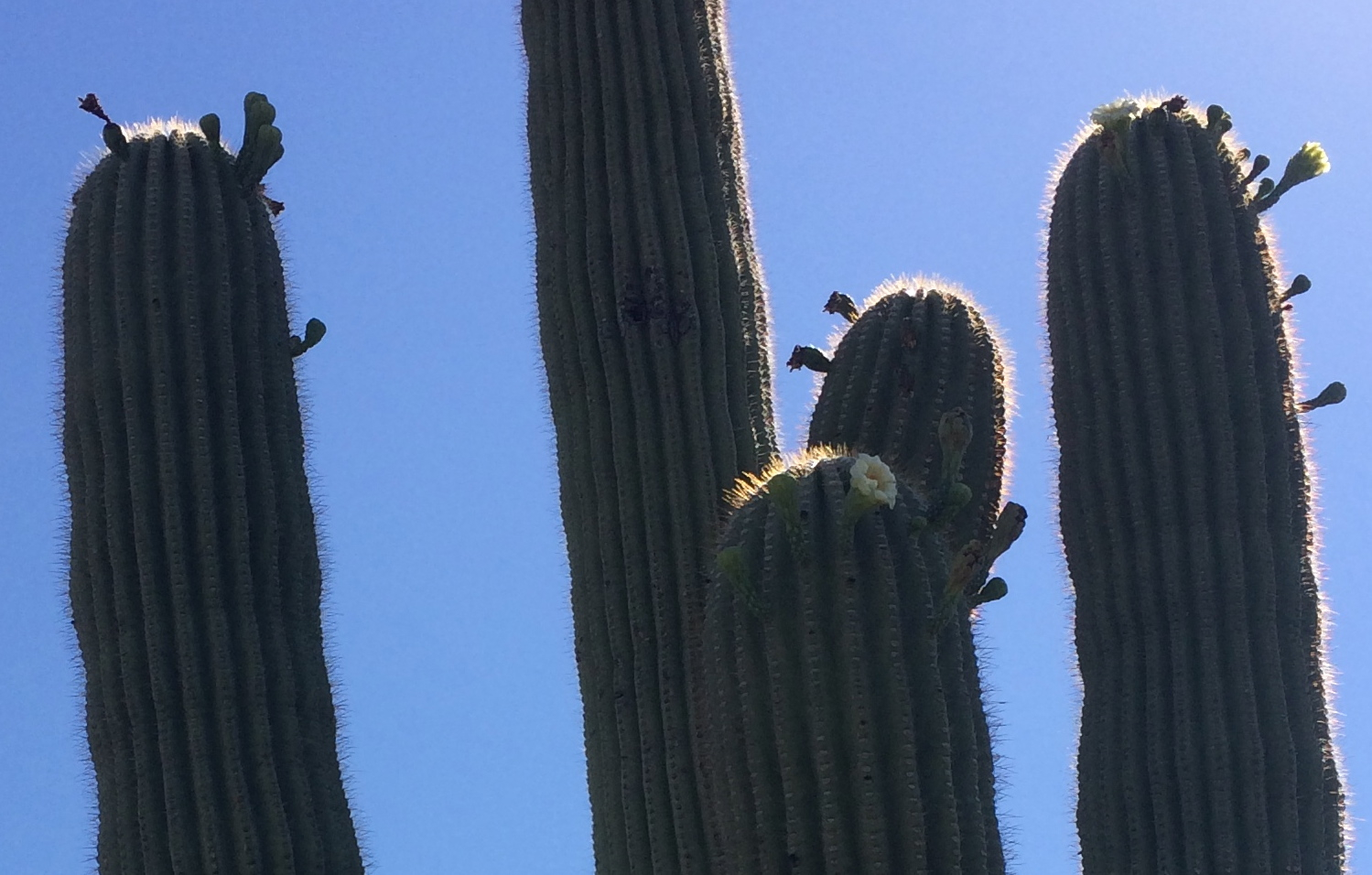
Keep your eyes peeled and prepare for more harvests from the latest new “promises” blooming for multiple times this season in the desert…..Check out these potential edibles:

This is the third bloom of saguaros this season--with pollination may give another fruit harvest

This is the third bloom of saguaros this season–if  pollinated may give yet another fruit harvest

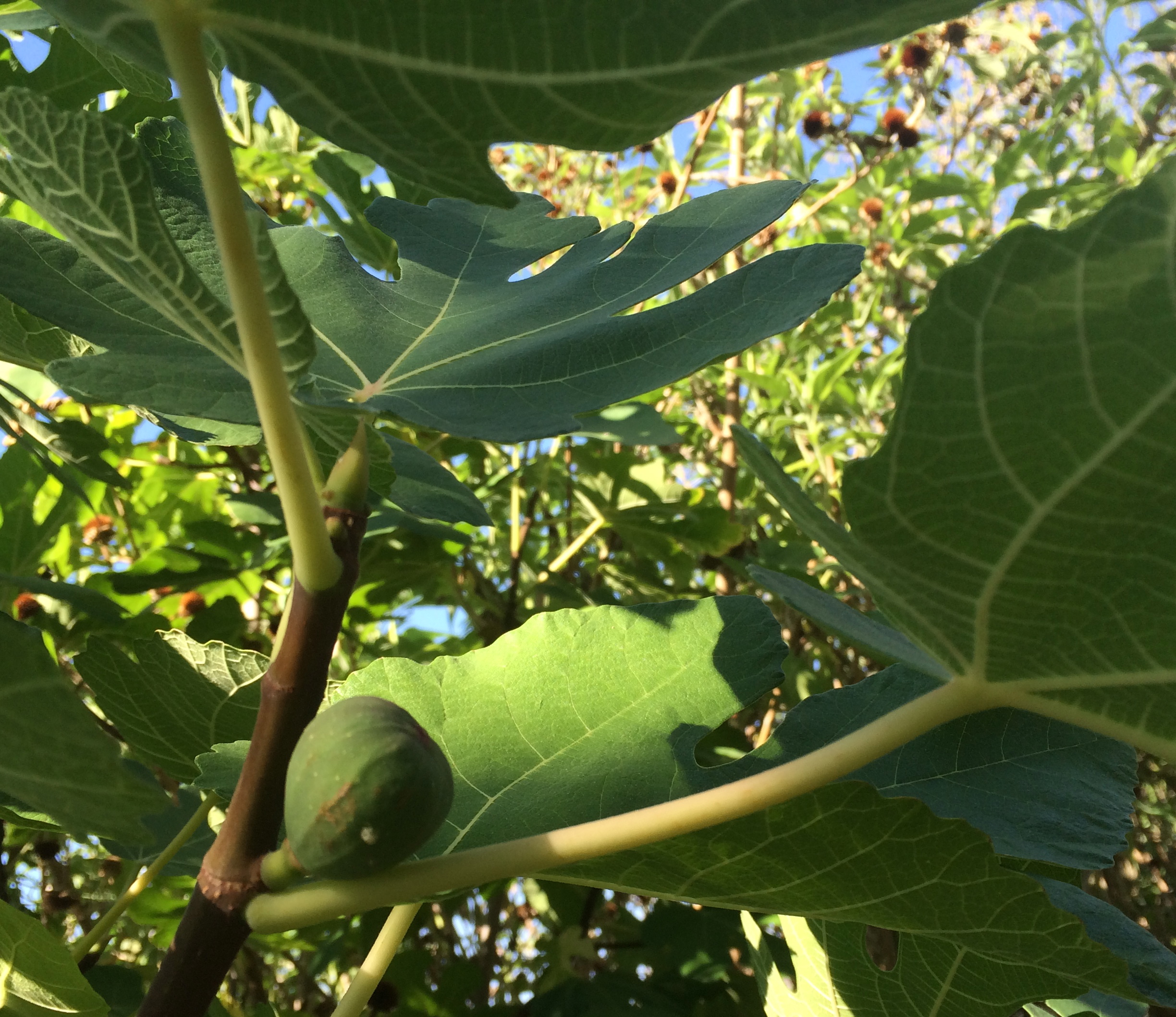
Green swelling Padre Kino fig--watch for preparing heirloom fruit ideas next month….

Green swelling Padre Kino fig–Young trees are available next week at the NSS plant sale!

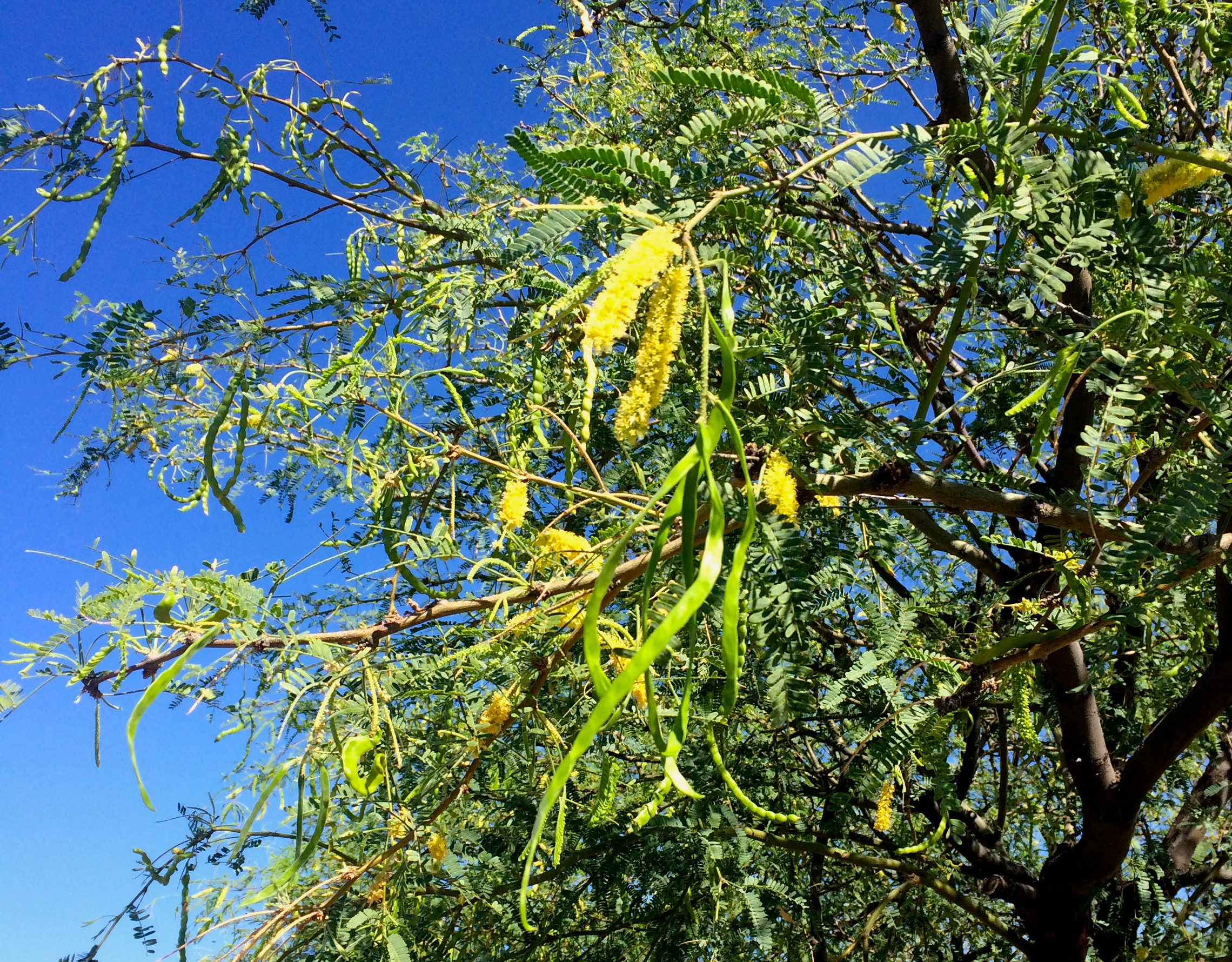
A new wave of mesquite flowers and green pods promise a second harvest this season.

A new wave of mesquite flowers and green pods promise a second harvest this season.

Don’t miss the NativeSeeds/SEARCH Monsoon Plant Sale this next weekend, Friday-Sunday, July 15-17, 2016!  For your own garden-to-table promises and preparations, check out the many starts of NSS heirloom summer vegetables and monsoon wildflowers.  There will be tomatillo plants, heirloom chile varieties, cucumber, many squash and melon varieties to give your garden a jump-start.  A few 5-gallon  Father Kino fig trees propagated at Mission Garden will be available for sale, so come early.

For well-seasoned ideas for desert cookery, two fabulously useful books continue to inspire:    Tucsonan Sandal English’s cookbook from the 1970’s Fruits of the Desert published by the Arizona Daily Star, and desert-foods aficionado (& Blog-Sister) Carolyn Niethammer’s book Cooking the Wild Southwest published by University of Arizona Press.  Borrow or buy, and use them with joy.

I wish you happy harvesting as the desert’s present promises become a cornucopia of fulfilling plenty!

[For anyone seeking heirloom foods and products made with wild foods, check out http://www.flordemayoarts.com and http://www.nativeseeds.org, or visit the Baggesen Family booth at Sunday St Philips farmers market.]


Epazote and Garden Herbs Blend Into Delicious Mole Verde

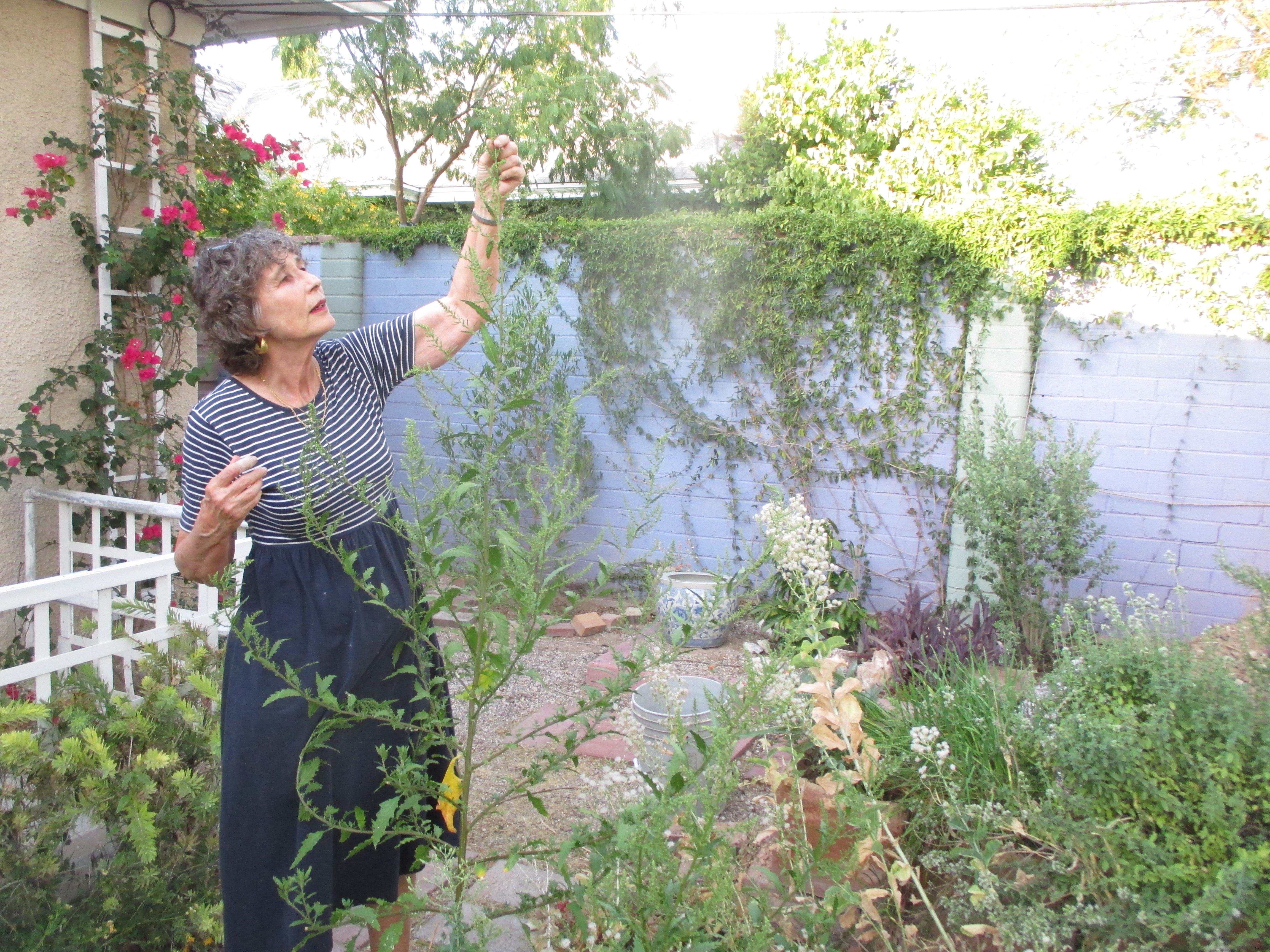
This epazote plant has grown to over 6 feet.

This epazote plant has grown to over 6 feet. It was a volunteer in the lettuce bed and loved the rich soil.

Carolyn here this week. This spring I have had epazote sprouting between my tomato plants, epazote in the pea pots, epazote in the kale and in the I’itoi onions. I harvested the last of the chard today and there was an epazote plant hiding in that row. For fun, I left one in the lettuce patch and it has grown over 6 feet, thriving in the rich soil and organic inputs in that area. After taking a picture today, I’m going to pull it before it releases a couple thousand seeds and takes over my entire garden.

I bought my first epazote plant from a lovely Mexican woman at the farmer’s market. That one died, but I tried again the next fall. This time I was more successful and now I can supply epazote to anyone who needs it.

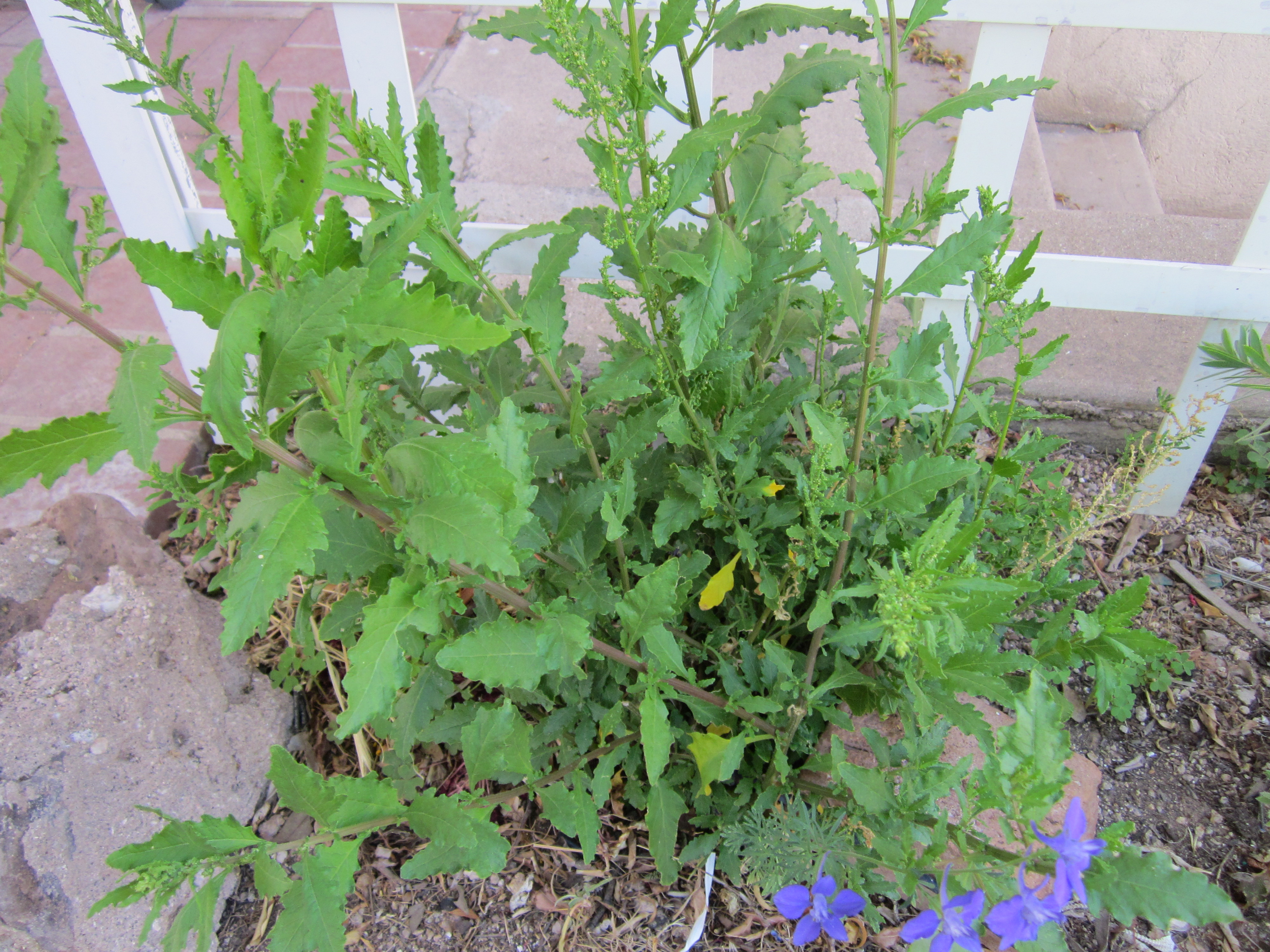
Healthy epazote plant earlier in the spring.

Healthy epazote plant earlier in the spring.

Epazote is a New World herb that originated in Central America and parts of Mexico and in the Nahuatl language is called epazo-tl. It has spread north to the U.S. and to the Caribbean. The scientific name was formerly Chenopodium ambrosoides but has been changed to Dysphania ambrosoides. Interestingly, it is related to quinoa, spinach and beets.

Epazote is used as an flavoring herb and its taste changes slightly as the plant ages. Chew on a leaf of a young plant and you will notice a light citrus-y flavor that starts on your tongue and spreads through your mouth. Leaves from older plants intensify the pine-y or eucalyptus flavor notes that underlie the citrus. Some say it tastes similar to tarragon.

In the Southwest, epazote is most frequently used in cooking black beans for flavor and also for its anti-gas effects. Add two or three sprigs during the last 15 minutes of cooking. If you have access to fresh epazote, feel free to try it in other dishes. A little chopped up in a corn relish adds a spritely flavor. If you make your own mole sauces, add a few leaves, particularly to a green mole. It also goes well in filling for tamales and sprinkled on the cheese in quesadillas

Another traditional use of epazote as developed by the native Mayans is as a tea, particularly as a remedy for intestinal parasites. Epazote includes 60-80 % ascaridole, which is toxic to several intestinal worms.

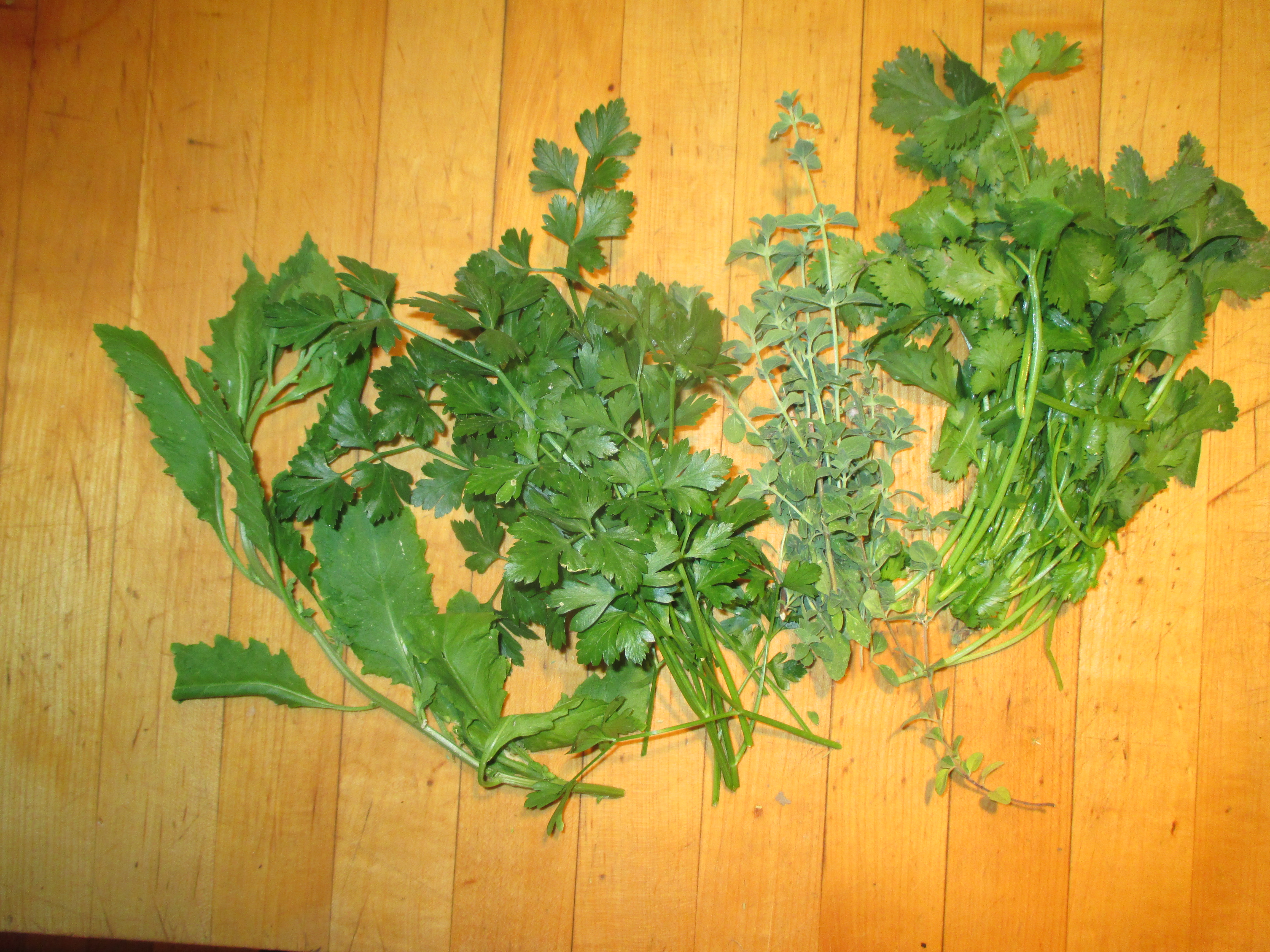
Herbs for Mole Verde from left: epazote, parsley, oregano, and cilantro.

Herbs for Mole Verde from left: epazote, parsley, oregano, and cilantro.

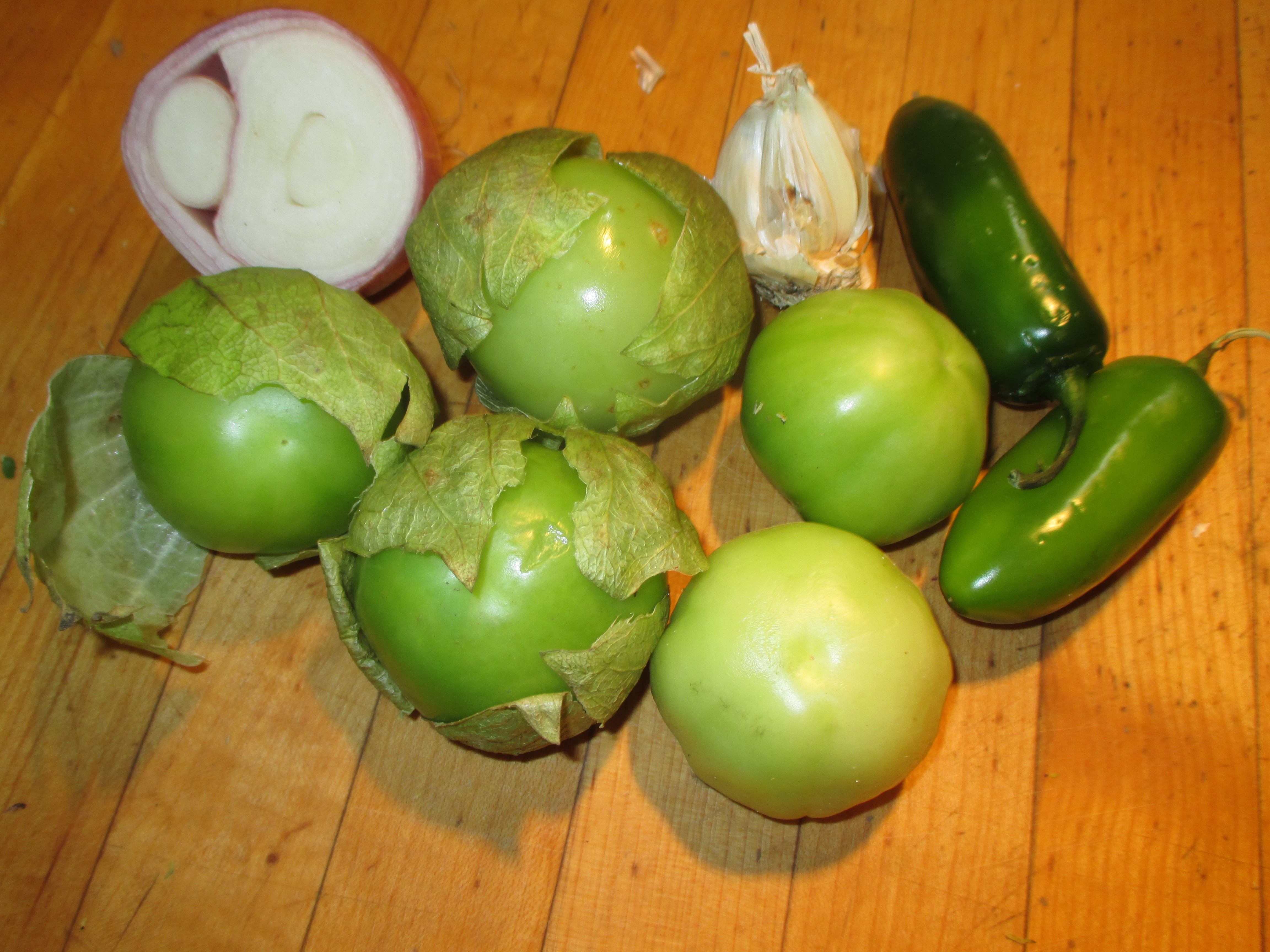
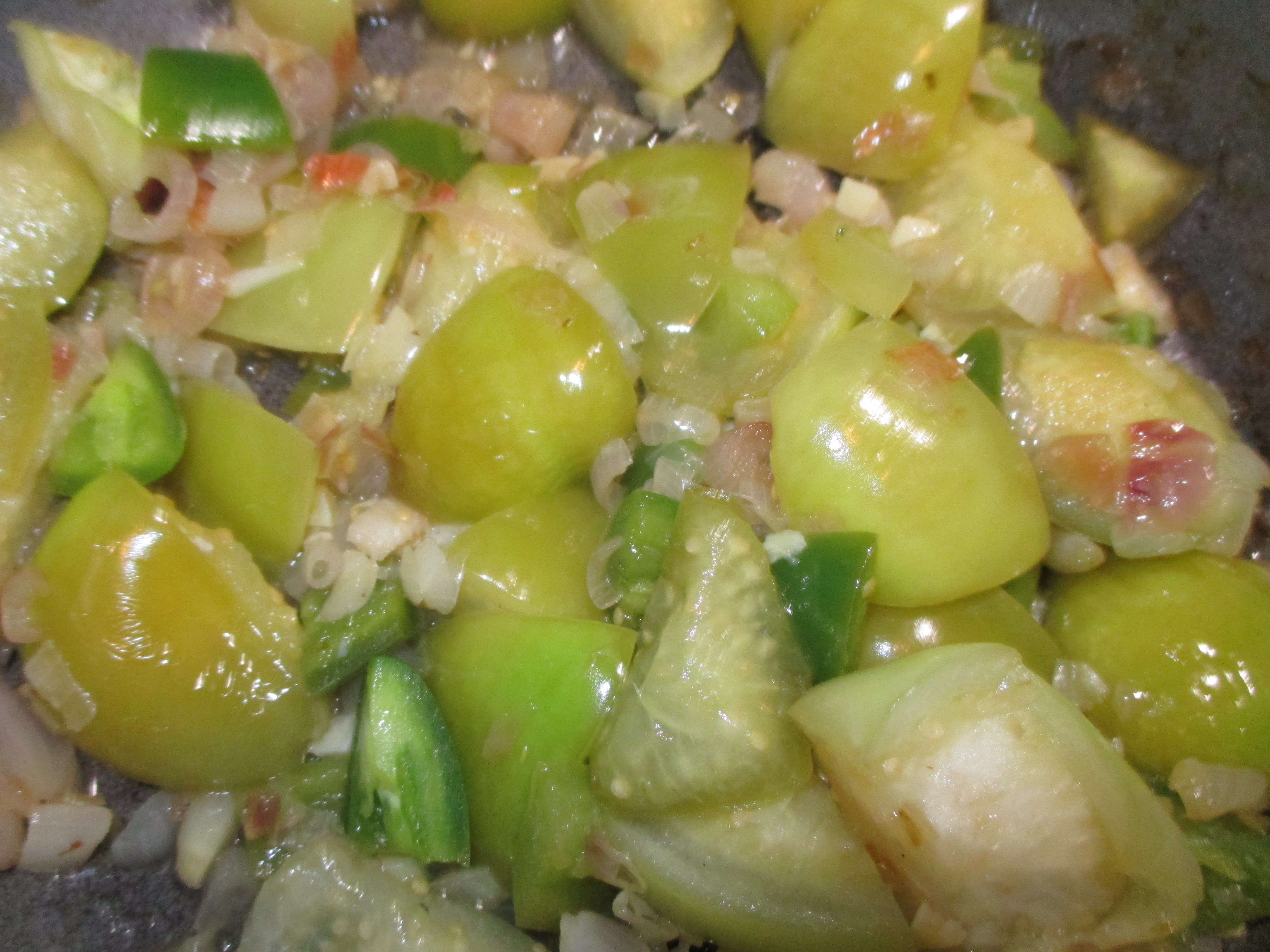
Here are the vegetables you will use: tomatillos, onion, garlic and jalapenos.

Here are the vegetables you will use: tomatillos, onion, garlic and jalapenos.

As with most leafy greens, epazote also provides some vitamins and minerals including vitamin A, B-complex vitamins (specifically folic acid) and vitamin C as well as calcium, manganese, copper,  potassium, phosphorous and zinc.

Mole Verde

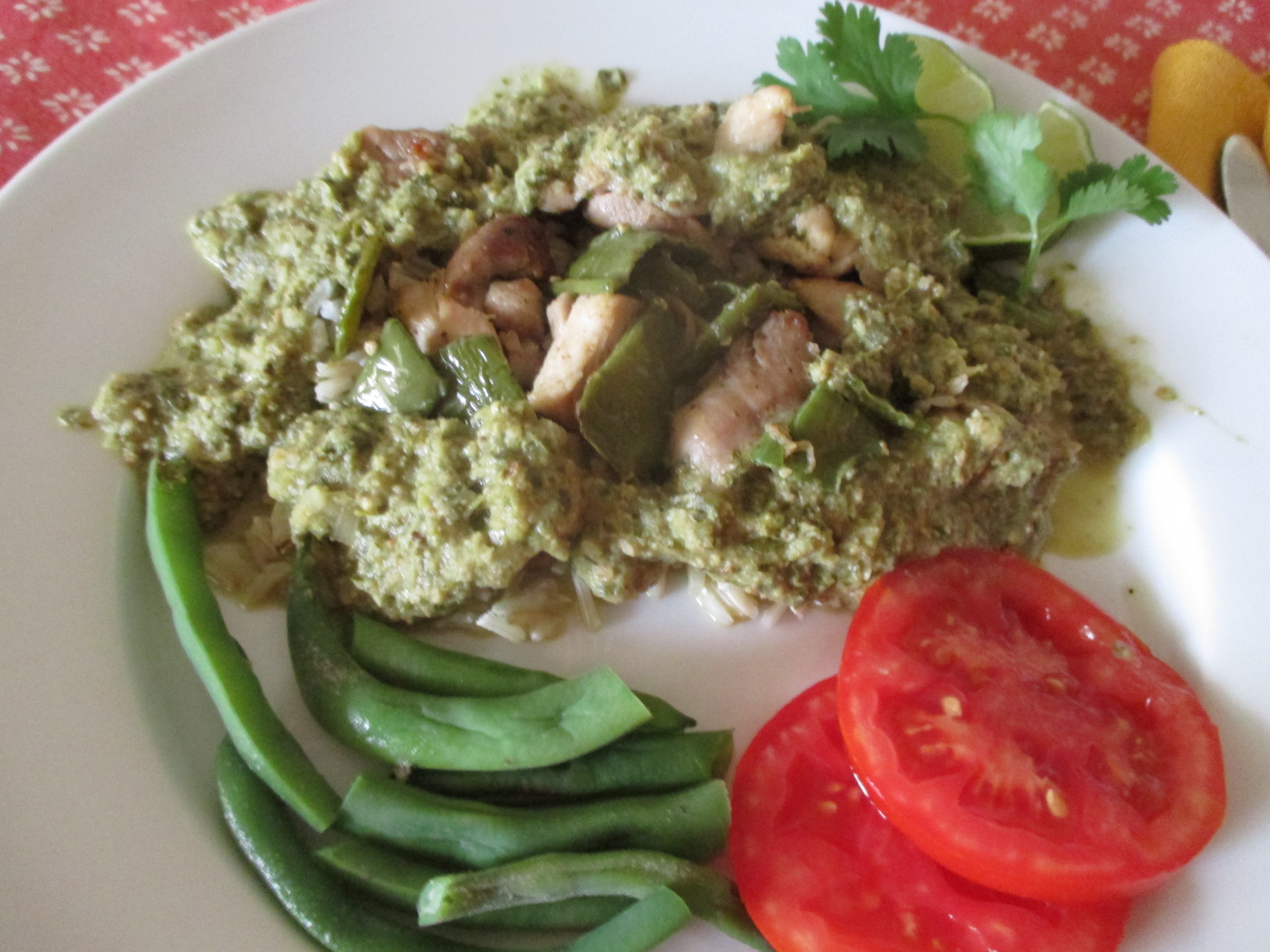
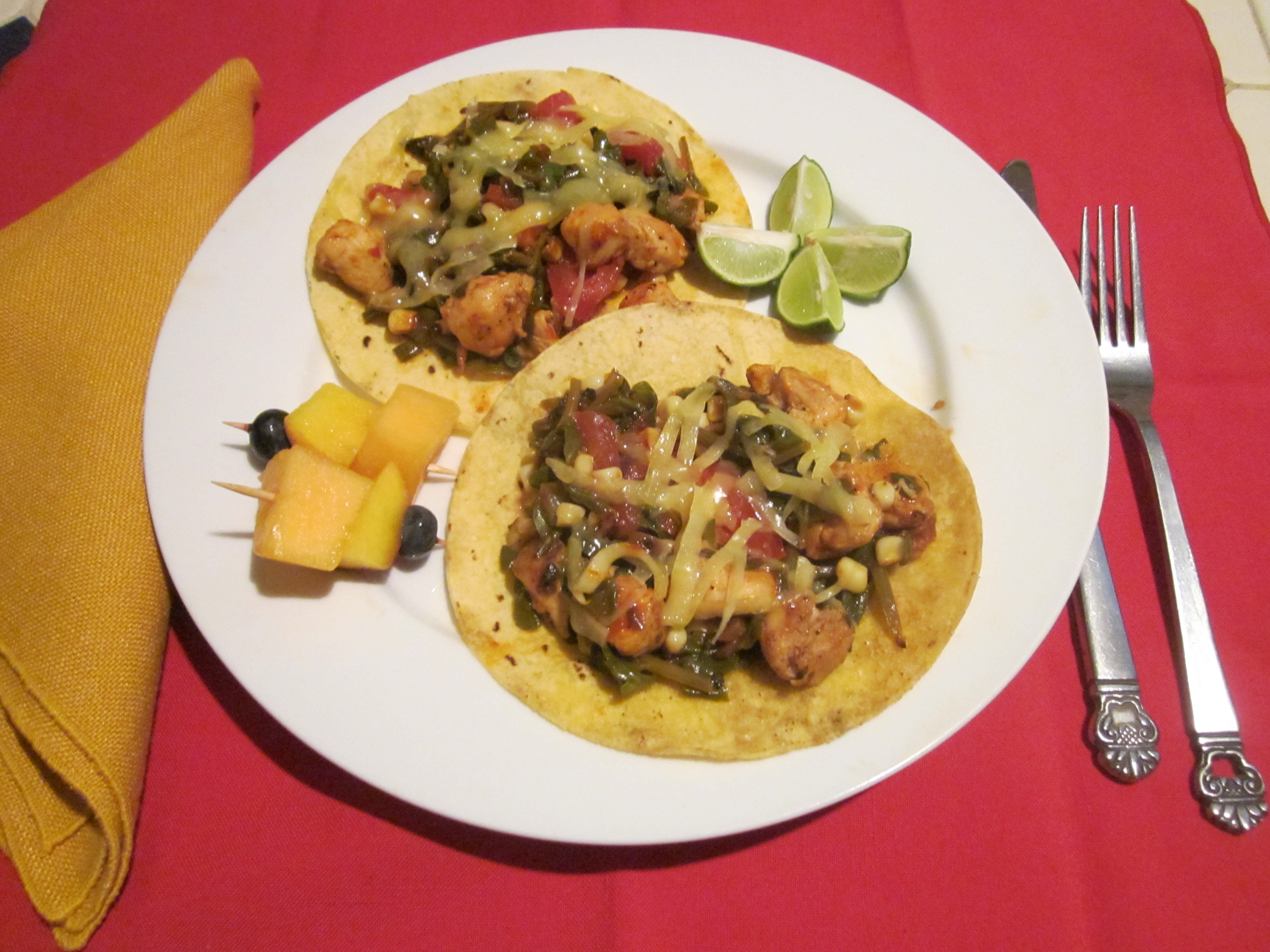
Here’s a recipe for a delicious green mole with epazote. This is a chewy, substantial version due to the pepitas.  I served the sauce with sautéed chicken breast pieces and fresh nopalitos from my garden. Makes about 6 generous servings.

Ingredients

1 cup pepitas (hulled pumpkin seeds)

1 cup roughly chopped white onion (about 1 small)

1 tablespoon minced garlic (about 3 medium cloves)

1 tablespoon vegetable oil

1/2 pound tomatillos, husked and cut in eighths (about 5 large)

2 medium jalapeño peppers, roughly chopped (seeds removed for a milder sauce)

1 cup packed coarsely chopped fresh cilantro leaves and tender stems

1/2 cup packed coarsely chopped fresh epazote

½ cup parsley leaves

2 tablespoons fresh oregano

2 cups low-sodium chicken stock, divided

Salt, to taste

Directions

Saute the onion, garlic, and tomatillos until soft.

Saute the onion, garlic, and tomatillos until soft.

  1. Prepare all your herbs first and set aside. In a medium heavy skillet over medium-high heat, toast pepitas until they start to pop and turn a light golden brown. Toss constantly so they won’t burn. Transfer to a blender and process until finely ground. You will have to stop the blender every few seconds to redistribute the contents.
  2. In a heavy saucepan, heat the oil and sauté the onion until it starts getting translucent. Add the garlic and cook another minute. Add the tomatillos and jalapeno and cook, stirring frequently until soft.
  3. Transfer the sautéed vegetables to the blender jar with the pepitas and the herbs. Add one cup of the chicken stock and puree until well combined. This may take a couple of minutes.
  4. Return the blended mixture to the saucepan and put it over medium heat. Meanwhile rinse the blender jar with the remaining cup of chicken broth and add to the pot. Reduce heat and simmer for 10 to 15 minutes to let the herbs release their flavors and the flavors to blend. Stir frequently.
  5. Use immediately or transfer to an airtight container and store in refrigerator for up to 3 days, reheating before use.
Serve the sauce with chicken, fish, or vegetables.

Serve the sauce with chicken, fish, or vegetables.

_____________________________________________________

You can buy seeds for epazote from Native Seeds/SEARCH.   They also carry a selection of cookbooks by Carolyn Niethammer. The books are also available online from Amazon and Barnes&Noble.

Everybody Cooks Desert Wild Plants

It’s Carolyn Niethammer with you this April Friday, my favorite time of year when the Sonoran Desert is bursting with life. The rains weren’t as heavy as El Niño had promised, but there was enough moisture so that our arid-adapted plants could produce a colorful and abundant spring. When I was a young reporter for the Arizona Daily Star we used to have a feature called “Everybody Cooks.” I loved going out into the community and talking to good cooks from all walks of life — Mexican nanas, musicians, business owners, Jewish homemakers — about what they made for holidays and everyday family meals. I recalled those good times earlier this month at the Native Seeds/SEARCH Arid Abundance Potluck.

People arrived at the Arid Abundance Potluck with so many creative uses of the delicacies of a Sonoran desert spring that I just had to document the event.

Chad Borseth shows off his cholla bud appetizer.

Chad Borseth shows off his cholla bud appetizer.

Chad Borseth, the manager of the NS/S retail store, started us out with a cholla bud appetizer. There’s an old joke about how a cook made chicken soup in 1880. It starts: first you catch the chicken. This is sort of like that. You do have to harvest, clean (meaning remove the thorns) and dry the cholla buds. Or you can go the the NS/S store and buy some already cleaned and dried. Chad boiled the dried cholla buds for about 45 minutes, drained them and then chilled them in white balsamic vinegar overnight. When he was ready to serve them at the potluck he cut  each of them in half and arranged them on a plate and drizzled them with prickly pear syrup. Toothpicks are handy for picking up the delicious little morsels.


IMG_0658

Nancy Reid serves up  her rich and delicious  Green Chile-Cholla Bud Quiche

Nancy Reid, a retail associate at the NS/S store,  brought a green chile and cholla bud quiche that she had modified from a recipe in a wonderful but out-of-print NS/S cookbook. She began by melting a tablespoon of butter in the bottom of an 8-inch round pan. In a bowl, she beat 4 eggs. Then she added 3/4 cup cooked cholla buds, 3/4 cup chopped green chiles, 1 cup of cottage cheese, 2 cups of shredded colby/jack cheese, and a little salt. It went in the oven at 325 degrees F. for 40 minutes.


Laura Neff with her salsa.

Laura Neff , NS/S retail associate, with her salsa.


What’s a southwestern meal without salsa? Laura Neff’s version includes 1/2 cup dried cholla buds boiled for 45 minutes and drained, 1/2 cup diced tomatoes, 1/4 cup diced red onion, 1/4 cup chopped cilantro, 1-2 finely minced jalapenos, and 1 tablespoon of lime juice. She combined everything except the cholla buds in a food processor. The cholla buds were chopped by hand and added  at the end.


My friend Connie Lauth wasn’t at the potluck but she made this gorgeous quiche recently for company. Connie lives on the desert at the very end of a road into the Tucson Mountains. While Chad and Laura used dried and reconstituted cholla buds, Connie just walked out her door and picked some fresh ones. She used nopalitos from Food City but by now there are plenty of fresh, new-growth prickly pear pads ready for harvest.

Nopalito-Cholla Bud Quiche

Connie’s Nopalito-Cholla Bud Quiche

Here’s Connie’s recipe:

Connie’s Desert Pie

1 cup of cholla buds

1 cup of nopalitos

½ cup thinly sliced red bell pepper

4 large eggs

1/2 cup milk,

1 ½ teaspoons pico de gallo seasoning

1 tablespoon of chopped fresh cilantro

1 frozen deep dish pie shell

1 cup shredded Mexican cheese

Dethorn cholla buds by holding them with tongs and burning them off over a gas stove.. Rinse. Microwave in a covered dish on high for 4 minutes.

Cut gathered or purchased nopalitos into 1/4-inch dice. Microwave with red bell peppers for about 4 minutes.  In a bowl, beat eggs and milk, add seasonings.  Layer egg mixture with vegetables and cheese in the pie shell. Bake at 400 degrees about 40 minutes until a knife inserted in center comes out clean

________________

If  you are inspired to try your hand at more desert gathering and cooking, my book Cooking the Wild Southwest: Delicous Recipes for Desert Plants can be your guide to 23 easily recognized, gathered and cooked  desert edibles.  If you want to harvest some nopales (prickly pear pads), you can find lots of recipes in The Prickly Pear Cookbook. Both books  are available in the Native Seeds/SEARCH retail store at 3061  N. Campbell or on their website. The books are also available from Amazon and B&N.


Oh Yum! Tasty Mesquite Meal Enhances Pie Crust and Waffles

Bodie Robins offers a selection of delicious gluten-free baked goods at farmers markets in Tucson and Sierra Vista.

Bodie Robins offers a selection of delicious gluten-free baked goods at farmers markets in Tucson and Sierra Vista.

For thousands of years, mesquite pods were the primary food of people who lived on the Sonoran Desert. It’s Carolyn here today recalling that when I first started researching and experimenting with mesquite in 1972, hardly anybody was eating this sweet nutritious food. Although a few Tohono O’odham kept up with the old ways, it was on the verge of being forgotten.

Until recently,  it wasn’t easy to process mesquite pods. Early Native women made mesquite meal by pounding the pods in bedrock mortars. By the 1970s it hadn’t gotten much easier. But fortunately for all of us someone (I recall it was at the Desert Museum) figured that the pods could be crushed and sifted by a hammermill, a common piece of farm equipment. After some years, Desert Harvesters took up the challenge and offered to grind the pods of all comers for a modest fee. Getting a beautiful, smooth tasty flour was now easy. And the world of mesquite baking opened up.

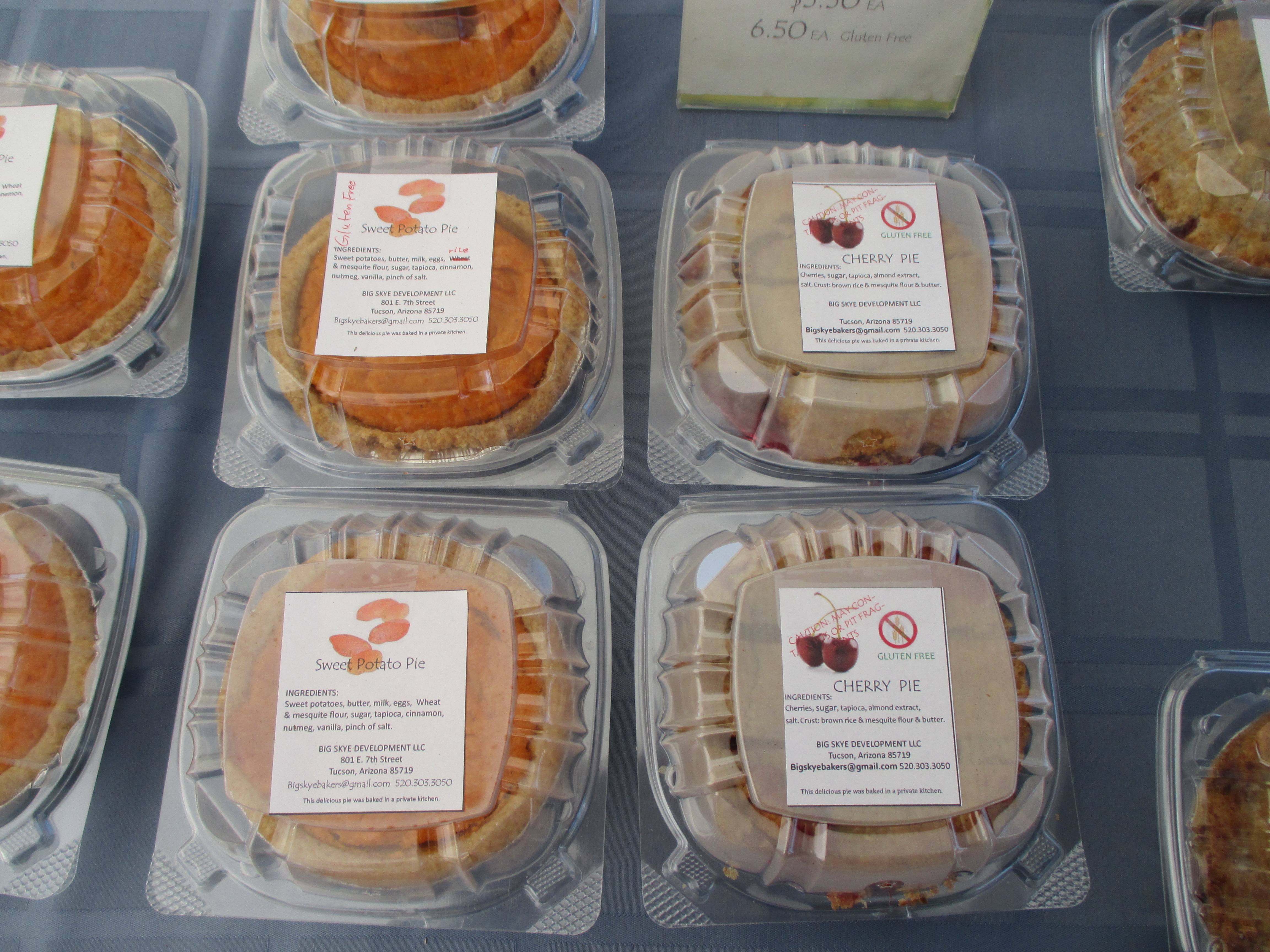
Mesquite crust adds extra deliciousness to Big Skye's fruit pies.

Mesquite crust adds extra deliciousness to Big Skye’s sweet potato and fruit pies.

Bodie Robins of Big Skye Bakers is one of the folks who have brought mesquite baking into the twenty-first century selling mesquite baked goods at farmers’ markets in Tucson and Sierra Vista.

Bodie, an architectural designer, began baking with mesquite as therapy in 2008 when construction took a dive with the recession. His first experiment produced some dog biscuits that he shared with his neighbors. He decided there might be a future in mesquite baking when his neighbors admitted they were eating the dog biscuits themselves. With salsa!

Bodie took his product to a farmers’ market. But it turns out not enough people were willing to pay for high-end mesquite dog biscuits (many dogs are willing to just chew the pods, unbaked), so he began to experiment with other baked goods, trying various combinations of flours until he produced a version he liked.

Today he sells pies with mesquite crust, cookies, and cupcakes. Many of his customers are attracted by the gluten-free nature of Bodie’s mesquite pie crust. One very grateful middle-aged customer was thrilled to find a pie crust he could eat and told Bodie he hadn’t been able to eat pie since he was 15 years old.

Bodie entices his customers with a little table setting at his farmers market booth. Personally, I'm ready to dig right in.

Bodie entices his customers with a little table setting at his farmers market booth. Personally, I’m ready to dig right in.

A perfect loaf of gluten-free bread eluded Bodie until recently when extensive experimenting has finally led to a mixture of mesquite meal, brown rice flour, tapioca and sweet potato flour that turns out a delicious loaf.

“My customers are particular about the foods they buy and eat,” he says .  “They like to learn about mesquite. There’s a romance to it – an arts and crafts movement about food. I get everything from savvy young college kids to the elderly.”

Bodie gathers the mesquite pods he uses himself and has them ground at the Baja Arizona mill at the Sierra Vista farmers’ market. He goes through up to 200 pounds a year and if he runs out, he can grind a few pounds in his Vitamix. He produces his goods in his home kitchen under the home baker cottage industry law.

You can find Bodie and his Big Skye specialty baked goods at the Rillito Farmers’ Market in Tucson on Sunday mornings from 9 a.m. to 1 p.m. and at the Sierra Vista Farmers’ Market on Thursdays from 10 a.m. to 2 p.m

Here’s a delicious recipe for waffles that Bodie developed. This recipe includes wheat flour, but if you are gluten sensitive, experiment with some other flours to find a mixture that works for you.

Mesquite waffles make a delicious breakfast or lunch.

Mesquite-Pecan waffles make a delicious breakfast or lunch.

Cinnamon-Pecan Mesquite Waffles

Ingredients

2 eggs separated

2 1/2 cups milk

¼ cup olive oil

1 cup all-purpose flour

½ cup whole-wheat flour

½ cup mesquite meal

1 cup finely chopped pecans

1 tablespoon cinnamon

1 tablespoon baking powder

½ teaspoon salt

1 tablespoon sugar

Directions

  1. Lightly oil and pre heat waffle iron.
  2. Separate eggs reserving the whites in a bowl and set aside. In another bowl mix egg yolks, milk and oil.
  3. Mix all dry ingredients together
  4. Add liquids to dry ingredients. Gently mix until smooth.
  5. Beat the egg whites until stiff.
  6. Fold in the egg whites to the waffle mix.
  7. Place 1/2 cup of batter onto hot waffle iron. Close lid. Bake until golden Repeat with remaining batter.

________________________________________________________________

Want more mesquite recipies? Check out my cookbook Cooking the Wild Southwest, Delicious Recipes for Desert Plants. You can buy it at the Native Seeds/SEARCH Store at 3061 North Campbell Avenue, in Tucson, or order it off the NSS website or from Barnes&Noble. If you need mesquite flour, buy it from Martha Burgess’s Flor de Mayo stand at the St. Phillip’s Farmers’ Market in Tucson on Sundays or order it here.


Taste Buds Ready to “Rejoice in Local”–at Mission Garden!

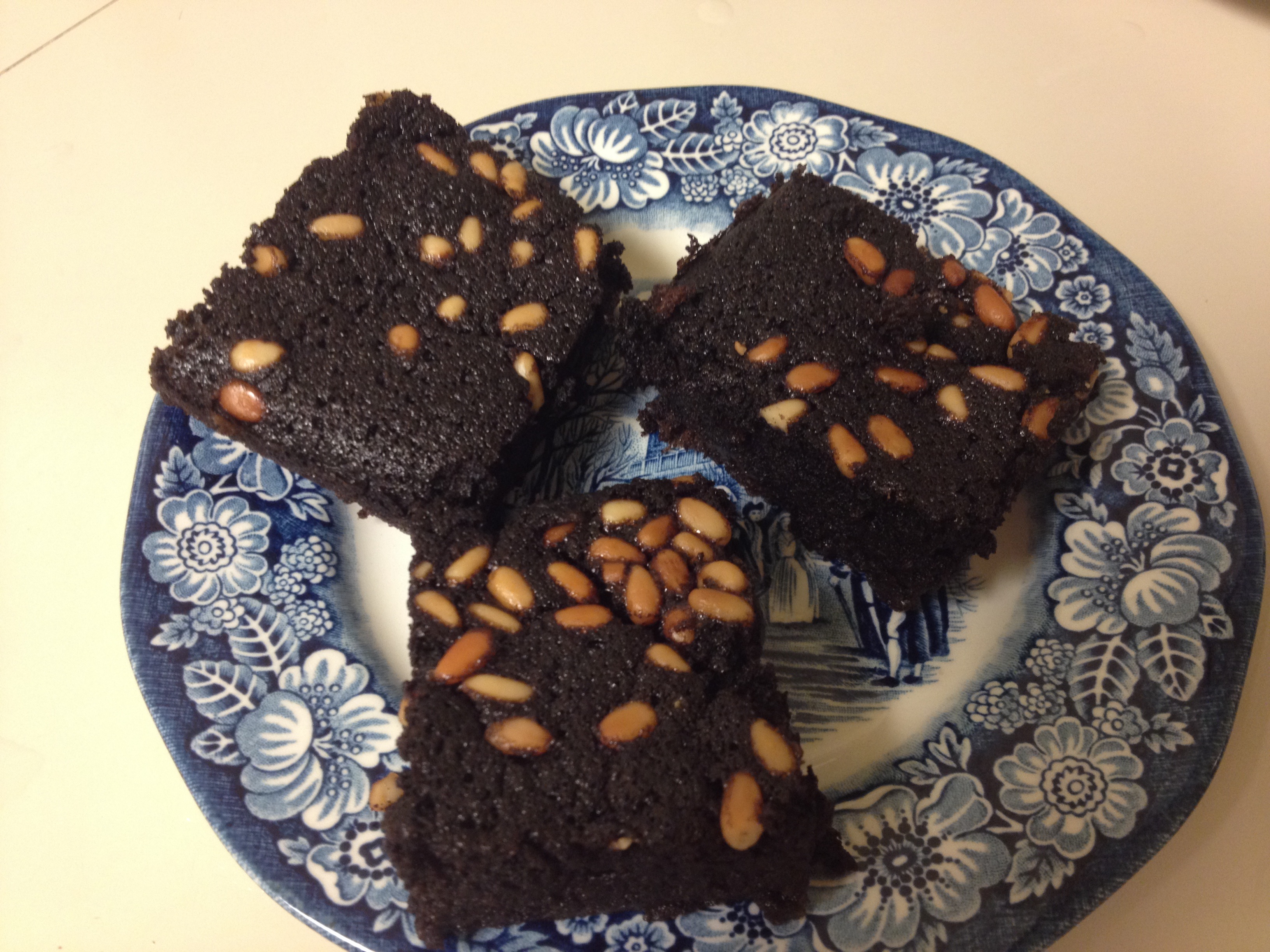
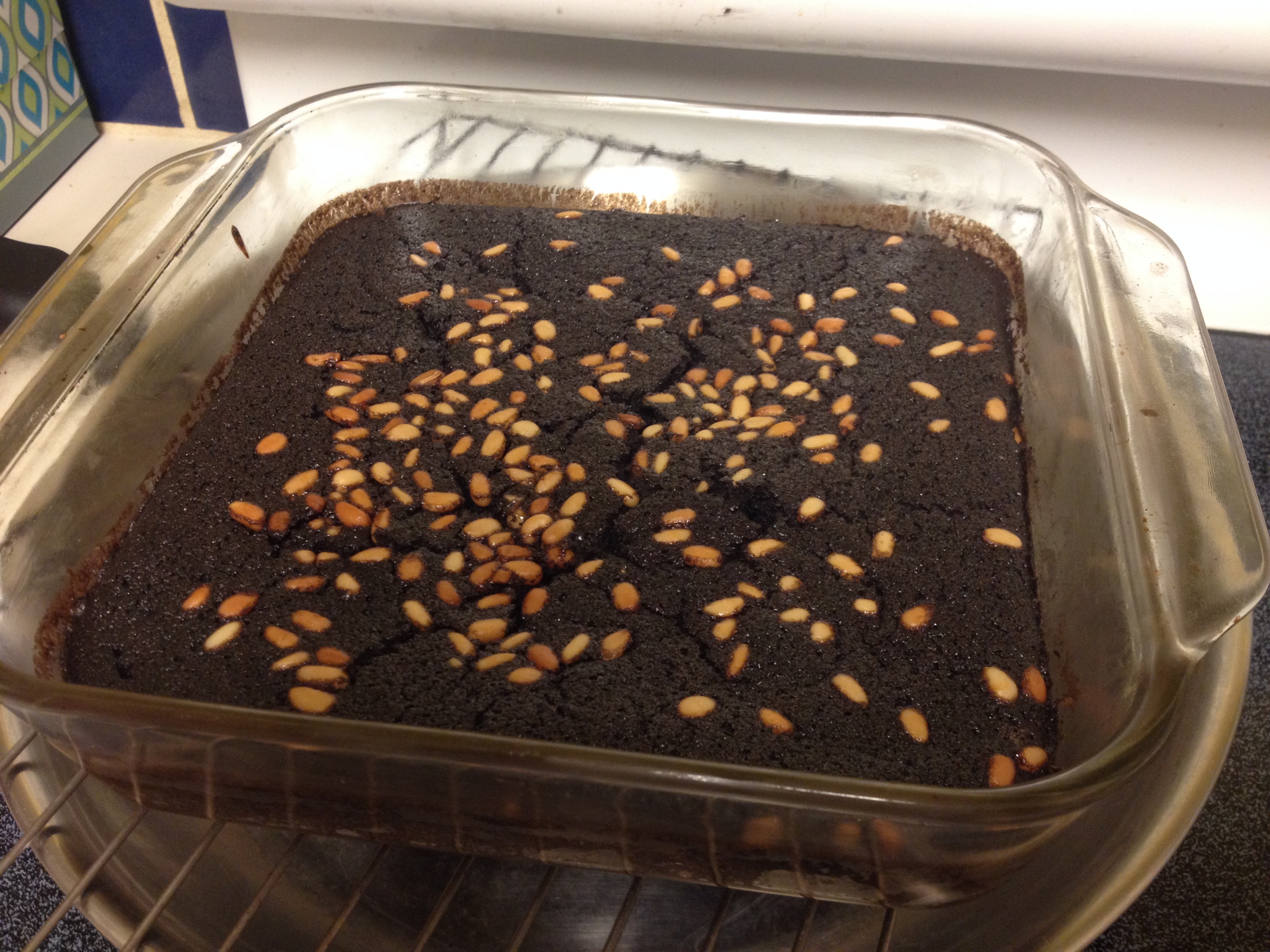
Gluten-free black tepary brownie-cockaigne for a desert dessert!

Yum!–Gluten-free Akimel O’odham Black Tepary Bean brownies with pinyones — a truly desert dessert served at the Farm-to-Table Picnic Feast at Mission Garden

Indeed, there is no doubt Tucson should be given the designation as an International City of Gastronomy!  Where else in the world could we enjoy a finer, more diverse, perfectly indigenous, more delectable and nutritious PICNIC-FEAST than here in Tucson?  Delicious dishes were the pieces de resistance by some of Tucson’s most renowned chefs for……the first-ever Farm-to-Table Picnic at Tucson’s Mission Garden.

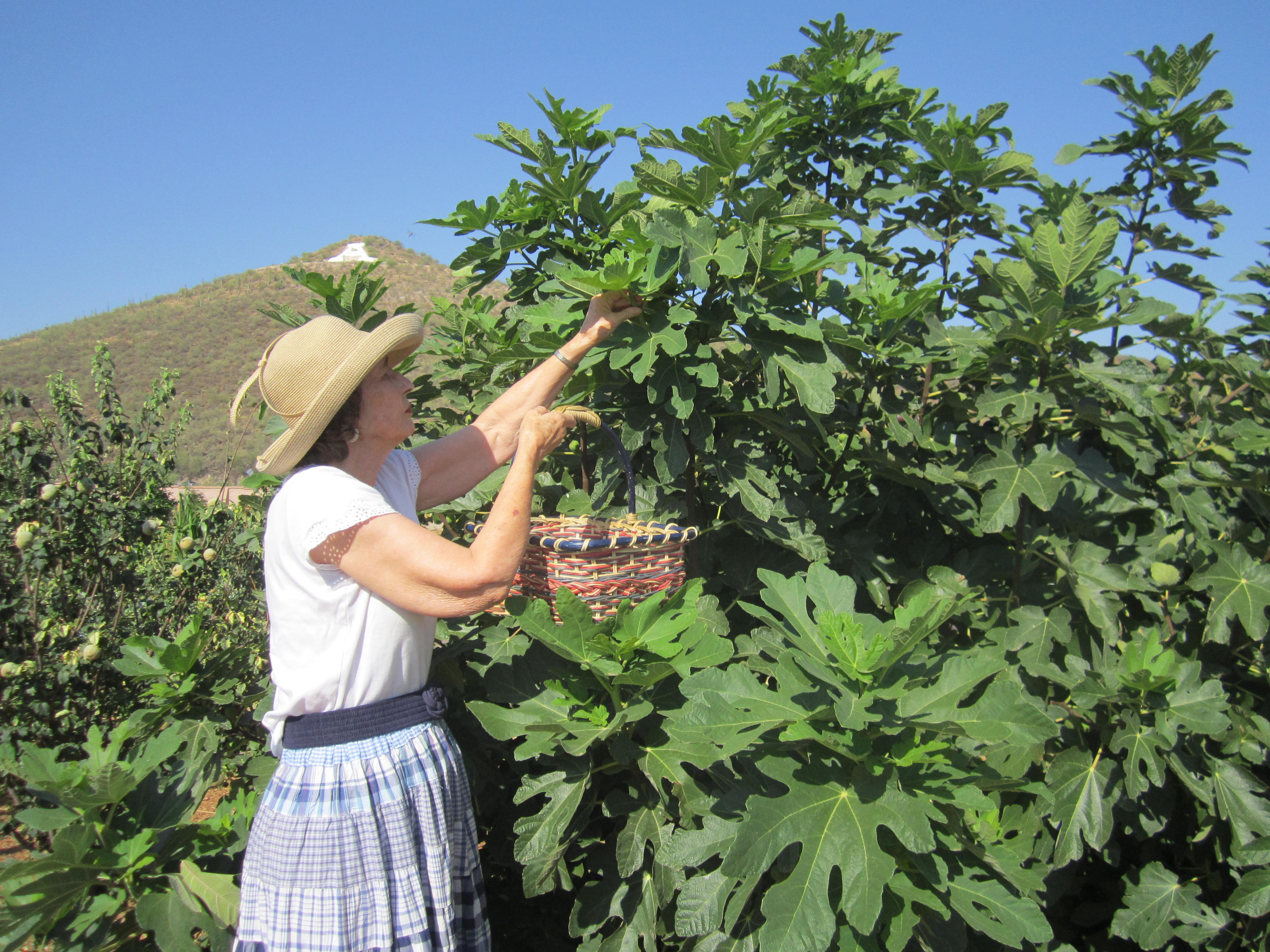
Picking heirloom figs at the Mission Garden for the Farm to Table Feast.

Native-foods cook and author Carolyn Niethammer picking heirloom figs at the Mission Garden for the Farm to Table Feast for her gone-to-heaven fig-bar postre.

At the base of our landmark A-Mountain–the very birthplace of Schuuck-shon–set in a scene of verdant orchard trees heavy with fruit, and heirloom vegetables bearing their colorful autumn harvest, we feasted this past Sunday, October 18, on the tried and true fruits of our desert land.    The community registered for this edible fundraiser via the two hosts of the Farm-to-Table Picnic Feast–our Tucson-born-and-bred organizations– Friends of Tucson’s Birthplace and NativeSeeds/SEARCH.   The cost of $75 covered a magnificent repast–not just a dainty little taste of hors d’oeuvres but a sumptuous serving of at least 7 gourmet entrees, plus a variety of hand-made desserts and some locally fermented beverages!  Either website can guide you to ways of supporting or volunteering for these worthy outfits–http://www.tucsonsbirthplace.org or http://www.nativeseeds.org.

At our special outdoor feast, we learned and appreciated where every single bite comes from!  Every ingredient was LOCAL–grown on our own Baja Arizona soil, bathed by our own Arizona sun, watered by our own Pleistocene aquifer, tended by our own neighbors’ hands not to mention those of Mission Garden and NSS volunteers and staff.

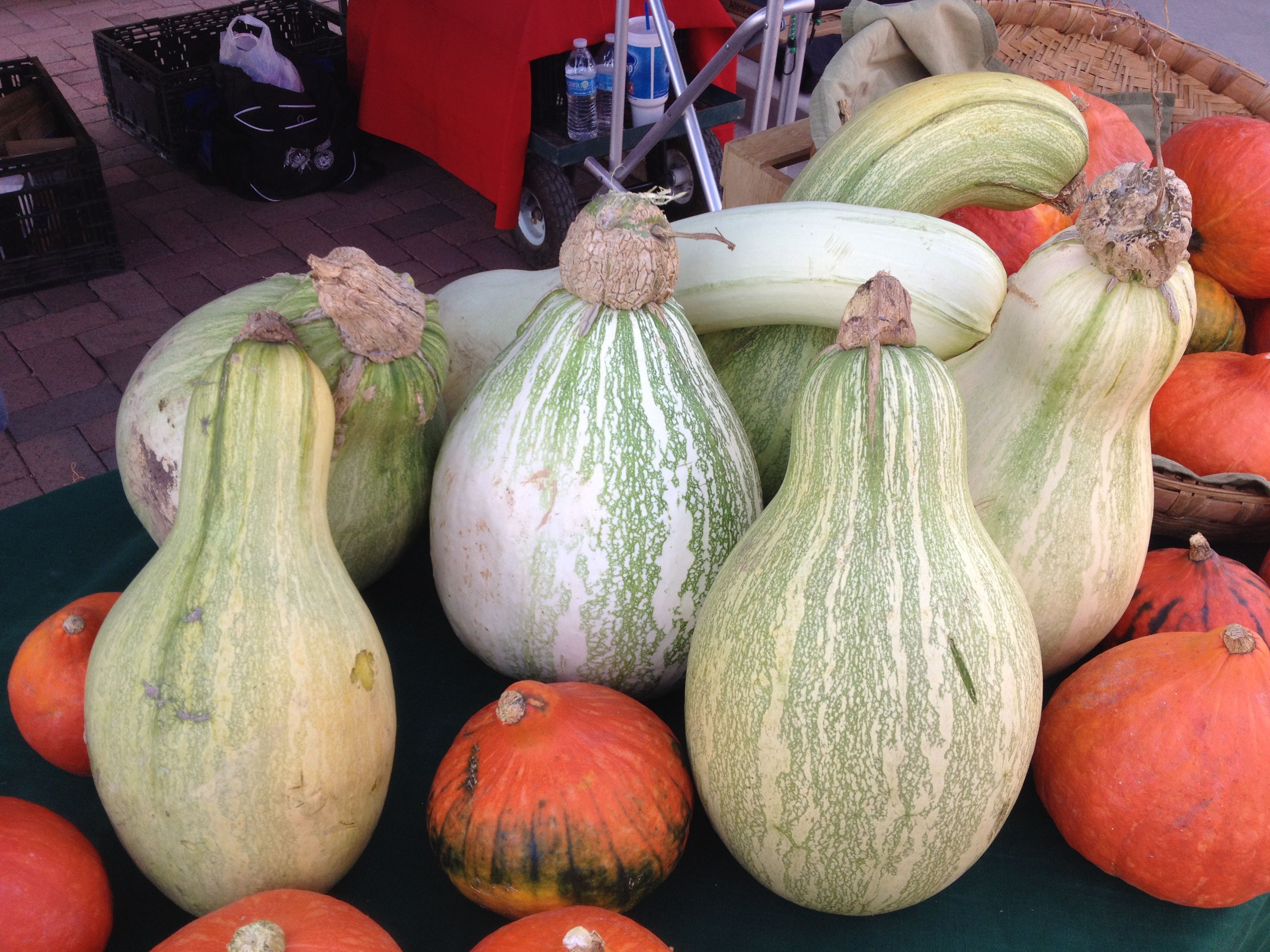
To recognize them from the source….the beautiful Native Tohono O’odham Ha:l squashes, grown at the NativeSeeds/SEARCH Conservation Farm, in combo with I’itoi’s Onions and other heirloom veggies, morphed into betacarotene-rich chile with Loew’s Ventana Canyon‘s Chef Ken Harvey’s magic.   Mission Garden’s heirloom pumpkins and greens transformed by Chef Doug Levy at Feast Tucson to a superb salad-supreme.

Traditional and delicious--Tohono O'odham Ha:l winter squash with magic inside--and curry pumpkins (MABphoto)

Traditional and delicious–Tohono O’odham Ha:l winter squash with magic inside of them–with curry pumpkins (MABphoto)

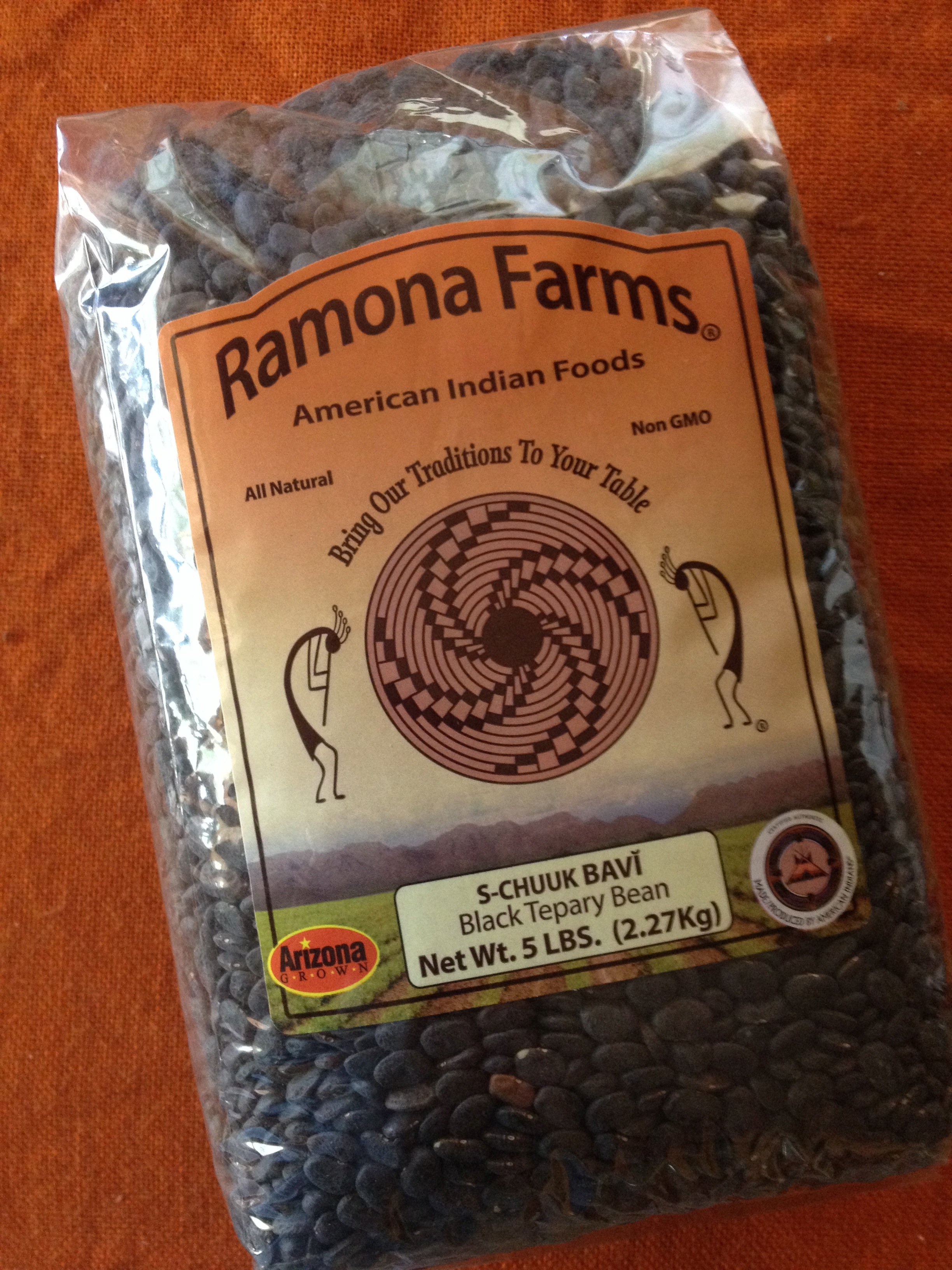
Akimel O’odham pearly black teparies from Pima farmer Ramona Button‘s fields  and locally-harvested cholla buds transformed with culinary sorcery by Chef Janos Wilder’s Downtown Kitchen into the most gourmet vegetarian delight.

S-Chuuk Bavi from Ramona Farms

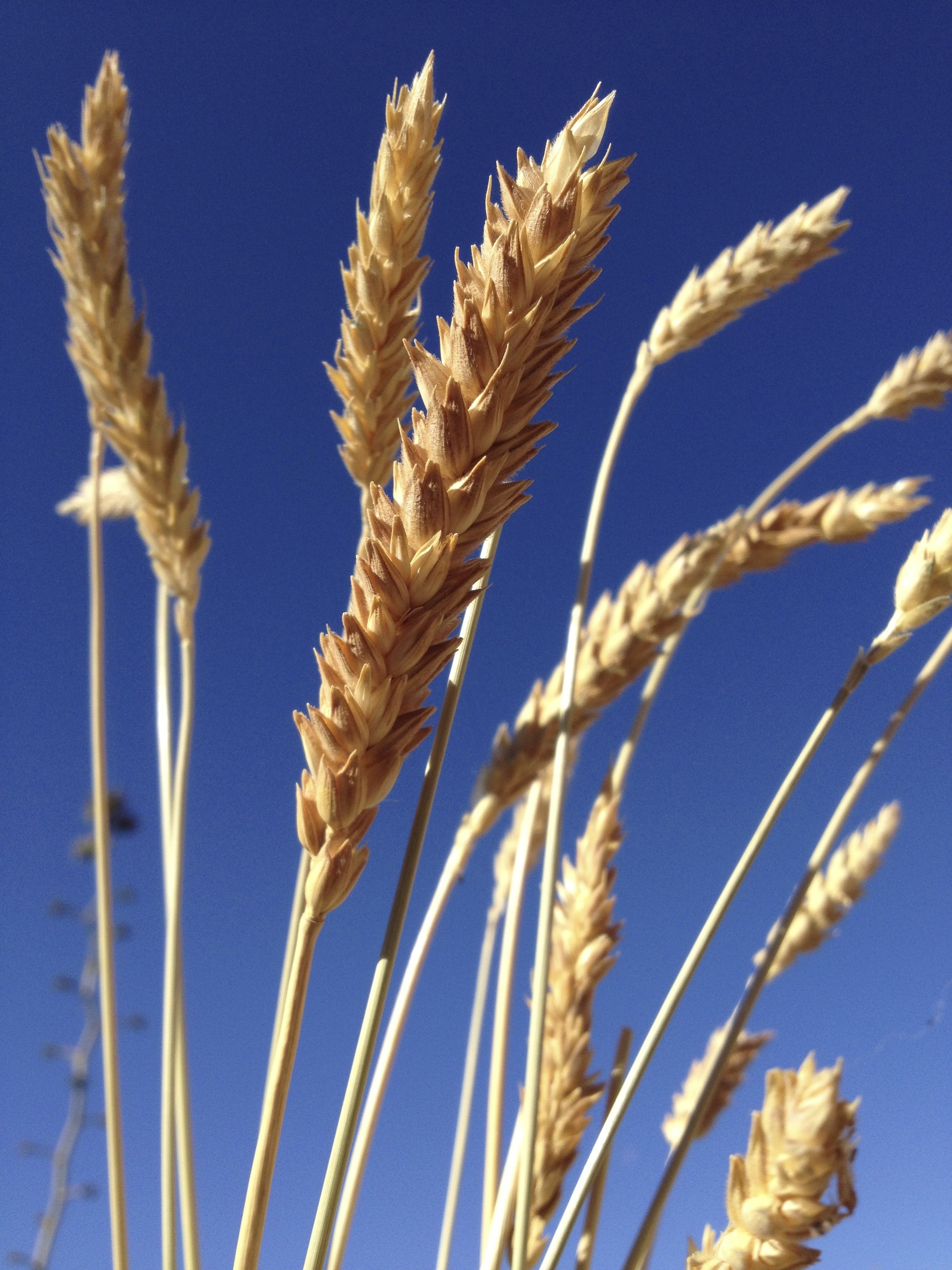
Padre Kino’s White Sonora Wheat from BKWFarms‘ organic fields became the most flavorful and delicately marinated wheat-berry salad by the hand of Chef Rebecca Ramey at Blue Willow Restaurant.  And speaking of transformation, BKWFarms’ organic white Sonora wheat, with the magic of friendly microbes at Dragoon Brewery, became a festive brew with an amazing back-story to delight all samplers.

Ripened seed heads of organic heirloom Padre Kino White Sonora Wheat from BKWFarms in Marana (MABurgess photo)

Ripened seed heads of organic heirloom Padre Kino White Sonora Wheat from BKWFarms in Marana (MABurgess photo)


Farmer Frank’s Crooked Sky Farms‘ GMO-free fresh corn expressed itself in a fresh-from-the garden casserole by Proper’s Chef Kris Vrolijk.    Tohono O’odham traditional melon with other fresh corn and tomato, evolved into a gourmet gazpacho created by the Chef at Desert Diamond Casino, our major event sponsor.


Tia Marta here thanking ALL who came to the Table–the Farm-to-Table outdoor Picnic Feast at Mission Garden–to enjoy this enriching experience of Tucson’s traditional foods, cultivated with love in our own “desert terroir.”*  THANKS TO ALL our local–yet world-famous–culinary talent who prepared these sacred foods with care and dedication!  THANKS ALSO to the supporters and volunteers who made this event such a success!   Was it a sign of its significance at that moving moment culminating the feast when the heavens blessed us with a glorious sunset?

The public is invited to visit the ever-changing setting of this feast–the very garden and orchard where many of the heirloom foods are still hanging on fruit-tree boughs or ripening on the vine.  The Mission Garden is open for tours every Saturday with knowledgeable guides to take you through this special desert oasis–a living agricultural history museum.  (For info see http://www.tucsonsbirthplace.org).

For your own table, you too can source the heirloom foods served at the Picnic Feast, at the NativeSeeds/SEARCH Store, 3061 N Campbell, Tucson, http://www.nativeseeds.org, or at the Flor de Mayo booth (online at http://www.flordemayoarts.com) and other farm booths at Sunday’s St Philips Farmers’ Market (www.foodinroot.com).

Native Black Tepary Beans from Flor de Mayo at St Philips farmers market Sundays

Native Black Tepary Beans from Flor de Mayo at St Philips farmers market Sundays

Join NativeSeeds/SEARCH as a member and stay in touch with seed-savers, gardeners, and cooks as we keep these desert-adapted foods alive and well into an unknown future.

Yours truly, Tia Marta, have also honored these heirloom foods artistically by documenting them from my garden in their harvest splendor as watercolor images.  I invite you to view them firsthand at two upcoming OPEN STUDIO eventsART TRAILS on Saturday, Oct 24, and the TPAC OPEN STUDIO weekend Nov.14-15 at Carolyn Leigh Studio.  Search by my studio name, Flor de Mayo Studio, or by artist’s name, Martha Ames Burgess, at  http://www.ArtTrails.org , and at http://www.tucsonpimaopenstudiotour.org  for directions, and do come by for a visit.  You can also check out some of my Southwest Native heirloom food images on my website gallery http://www.flordemayoarts.com — enjoy!

NativeSeeds/SEARCH heirloom Navajo Cushaw Squash watercolor by artist Martha Ames Burgess

NativeSeeds/SEARCH heirloom Navajo Cushaw watercolor by artist Martha Ames Burgess


What will Tucson's top chefs cook for the Heritage Picnic?

Tucson’s top chefs cook for the Farm-to-Table Heritage Foods Picnic Feast


*Desert Terroir,  by renowned author and co-founder of NativeSeeds/SEARCH, available at the NSS store, is a great read about the deep significance of LOCAL.  We can “internalize” his messages by shopping at farmers’ markets,  growing our own, and honoring long-successful desert traditions, seeds, and foods.

Black Teparies Make a Come-Back!

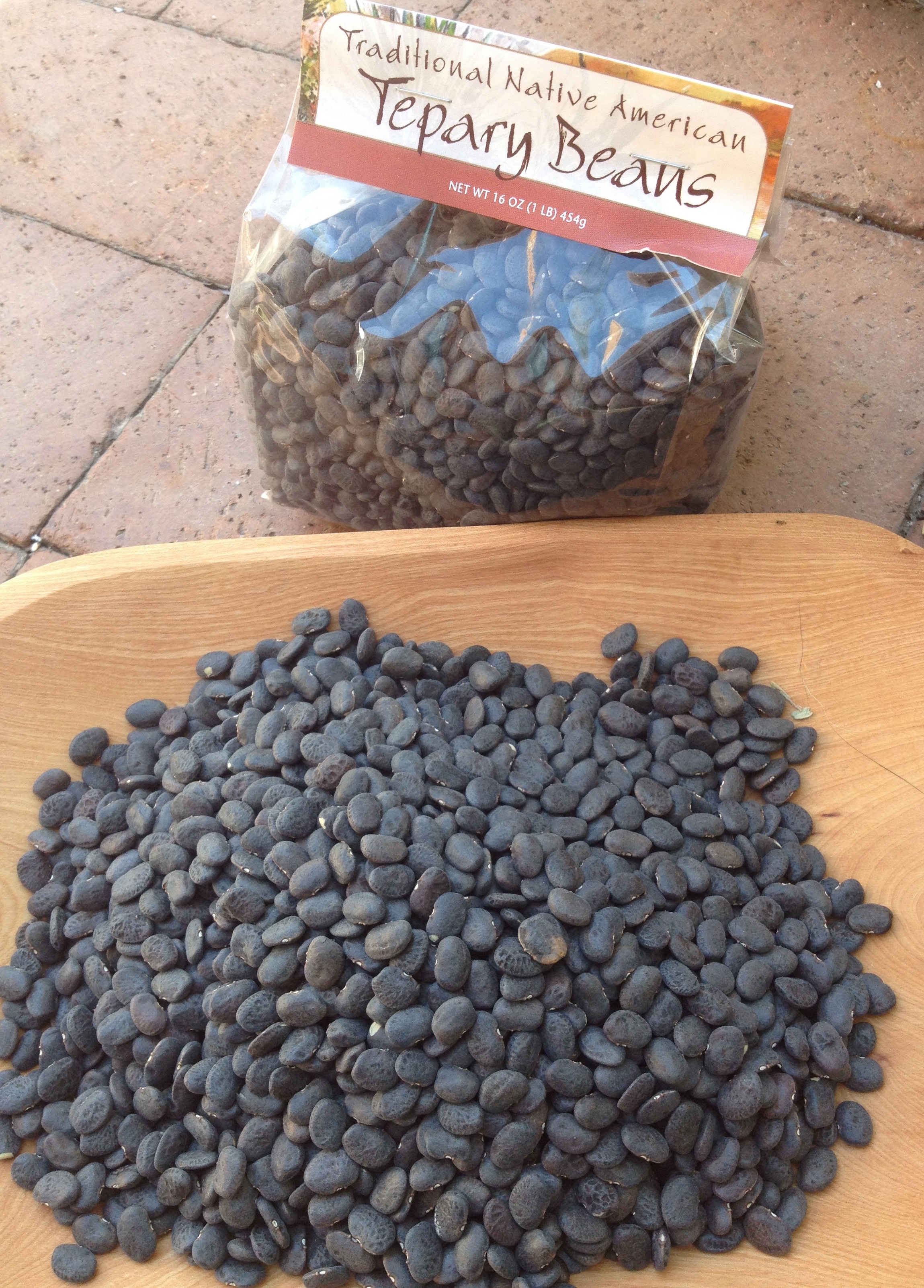
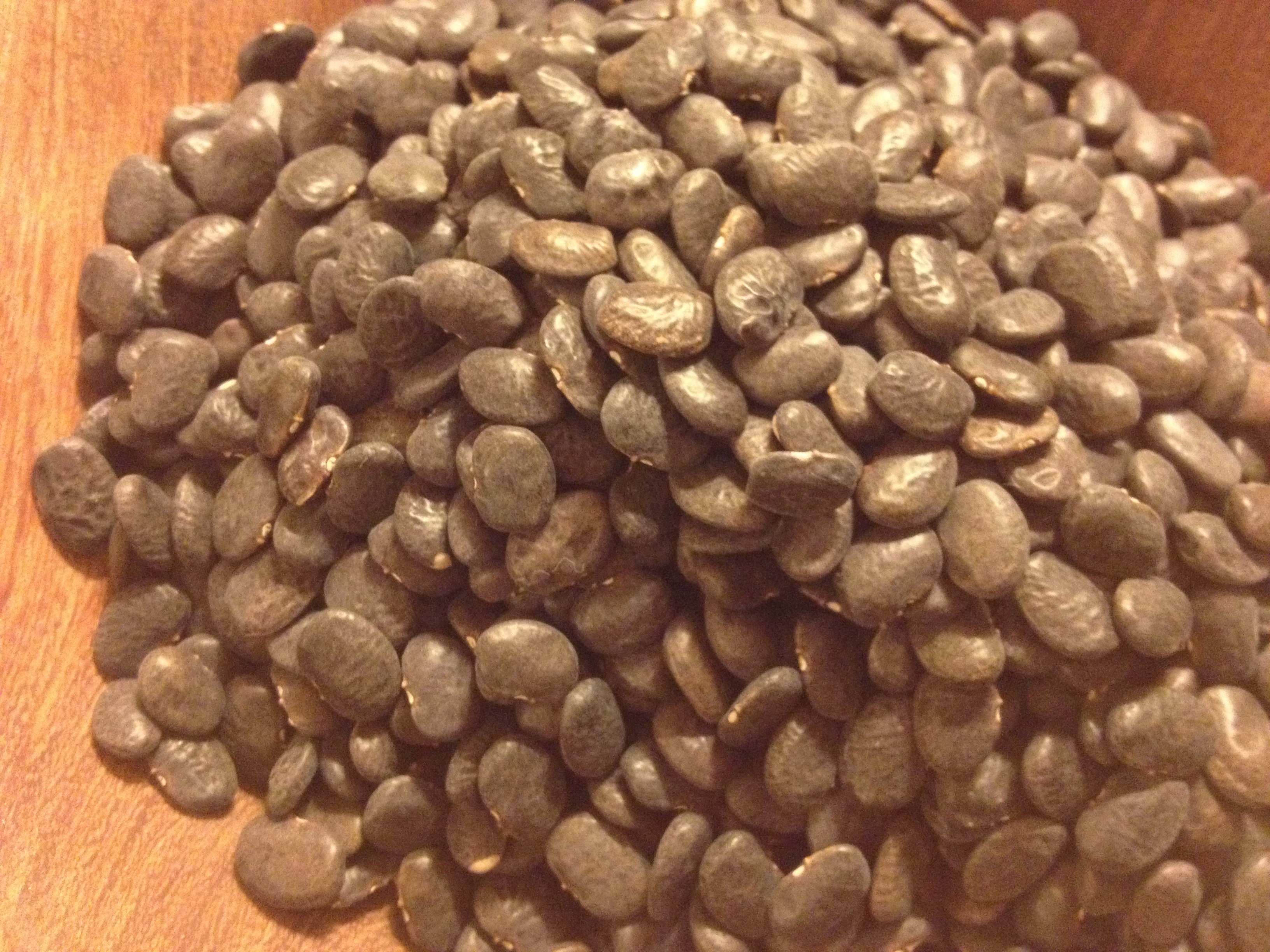
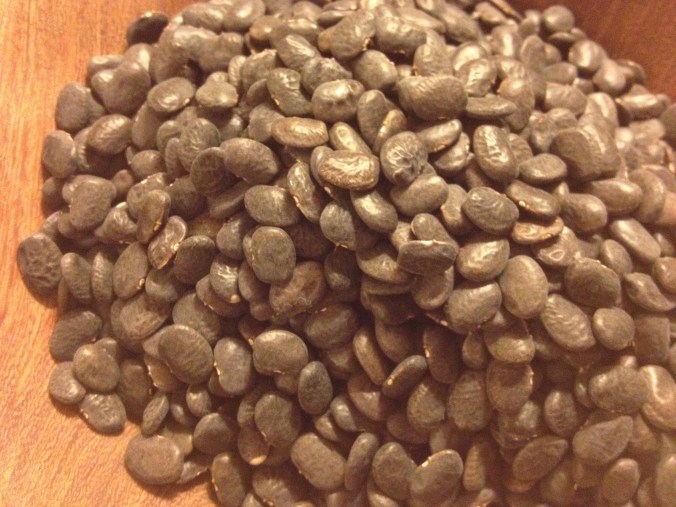
Rich black teary beans dried, ready to hydrate for cooking

Rich black tepary beans dried, ready to hydrate for cooking

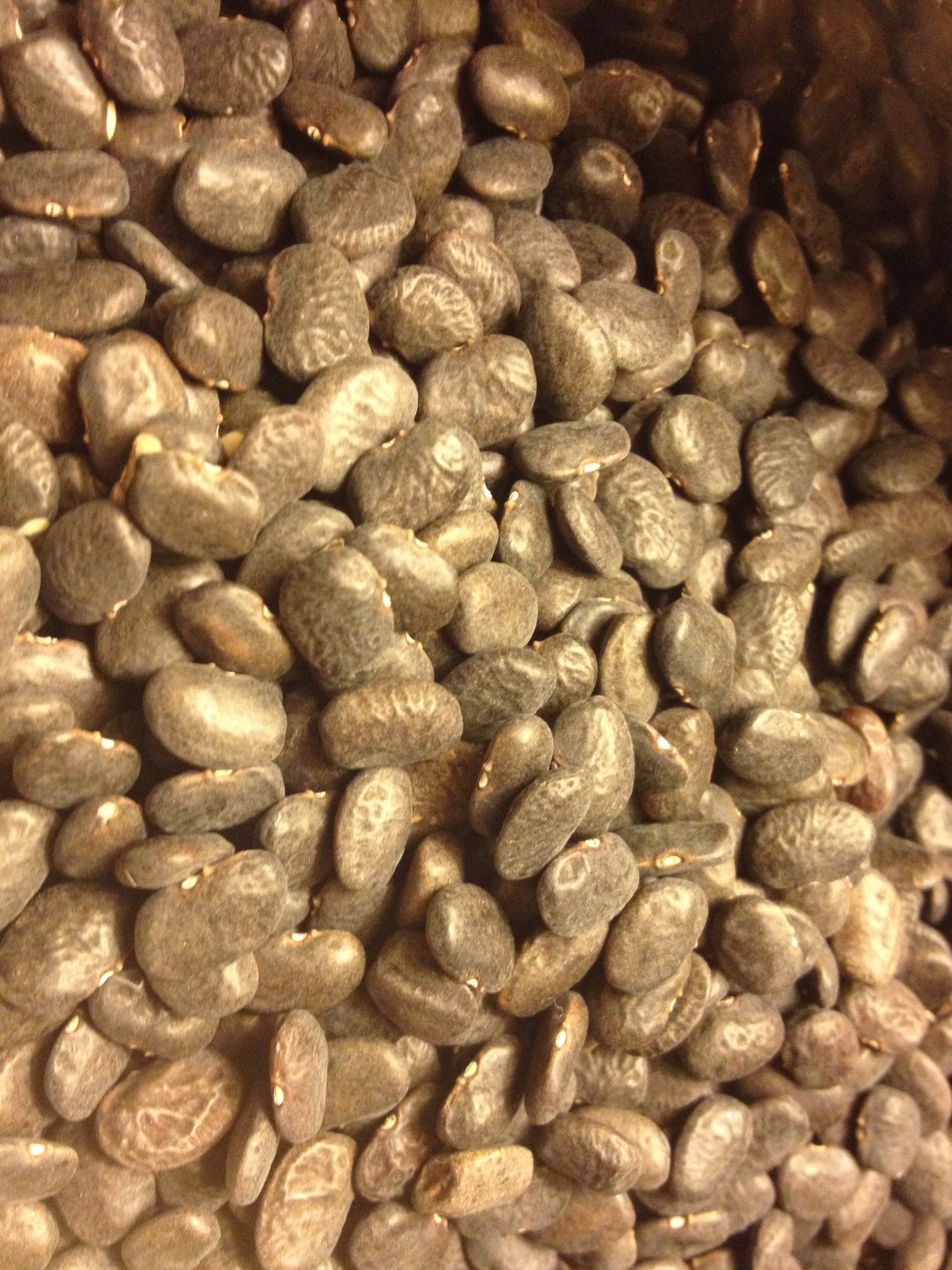
In some light they are a dull charcoal difficult to spot if the pods shatter onto the ground. Sometimes they appear shiny black or opalescent. Somehow black teparies appear to have an antiquity about them–mysteriously harking back to a time rich in prehistory. Tia Marta here to tell you a little about the black tepary bean’s odyssey back into cultivation and into the cooking pots of Southwesterners once again.
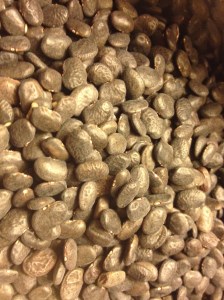
Shiny black teparies close up

Shiny black teparies close up

Back in 1912, before WWI and the rapid plunge the “remote” Southwest unavoidably took into East-Coast food fads, there was a crop survey done of the many types of tepary beans being grown and used by different Native American families and communities throughout the Borderlands. The diversity at that time was astounding—some 40+ different colors, forms, sizes, speckles, of tepary beans were reported. Within about a decade there remained only a couple of dominant tepary colors—“red” (an orangy-brown) and white. [For more history, check out Volume 5, No.1 of Desert Plants Journal published by the University of Arizona CALS. Specifically this issue is devoted to tepary beans, and includes an article by yours truly.]

The neat thing about cultivars that are still genetically close to their wild ancestors is that they still contain a diversity of genes that can “pop out” occasionally as visibly different seeds. In the case of the teparies, every so often in a harvest of white teparies, for example, there may turn up a few coral pink, or blue speckled, or even black beans. At the University of Arizona’s Maricopa Experimental Farm, an amazing crop researcher, Mike Sheedy, was, for several years growing teparies to isolate some of these genetic “sports”. He used assistance from his kids (In farming, child labor rules just can’t apply) to help pick out the odd-ball seeds from hundreds of pounds of harvested teparies. Over the years, he grew the separated colors in isolation from each other to preserve color purity. Before research funds ran out he had “re-created” an ancient lineage of black teparies—i.e. he has assisted the ancient genes to come again to the fore, to bring the “invisible” genotype back into the “visible” phenotypes. At termination of his research project he generously donated the black tepary collection to the traditional Pima farming family of Ramona and Terry Button.
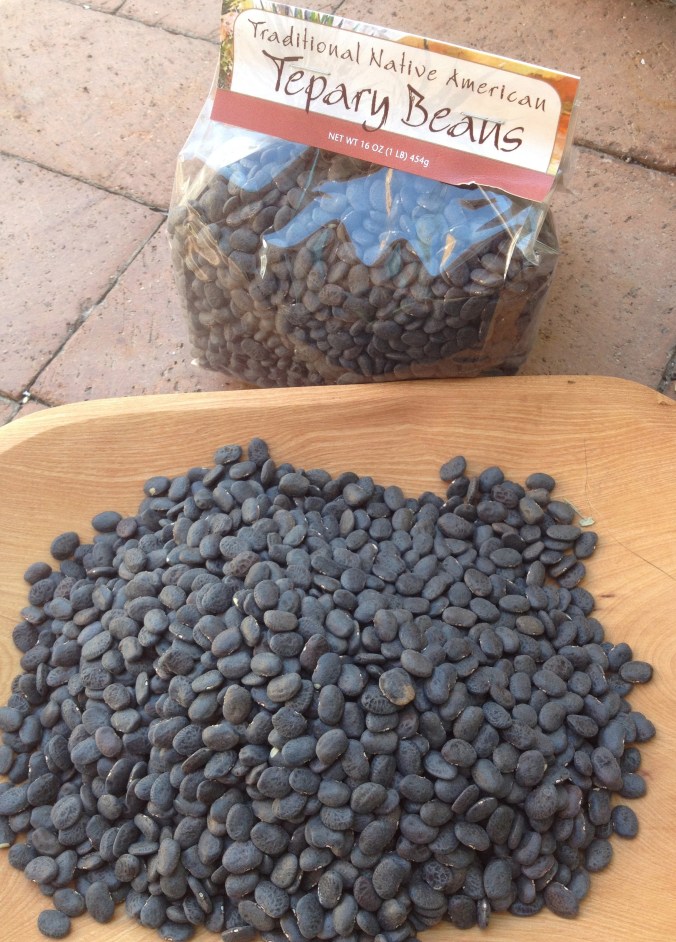
Native Black Tepary Beans & Flor de Mayo 1-lb pkg

Native Black Tepary Beans & Flor de Mayo 1-lb pkg

Now—tah-dah!—at last black teparies are in agricultural production on ancestral lands! The public can purchase these little food gems of antiquity now at the NativeSeeds/SEARCH store (3061 N Campbell Ave, Tucson) www.nativeseeds.org , at the Flor de Mayo booth at Sunday St Philips Farmers Market www.flordemayoarts.com , or online via www.ramonafarms.com.
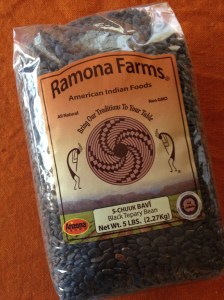
S-Chuuk Bavi from Ramona Farms

Black teparies are very different in taste from the red or white teparies—although all teparies are much richer than their more distant cousins like the common bean, lima or black-eye pea. Black tepary, schkug ba:wĭ of the Tohono and Akimel O’odham, is the deepest, nuttiest of all, with an earthy bouquet and a slightly bitter after-note reminiscent of coffee. Well, you will just have to try your own taste buds on them!

The public will have an exciting opportunity to taste black teparies prepared by none other than our beloved Tucson Chef Janos Wilder (of Downtown Kitchen fame) at the upcoming Farm to Table Picnic feast at Mission Garden, Sunday afternoon, October 18, 4-6:30pm. Janos is not letting on what his special black tepary recipe will be, but we can be sure it’ll be sensational. [The picnic is by pre-registration only so buy your tickets soon! Online purchase is via the Friends of Tucson’s Birthplace site www.tucsonsbirthplace.org.]
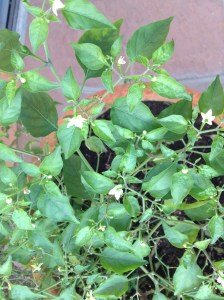
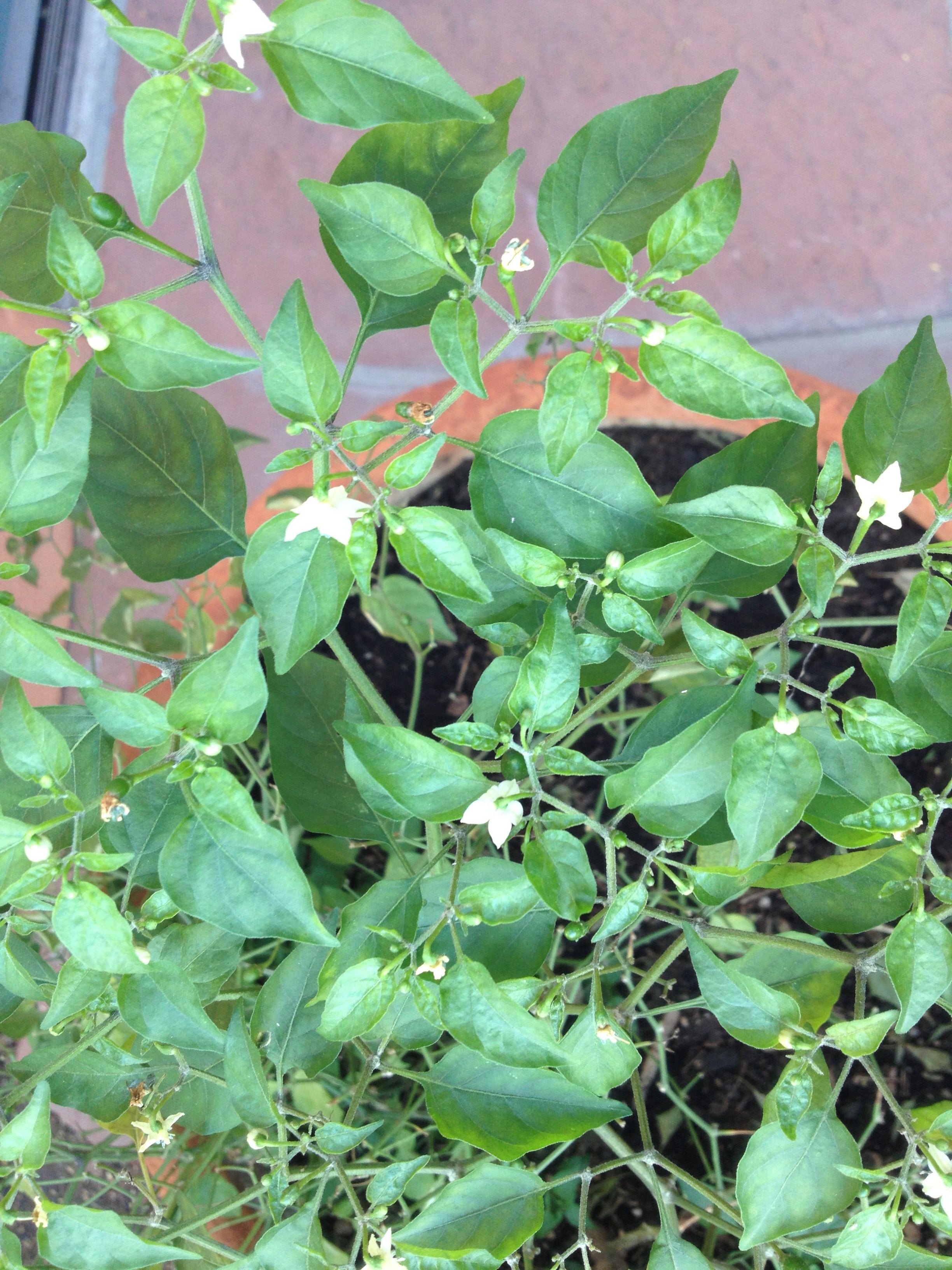
Potted blooming chiltepin plant for edible landscaping

Potted blooming chiltepin plant for edible landscaping

All of the heirloom foods served at the Farm to Table Picnic are being grown (even as I write) locally in Baja Arizona, either at the NativeSeeds/SEARCH Conservation Farm in Patagonia, or at the Mission Garden itself, or by sponsoring farmers and ranchers such as BKWFarmsInc, the 47-Ranch, and Ramona Farms. Some of Tucson’s best chefs are donating their skill and time to prepare different dishes for us. It will be a great opportunity to put the fun in fundraising for two worthy local non-profits, to share the delicious tastes of our heirloom foods of the Borderlands, and to share community joy in what we are able to produce together locally.

For adventuresome cooks, dessert addicts, and chocoholics, I would like to share two variations on brownies made with—yes, you guessed it—black tepary beans! You will not believe how yummy these are.
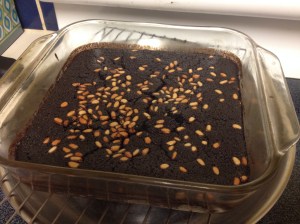
Gluten-free Black Tepary Brownie-Cockaigne on cooling rack

Gluten-free Black Tepary Brownie-Cockaigne on cooling rack


First, cooking black teparies (as with all teparies) takes some time—and premeditation.  The day before you want to use them, sort, wash, and pre-soak your black teparies. I hit them with a quick boil and let them sit overnight to hydrate slowly. Change the water the next day, adding fresh drinking water. Simmer until soft (it may take 2-3 hours on stovetop or 4-6 in crockpot). You want them beyond al dente in order to puree them in a blender or CuisinArt for the following recipes.


Muff’s Gluten-free Black Tepary Bean Brownies-Cockaigne

Ingredients:

1 cup cooked and pureed black tepary beans

1 stick butter= ¼ lb= ½ cup butter

5 Tbsp dark 100% cocoa powder, unsweetened (1 oz.)

¼ tsp sea salt

1 cup organic cane sugar

1 cup loose organic brown sugar

1 tsp vanilla extract

4 eggs well-beaten

¼- ½ cup nutmeats (I use pinyon nuts to keep the Southwest theme)

Directions for Muff’s Gluten-free Black Tepary Brownie-Cockaigne:

Preheat oven to 350 degrees F. Grease an 8×8” baking dish and place a wax paper cut to fit the bottom of pan. Melt butter (preferably in top of double boiler). Stir in thoroughly 5 Tbsp dark unsweetened cocoa powder. Let the mixture cool. Add sugars and sea salt to mixture and beat until creamy. Add vanilla. Beat 4 eggs and add to mixture stirring until uniform in color. Add 1 cup pureed black teparies and hand-mix. Pour batter into greased bake pan. Sprinkle top of batter with pinyones or other nutmeats. Bake 45-50 minutes until it tests done with toothpick.   Cool pan on a rack. Cut in small squares to serve because it is so rich and moist. Enjoy their delicious flavors AND the healthy qualities of high protein/high complex carb teparies, protein-rich eggs, and the benefits of dark chocolate!
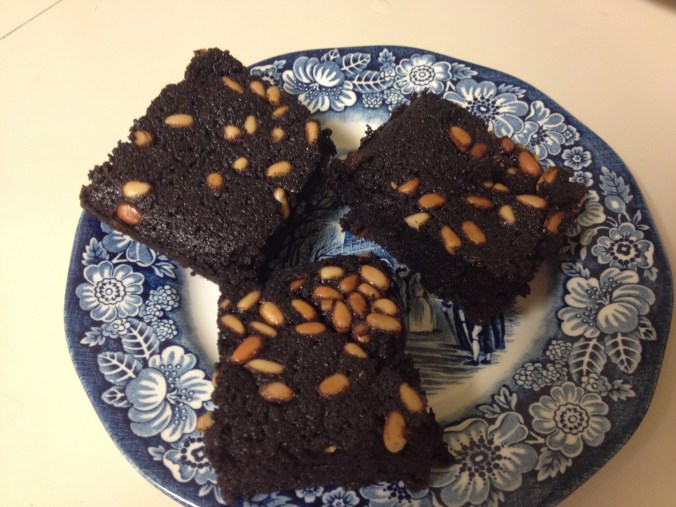
Gluten-free black tepary brownie-cockaigne ready to eat

Gluten-free Black Tepary Brownie-Cockaigne ready to eat–wheat-free, light, nutritious and delicious!

My next black tepary brownie recipe was first inspired by food-writer and “Blog-sister” Carolyn Niethammer’s recipe found in her book Cooking the Wild Southwest (p.133)–a must-have in every SW cook’s kitchen shelf. Here I’ve made some interesting gastronomic additions…including the use of our fantastic local heirloom White Sonora Wheat flour, crushed wild chiltepines, and Mano y Metate’s fresh-ground Mole Dulce powder produced by our local Molera herself, Amy Valdes Schwemm.


“Hot-Dam”* Black Tepary Brownie Bars [*in the best sense of the expression]

Ingredients:

5 Tbsp unsweetened 100% cocoa powder

½ stick (1/4 cup) melted butter

¾ cup organic cane sugar

¾ cup org brown sugar, not-packed

2 eggs, beaten

2 tsp vanilla extract

¾ cup pureed cooked black teparies

¾ cup organic heirloom White Sonora Wheat flour**

3 or 4+ crushed wild chiltepin peppers*** (number depends on your desired picante level)

¼ tsp sea salt

1-2 Tbsp Mano y Metate ground Mole Dulce powder

2 Tbsp raw pinyon nutmeats
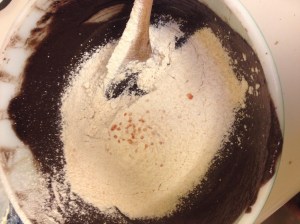
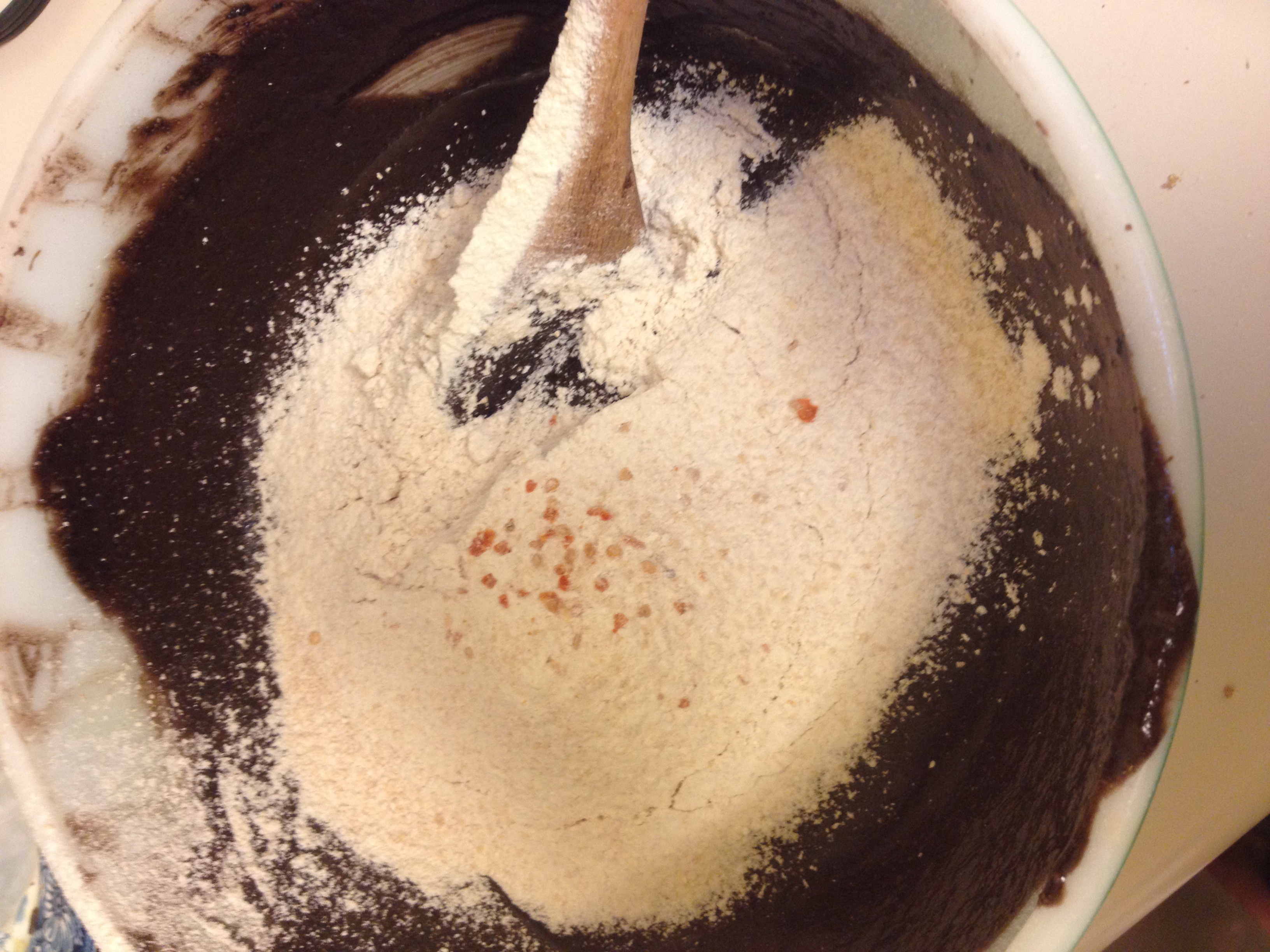
Adding White Sonora Wheat flour and crushed chiltepin to molten chocolate mixture

Adding White Sonora Wheat flour and crushed chiltepin to molten chocolate mixture

** Freshly milled White Sonora Wheat is available at our Flor de Mayo booth, Sunday’s St Philips farmers market (www.foodinroot.com). Call ahead for quantities larger than 1 kilo—520-907-9471.

***whole wild-harvested Chiltepines are available at the NSS Store, 3061 N Campbell, and at Flor de Mayo booth, Sunday St Philips farmers mkt. Chiltepin plants to grow can be purchased at NSS plant sales.
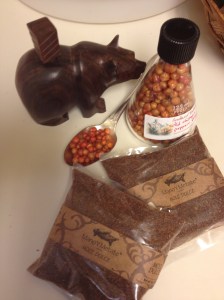
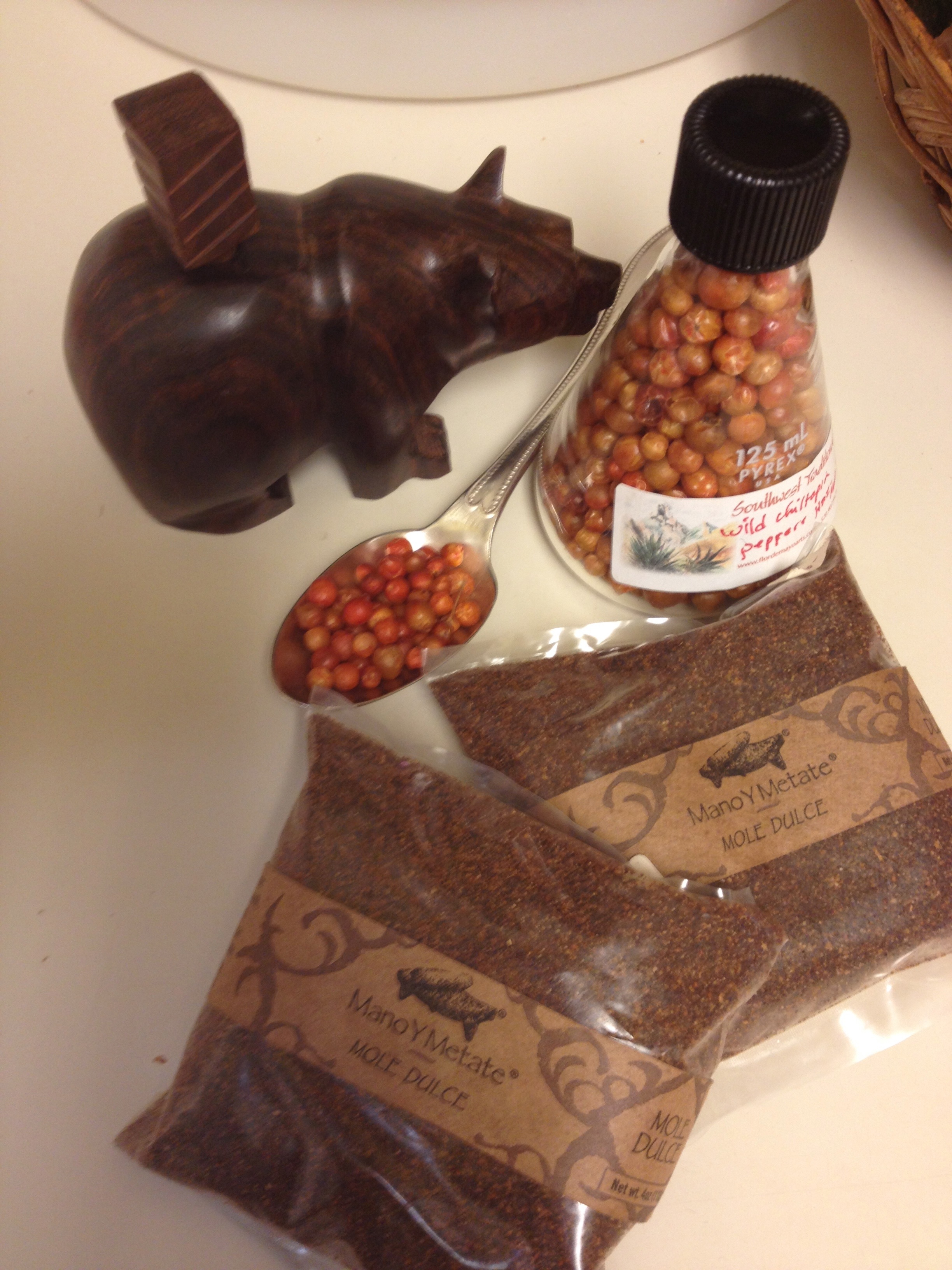
Flavors to guild the lily--Wild chiltepin peppers, ironwood bear molinillo grinder, and Mole Dulce powder

Flavors to guild the lily–Wild chiltepin peppers, ironwood bear molinillo chiltepin grinder, and Mole Dulce powder (all available at NSS store and Flor de Mayo at St Philips farmers market)


Directions for “Hot-dam” Black Tepary Brownie Bars:

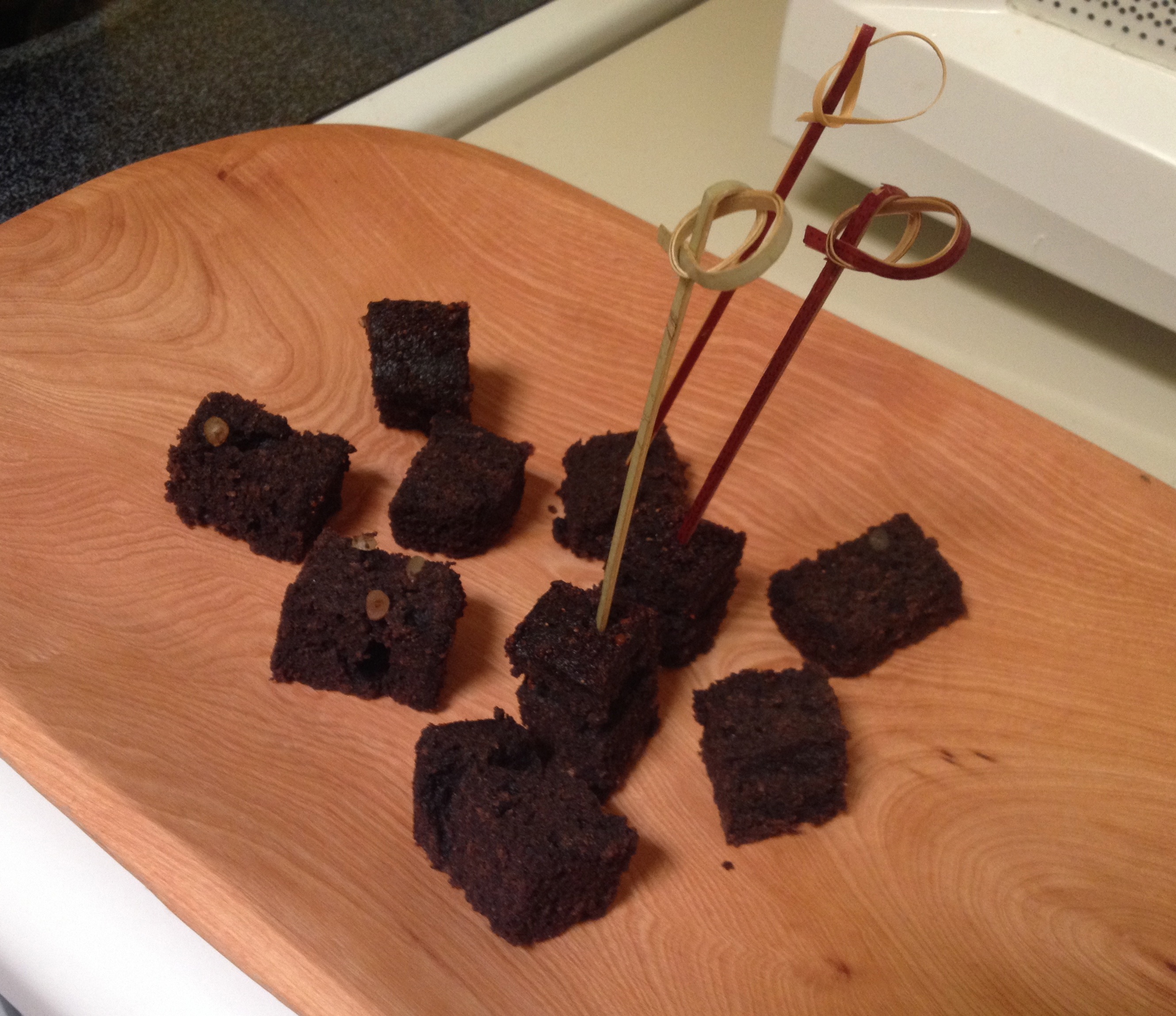
Pre-heat oven to 325F. Grease 8×8” baking pan with wax paper set in bottom. Melt butter and mix powdered cocoa in thoroughly. Add the brown sugar and organic white sugar and vanilla to the butter and cocoa, and beat. Beat 2 eggs and stir thoroughly into the choc/sugar mixture. Wisk in ¾ cup pureed black teparies. Sift together: ¾ C white Sonora wheat flour, ¼ tsp sea salt, and the well-crushed chiltepin peppers. Stir dry ingredients into liquid mixture. Add pinyon nutmeats. Pour batter into bake-pan. Sprinkle 1-2 Tbsp of Mole Dulce powder on top of the batter. Bake 25 minutes or until it tests done (when fingerprint pressed on top springs back). When cooled, cut into small bite-size squares to be served with hors d’oeuvre picks—you will see why…..(and don’t rub your eyes after eating.)
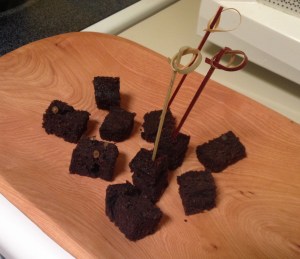
"Hot-dam" Black Tepary Brownies ready to enjoy!

“Hot-dam” Black Tepary Brownies ready to enjoy!


Tia Marta is hoping you enjoy these fruits and flavors of the Sonoran Desert assisted by fruits of tropical North America—a marriage made in dessert-Heaven! With every bite we should be thanking ancient tepary farmers, and the recent ones who have brought back the Black Tepary from near genetic-oblivion.


Coming this week to Tucson is a food event not to miss: the Farmer to Chef Connection, this Wednesday, September 16, at Tucson Community Center, 12:00noon-5:30pm, sponsored by LocalFirstArizona. Google their site for tickets and come enjoy a smorgasbord of local tastes.

Also be sure to mark your calendar for October 18 and join NativeSeeds/SEARCH and Friends of Tucson’s Birthplace at the very heart of Tucson’s Birthplace –the Mission Garden at the base of A-Mountain—for the first-ever outdoor Farm to Table Picnic. It will be a feast to remember. Make reservations now and we’ll see you there for fun, flavor, history and friendship!

You Say Purslane, I Say Verdolagas

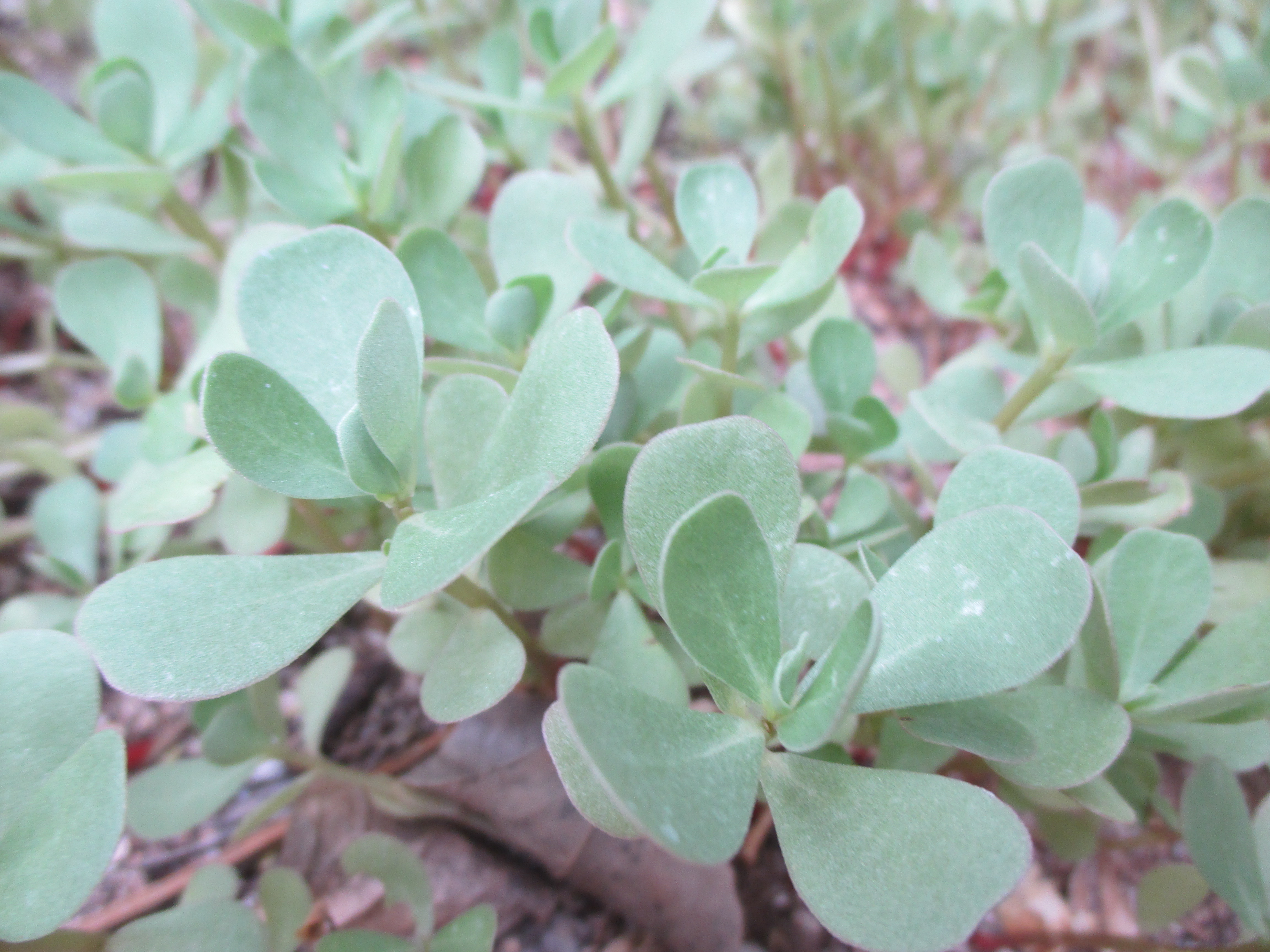
Purslane just sprigs so far due to late rains at my house.

Purslane is  just sprigs so far this year due to late rains at my house.

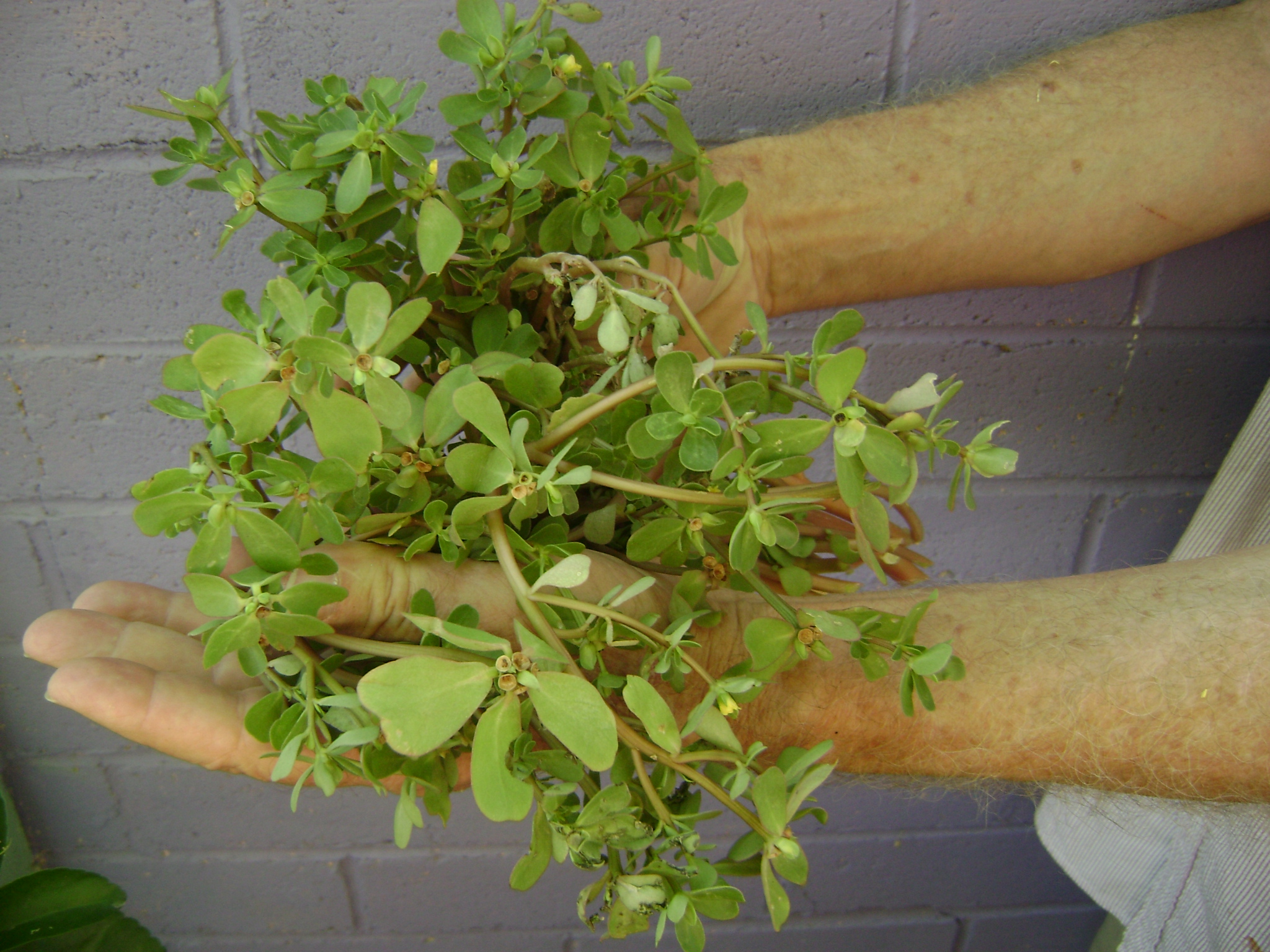
Here's how it should look once we get some more rain.

Here’s how it should look once we get some more rain.

If you’ve had any decent monsoon rain by now, you may have a vitamin powerhouse coming up in your yard.  Purslane, also called verdolagas, grows in many Southwest backyards in the summer.  It prefers rich, recently turned soils so look for it under your rose bushes or in a flower garden. It has small fleshly leaves about the size of a fingernail, pinkish stems, and grows close to the ground.  I have only a small patch this year where a small rain barrel spilled over. There should be more, but rains have been skimpy in our part of downtown Tucson.

It’s sad but true that right now people are out in their yards pulling these plants out and tossing them in the garbage (or compost for the more enlightened). They should be tossing them in the wok (see recipe below.) Purslane provides six times more vitamin E than spinach and seven times more beta carotene than carrots. It’s also rich in vitamin C, magnesium, riboflavin, potassium and phosphorus. One cup of cooked purslane has 25 milligrams (20 percent of the recommended daily intake) of vitamin C.

Especially important to those of us eating a modern diet, purslane is very high in an essential omega-3 fatty acid called alpha-linolenic acid (ALA). Omega-3s are a class of polyunsaturated essential fatty acids. Your body cannot manufacture essential fatty acids, so you must get them from food. Certain fibers also help in controlling blood sugar.

Sometimes all this talk of nutrition can turn people off  — you might be saying “OK, but what does it taste like?” Delicious, actually. There are lots of ways to use purslane. The mild lemony flavor goes with everything. Purslane can be eaten raw chopped in salads or sautéed . Add it to a stew.   Or toss it in the blender when making a green smoothie and it will add body as well as vitamins.

There’s something else, too. Something beyond just the vitamins that come from eating plants from your own yard. It’s a connection to the land you live on, the seasonal treat that Mother Nature has provided. By eating with the season, you become more than a mere spectator to life’s cycle. You think about these tiny seeds that wait for the rain, then manage to live as the sun beats down with 100-degree fury. And there’s the connection to past generations of people who lived here and ate these plants–a connection that broccoli will never give you.

My friend Roni Rivera-Ashford taught me to put a bowl under the colander and catch the water you use to rinse the purslane. You will find lots of very tiny black seeds in the water.  Botanists tell us that a single purslane plant can produce up to 200,000 seeds. Pour that water with the seeds on a potted plant and you’ll have purslane next year.

Since it’s free and (usually) abundant, why not try some?  Here’s the classic prepartion cooked up in Mexican kitchens every summer.

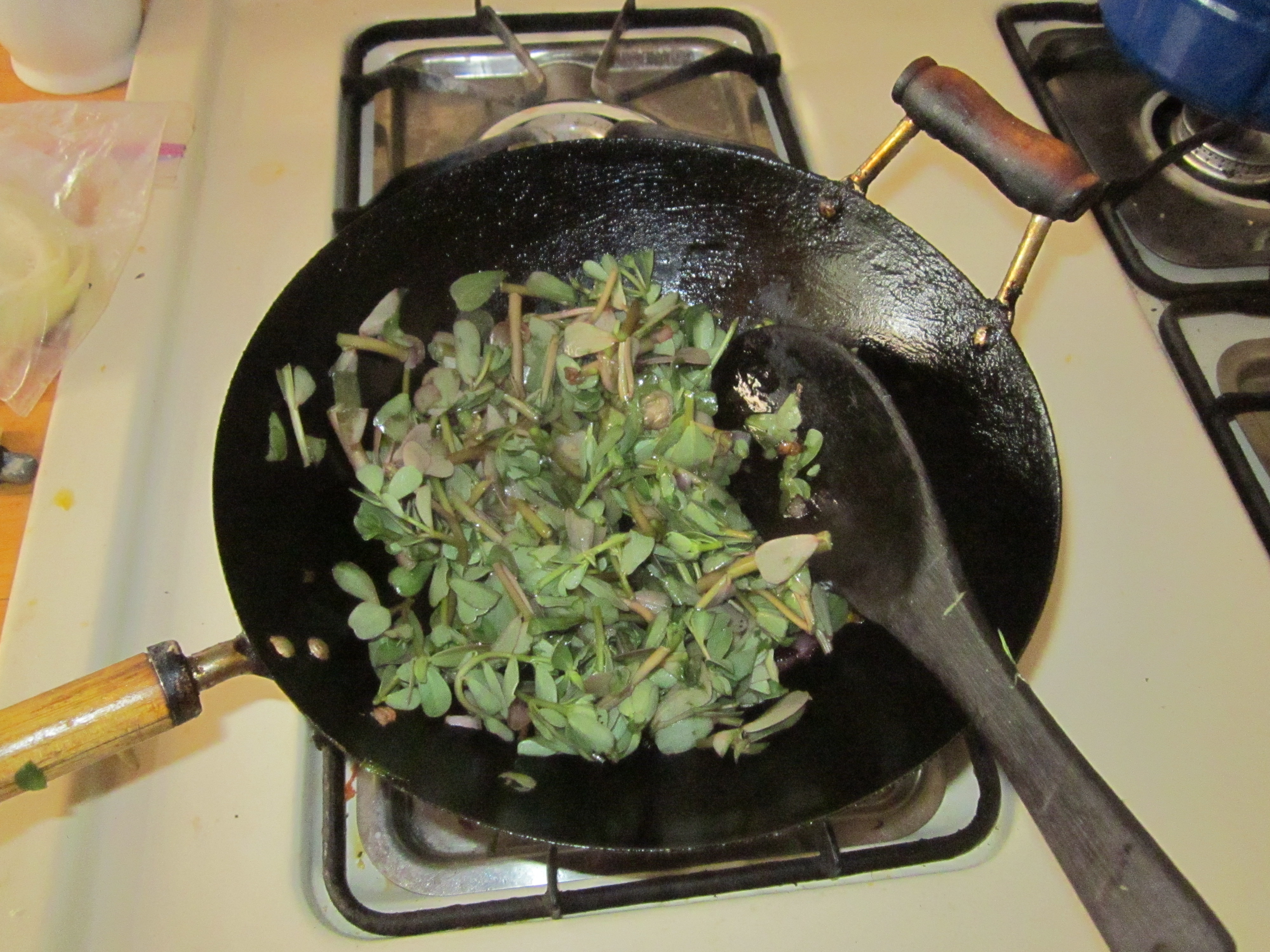
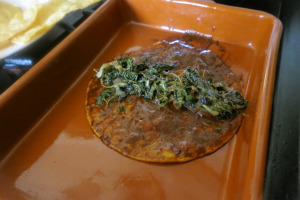
To prepare the purslane, first chop and sauté  some onion and garlic in a little oil.  When the onion is translucent, add the purslane.

IMG_0880

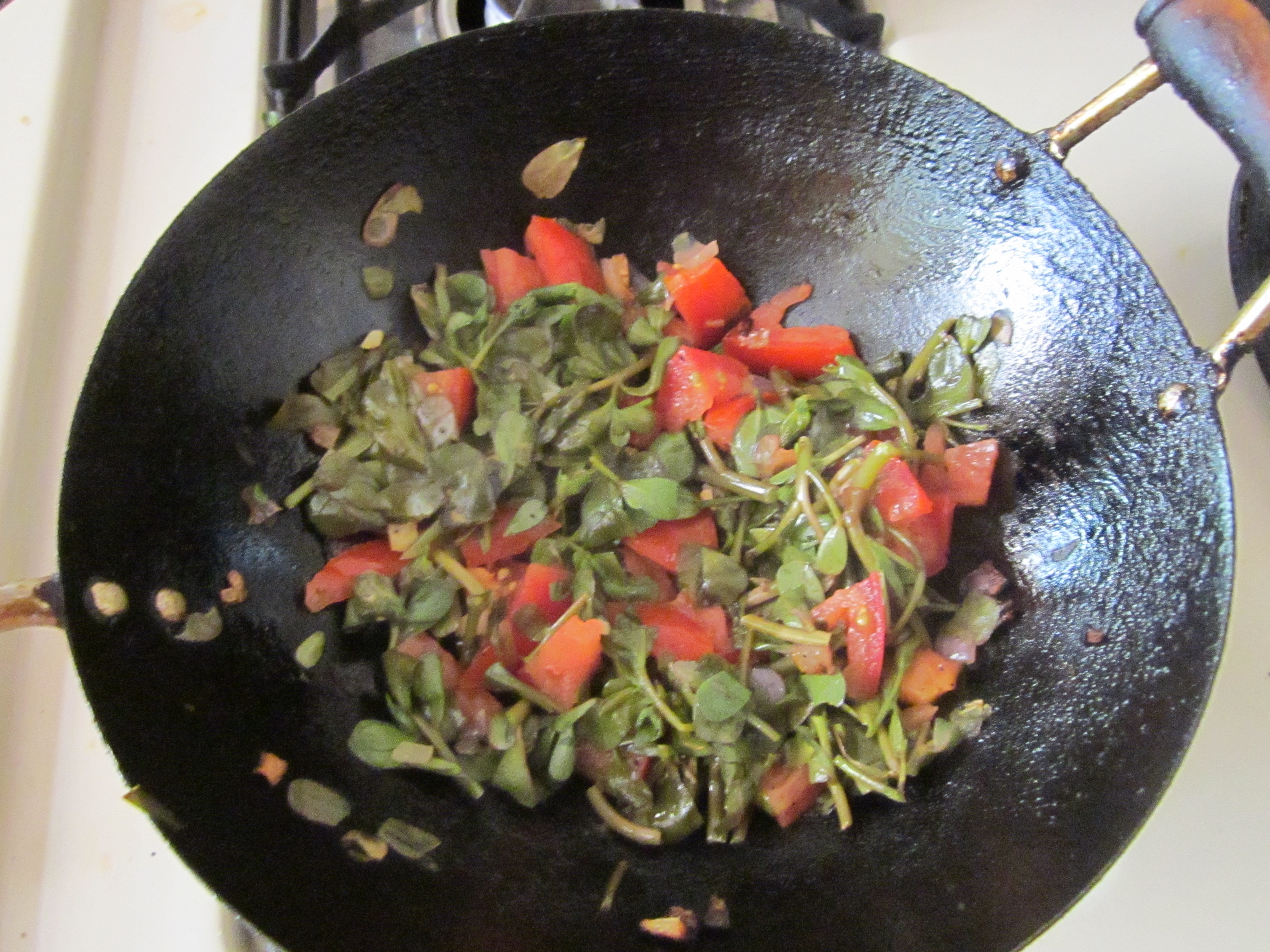
Next, toss in some chopped fresh tomatoes.

IMG_0881At this point you can eat it, maybe with a little cheese on top. Or to make a heartier meal, saute some small bits of chicken. Now you’ve got a great side dish. Or how about filling for some enchiladas.

Dip the tortilla in chile sauce, add some purslane and roll.

Dip the tortilla in chile sauce, add some purslane and roll.

My favorite is tostadas. Yum!

IMG_0884

_________________________________________

Interested in more ideas for using the wild foods of the Southwest?  Check out my books Cooking the Wild Southwest  where you’ll find recipes for 23 delicious wild plants, and The Prickly Pear Cookbook with lots of recipes for both the prickly pear fruit and pads.   Here’s a little video with ideas for other local wild plants to add novelty and nutrition to your diet.

Fig Jam Ready for Farm to Table Picnic

Picking figs at the Mission Garden.

Picking figs at the Mission Garden operated by Friends of Tucson’s Birthplace.

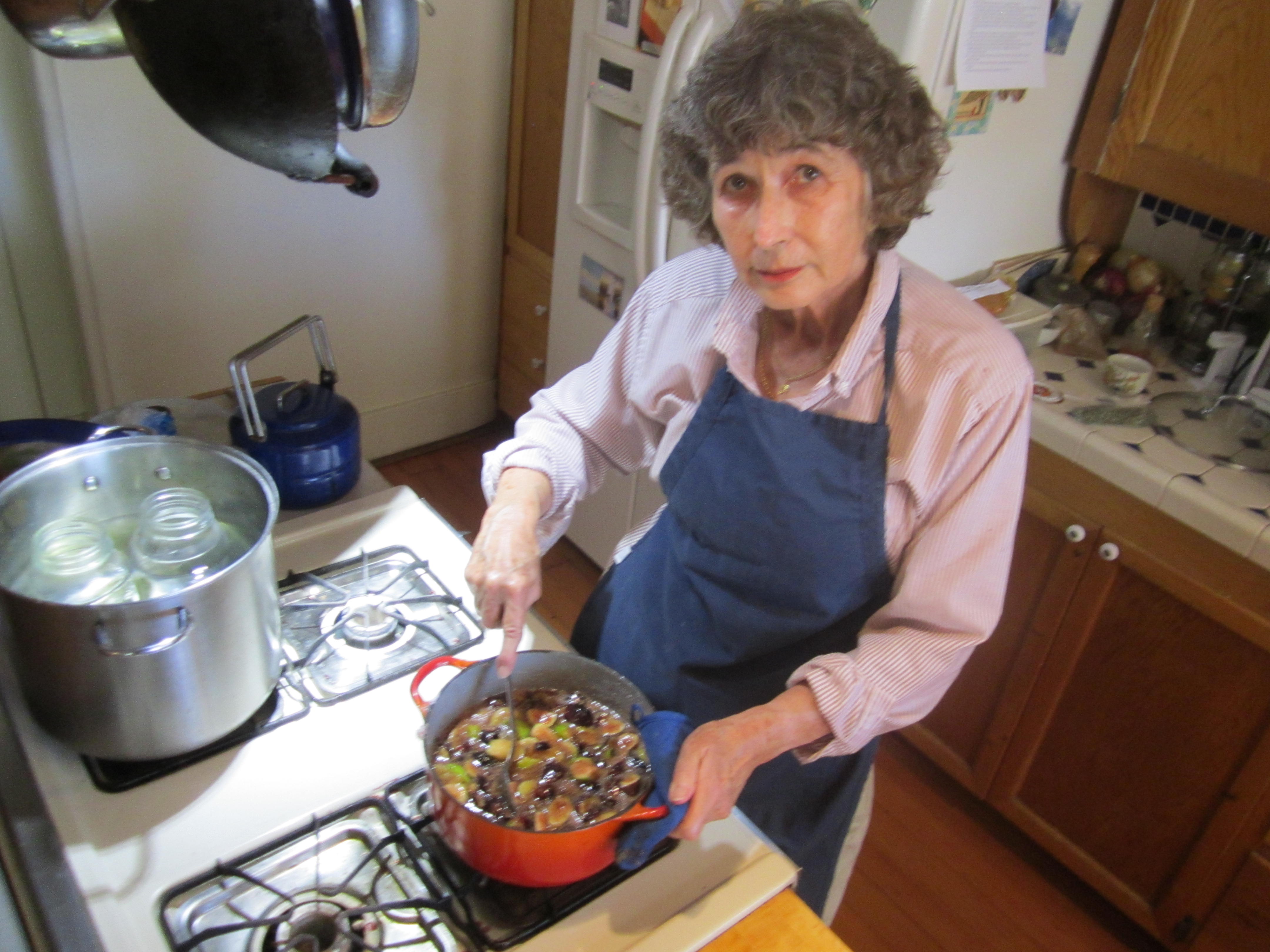
The hottest weather of summer brings Tucson one of its sweetest treats, figs. The figs at the Mission Garden operated by Friends of Tucson’s Birthplace, are ripening  now. Some of the trees have already produced and are beginning to  grow their second crop. This is Carolyn today, and that is me picking figs from one of the trees in the lush recreated historic garden near the Santa Cruz River.  The plan was to preserve the figs as jam to be used as an ingredient in cookies  for the Farm to Table Picnic being organized by the  Mission Garden and Native Seeds/ SEARCH.  On the late afternoon of October 18, dinners will be able to picnic on Southern Arizona’s agricultural  bounty at tables  spread through the Garden. (Ticket detals next month).

The brown figs at Mission Garden are living relics of trees brought to Southern Arizona by Father Kino. They were grown from twigs cut from plants behind the Sosa-Carrillo House. Historic records show that those trees came from cuttings of trees at San Xavier Mission. The green figs were grown from cuttings taken from trees at the  settlements near the Ruby and Oro Blanco mines.

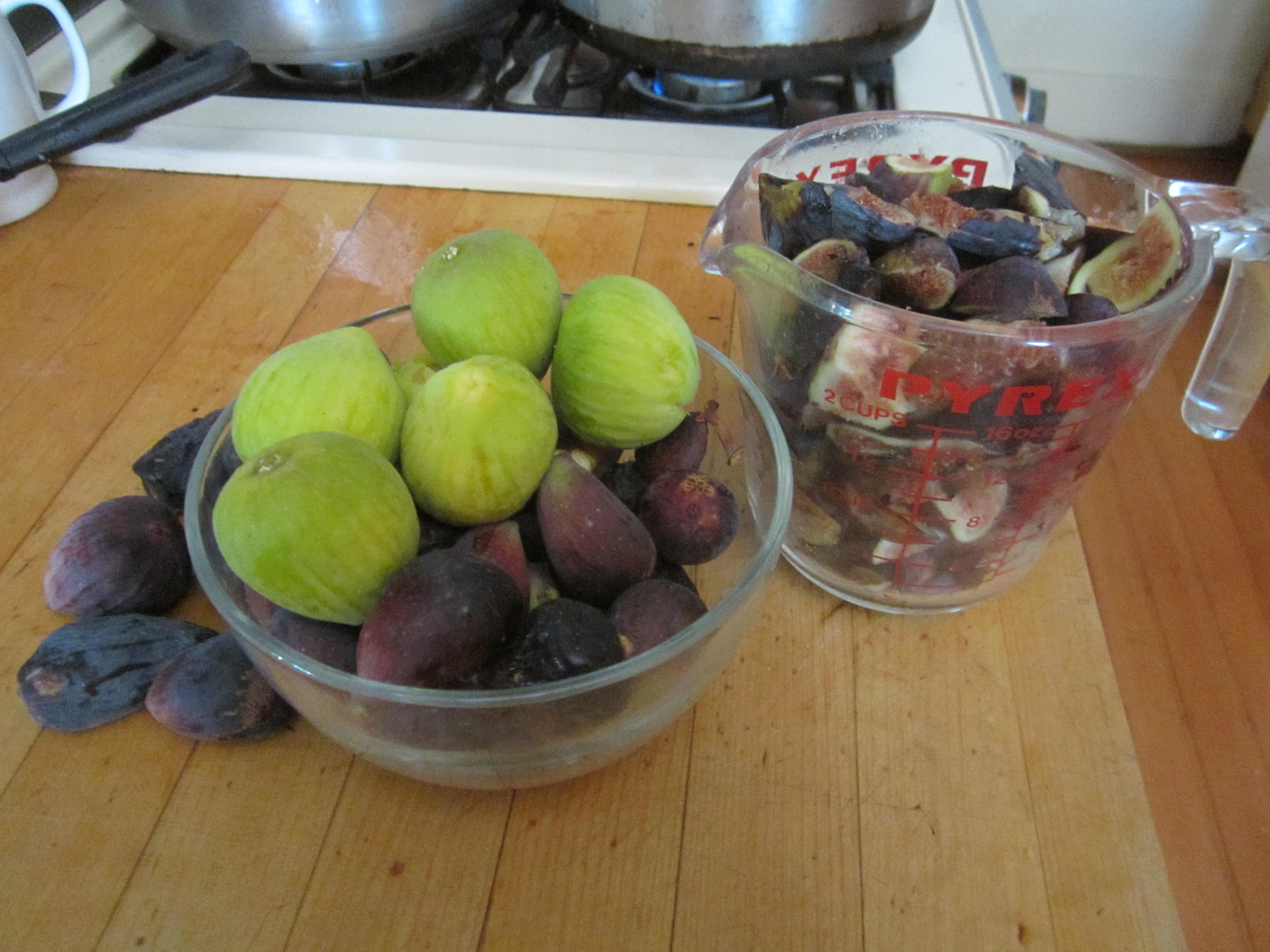
Plump figs from Mission Garden. The green ones are called "white" and some people think they are sweeter.

Plump figs from Mission Garden. The green ones are called “white” and some people think they are sweeter.

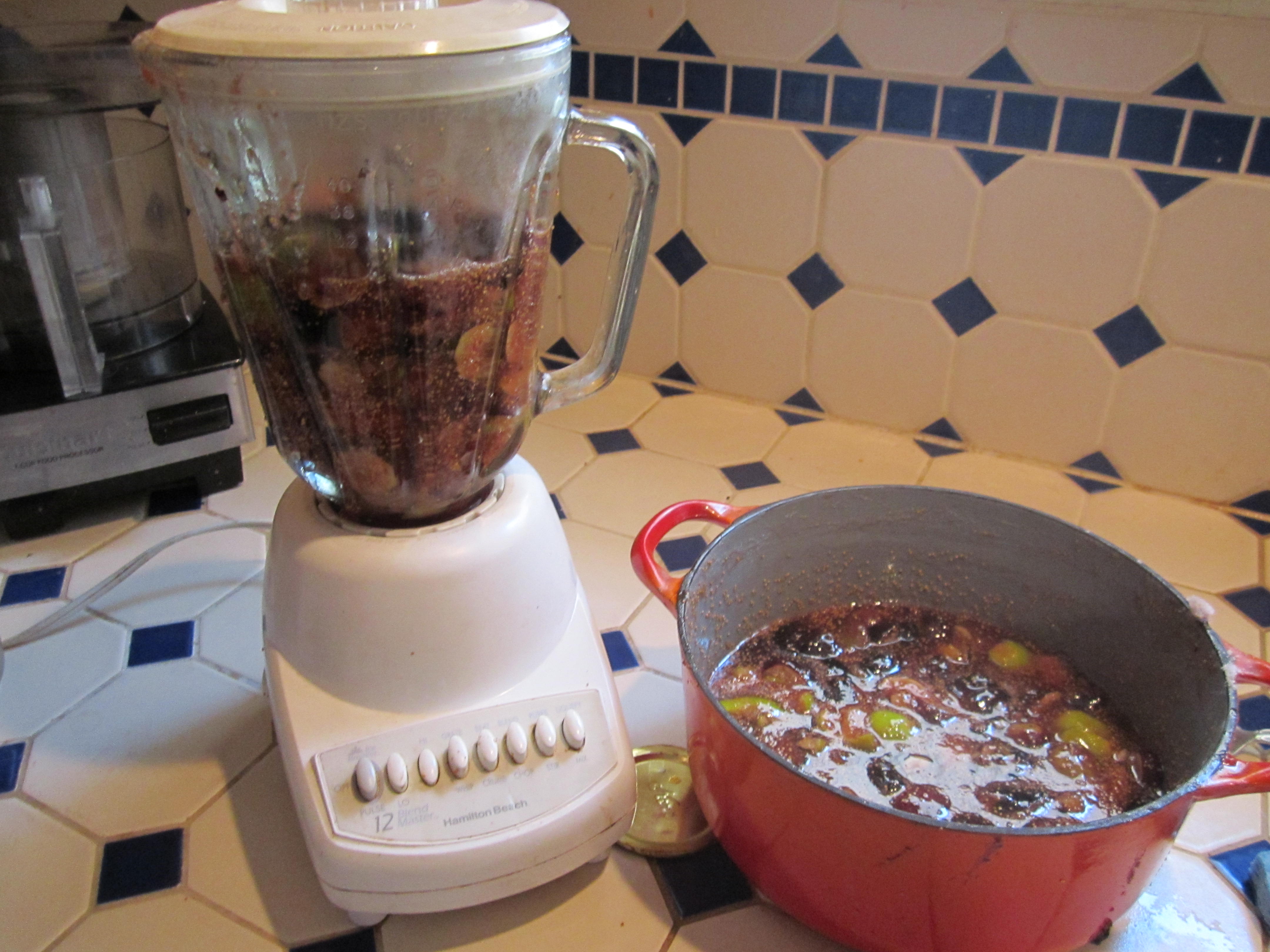
Generally in making jam the old-fashioned way without added commercial pectin, you measure an equal quantity of fruit and sugar and simmer until it is thick. Because these figs were incredibly sweet and because I plan to spread the jam over a base crust, I didn’t care if the jam set up like I would, say a plum or strawberry jam. So I thought it would be safe to use less sugar. Ultimately I used about 4 cups of sugar to 8 cups of chopped figs, about half the usual amount. Since I wanted a smooth product, I put the chopped figs through the blender.  I could have also used my food processor.

Blending the chopped figs for a smooth product.

Blending the chopped figs for a smooth product.

Next came the long slow cooking.  In the picture below, you can see the large pot on the left where I was boiling the storage  jars to sterilize them.

Cooking the jam.

Cooking the jam.

In any jam making, you need to simmer the fruit and sugar until it reaches about 220 degrees F. This takes both time and careful watching to get the jam to a point where it is not too runny and not too stiff.  In Tucson, because of our altitude, 218 degrees F usually gives a better product. Use too high a heat and the jam will burn on the bottom of the pot before it reaches the proper temperature.

To check the temperture,  I used to use a traditional candy thermometer that looks like this and works with a column of mercury:

Traditional candy thermometer.

Traditional candy thermometer.

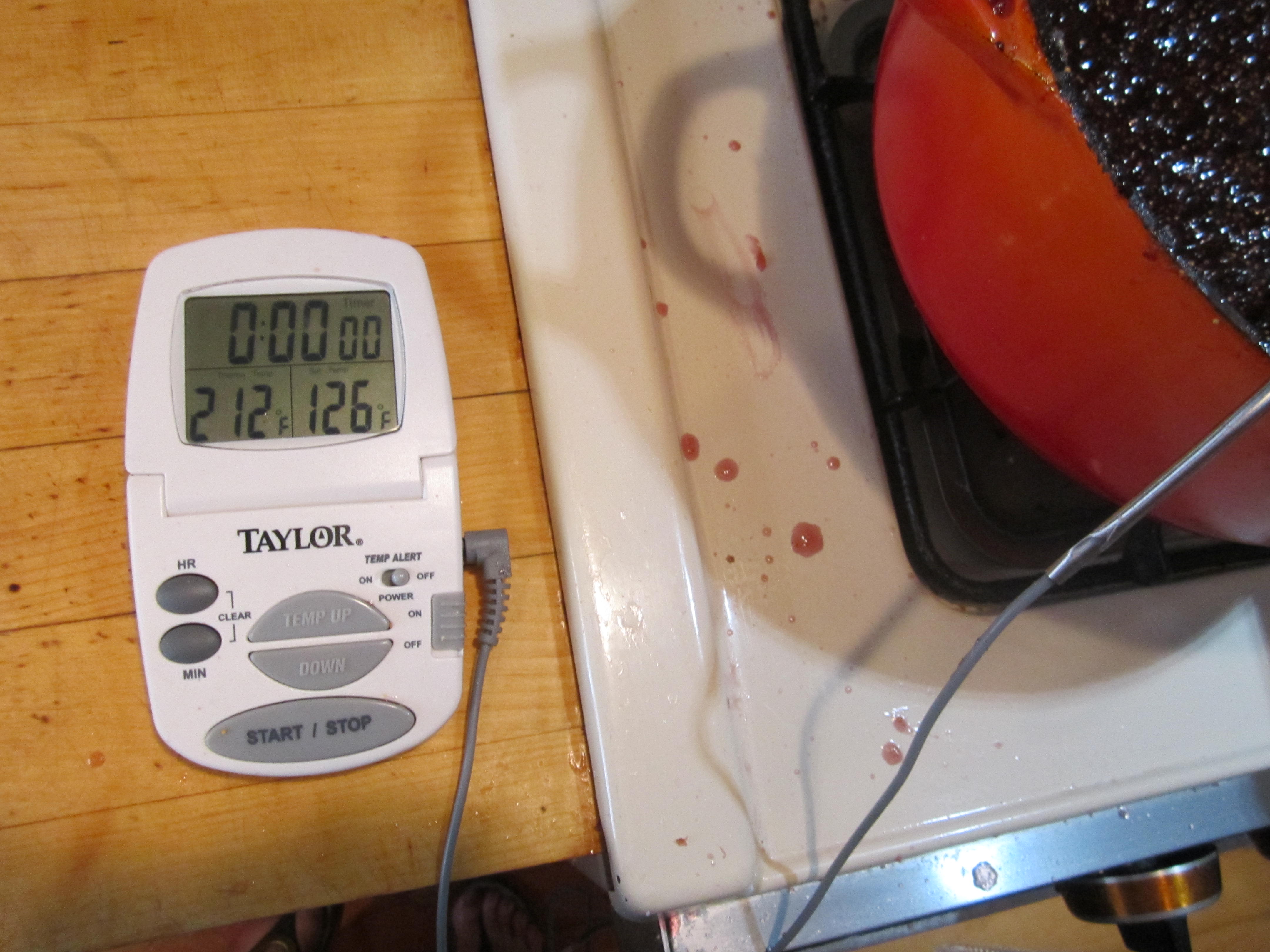
A couple of Christmases ago, however Santa brought me a digital thermometer that is good for roasting a turkey, cooking a thick steak and making jam. It has a probe that sticks in whatever you are cooking and gives you a readout.   See the photo below. You can see this one has reached 212 degrees F. and the jam is almost done.:

Battery-operated digital cooking thermometer.

Battery-operated digital cooking thermometer. The thin silver wire on the right is a probe that rested in the jam.

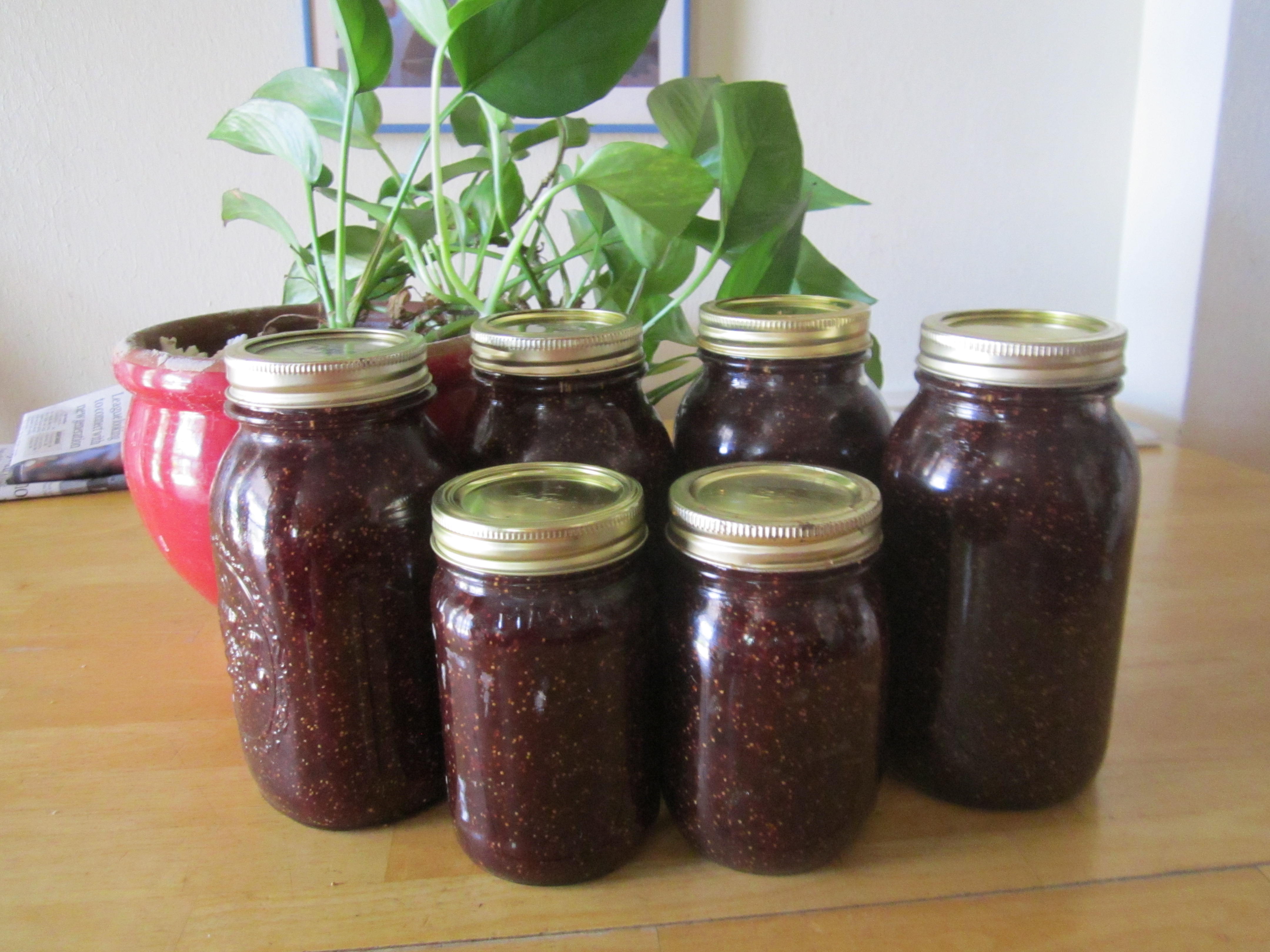
Once finished, the jam just needed to be ladled into the prepared jars, capped and processed for 10 minutes in a boiling water bath.  That’s a lot of jam, but I’ll be baking cookies for 200 ticket holders and a whole bunch of volunteers.

Five quarts of fig jam will wait until October to be made into fig bars for the Farm to Table Dinner.

Five quarts of fig jam will wait until October to be made into fig bars for the Farm to Table Dinner.

I can’t show you a picture of the fig bars, because I haven’t made them yet. But I have used this recipe previously and it is great. It is a modification of a recipe in Fruits of the Desert by the late food writer Sandal English.  If you have fresh figs and are looking for a way to showcase them, try this:

Layered Fig Bars

1 cup sifted flour

1/2 teaspoon baking soda

1/2 teaspoon salt

1 cup oatmeal, quick or old-fashioned

1 cup firmly packed brown sugar

1/2 cup butter, melted

1-1/2 to 2 cups fig jam

Preheat oven to 350 degrees F. and line an 8-inch square pan with foil or parchment paper, leaving some extending over two sides as flaps.

Sift together the flour, baking soda and salt in a large bowl. Mix in the oatmeal and sugar. Stir in the melted butter and mix until crumbly. Firmly press 2/3 of the mixture in the bottom of the prepared pan. Spread fig jam evenly over the base layer. Top with remaining crumb mixture. Gently pat the top layer down. Bake in preheated overn for about 30 minutes. Cool, lift from the pan using the paper flaps, and cut into 24 bars.

Note: If you are making this for your family and don’t care that the bars come out perfectly shaped, you can skip the step of lining the pan.

_________________________________________

Looking for ideas for how to use desert fruits and vegetables?  The Prickly Pear Cookbook has delicious recipes for both the fruit and pads and complete instructions for gathering and processing. Cooking the Wild Southwest gives directions for harvesting and cooking 23 easily gathered desert plants. Find both at the Native Seeds/SEARCH retail store on Campbell or at on-line sellers.

Harvest Time for I’itoi Onions

Big clump of iItoi onions. All this from just one little onion planted last October.

Big clump of  I’itoi onions. All this from just one little onion planted last October.

I had to put my vegetable garden to bed for the summer early this year since we were leaving for a month.  No use having the housesitter water for the weeks we were gone as the hot weather would overcome the vegetables about the time we got home anyhow. The plants were at the end of their season, but still pulling them up was almost as painful as putting down a beloved pet. I go through this mourning every year when one by one the winter crops reach the end of their production – first the peas, then the broccoli, then the last of the lettuce and spinach even in the shade. The kale was still so hearty I simply could not consign it to the compose bin. After freezing some for soup and making as many kale chips as we could handle, I dug up the plants and put them in a pot to transfer to a friend.

One chore involved pulling out the remaining I’itoi bunching (or multiplier) onions.  I’ve been using them all spring, but they are very prolific. One little onion that looks like this produced the bunch in my hands at the top of the page:

Lovely little iItoi onion with penny for size comparison.

Lovely little I’itoi onion with penny for size comparison.

I’itoi onions were brought to the Southwest in the 17th century by Spanish missionaries, but have become such a part of the Tohono O’odham biology that they are called by the name of their creation diety, Elder Brother, or I’itoi.  These little gems were beginning to die out when they were brought to Native Seeds SEARCH by a Tohono O’odham woman.  They are one of the plants in the Slow Food Ark of Taste. 

I’itoi onions (Allium cepa var. aggregatum) are easy to grow — in the fall, just plant each bulb about an inch below the surface and at least eight inches apart.  They will send up chive-like greens first that can be used until you decide they have multiplied enough and pull them up for use.  When you harvest the last clump in the summer,  put aside a dozen or so bulbs in a paper bag and set aside on a cool shelf to await fall.  (I find it amusing that the onions “know” when to start again — if I don’t get around to putting them back in the ground until later in September, I sometimes find that they have begun to sprout in anticipation.)

To prepare onions for cooking, first separate and clean off the dirt,  then peel.

Like most onions, these contain potassium, vitamin C, folic acid and vitamin B6. Onions contain substantially the same amount of vitamins and minerals when cooked.  I’itoi onions can be substituted for onions or shallots.  You can find them at farmers’ markets and from Crooked Sky Farms in Prescott and the Phoenix area and from Native Seeds SEARCH. Both of these places will ship to you as well.

A healthy row of iItoi onions.

A healthy row of iItoi onions.

You’ll have a ratio of green tops to bulb of about 10:1 so you’ll have to find a use for all the green onion tops.   When you’ve used all you can fresh, freeze them to add to soup stock later. You can also make delicious Chinese Onion Pancakes.

Savory pancakes using onion tops.

Savory pancakes using onion tops. (Photo from Serious Eats)

It’s easy, but rather than recount the recipe here, go to this link. These are the best directions I’ve found for making this delicacy and the author also gives a wonderful tutorial on the difference between adding cold and hot water to flour.

If you’d like a recipe to show off your onion harvest, this one is easy and delicious.

I'itoi onions cooking for Sweet and Sour sauce.

I’itoi onions cooking for Sweet and Sour sauce.

 Sweet and Sour I’itoi Onions

Here’s my recipe for sweet and sour I’itoi onions.  You can use red wine and red wine vinegar or white wine and white wine vinegar. Makes a great topping for grilled fish or chicken or mix it into steamed vegetables to add flavor.

1 cup cleaned and sliced I’itoi onions

1/2 cup water

2 tablespoons wine vinegar

2 tablespoons wine

1 tablespoon olive oil

1 teaspoon sugar or agave syrup

1/2 cup water (again)

In a large heavy frying pan, cook sliced I’itoi onions and water covered over very low heat for 10 minutes until soft.  Add wine, wine vinegar, olive oil and sugar or agave syrup.  Cook over very low heat for another 10 minutes.

My blog sister Jacqueline Soule wrote a column about I’itoi onions for the Explorer and finished with a recipe for I’itoi onion and goat cheese scones. You can see it here

**************************

If you are interested in wild and heritage foods of the Southwest, check out my cookbooks Cooking the Wild Southwest, Delicious Recipes for Desert Plants,   and the Prickly Pear Cookbook.  The books are also available through Native Seeds/SEARCH. For inspiration and directions on what wild plants are available in what season, watch a short video here.