Uncovering the Chocolate History of the Southwest

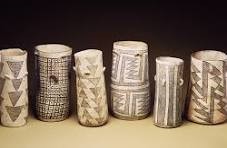
Chocolate drinking vessels found in Pueblo Bonito.

It may seem a stretch to discuss chocolate in a blog on Southwest food. But chocolate has been in the area since the 9th century. It’s Carolyn writing today and as a chocolate addict, I find the history of chocolate in our area fascinating. In the late 1800s, rancher Richard Wetherill was poking around in Pueblo Bonito in Chaco Canyon in the Four Corners area and excavated 111 cylinder jars. Archaeological technology has advanced greatly since then and researchers have dated the strata in which they were discovered to 1000 CE. Even more interesting, substances inside the jars and in pieces of broken jars indicate that the jars contained chocolate. Since the jars were all found in one room, scientists speculate that the chocolate was being used ritually. Archaeologist Dorothy Washburn also found residue that appears to be from chocolate in bowls from the site of Alkali Ridge, Utah, that date to 780 CE, even earlier.

Consider that the closest place chocolate was grown was 1,200 miles south in Mexico. This was before draft animals were used, so a trader or a series of traders carried chocolate all that way on their back, along with macaw feathers and copper bells.  With all that travelling, chocolate must have required quite a bit of turquoise and other goods in exchange.  

The Spanish Bring Chocolate to the Southwest

When the Spanish missionaries and soldiers came north to what we call the Southwest, they brought chocolate, one of their very few luxuries. Chocolate, being a New World crop, was much less expensive than tea, which had to come by a months-long trip across the Pacific Ocean from Asia. Their drink wasn’t the creamy concoction we now savor. Then chocolate was mixed with water and sometimes honey to sweeten it.

Father Phillip Segesser, one of the earliest priests at San Xavier Mission in Tucson, complained in a letter to his Swiss relatives that every non-Native visitor expected to be served chocolate. Father Segesser lived a very humble life, and he found this presumptuous. It is also interesting that provision orders from the day for both soldiers and priests listed both ordinary chocolate and fine chocolate, the later of which cost twice as much. We can guess what Segesser served his visitors.

During the 1781 Yuma uprising near modern day Yuma, Franciscan priest Fray Francisco Garces requested that he be allowed to finish drinking his chocolate before being beaten to death by the Quechans.

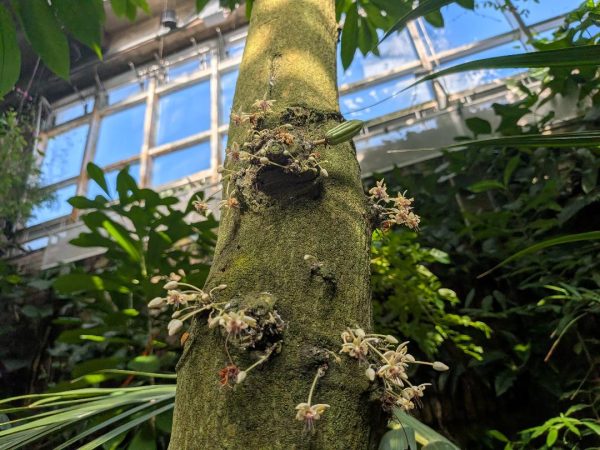
 I was happy in two recent trips to learn more about my obsession. In the large green house at the Atlanta Botanical Garden, I saw a cacao tree up close and was amazed to learn that the flowers grow right from the trunk.


Cacao tree in flower in the Atlanta Botanical Garden. See a small green chocolate pod in the upper right.

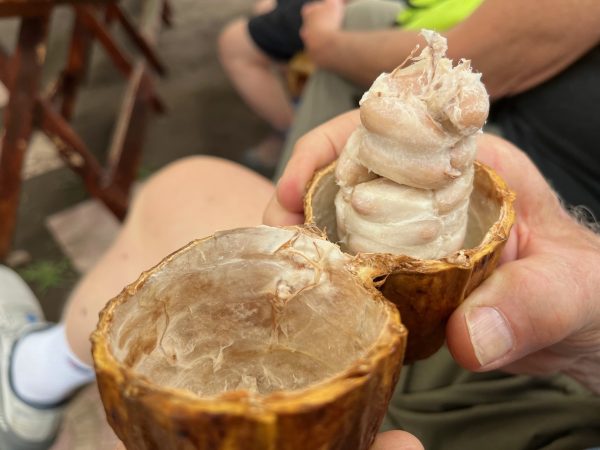
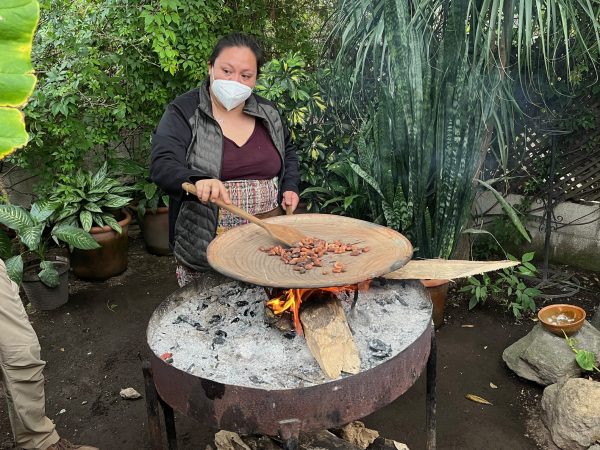
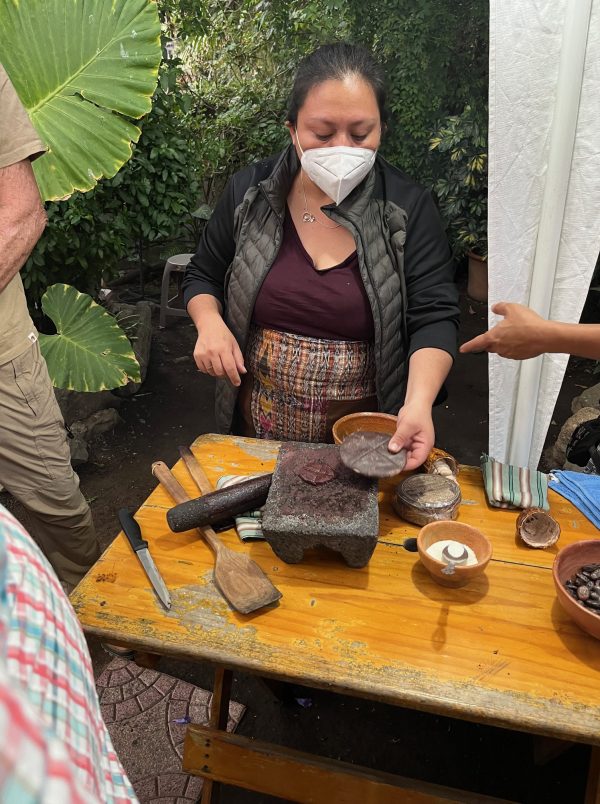
In Guatemala, I visited an artisanal chocolate maker. I got to see all aspects of converting a cacao bean into a chocolate bar, from opening the pod, to cleaning the beans, then roasting them on a comal before grinding them to a paste and adding sugar.

Just opened cacao pod. The seeds are inside the white covering.

Guatemalan artisan chocolate maker roasts cacao beans over coals.


The roasted beans are ground, combined with sugar, and formed into a patty. They are surprisingly oily. Perhaps patties like this were what the early traders brought to Pueblo Bonito in Chaco Canyon. 

Chocolate pairs so well with our  mesquite meal–a perfect blend of tropics and desert. These waffles will make a holiday breakfast treat.

Chocolate Mesquite Waffles

½ cup all-purpose flour

½ cup whole wheat flour

½ cup mesquite meal plus 1 tablespoon

3 tablespoons cocoa

1 tablespoon baking powder

½ teaspoon salt

2 egg yolks

1 ¼ cup milk of choice

½ cup oil

2 egg whites beaten stiff

In a large bowl, sift together dry ingredients. In a small bowl, combine egg yolk, milk and oil. Stir the wet mixture into the dry ingredients. Fold in egg white, leaving some fluffs. Do not over mix. Pour batter into hot waffle maker and follow manufacturer’s directions.

Makes about 8 waffles.

Recipe adapted from Eat Mesquite (2011) by Desert Harvesters

__________________________________________________

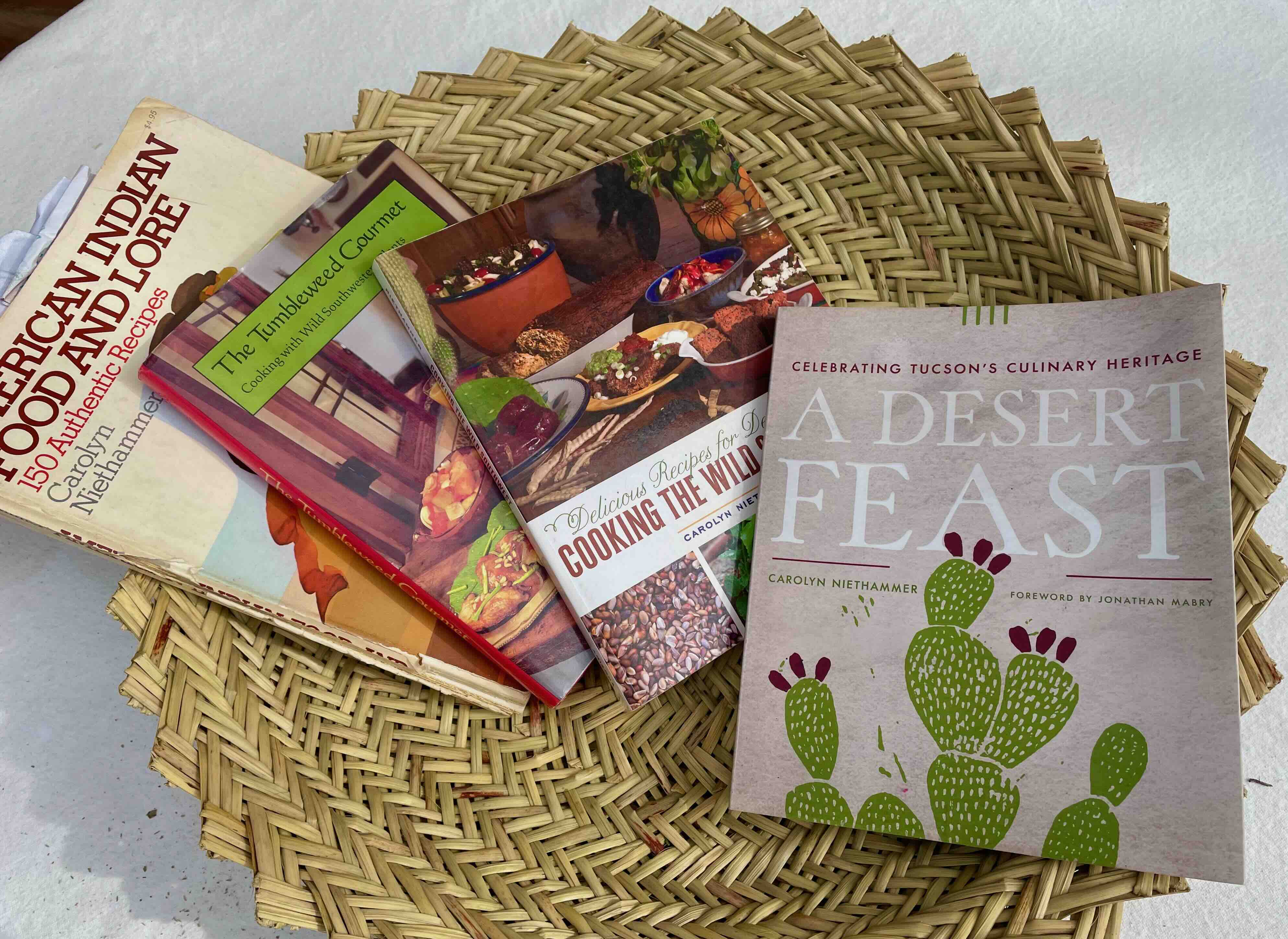
You can learn more about the history of food in Southern Arizona in my latest book A Desert Feast, the story of the last 4,000 years of food in the Sonoran Desert. Want more recipes using  foods of the Southwest? You’d find ideas for collecting and using 23 easily recognized and gathered desert foods in Cooking the Wild Southwest: Delicious Recipes for Desert Foods.  . Recipes from top Southwest chefs are collected in The New Southwest Cookbook. Just click on the titles for more information. You can learn more about me on my website.
A Foraging Consciousness for Famine Times

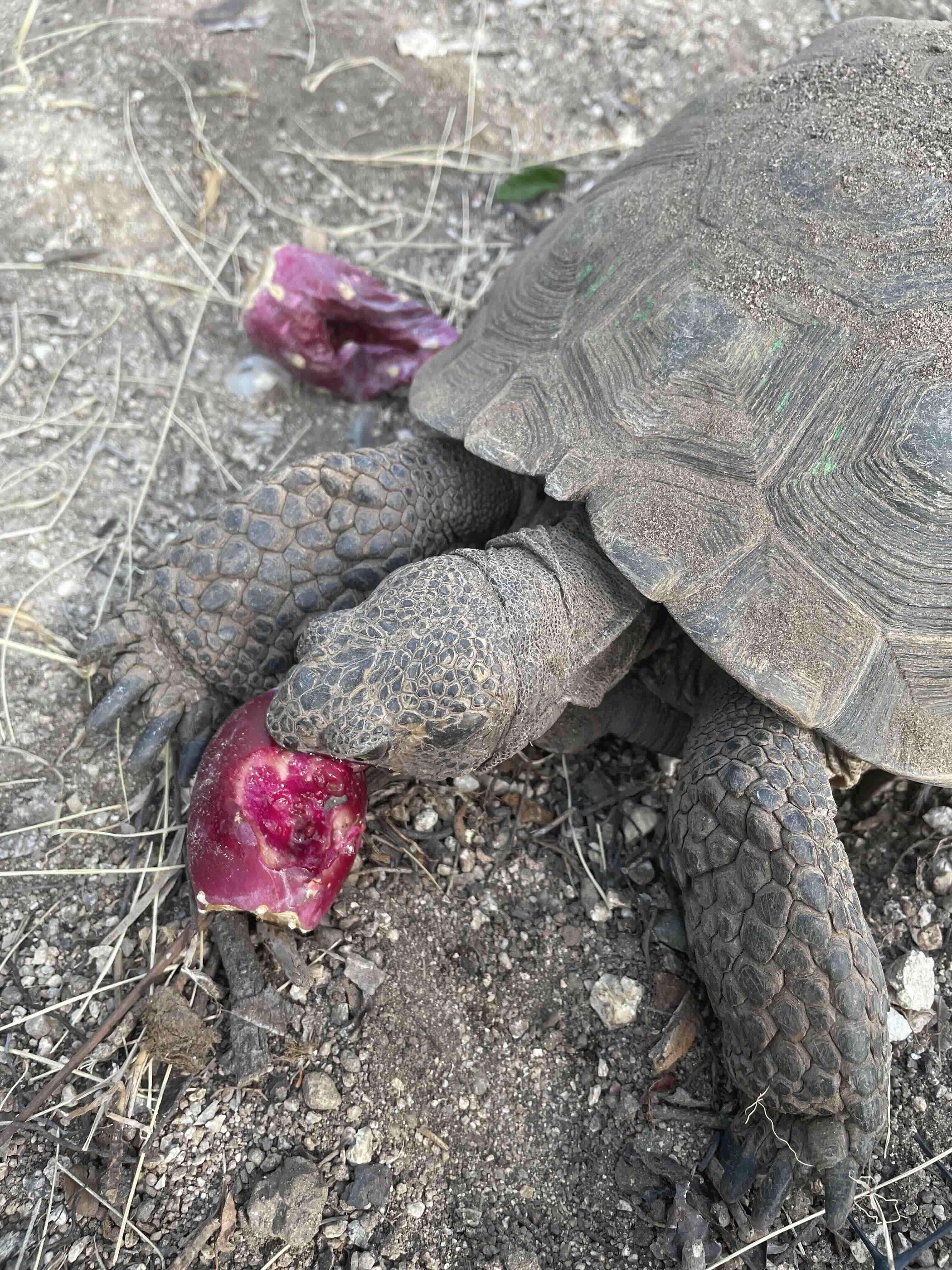
We aren’t alone. Living through this extended drought and awesome heat in the Sonoran Desert is a major feat for any creature out there–plant or animal–no matter how desert-adapted it may be! We are all feeling it. Difficult to imagine how creatures, like the long-lived desert tortoise, manage through the kind of intense drought we are experiencing.

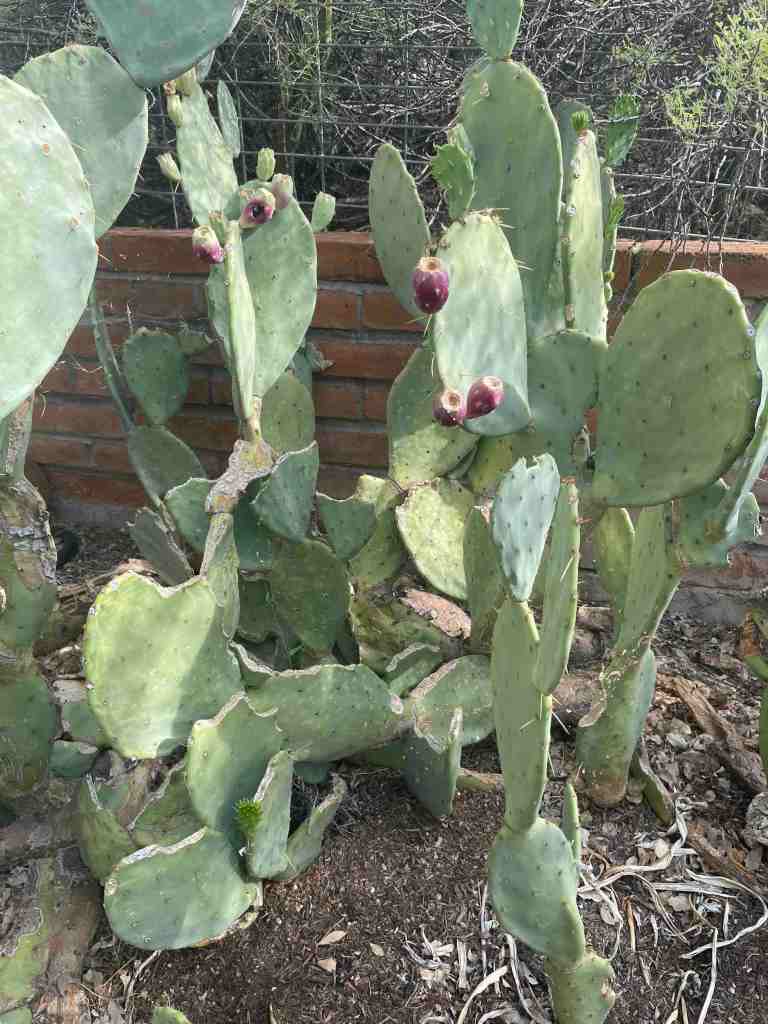
Even in my back yard, my tended prickly pear, covered in buds and tender nopales last April, is ending this summer with tunas dropping before mature or devoured by cactus wrens, and pads chomped by packrats or ground squirrels.

Tia Marta here to share some thoughts about us humans harvesting from the wild. As I learned from my Tohono O’odham mentor, in earlier times Indigenous people had to suffer through lean times using the desert foods they’d stored from times of plenty. They knew sporatic seasonal productivity is the name of the game in the desert. Wise cultural tradition dictates that you harvest abundance when it happens, share your plenty, and store as much as possible against the expected lean times.

Very few native prickly pears have produced fruit this year in the Sonoran Desert, so as human desert harvesters I feel we must refrain this year, and consider the needs of our wild neighbors, the deer, javalina, cottontails, rodents, birds, etc who need what forage remains– far more than we do.

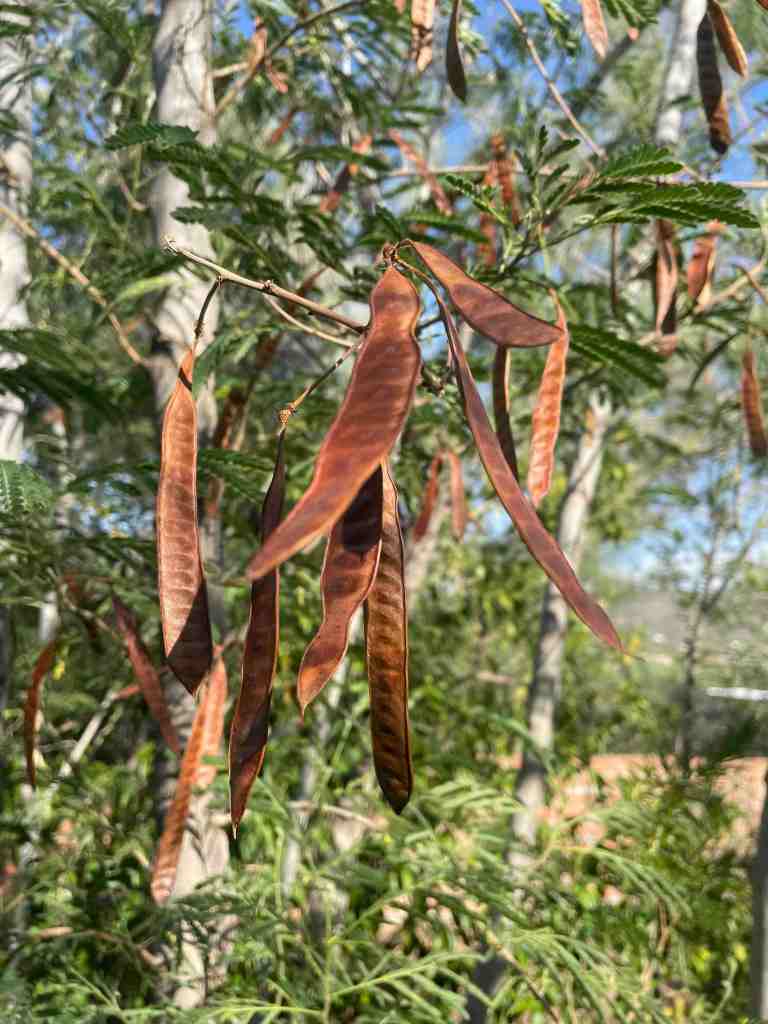
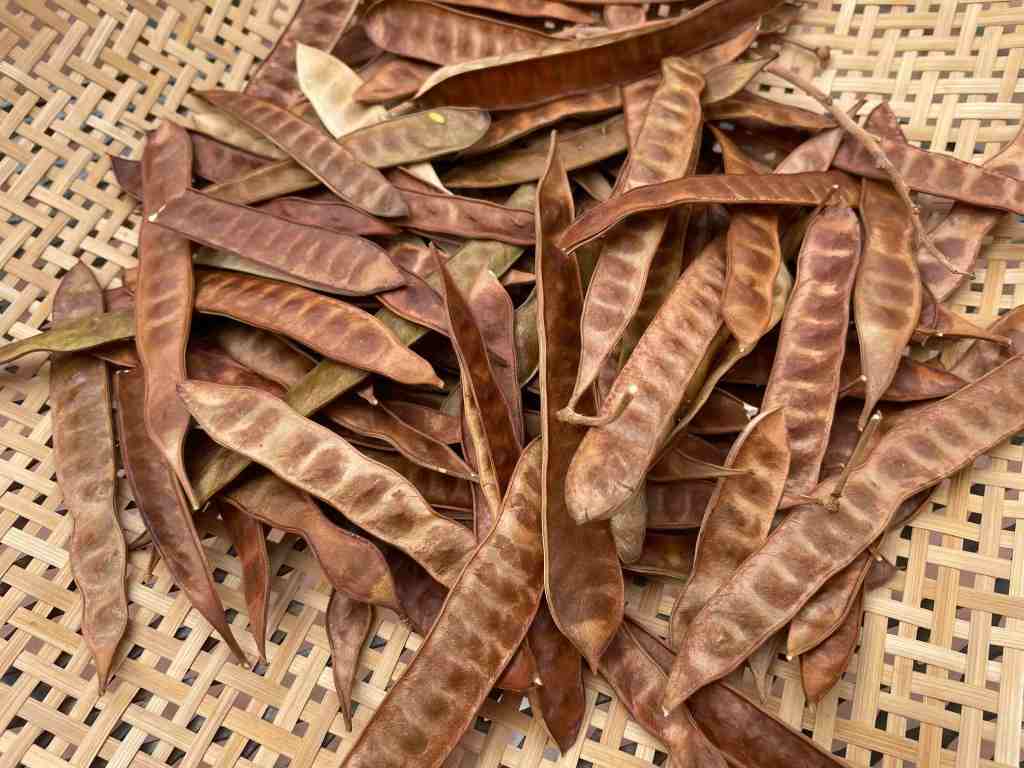
Instead, I suggest we go for an invasive! How about eating from the white lead tree, known as guaje in Mexico, huaxin by the Aztec in its region of origin? Its presence as an invader into the Sonoran Desert generates interesting controversy. The seeds contain an amino acid mimocine toxic for us mammals who have no rumen for digestion. However Guaje‘s young pods, when green, can be cooked in soups or in tacos, as cooking removes the toxicity. This small fast-growing tree has other positive attributes: It is used as great cattle fodder, provides stovewood fuel, erosion remediation, herbal medicine, and it adds soil nitrogen. Its profuse and often continued flowering makes it a good pollinator support. Caution: it IS an invasive species and, if let loose in our desert, could compromise our precious natives..

Guajes (Leucaena leucocephala) have been known and appreciated in Sonora, Mexico, for decades if not centuries. It is planted on the University of Arizona campus (see UA Arboretum) and is being researched as a potential future food plant for climate change by horticulturists at Mission Garden. I’m glad guaje volunteered in our yard from soil in a potted plant. It created a little grove of blessed shade for us, and bees have been abuzz over its puffs of cream-white flowers every spring.

I recently gathered a gallon bag of dry pods which yielded only 1/8 cup of small seed. They resemble flax seed. I soaked them to see if any were viable. About 1/3 of them swelled. When cooked for 15 minutes to remove mimosine, and drained, they proved nut-like and tasty. I’m adding them to my home-made bean dip. As a legume they will provide good protein in addition to texture and new flavor.

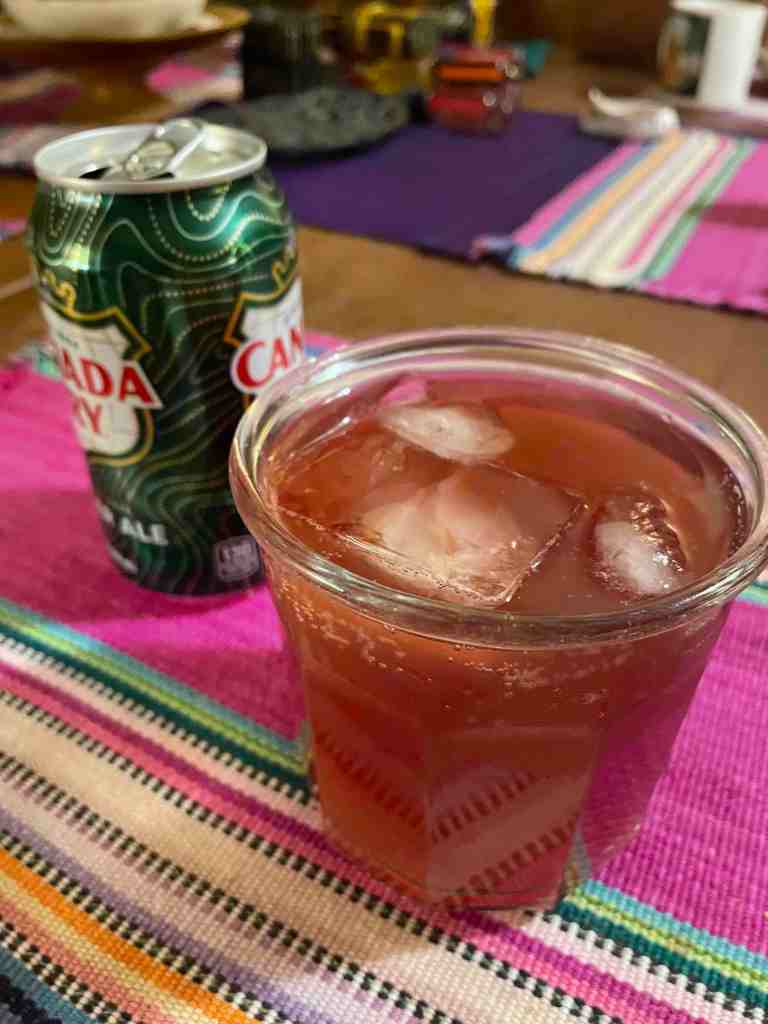
To go with the dip, I’m using a scant amount (a tablespoon per 8oz) of my conserved prickly pear juice, harvested and frozen August last year, with flavored fizzy, gingerale and a splash of mescal. With this dressed up punch, we’re sending a toast to all desert creatures out there! We hope they are benefitting from any prickly pear tunas that may be ripening in our hot, dry desert!

May we be conscious of all the plants and animals around us during these weather-stress times! For more ideas on local “famine foods” see SavorSister Carolyn’s post and Tia Marta’s post. For ideas of what we can grow in prep for more climate extremes, check out Ethnobotanist Gary Paul Nabhan’s inspirational book Growing Food in a Hotter, Drier Land: Lessons from Desert Farmers on Adapting to Climate Uncertainty.

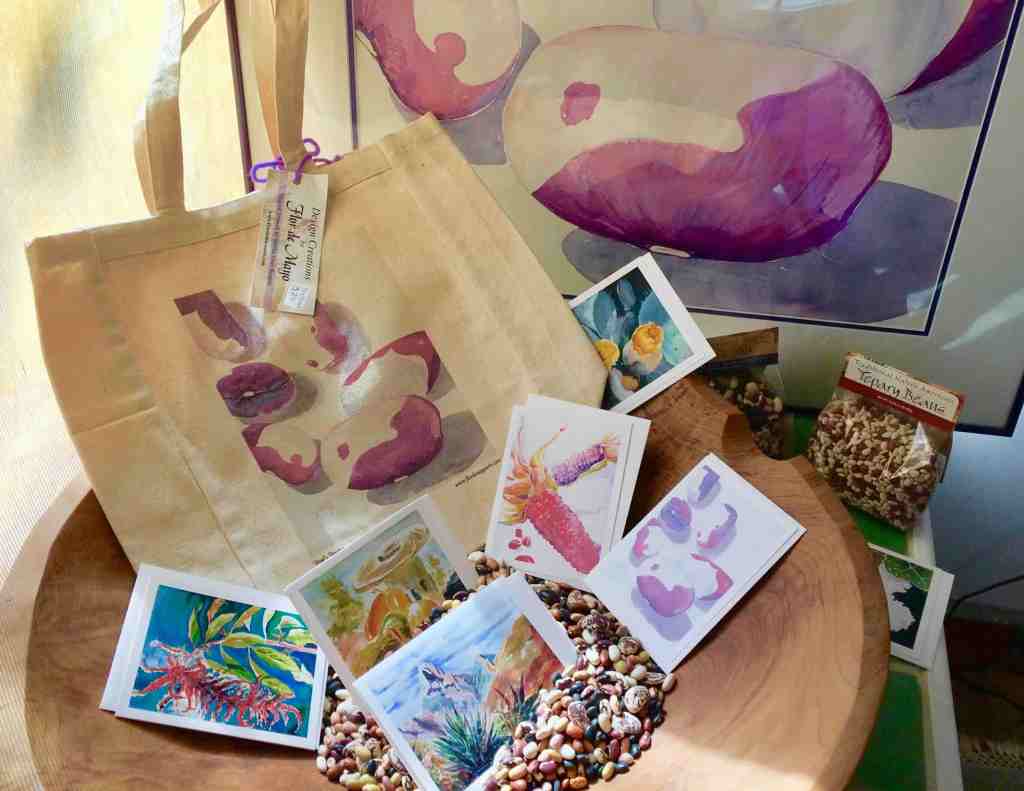
A colorful assortment of Tia Marta’s watercolor art-notecards depicting Southwest Native American heirloom foods can be found at the Mission Garden shop, or online at NativeSeeds/SEARCH.

Sonoran Summer Tacos with Nopales and Verdolagas

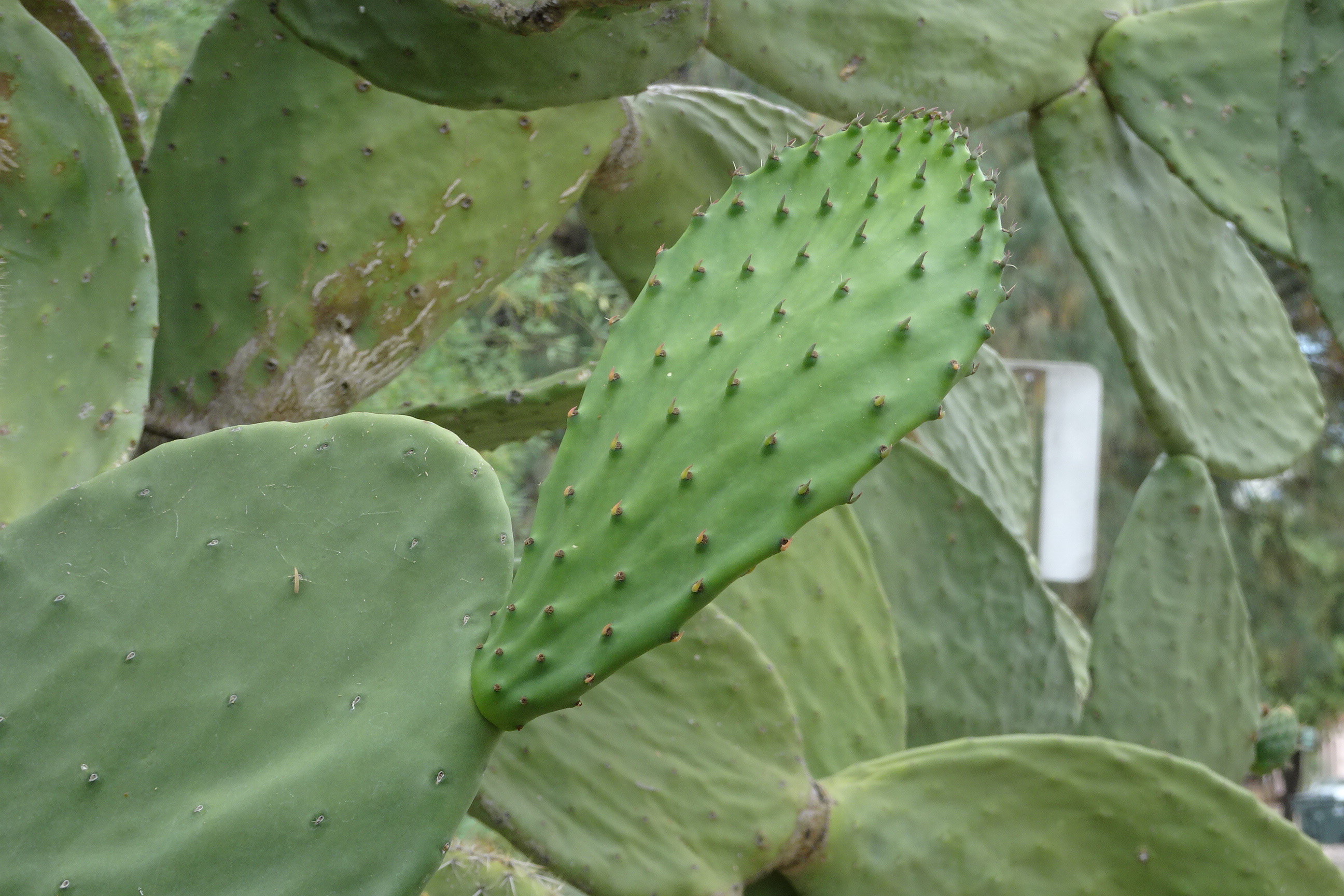
It’s Carolyn today and I’m out in my garden to pick some delicious and healthy vegetables to bring you a season-spanning recipe. If your Ficus Indica prickly pear (the Mexican tall kind) sent out its leaves a little late this spring, you probably have a few smaller pads that are still tender enough to cook. Combine those with the purslane in your summer garden for a delicious vegetable side dish or taco filling.  If you don’t have your own cactus. you can always pick up some nopal pads at any Mexican grocery store. If you buy the kind already cleaned, you’ll need to use them right away as once they are scraped, they go bad quickly. We have previously discussed how to clean prickly pear pads here. 

We’ve also discussed purslane previously in this blog here, but I’ll copy the nutritional information because it is so important:

It’s sad but true that right now people are out in their yards pulling these plants out and tossing them in the garbage (or compost for the more enlightened). They should be tossing them in the wok  or frying pan (see recipe below.) Purslane provides six times more vitamin E than spinach and seven times more beta carotene than carrots. It’s also rich in vitamin C, magnesium, riboflavin, potassium and phosphorus. One cup of cooked purslane has 25 milligrams (20 percent of the recommended daily intake) of vitamin C.

Especially important to those of us eating a modern diet, purslane is very high in an essential omega-3 fatty acid called alpha-linolenic acid (ALA). Omega-3s are a class of polyunsaturated essential fatty acids. Your body cannot manufacture essential fatty acids, so you must get them from food. Certain fibers also help in controlling blood sugar.

If your aren’t familiar with purslane or verdolagas, here’s a closeup photo:

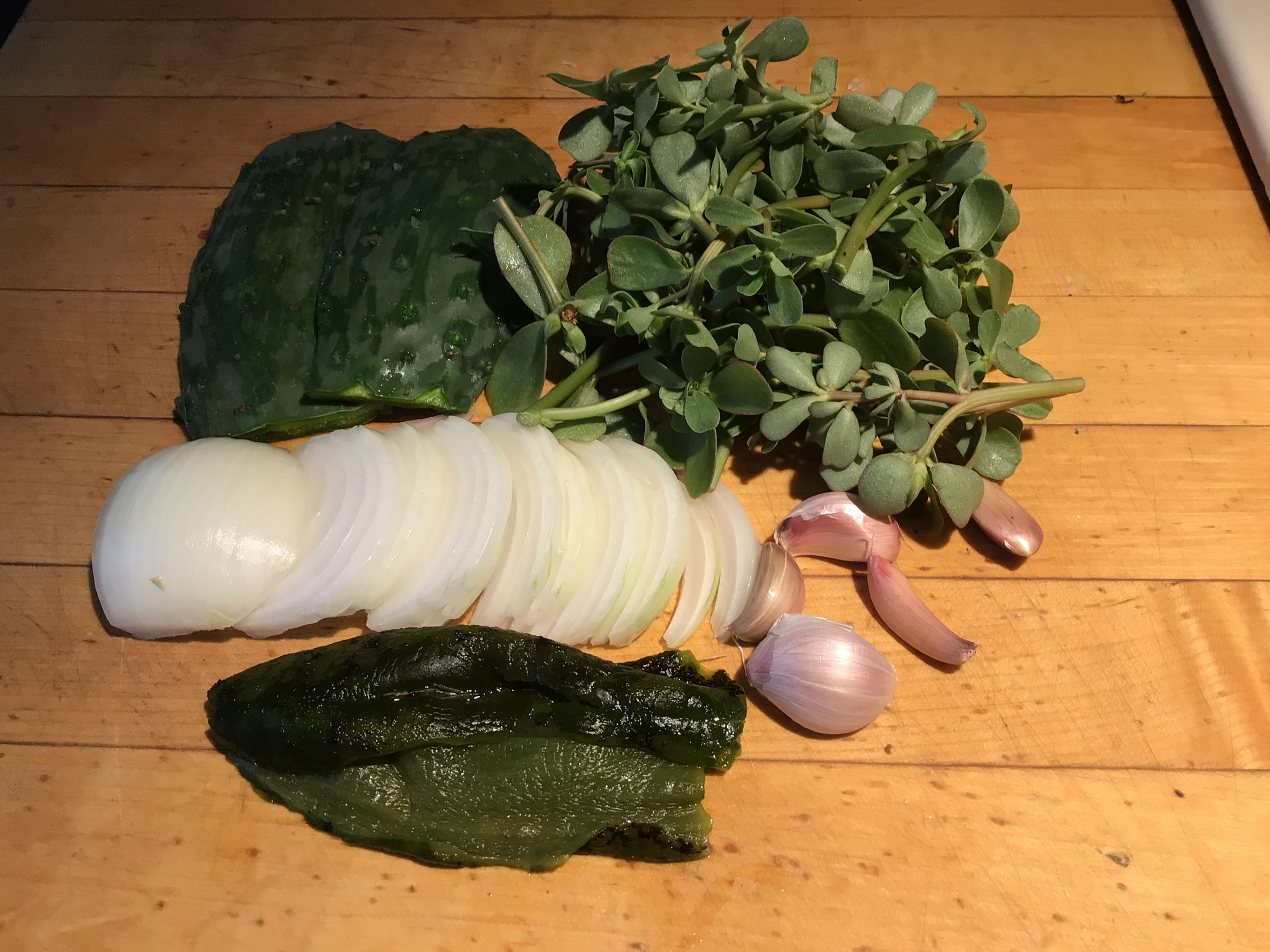
Here are all your ingredients for the tacos: (top) prickly pear leaves and purslane, (bottom) onion slices, garlic and poblano chile.


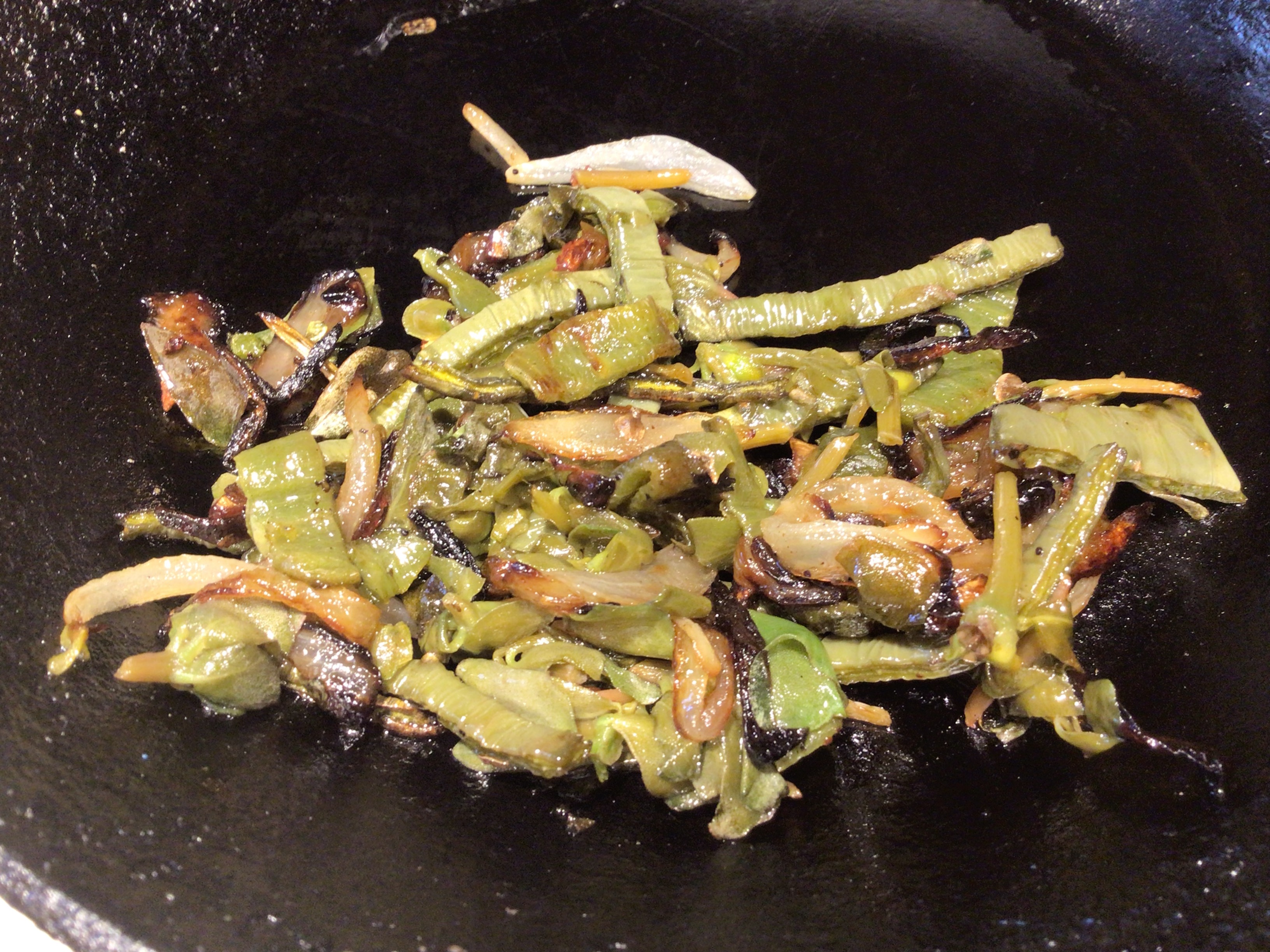
This is what the ingredients will look like cooked.

Sonoran Summer Tacos

2  2×4-inch prickly pear pads or equivalent

½ white or yellow onion

2 cloves garlic, minced (1 teaspoon)

2 tablespoons neutral vegetable oil

1 cup verdolaga (purslane), packed

1 roasted, peeled, cleaned Anaheim or poblano chile, cut into pieces

      (or 2 tablespoons chopped canned green chiles)

4 corn tortillas or small flour tortillas

2-4 tablespoons crumbled cotija cheese or cheese of choice

Using rubber gloves, clean the stickers from the prickly pear pads. Rinse and cut into pieces 2 inches by 1/8 inch (roughly the size of a wood matchstick.) Set aside.

Cut the onion into thin strands by cutting from the root to the stem (not crosswise). Add the oil to a heavy frying pan and begin sautéing the onion over low medium heat. You want it to cook slowly until soft and light brown. After about 10 minutes, add the garlic. While that is happening, you can prep the rest of the ingredients.

Cut the fresh chile into pieces about 1 inch by 1/8 inch. Chop the verdolagas (purslane) roughly. After 10-15 minutes when the onions are ready, stir in the greens and chile and continue to cook.

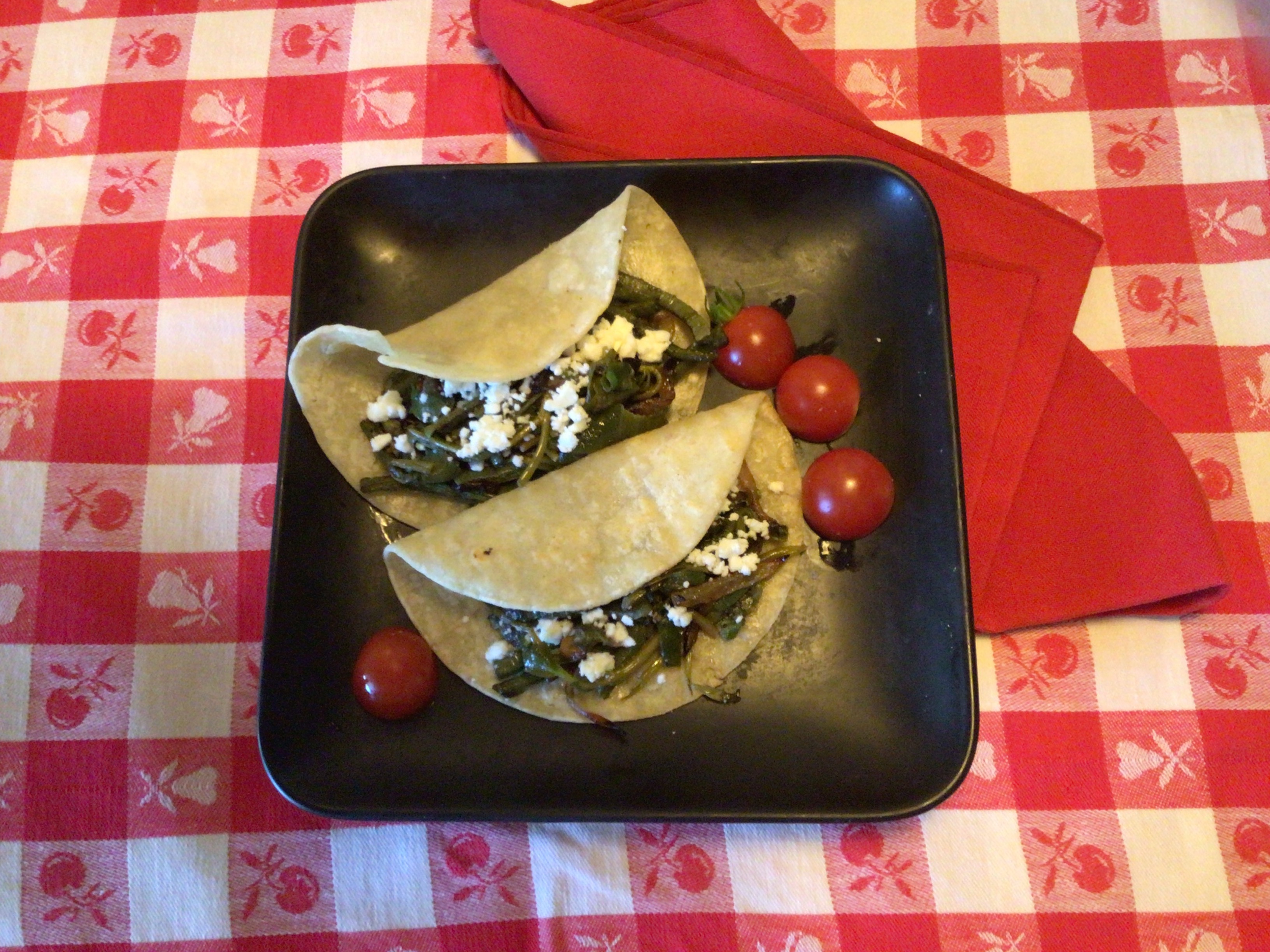
Coat a heavy frying pan with a light spray of oil and soften the tortillas. Divide the vegetables among the tortillas. Sprinkle with cheese and fold over.

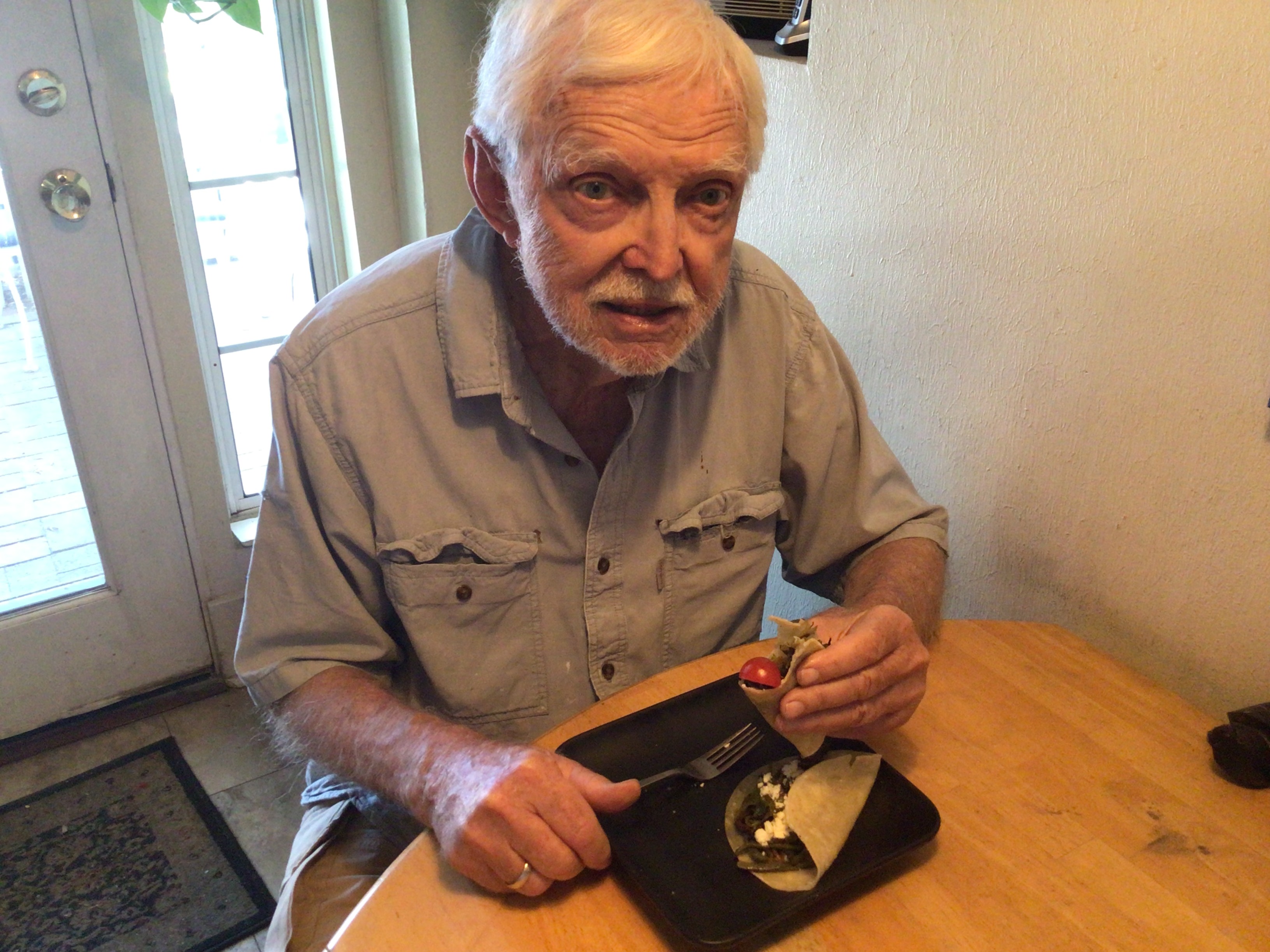
Every recipe writer whether for a blog or cookbook, needs a taste tester. Is it good? Would you eat it again? Here is my taste tester who has eaten his way through five cookbooks and dozens of these blog posts over forty years.

Chief taste tester Ford Burkhart works his way through the Sonoran Summer Tacos for lunch. He gave them the thumbs up. 

____________________________________

You can learn more about the history of food in Southern Arizona in my latest book A Desert Feast, the story of the last 4,000 years of food in the Sonoran Desert. Want more recipes using  foods of the Southwest? You’d find ideas for collecting and using 23 easily recognized and gathered desert foods in Cooking the Wild Southwest: Delicious Recipes for Desert Foods.  . Recipes from top Southwest chefs are collected in The New Southwest Cookbook. Just click on the titles for more information. You can learn more about me on my website.
GET READY FOR NOPALITO SEASON

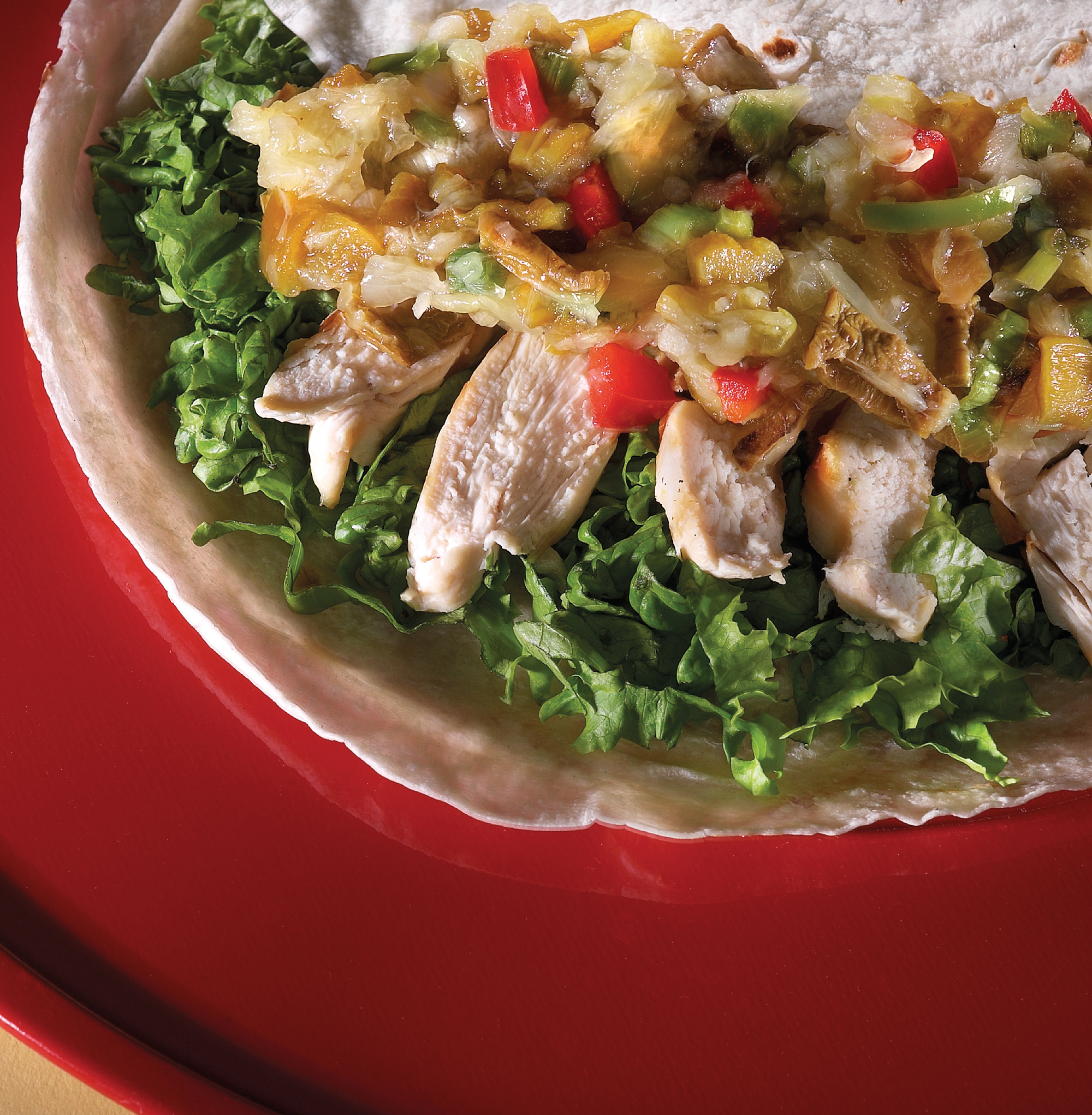
Grilled Chicken with Nopalito and Pineapple Salsa

Grilled Chicken with Nopalito and Pineapple Salsa (from The Prickly Pear Cookbook)

(Note: I will be teaching a class on cooking with nopales at the Presidio of Tucson on April 3. You can sign up on their website.)

The new prickly pear pads (nopales) that we cook and use for nopalitos are usually ready in from March to early May.  It’s Carolyn here today tempting you with two recipes for a delicious salsas made with nopalitos. (Definition of nopalito: a nopal, or cactus pad, cut into little pieces).

Why bother to learn how to use prickly pear pads? For hundreds of years, both the fruit and pads were considered folk medicine in Mexico and early research showed that the fibers in nopales were helpful in curbing blood sugar. Today, researchers in the US and Europe are using sophisticated laboratory techniques and specially bred mouse models (that would be transgenic mice, not transgender mice)  to investigate prickly pear fruits, pads, flowers, and seeds as a cure for a wide array variety of ills.

Investigators are looking into prickly pear compounds as antioxidant, antiviral, anti tumor, anti diabetic, and antiparasite.  It may be useful in combating a range of cancers including leukemia, lung, gastric, colon, and ovarian. Studies have considered its use in the treatment of ulcers and alcoholism and a possible role in boosting memory and energy metabolism. Many research labs are investigating prickly pear for cancer prevention.

The many varieties of prickly pear put out their new growth when the spring warms up. All prickly pear pads are edible (meaning they not only won’t kill you but in this case are very nutritious), but they are only appropriate for food when they are new. After about six weeks, they develop a fibrous infrastructure. The easiest kind of pads to prepare are those from the large Mexican variety of prickly pear that do not grow wild north of Mexico. You can grow them in your yard if your winter doesn’t bring much freezing. Or you can get them at a Mexican grocery story. They are called Ficus indica or sometimes Burbank because Luther Burbank did some breeding work on them. The wild cactus pads are also delicious, but harder to prepare because of the abundance of spines.

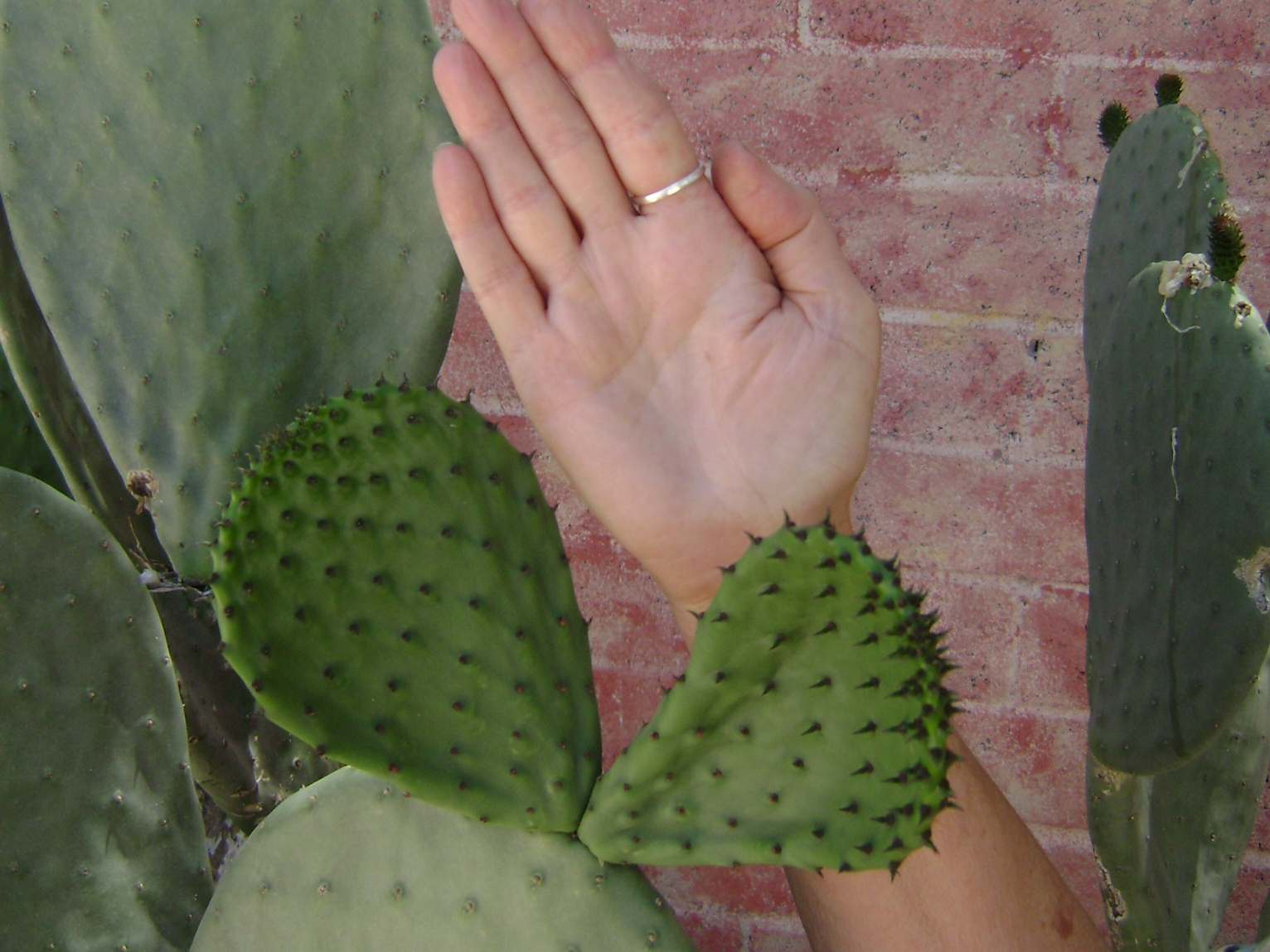
You can do a rough estimate of when a pad is ready to pick if it is about the size of your hand. The nopales available in Mexican grocery stores are grown by farmers who know how to manipulate the plant to keep fresh pads coming year ’round.

Pick nopales in the spring when the size of your hand.

Pick nopales in the spring when the size of your hand.

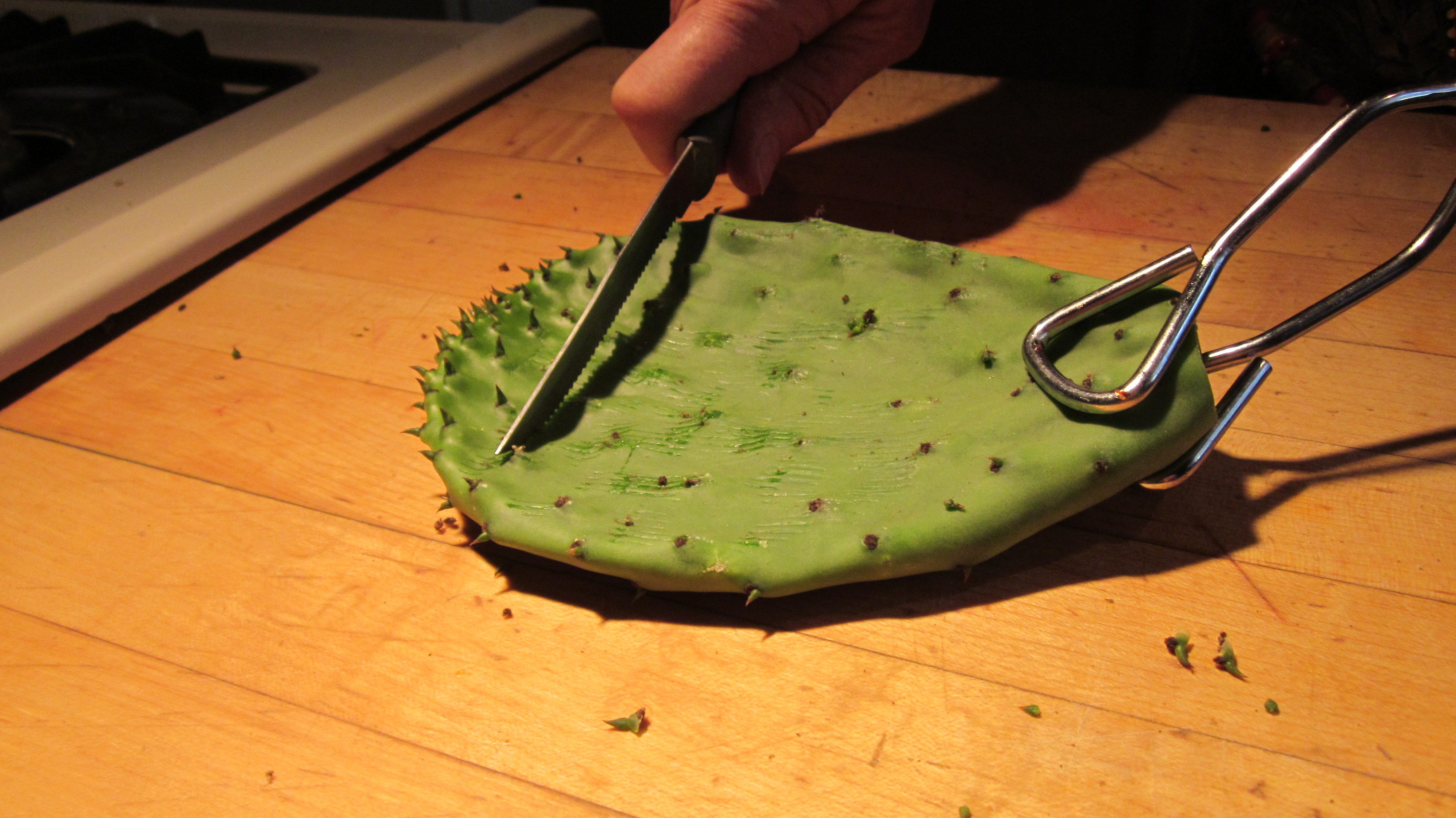
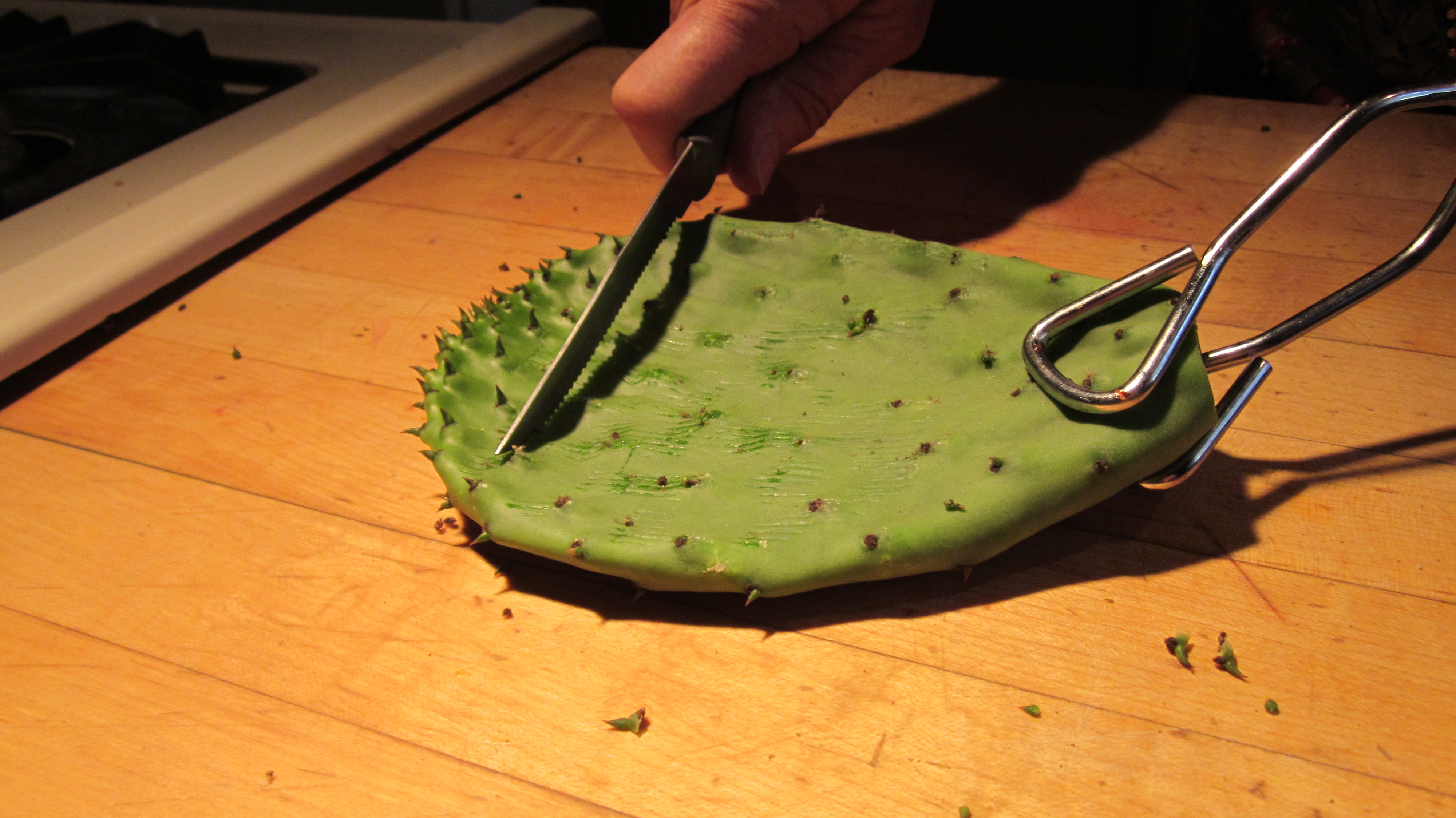
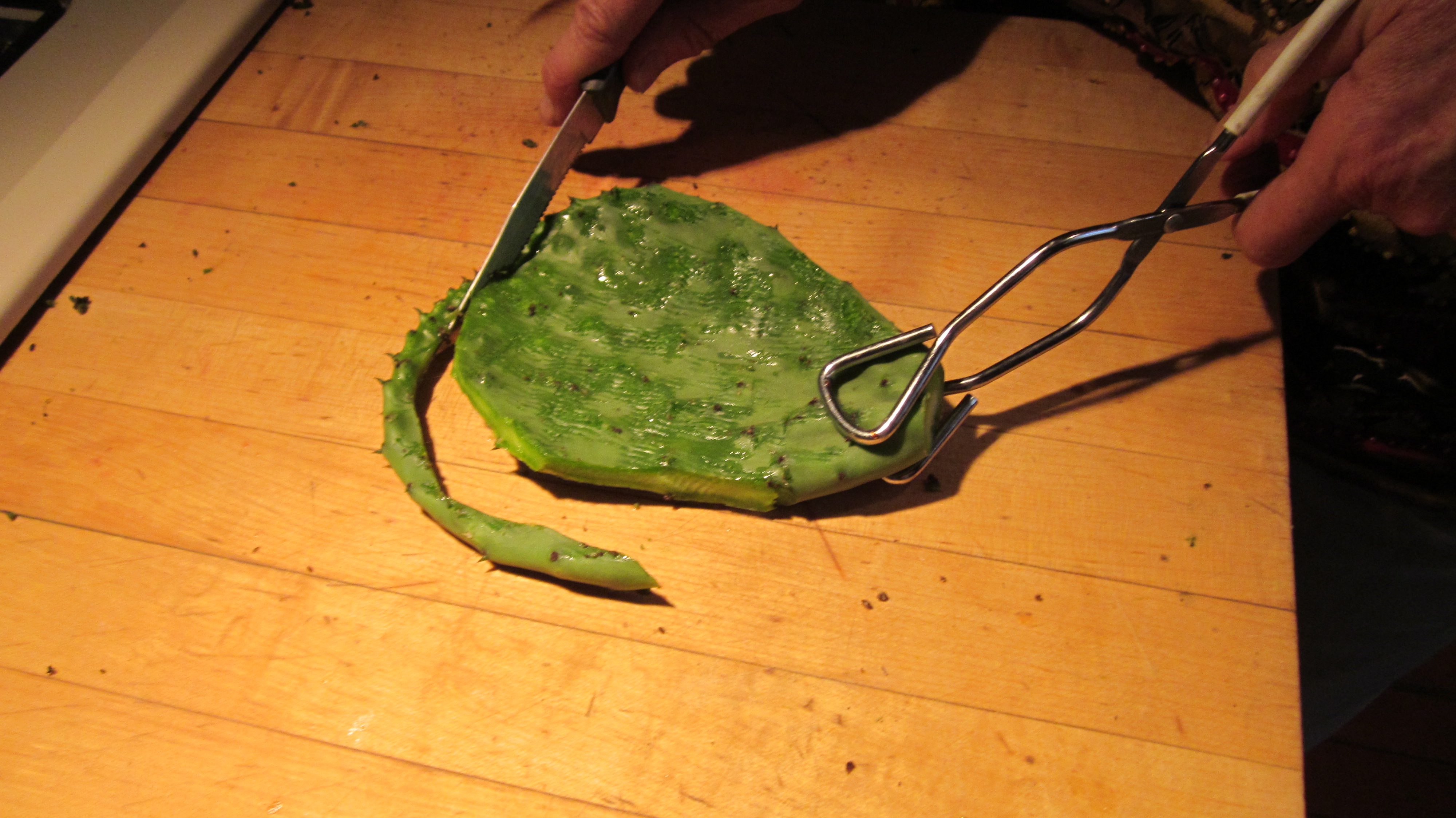
To prepare the nopales, you’ll use  tongs, of course, and then don rubber kitchen gloves to protect your hands as you get rid of the stickers. You don’t need industrial strength gloves, just good quality ones from the grocery store will do. Using a common steak knife, scrape vigorously against the growth (from outer edge to stem) to remove the stickers.

Scrape the thorns vigorously in the direction of the stem.

Scrape the thorns vigorously in the direction of the stem.

The edge has lots of stickers so just trim it off.

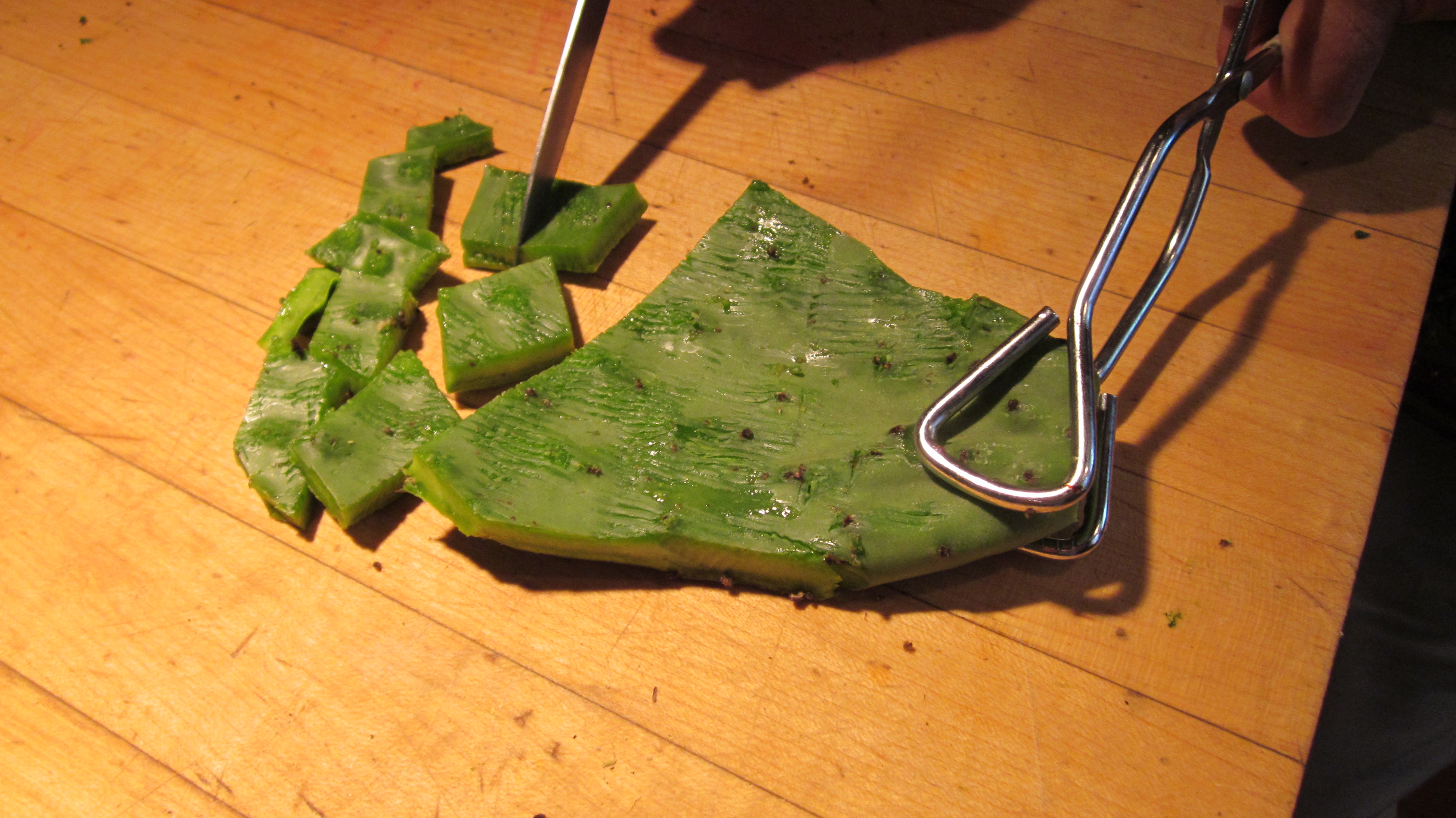
IMG_0196At this point, you can cut it into small pieces to cook or leave it whole and cut it up later. You can cook them in a frying pan filmed with oil, or use the Rick Bayless method (of TV show fame) and toss them with a little oil, sprinkle with sale, put on a cookie sheet and roast in a 375 degree oven for 20 minutes.  In any case, you should check them and turn them over as they cook.

Cut into small pieces to cook.

Cut into small pieces to cook.

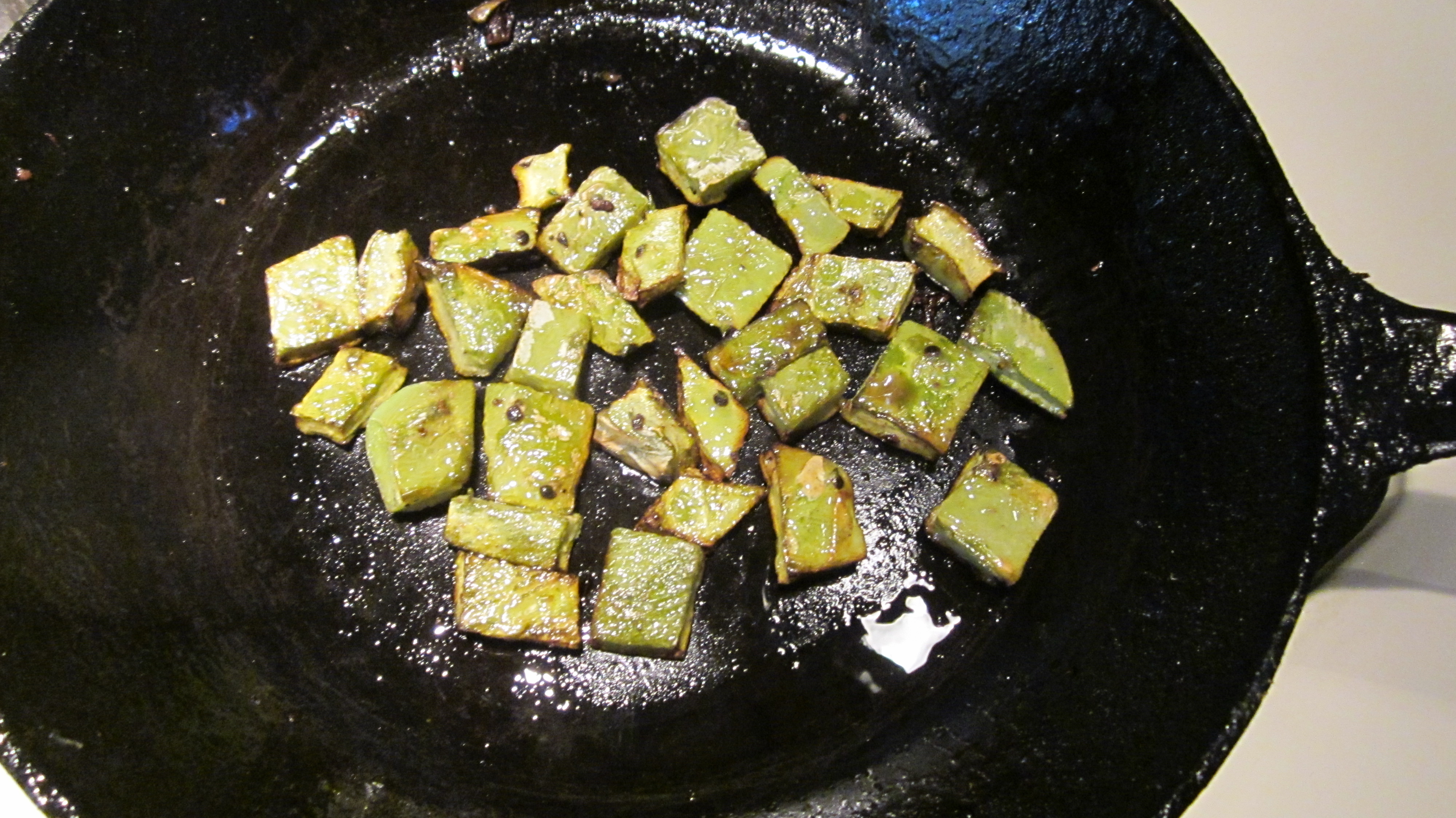
The nopales will turn from bright green to a more olive color as they cook. The gummy sap that some people find objectionable will dry up and become less noticeable.

The cooked nopalitos turn from bright green to olive.

The cooked nopalitos turn from bright green to olive.

You can also cook nopales on the barbecue alongside some chicken to make a delicious taco. 

Here’s the recipe for the sauce in the picture at the top of the blog:

Nopalito and Pineapple Salsa

1 raw, cleaned prickly pear pad

1 tablespoon vegetable oil

1 cup canned crushed pineapple packed in it’s own juice

¼ cup finely chopped red bell pepper

¼ cup thinly sliced green onions, including some tops

1 tablespoon canned green chiles

1 finely minced serrano chile (optional)

½ teaspoon finely minced garlic

2 tablespoons lime juice

¼ teaspoon salt

1 tablespoon finely minced cilantro (optional)

Cut prickly pear pad in 1 ½ inch squares.  Film a heavy frying pan with the oil and add the prickly pear pads.  Cook over low heat, turning occasionally, until pieces have given up much of their juice and are slightly brown. Remove from pan, cool, and chop into pieces as wide as a matchstick and about ¼-inch long.

Transfer to medium bowl.  Add remaining ingredients, stir to combine and set aside for flavors to mingle.

Nopalito and Bean Salsa

Here’s an even easier recipe and you might have everything except the nopales in your pantry.

1 1/2 cups commercial red salsa

1/2 cup canned black beans, rinsed

1/2 cup cooked nopalitos

1 tablespoon lime juice

1-2 tablespoons chopped cilantro

Combine all ingredients in a bowl. Serve with chips.

______________________

You can learn more about the history of food in Southern Arizona in my latest book A Desert Feast, the story of the last 4,000 years of food in the Sonoran Desert. Want more recipes using  foods of the Southwest? You’d find ideas for collecting and using 23 easily recognized and gathered desert foods in Cooking the Wild Southwest: Delicious Recipes for Desert Foods.  . Recipes from top Southwest chefs are collected in The New Southwest Cookbook. Just click on the titles for more information. You can learn more about me on my website.
Welcome to 2025

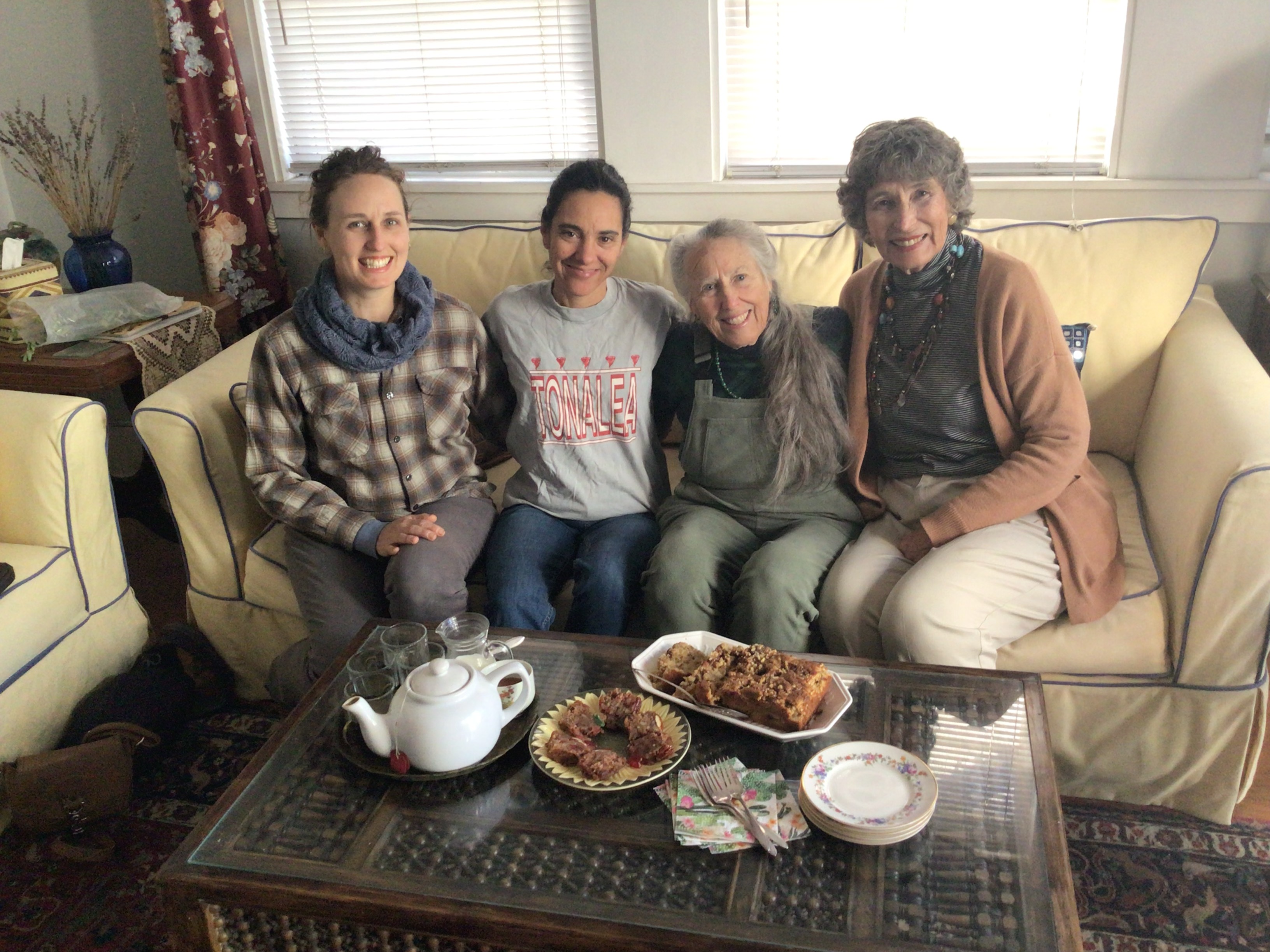
Savor Sisters (from left) Emily Rockey, Amy Valdes Schwemm, Martha Burgess, and Carolyn Niethammer gather to plan out the Savor year. We sampled a mesquite apple cake that may show up in a post.

As the Savor the Southwest blog enters its 13th year, we are so grateful to you, our readers, for following along and indulging us as we share our love of the flavors of the Southwest using both wild and cultivated plants.  During those years we have entered 370 posts sharing recipes for everything from Christmas cookies (mesquite gingerfolk, anyone?) to how to cook quince. Our readers hail from nine foreign countries as well as the United States. 

This year, we are thrilled to welcome a new Savor Sister, Emily Rockey. Emily has worked as a professional gardener for public gardens including most recently Tucson’s historic Mission Garden. Now as she returns to the university to learn even more about the soil that supports both wild and cultivated plants, she has time to share with us her expertise and creativity. Read her full bio on the Authors page. She has already shared her method for making prickly pear wine in a guest post last year. From now on she will be a regular and we are thrilled to welcome her. 

Lime Marmalade-Make It Spicy and Boozy

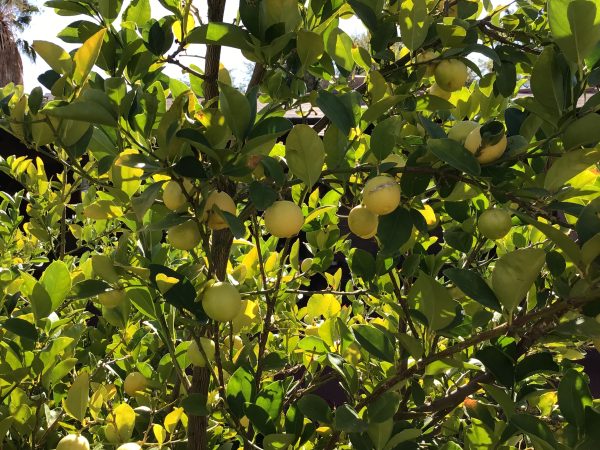
This is the season for small Mexican limes. Trees are usually very prolific and owners are happy to share the harvest. They are also available in produce sections of some store, particularly in the Southwest.

I live a five-hour drive from some glorious Mexican beaches along the Gulf of California. When I was younger, we often headed there on camping trips. As soon as we crossed the border, we’d buy a bag of Mexican limones from kids hawking them on the street and a bottle of tequila. A few sucks on the limes and a few swigs of the tequila and our vacation had begun. It’s Carolyn with you today. My days of crashing on the beach in a sleeping bag are over, but the love of the flavors that evoke our earlier adventures remains. Today I’ll show you how to combine those flavors into an adults-only marmalade.

This is the best season for the small limes called limones in Mexico or Mexican or Key limes elsewhere. If you live in a warm climate and have a friend with a tree, they will probably be happy to give you some. They are also widely available in grocery stores. Spike them with tequila or mescal and maybe jalapeño and you’ve got a treat made for gift giving. But keep some for yourself.  This is an adaptation of a recipe from the 1965 version of “Joy of Cooking” that I have used for all my citrus marmalades for decades.

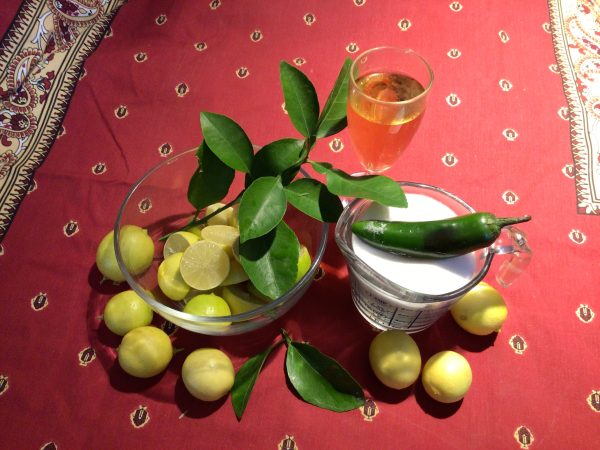
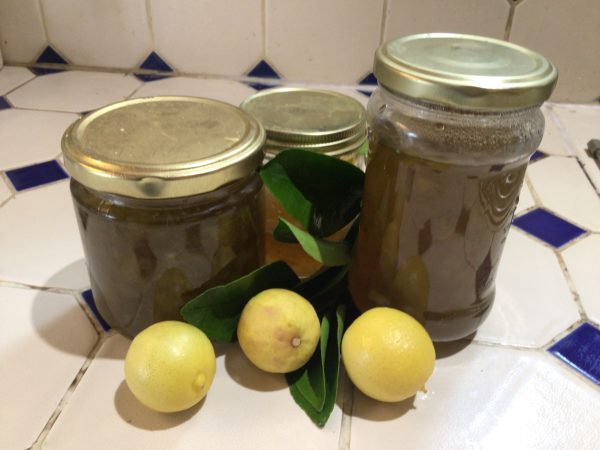
This is all you need to make a delicious lime marmalade: limes, sugar, some tequila or mescal, and a jalapeno

While tequila will work just fine, I prefer mescal for the smoky distinctive flavor. The soaking steps are to make sure the the rinds are very soft and almost melt into the rest of the marmalade.

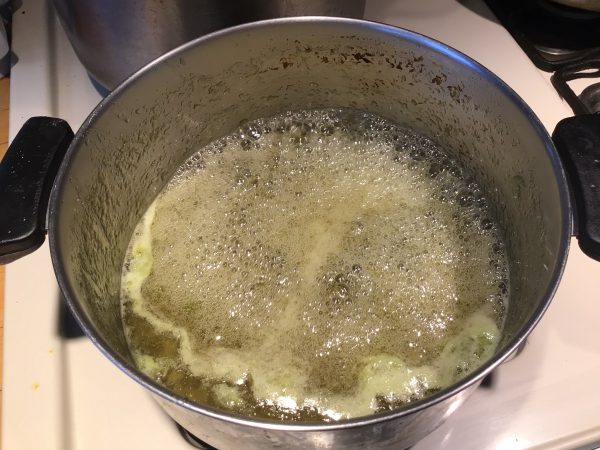
Here’s the marmalade happily boiling and getting thick.

The thermometer registered 220 degrees but had risen another degree in the time it took me to focus the camera. Moves fast at this point.

Boozy Spicy Lime Marmalade

(Makes 3 cups)

1 cup ground Mexican limes (11-12)

3 cups water

3 cups sugar

1 small jalapeño (optional)

1/4 -1/2 cup tequila or mescal

Quarter the limes and remove any seeds. Slit the jalapeno lengthwise and remove seeds and ribs. If you are using a food processor, add the quartered limes and jalapeno and process until all pieces are very fine. If you are using a blender, add the quartered limes and jalapeno and one cup of the water. Whirl until all rind pieces are fine.

Add fruit mixture to a large pot and add three cups of water or just two if you already used one cup in the blender. If any larger pieces of rind made it through, take them out and chop or slice finely. Let this sit for at least 12 hours. This softens the rind. (No, don’t get up at 2 a.m. if this is when the 12 hours are up. Proceed when convenient.) Bring the mixture to a boil and let sit for at least another six hours.

During the wait time, you can collect your jars. You will need enough jars for 3 cups. Sterilize them by covering with water and bringing to a boil or run them through a hot dishwasher cycle. If you use standard jars with two-part lids, they will seal. If you use recycled jars that don’t seal, you will need to store the marmalade in the refrigerator. Place the clean jars on clean newspaper or a kitchen towel.

When ready to proceed, add the sugar to the fruit, stir to combine, and bring the mixture to a slow simmer. Cook until it registers 220 degrees on a thermometer. This will take about 30 minutes. If you don’t have a cooking thermometer, take out a little and put it on a saucer in the freezer. (Turn the heat off under the marmalade while doing this.) If it firms up after 5 minutes, it’s done. If not, keep cooking. Watch closely. Once the temperature is reached, pour in the tequila or mescal. It will bubble furiously while the alcohol burns off. You’ll have to cook a little while longer to bring the temperature back up. At the end the temperature goes up quickly. Stir, scraping the bottom, very frequently to keep it from sticking and burning.

Ladle into jars. The marmalade will firm up as it cools over the next day.

(Note: If you’d like to make this quite spicy, add either more jalapeno or a small serrano chile.)

_________________________________________

_____________________________________________________________________

Carolyn Niethammer is a cookbook writer and cooking teacher. Find more Southwestern recipes in The New Southwest Cookbook and Cooking the Wild Southwest on-line or ask your favorite bookstore to order for you. Discover why Tucson was named a UNESCO City of Gastronomy in her book A Desert Feast: Celebrating Tucson’s Culinary Heritage.

Tepache: An Sonoran Summer Favorite

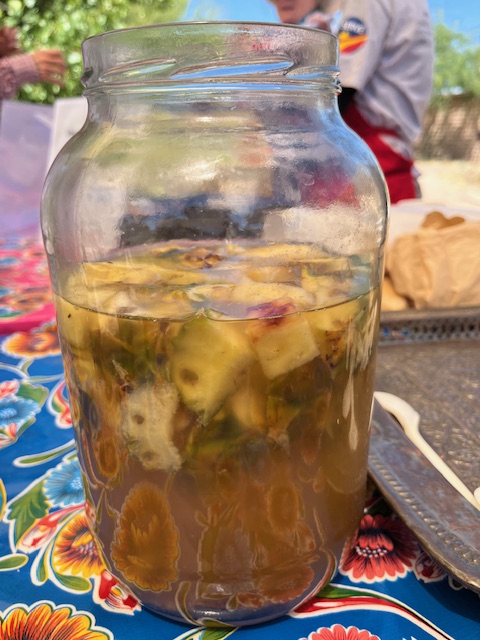
Josefina Lizárraga served her tepache at a recent event at Mission Garden in Tucson. Josefina is a font of wisdom on the traditional foods of the Sonoran Desert.

The summer heat has settled in here in Southern Arizona and cooling drinks are the order of the day. Of course, there is always water, but it’s nice to be amused by something more flavorful. 

It’s Carolyn today, bringing you a recipe for tepache, a simple pineapple drink that is a classic regional favorite. It is made with pineapple peels, the part you usually throw away, and a Mexican sugar staple, a hard cone of brown sugar called piloncillo. Properly made, tepache has a slight alcoholic zing. It won’t get you drunk, but it’s best reserved for adults. 

We recently learned how to make tepache from Josefina Lizárraga, who comes often to Mission Garden in Tucson to share her tips for dealing with local fruit. She is affectionately called La Madrina del Jardín. The process is pretty simple.

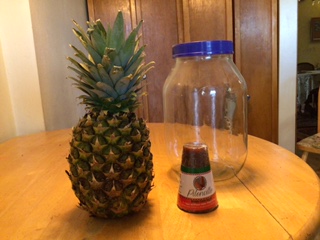
A nice ripe pineapple, a cone of piloncillo, and a jar are all you need to make tepache.

Tepache Recipe

Choose a ripe pineapple with a nice fruity fragrance. Wash the outside. As you cut off the peel, leave a little more of the fruit than you would if you were tossing it out. Cut the peel and the core into smaller pieces and add to the jar.

Bring about two cups of water to a boil in a small saucepan and add the piloncillo. Turn off the heat and let the sugar dissolve. If you can’t find piloncillo, use 8 ounces of dark brown or turbinado sugar.

Put the pineapple peels into your gallon glass jar and add whatever fruit you won’t be eating as well. Adding some of the fruit will give your tepache more flavor. You can also add a few cinnamon sticks.

Cut the pineapple peel and core into chunks.

Add the dissolved sugar and water and top up the water to about 3/5ths. Cover the jar with a cloth. DO NOT SCREW DOWN A LID. Put the jar on your counter. Josefina says just 4 to 4 1/2 days. Longer will result in vinegar. Refrigerate your tepache and enjoy with ice.

This is Josefina’s tepache she was serving at Mission Garden.

___________________________________________________________

You can learn more about the history of food in Southern Arizona in my latest book A Desert Feast, the story of the last 4,000 years of food in the Sonoran Desert. Want more recipes using  foods of the Southwest? You’d find ideas for collecting and using 23 easily recognized and gathered desert foods in Cooking the Wild Southwest: Delicious Recipes for Desert Foods.  . Recipes from top Southwest chefs are collected in The New Southwest Cookbook. Just click on the titles for more information. You can learn more about me on my website.
Homemade Chipotle Chiles in Adobo: Guest Editor Tells Why

I

It’s Carolyn this week and we Savor Sisters have decided that’s it’s time to share some of the brilliance of our cooking friends with our readers.  Tia Marta and I began experimenting with wild foods and Southwest flavorings five decades ago ( I wrote about that last month), Amy is a little younger. But as we have been cooking, and testing, and writing about it, many friends have taken parallel journeys to come up with marvelous and tasty dishes using Southwest ingredients, both wild and domestic. This year we are inviting some of them of do guest posts. We are going to start with David Scott Allen who writes a blog called Cocoa & Lavender that every week offers inventive and delicious recipes. You can check it out and subscribe here.

David’s post this week seemed perfect for the readers of Savor the Southwest–homemade chipotles in adobo sauce. I never considered it, but his reasons, avoiding garlic, make perfect sense. Chipotle chiles are jalapenos that have ripened to red and then been smoked. And it sounds delicious. I’ll let David take it from here:

A Smokin’ Hot Condiment by David Scott Allen

As always, it’s the condiments that (could) kill me.

When I dine at friends’ homes, and they know of my garlic allergy, they are so kind and careful never to cook with garlic. But it is hidden everywhere – not just in prepared foods where one might expect it, but in all sorts of condiments: mustards, mayos, ketchups, steak sauces, soup bases, hot sauces, and rubs.

Who would think that a teaspoon of Worcestershire Sauce would make me sick? Or that a run-of-the-mill mustard would have garlic. I have nearly poisoned myself by. Maybe my next thriller will be “Death by Condiments.”

Chipotle chiles in adobo (smoked jalapeño peppers in a tomato-based sauce) is one of our favorite condiments for adding to soups, stews, vegetables, marinades, and sauces. They are widely available in small cans but only once was I able to find a can that didn’t list garlic. And that was more than 25 years ago.

Thus, like many condiments everyone else has the luxury of taking for granted – taking from the grocery shelf – I need to make my own. Truth be told, this turns out to be a lot of fun, and the kitchen smells great.

Honestly, I think learning to make my own condiments has made me better cook. It certainly makes me appreciate how flavoring happens in food, and what the home cook had to do before there were millions of tiny bottles of this-and-that available for purchase.

If you are unfamiliar with this condiment, here is a link to a New Mexico corn chowder that will warm any winter night. I hope it is warm where you are… if not, make some chipotles in adobo and feel the heat!

Chipotle Chiles in Adobo

1 tablespoon olive oil

1/2 large white onion, peeled and chopped (a generous cup)

2 shallots, peeled and chopped

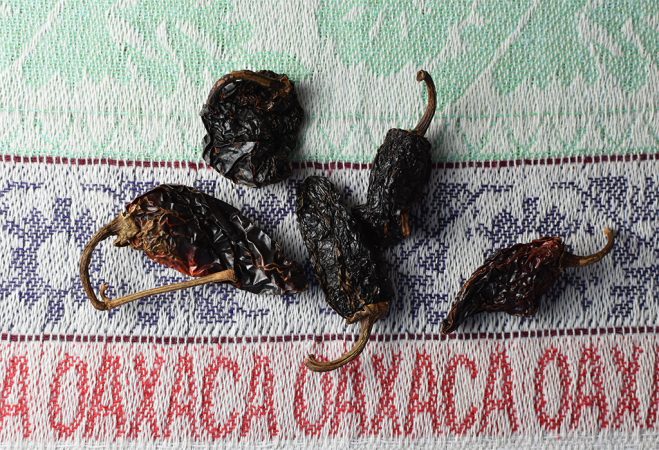
1 ounce dehydrated chipotle peppers (I got them from Penzeys)

3 cups boiling water

1 cup canned tomato sauce

1 tablespoon tomato paste

2 teaspoons brown sugar

1/2 cup water

1/2 cup cider vinegar

1/2 teaspoon salt, or more to taste

reserved soaking liquid, as necessary

Heat the olive oil on a skillet over medium-low heat and cook onions and shallots until clear and slightly golden.

While the onions and shallots are cooking, remove the stems from the chiles and place them in a bowl. Cover them with boiling water and weigh them down with a small plate; soak for 20 minutes. They will not soften as much as other chiles; don’t be concerned if they feel leathery.

Remove the soaked chipotles and place them in a blender (see note below); reserve soaking liquid. Add the tomato sauce, tomato paste, and brown sugar. Blend until you have a uniform paste.

Scrape the blended chipotles and tomato sauce into saucepan and add in 1/2 cup of the soaking liquid.

Add the cooked onions and shallots, along with the salt and vinegar to the pan. (If you are keeping some chiles whole, add them at this point.) Mix well. Bring to a boil, then reduce heat and simmer for 90 minutes until very thick. Check often after the first hour. If the sauce has dried too much, add reserved soaking liquid as needed, using water if you run out of soaking liquid. As it cooks, the mixture will turn a very dark, mahogany brown. (Note from Carolyn: watch this like a hawk. Putter around the kitchen to keep an eye on it. You don’t want it to burn.)

I like to purée the mixture one more time before putting it in jars. Leave it chunky, if you prefer.

Note: If you would like some whole chipotle chilies, purée half of them with the tomato sauce, and reserve the remainder to cook whole.

How can you use your homemade chipotle sauce? Add a bit to spaghetti, soup, or sauces. Find links to these recipes in the Cocoa & Lavender blog here.
___________________________________________

Carolyn Niethammer writes about the foods and people of the Southwest. Her most recent book, A Desert Feast, Celebrating Tucson’s Culinary History, tells the story of the last 4,000 years of food history in Tucson and the Santa Cruz River Valley. 

50 Years Exploring Wild Foods of the Southwest

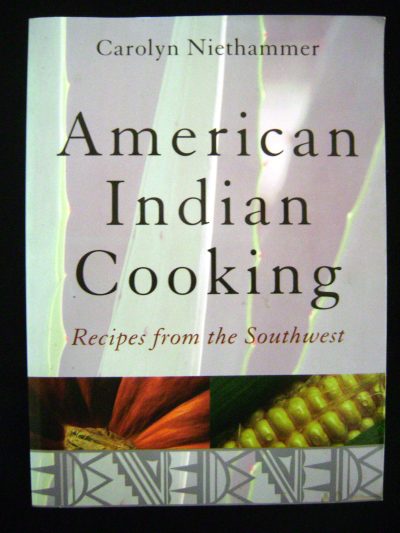
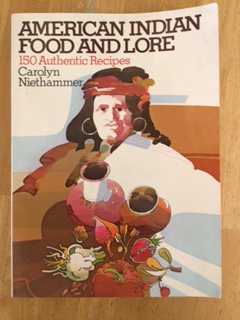
It’s Carolyn here today with a walk down memory lane. This year celebrates 50 years since the first publication of my first book American Indian Food and Lore, now republished as American Indian Cooking: Recipes from the Southwest. In 1970, I was a young out-of-work journalist and through an unlikely set of circumstances ended up with a contract for a book on Indian cooking with Macmillan, a major New York publisher. Preliminary research showed that traditional Native American food revolved around edible wild plants and corn, beans, and squash.

My college science was zoology so I had a lot to learn about edible plants. I began by reading every ethnobotany written about Southwestern plants. I found mentors to take me on plant walks, including the late renowned botanist Richard Felger. When I knew enough to ask intelligent questions, I headed out to talk to the experts, Native American women. My first teachers were two lovely Tohono O’odham women on the San Xavier section of the reservation who spent an afternoon teaching me to cook mesquite the way their mothers had. I put the leftovers in the backseat of my car and had a head-on collision on a narrow dirt road on the way home. Woke up in the hospital with mesquite mush in my hair.

Here I am in 1971 trying to learn to distinguish one little green plant from another.

Perhaps that was some sort of christening, so for $150 I bought a Chevy wagon and the summer of 1971, I headed to remote areas on the Hopi, Navajo, Zuni, Havasupai, and Pueblo reservations. Many very generous middle-aged Native women taught me about plants they had gathered with their grandmothers. I worked in an office that winter to gather some money and headed out again the summer of 1972.

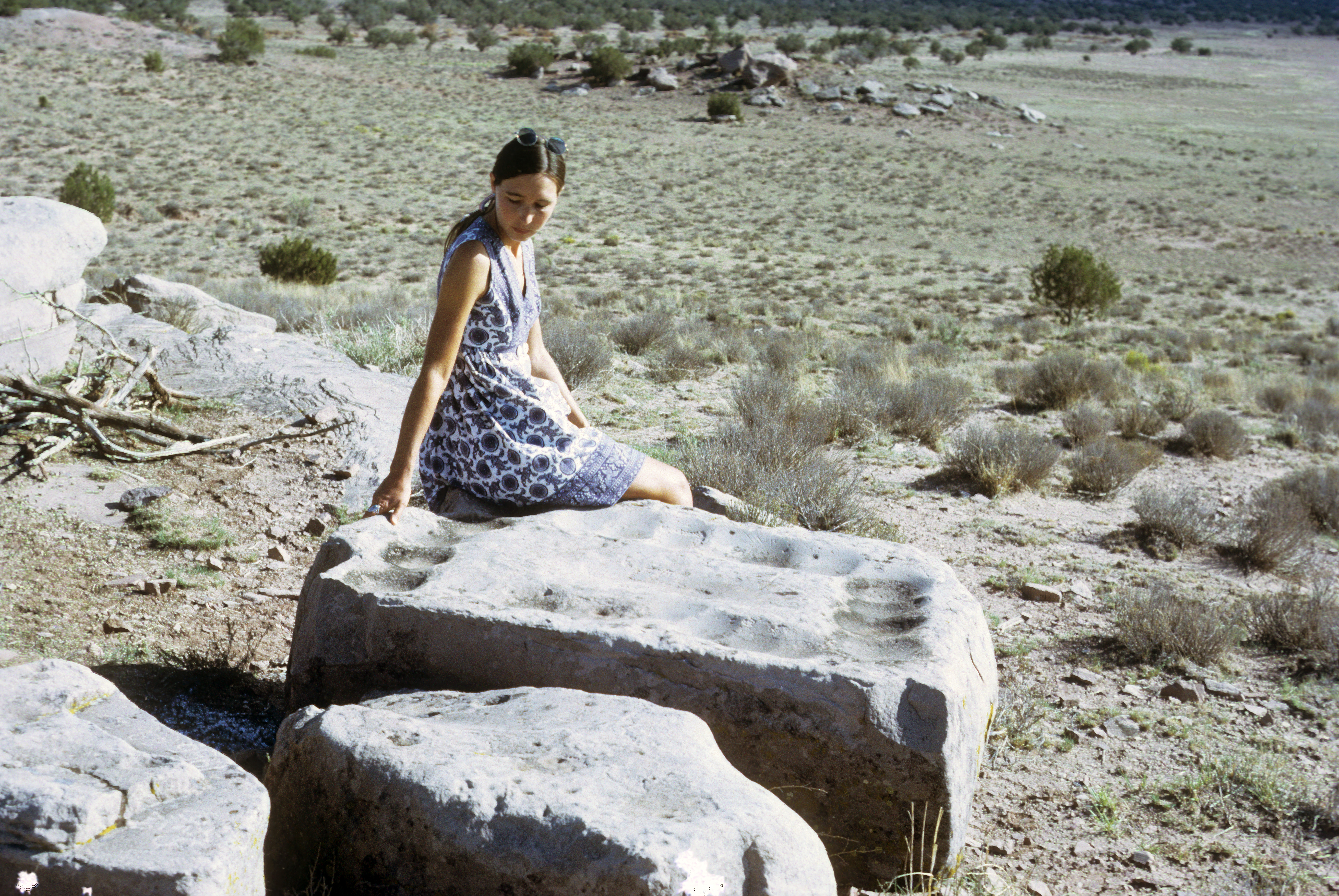
Finding a communal grinding stone at Hawikuh (founded c. 1400) near the Zuni Reservation. Imagine the women sitting around the stone doing food preparation.

Then it was time to test the recipes when I had them and develop recipes when necessary. A friend lent me an electric typewriter (such a luxury), and I wrote up what I had learned. A small grant allowed me to pay Jenean Thomson to do the gorgeous and accurate line drawings of the plants.

Jenean Thomson’s ocotillo illustration.

The book was “in press” for two years and was released by MacMillan in 1974. Euell Gibbons had published several well-known books on edible wild plants, but they were all Eastern species. American Indian Food and Lore joined a very few popular books on edible Western plants. Sunset Magazine even came and did an article on my wild food gathering class. Writer and ethnobotanist Gary Nabhan joined me, and one year we did a class we privately called Gary and Carri’s Thorny Foods Review.

After two decades, with changes in ownership, Macmillan decided the book didn’t fit their line, but the University of Nebraska Press liked it. In 1999, they republished the book under their Bison Books line as American Indian Cooking: Recipes from the Southwest with a lovely new cover.

I have followed this title with four more books on Southwestern food, but my first foray into cookbooks with the all the memories I have doing the research remains a high point of my life.

Here is one of the original recipes taught to me by a Navajo cook.

Navajo Griddle Cakes

(Makes 14 4-inch cakes)

Although this calls for lamb’s-quarter seeds, you can substitute amaranth, quinoa, chia, or sunflower seeds.

¾ cup ground lamb’s-quarter seeds

¾ cup whole wheat flour

2 tablespoons sugar or honey

½ teaspoon salt

1 teaspoon baking powder

1 egg

2 cups milk

2 tablespoons oil or bacon drippings.

Combine dry ingredients in a bowl. In another bowl beat together egg, milk, and fat and add to dry ingredients. Heat the griddle and add a small amount of oil. Test the griddle by letting a few drops of cold water fall on it. If the water bounces and sputters, the griddle is ready to use. Bake the pancakes.

__________________________________

Note from SavorSisterTiaMarta:  If you want to find other fascinating, flavorful, and from-the-earth Indigenous recipes that were gifted to Carolyn 50 years ago and which she published in American Indian Food and Lore, you can chase down used book copies via Thriftbooks, Amazonbooks and other sites.  This first book is a treasure trove of totally useful, current ideas!

Celebrating Three Tucson Women and Their Innovative Work with Southwest Foods

An Interview with Gary Paul Nabhan

by a SavortheSouthwest.blog Fan

Caption:  Faces behind the blog–the SavorSisters left to right:  Mano y Metate Molera Amy Valdes Schwemm, Author/Culinary Artist/Hostess Extraordinaire Carolyn Niethammer, and Flor de Mayo Prickly Harvester/Frijol Aficionada Martha Ames Burgess

[Esteemed SavortheSouthwest Blog Readers:  Our friend, colleague, desert foods philosopher, orchardist, inspirational instigator of culinary action, and author Gary Paul Nabhan asked to be interviewed.  We were super-honored to learn he is such a fan of our blog!  Here are his shared off-the-cuff remarks.]

Author Gary Paul Nabhan, with local beef and lamb grower Dennis Moroney, owner/founder of Sky Island Brand Meats (enjoying a concert by musician- grasslands botanist-author Jim Koweek in Sonoita, AZ)

INTERVIEW FOLLOWS

Question from a SavortheSouthwest.blog Fan:  So Gary, why are you eager to celebrate these Southwest foodies’ lifework, that of Carolyn Niethammer, Martha Ames Burgess, and Amy Valdés Schwemm?

Gary:  Aside from the fact that they have had enormous influence, not just on me but our whole community, each of them has been a remarkable pioneer or innovator with Southwest foods.  I value their friendships –but also their brightness.

Question: When and how did you get to know each of them?

Gary: When I moved to Tucson in 1975 or so, both Kit Schweitzer and Lloyd Finley heard of my interest in food ethnobotany and said I had to meet Carri.  She was probably working on her book American Indian Food and Lore by then, which was one of the first regional books on Indigenous cuisine in the Southwest.  We did some field harvesting workshops together on seasonal wild foods in the Tucson area, calling it “Gary and Carri’s Thorny Food Review.”  Next we worked together on Pima County Public Library’s amazingly innovative live-talk series, the Sonoran Heritage Program.

With Muffin, in the 1970s we were both engaged with the Arizona-Sonora Desert Museum and with Tumamoc Hill’s Mescal,Marching,&Menudo Society. As fellow grad-students, we’d practice our research findings on each other with presentations and potlucks.  Later, we were conserving seeds and traditional planting know-how with NativeSeedsSEARCH [the organization Gary co-founded] and shared by Indigenous farmer friends. To this day, no single educator of nature and culture has eclipsed Muffin’s capacity to bring Tucsonans out for hands-on experiential programs.  I recall an event that she organized, a Desert Museum program with Tucson explorer Tad Nichols showing his 1943-44 film of flying over the newly-exploding Paricutin volcano. Over 600 people were attracted to Tad’s presentation thanks to Muffin’s enthusiasm. We both had friendships with Tohono O’odham Elder women on the Nation, so traveled out there together a lot, learning from them.  She actually was a model for one of the characters in my first book.

[Nabhan’s book The Desert Smells like Rain, a Naturalist in O’odham Country, first published in 1982, has been reprinted recently by University of Arizona Press!]

I got to know Amy later through her work with Mano y Metate and Desert Harvesters.  Her Mano y Metate moles—which she re-created from scratch when NativeSeedsSEARCH’s Mexican mole source vanished–have always been extraordinary in both honoring tradition–and in kicking fragrances up a notch. Amy agreed to cater one of the first dinners we had in Patagonia when I founded the national network on rare food conservation called Renewing America’s Food Traditions. Our guests from all over–Deborah Madison from Santa Fe, leaders in Chefs Collaborative, and Slow Food USA–loved her creativity as much as I did.

[Amy’s Mole mixes make being a gourmet cook almost instantly possible!]

Question:  What do you think these three Savor-Sisters have in common, in terms of values and strategies for promoting Southwestern foods?

Gary:  That’s easy to respond to:  They all have deeply listened to Indigenous and traditional home cooks, rather than –excuse my Espanglish—simply sitting on their nalgas in front of their desks to make up mierda without any tangible ties to historic traditions. Carolyn’s first book was really a food ethnography acknowledging dozens of Southwest Native women and their traditional foodways. Muffin has done the same with Tohono O’odham women–listening and participating in food harvesting and preparation with elders. And Amy has continued the traditions of her own grandmothers. Not every writer or chef takes that time:  each of these three Tucsonans stands in the tradition of Paula Wolfert, Diana Kennedy and Lois Ellen Frank.

Question:  Any other thoughts you dare share about these Three Mesquiteers?

Gary:  Actually yes–one more thing:  One of the aspirations that Jonathan Mabry, head of Tucson’s City of Gastronomy program, and I had when we were submitting the proposal to make Tucson the first UNESCO City of Gastronomy in the U.S. was this:  to continue the elaboration and celebration of the unique gastronomy of this place and its many cultures. Shortly after getting that designation, I knocked on Carri’s door and said, “Tag, you’re it! No one else can offer the detailed overview of Tucson’s complex culinary legacy in print better than you.  What still needs to happen is to create or articulate a collective identity for a Sonoran Desert cuisine that is identifiable, unique—as it is in New Orleans, Charleston, Boston, or Santa Fe.  So, it’s up to you to express what a distinctive regional cuisine means for us, and illustrate it with great sample dishes, sample menus.”

That’s really a huge task—larger than what one book can ever do—but she started that process.  She had Tucson’s home cooks, chefs, growers–young, veteran, Indigenous—even brewers and distillers all understand what they, as a community, have to build on– that no one in Phoenix, El Paso or Albuquerque can touch.  The result was her latest book A Desert Feast: Celebrating Tucson’s Culinary Traditions.      

Each of Carolyn’s books is a treasure trove of local food delights, ideas and info.

Question:  Okay, so what are you up to these days as Extinguished Professor Nabhan?  We’ve heard a rumor that you sometimes write books in the middle of the night.

Gary:  Yeah, sleeplessness is my only real asset.  Of course, I’m still rambling around festivals promoting Agave Spirits, my latest book coauthored with David Suro. But I’m also at work on a book with James Beard-award-winning chef and food writer Beth Dooley on the links between and benefits of desert cuisines from around the world in this time of rapid climate change. We’re showing a commonality between what people grow and how they prepare foods from the deserts of India and Persia, through the Middle East and North African “Maghreb”, to the Canaries, Caribbean, northern Mexico and the U.S. Southwest. These will be recipes so aromatic and full of healthful antioxidants that no one will ever say again that living well and eating sustainably in a hot dry world is difficult–if not impossible. And most hopeful, these deserts’ foods can even buffer us from heat stress, dehydration and damaging solar radiation…  So stay tuned!

[The Savor-Sisters thank you, Gary, for your candid thoughts and perspectives about us and our mission in sharing what we do via this blog.  Indeed all of us, dear blog readers included, are anticipating Gary’s next book.  (We can hardly keep up with his blistering writing rate.)  Bravo to him for continuing to share his significant desert stories, and to inspire us resiliently into hotter, drier times! With appreciation, Carri, Amy, and Muff]