Eat Mesquite and More: a Cookbook for Sonoran Desert Living

Happy Summer, friends!

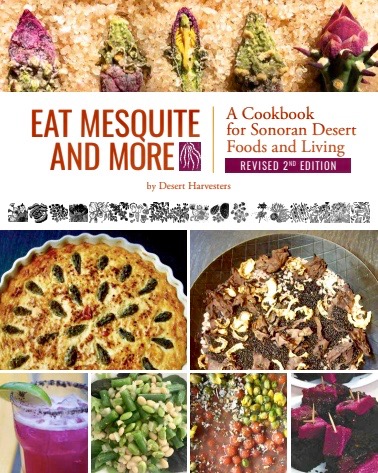
Amy here, on a hot, hot morning, sitting the shade. Have you seen Desert Harvester’s new edition of the cookbook??? It is 400 pages! with lots of color photographs and original art. It really is worth getting the book for the art alone.

But today I want to highlight the ethics in book. It starts with a poem by Ofelia Zepeda, followed by a land acknowledgement, and a Desert Harvesters ManiFEASTO in English and Spanish. There is a recipe for Abundance and a detailed primer on Reciprocity, elaborating on “Get to Know vs Grab and Go” and “Rewild vs Defiled” and a whole other section on living and eating in place. So yes, even if you don’t live in the desert where these plants grow, and even if you never plan to cook, this is still a tremendous resource and inspiration.

As the title declares, Desert Harvesters has morphed from mesquite milling focused to offering intimate portraits and recipes of over 20 desert ingredients. Have you harvested: mesquite, ironwood, saguaro, acorn, devil’s claw, wolfberry, hackberry, mushrooms, chiltepin, barrel cactus, prickly pear pads and fruit, cholla, chia, agave, palo verde, yucca, ocotillo, globe mallow, purslane, packrats, grasshoppers or cicadas? With detailed harvesting instructions, seasonal timing and expert tips, a novice harvesters can actually get out there and try! Many desert plants offer multiple delicacies, such as ironwood tree as green seeds, mature seeds, flowers and seed sprouts.

There are a LOT of recipes, some easy and some taking days or longer to make. I didn’t count how many recipes are in the book, but it says only 80 of them are bilingual, English and Spanish and 65 are new to this edition. There are a few medicine recipes, too. This book really does have something new for even the most seasoned harvester. The recipes are contributed and tested by community members far and wide, encompassing ancient wisdom and modern innovation from many cultures. It also includes many recipes from us Savor Sisters, Carolyn, Tia Marta and I.

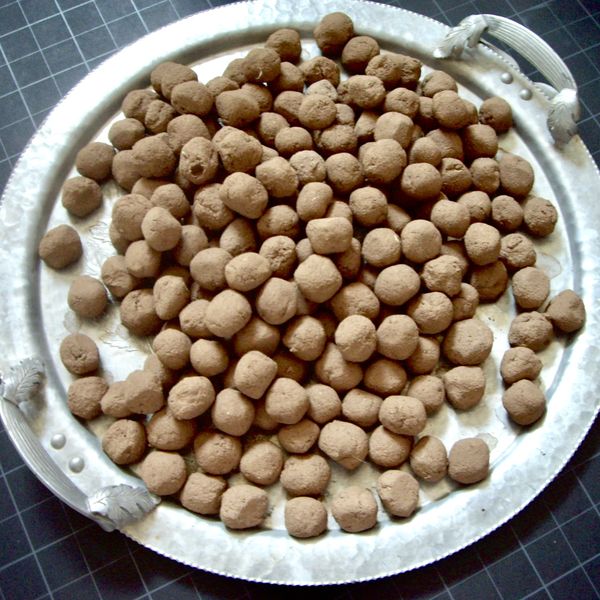
If you still aren’t convinced to buy this book or find it in the library, go to Desert Harvesters Facebook page. There you will see recipes for Seed Balls for planting and Saguaro Fruit Truffles for eating. Don’t mix them up!
Spring Grapefruit Salsa

In Tucson the mesquite trees have fresh new leaves and bags of grapefruits are looking for homes. Happy Spring! Amy here using grapefruits a way I learned from my friend and mentor Barbara Rose of Beantree Farm. You can find the original recipe as well as so much other inspiration in a new edition of the Desert Harvesters Cookbook available to preorder now.

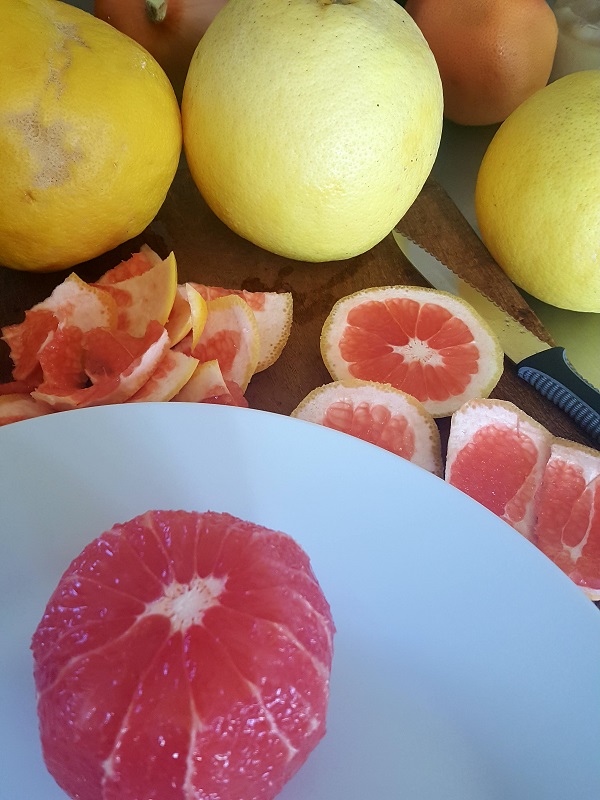
Salsa is commonly made with tomatoes or tomatillos, but when fresh tomatoes are months away, grapefruit are plentiful, juicy, sour and pulpy with a hint of sweet. Yum! Start by cutting the stem end and blossom ends of the fruit.

Then cut down the sides to remove the peel, including the pith. Candy the rinds if you like!

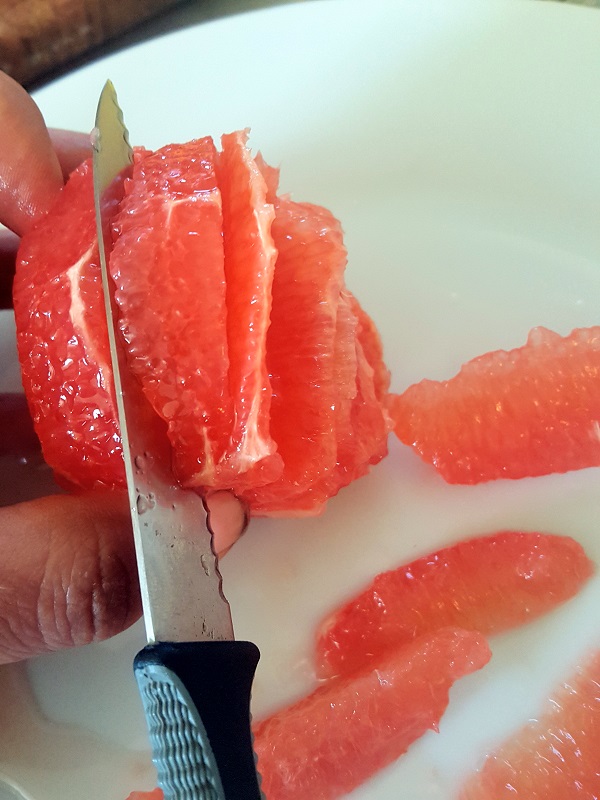
With a paring knife, cut along both sides of each segment to release the pulp in wedges. This goes more quickly than it sounds.

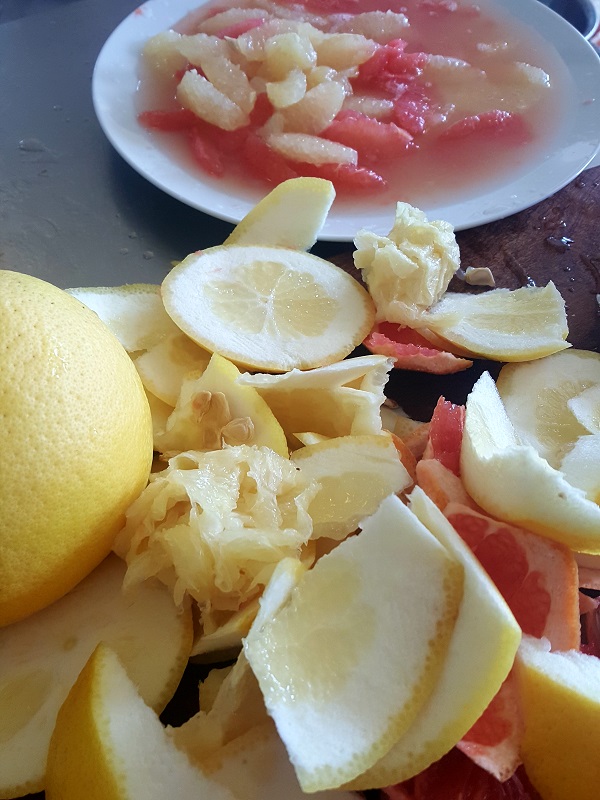
I don’t worry about getting every little piece of pulp since I squeeze the juice out of the membranes left behind.

Remove the seeds and drink some of the excess juice. A mix of different colored grapefruit or even oranges is fun. Use what you have!

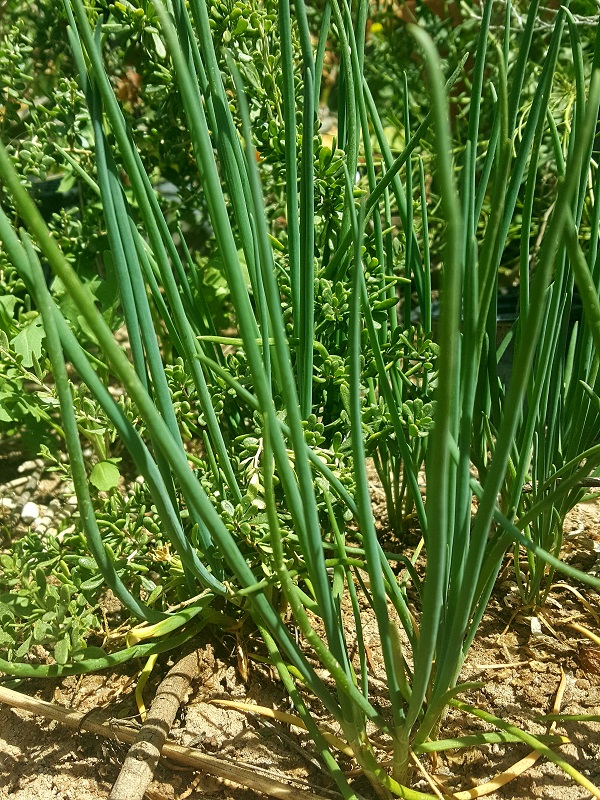
I’itois bunching onion tops have a unique onion flavor but any color onion will work: bulbous white, red or yellow, green spring onion tops, shallots… whatever you have.

Besides a smashed clove of garlic, a splash of cooking oil (any kind), a pinch of salt, and rubbed Mexican oregano, the not so secret ingredient is crushed chiltepin! Use as few or many as you like. Allow the salsa flavors of blend and the chiltepin and oregano to rehydrate.

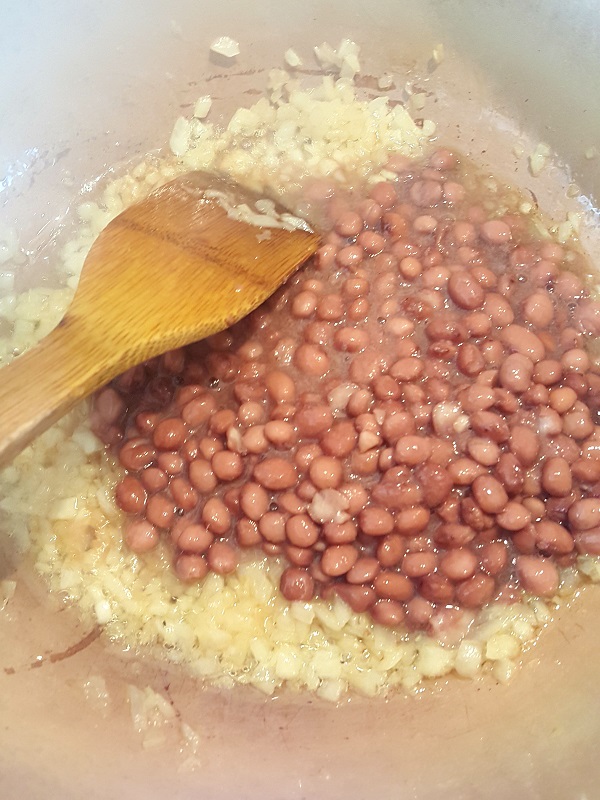
Wanting something to go with the salsa, I made tostadas. Sautéed onion and cooked pink beans are a great base.

Mashed beans stick to tostadas better.

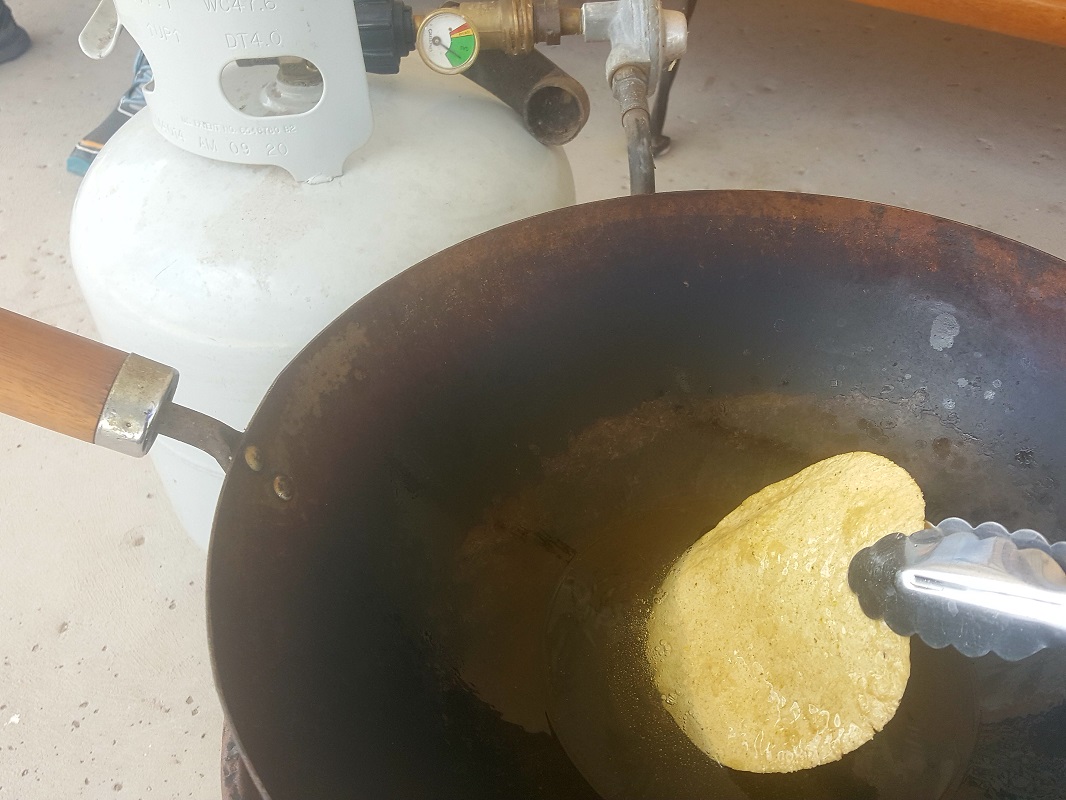
Fry corn tortillas in oil until crispy. In order to not set off the smoke detector, frying outside is the best, especially in beautiful spring weather.

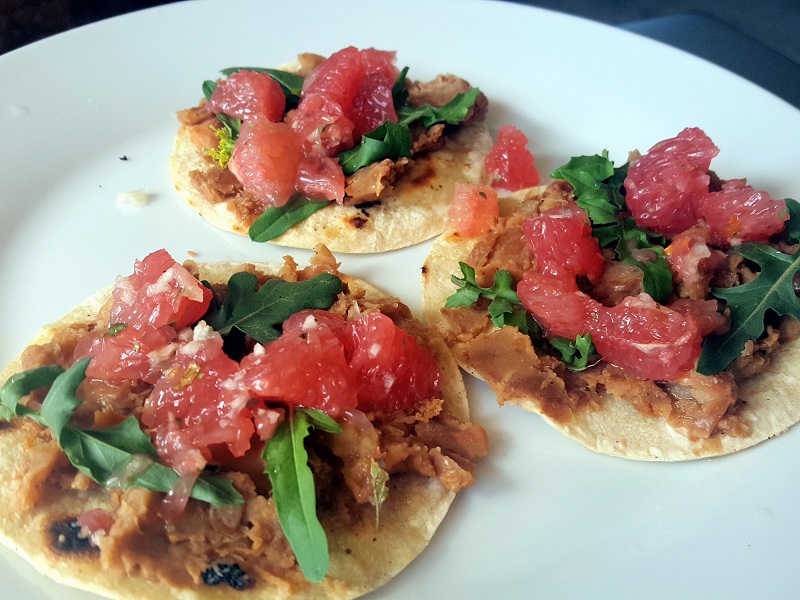
Lettuce or most any green or sprout can all liven up tostadas. Wild mustard greens, like arugula, add a peppery bite.

Assemble and enjoy outside!

Easy Summer Corn Treat: Coctel de Elote

Hello friends! Amy here celebrating the harvest on the Autumn Equinox.

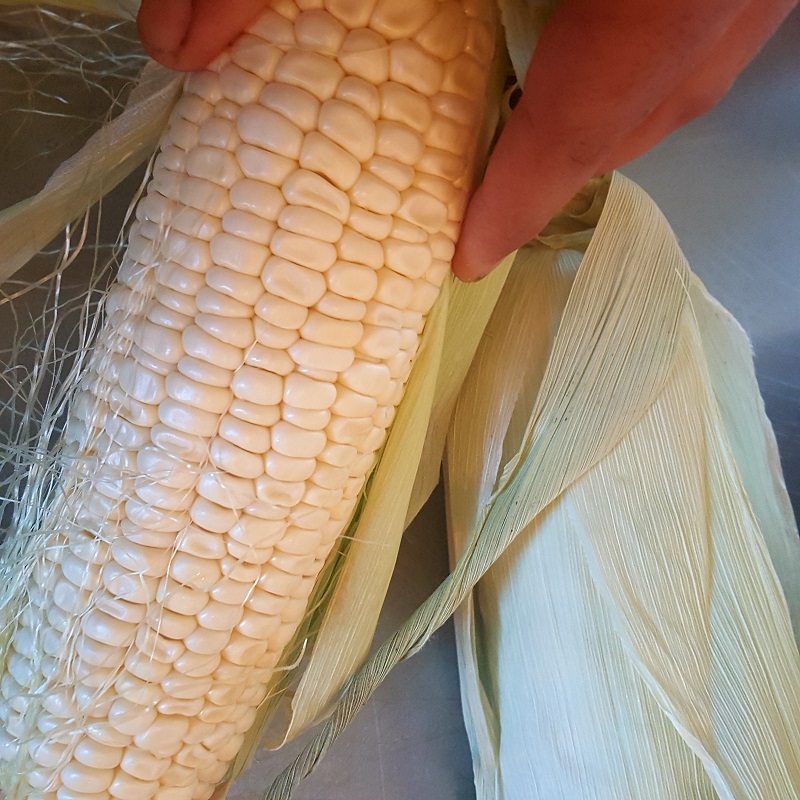
At Mexican Raspado places, I never order the shaved ice with sweet syrup, fruit, ice cream, etc. I always get Coctel de Elote, a corn soup served hot and it is DELICIOUS even in hot weather. It can be made with very immature flour or dent corn varieties also known as starchy “field corn” varieties. These are the same corn varieties that are allowed to mature dry on the plant and made into tortillas, tamales and countless other creations. But elote for coctel de elote can also be sweet corn and that’s what I had from my share at Tucson Community Supported Agriculture.

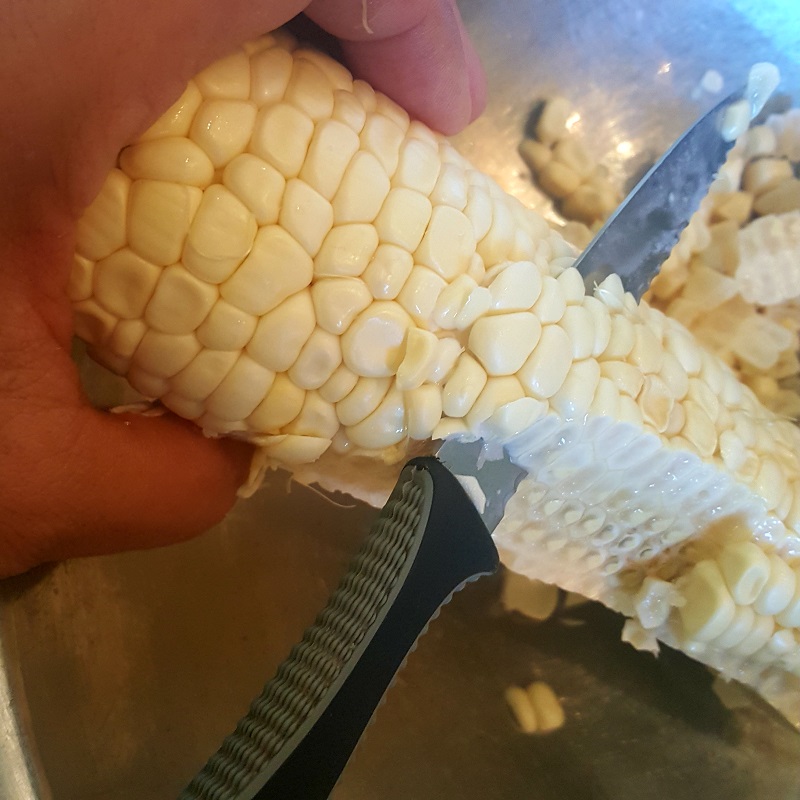
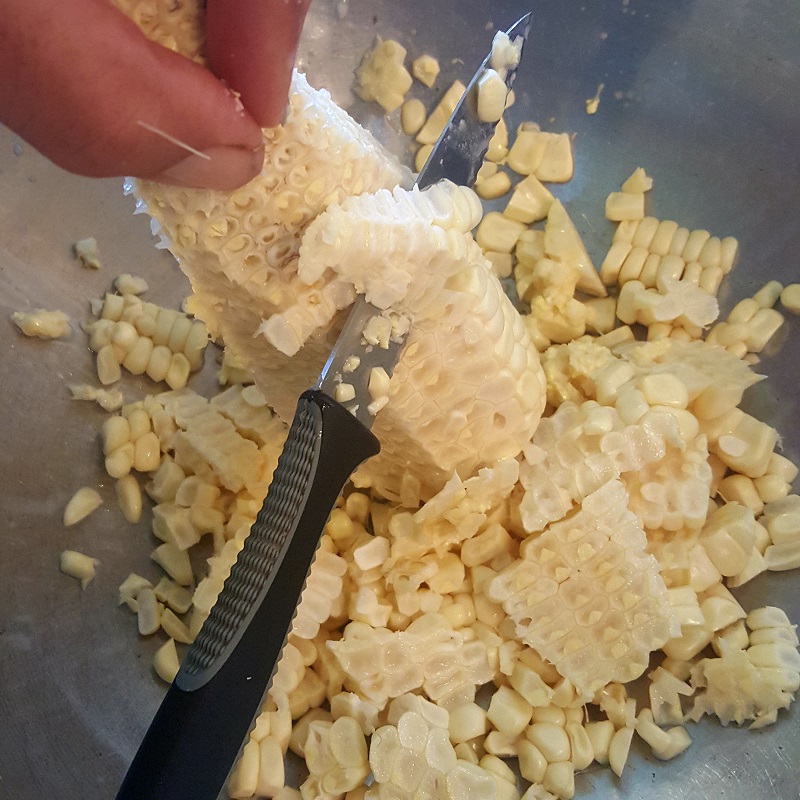
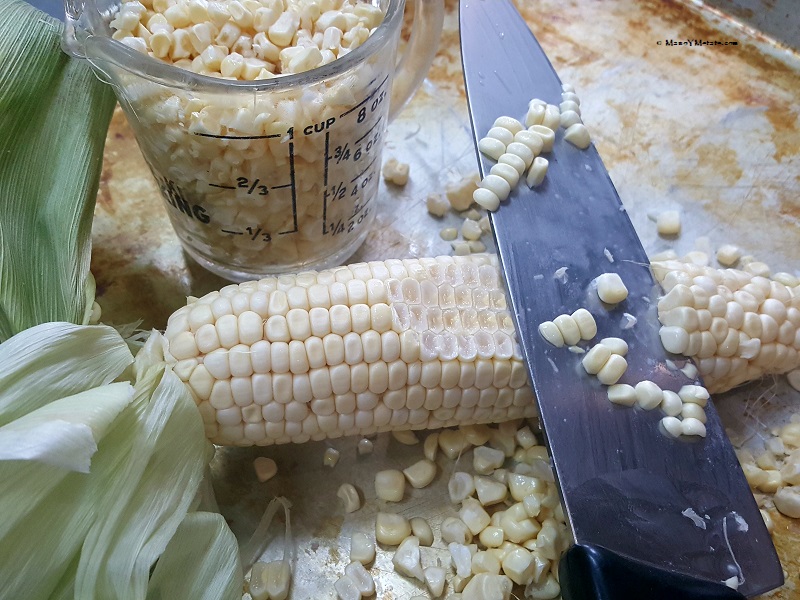
I started by cutting the kernels off the cob, with a sharp little knife within a big bowl.

The kernels can be cut pretty deeply, and the juicy insides scraped into the bowl with the rest.

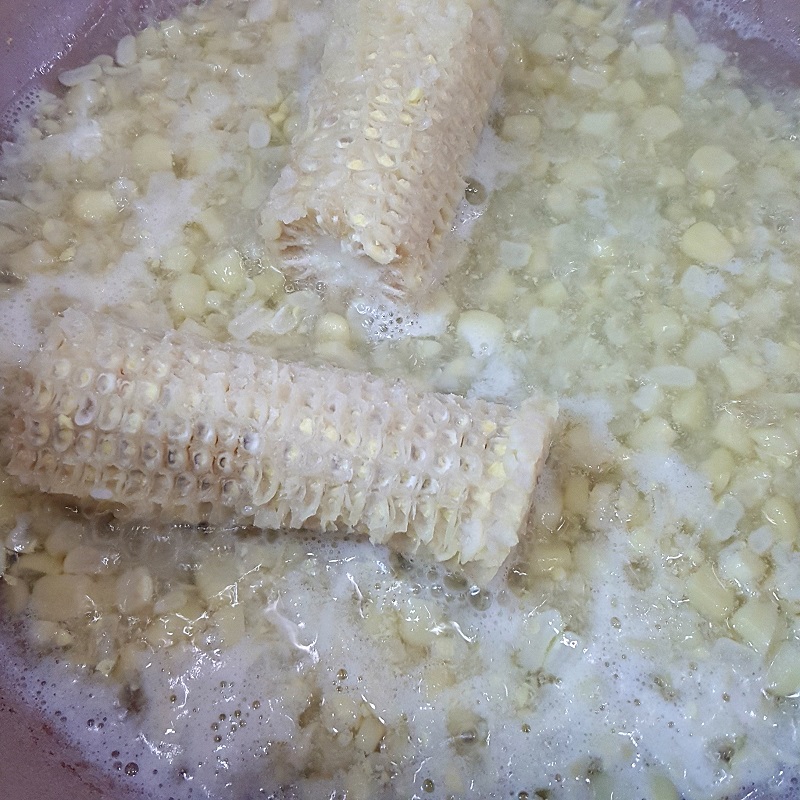
Then the kernels are boiled in just enough water to cover, with a dash of salt. The cobs go in to extract every bit of their goodness to the soup and to add their own distinctive flavor to the broth.

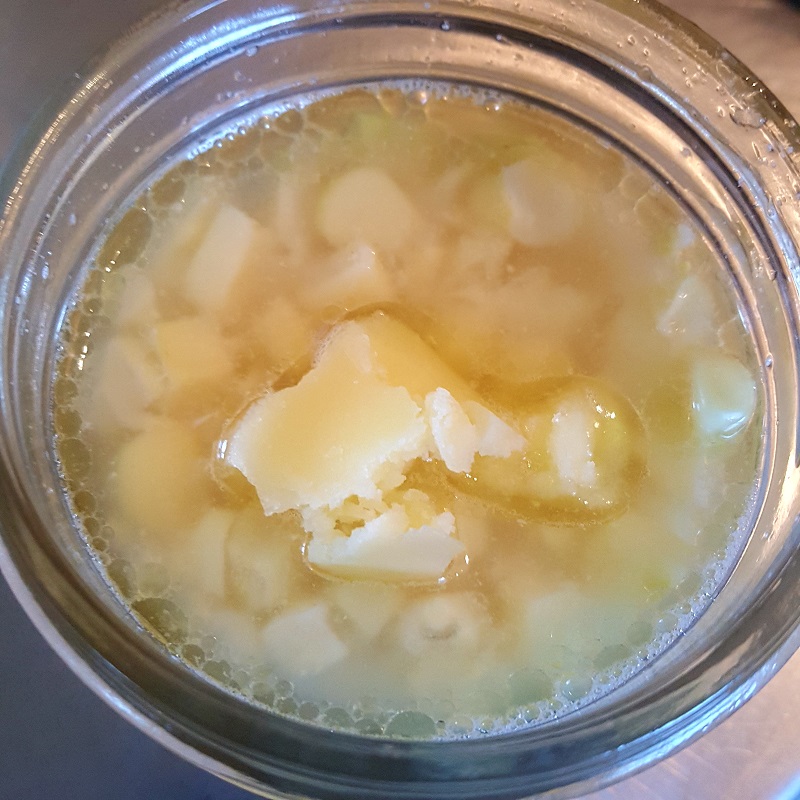
After simmering for a few minutes, the corn was tender. I poured my soup for one into a small jar to serve, leaving the cobs behind. Then, butter!

At the raspado place, they will ask what toppings would you like, but the only answer is everything, the works!

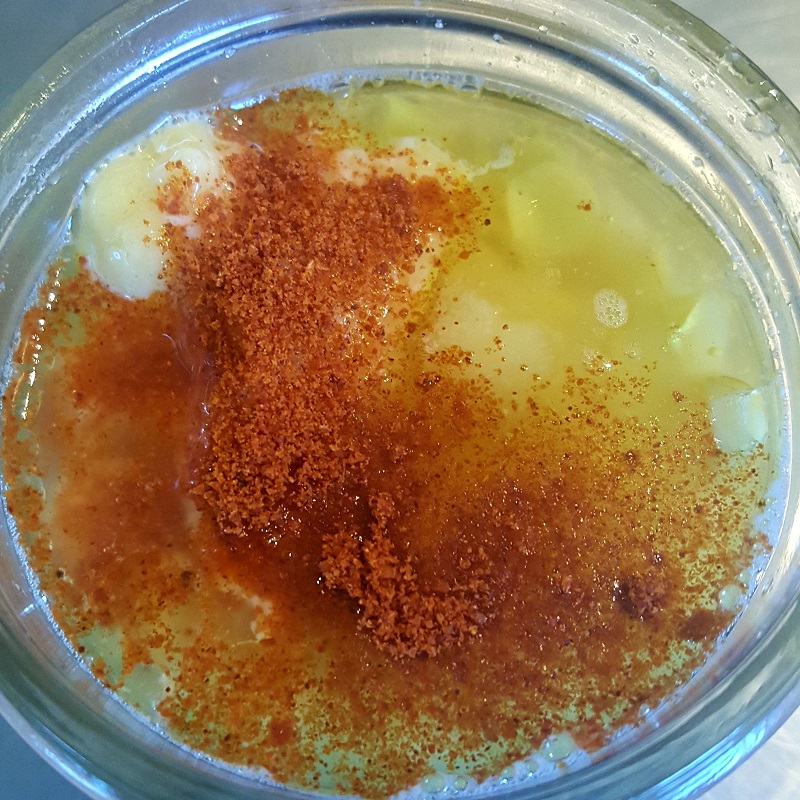
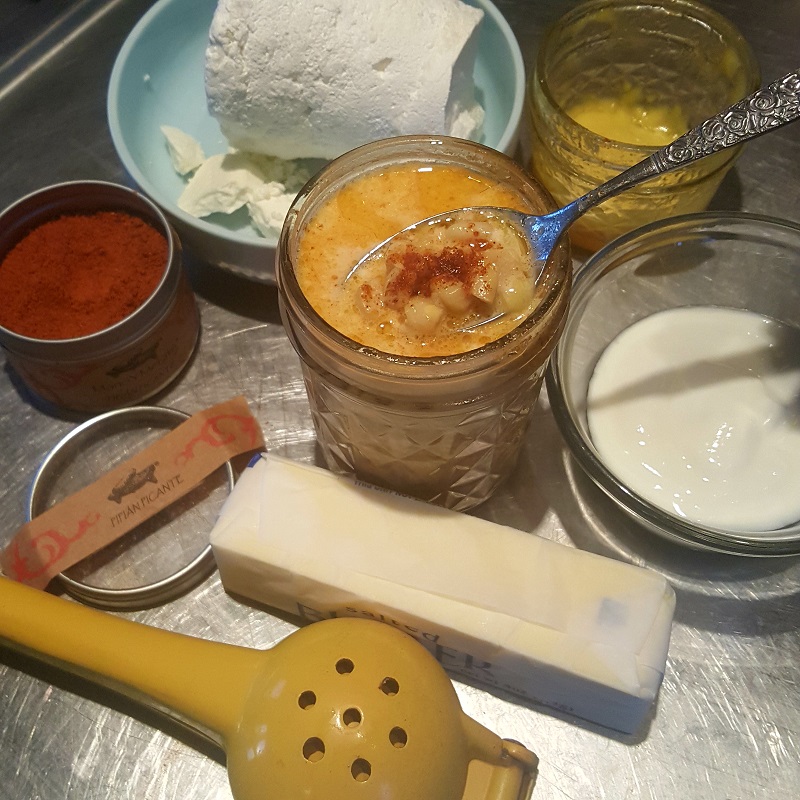
I started with some Mano Y Metate Mole Powder, Pipian Picante. I think any mole powder would be great here, and the traditional would be plain chile powder or a dash of hot sauce.

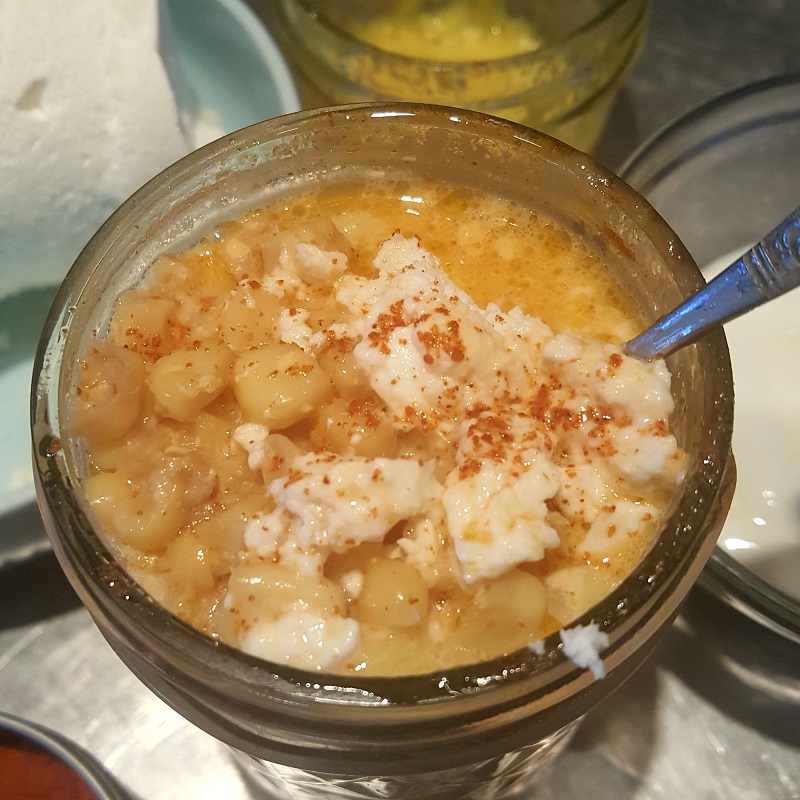
I then juiced a lime into the glass. But this wasn’t enough and I resorted to lemon juice I had frozen in quantity from the spring. Also, homemade mayonnaise (just an egg yolk with mild oil whisked into it until it is thick), store bought creama (Mexican sour cream). Basically, just keep adding and tasting until it is irresistible. Then a final sprinkling of fresh cheese (in this case, homemade goat cheese) sprinkled on top.

Enjoy with a long spoon in the short, hot afternoon.

Treat yourself day: Scallops with Mole Verde

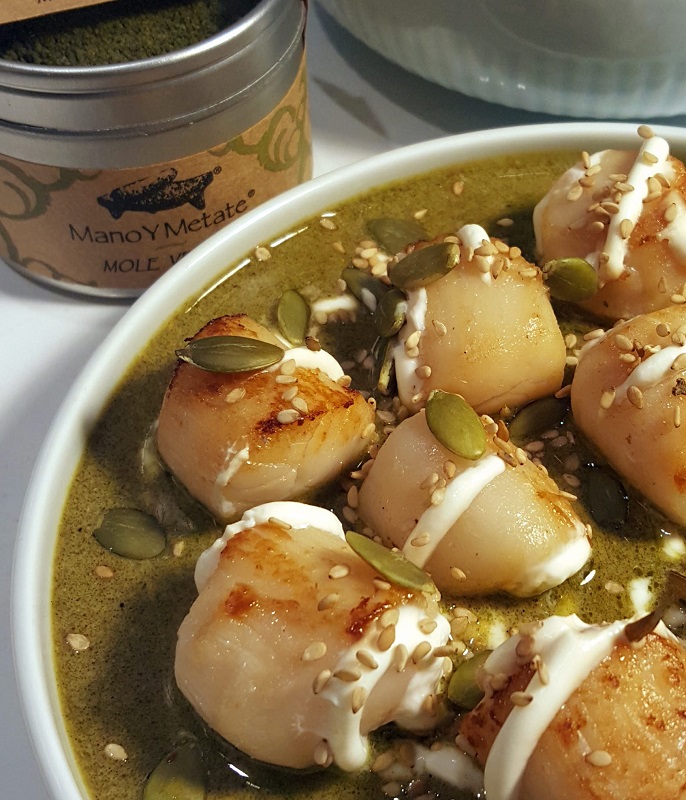
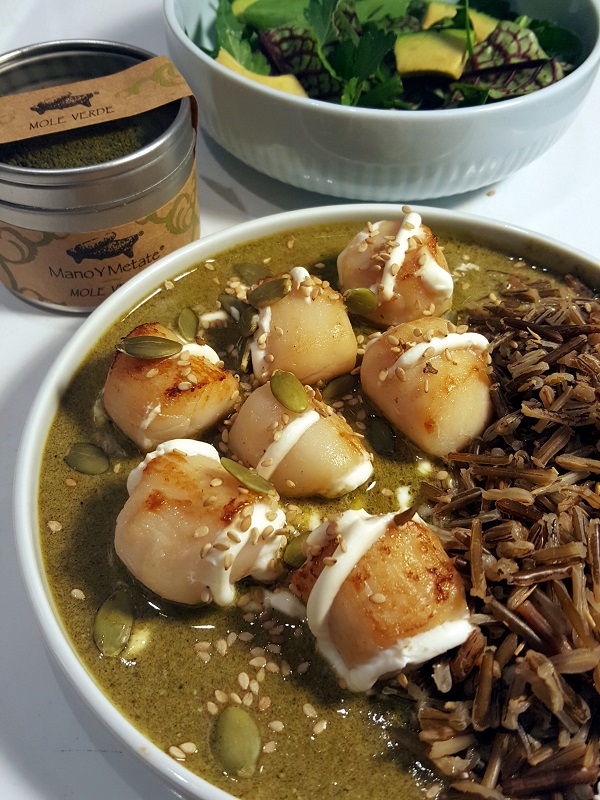
Hello Friends, I’ve always wanted to try mole with scallops since I saw saw it in a book. It paired a very modern white chocolate mole with scallops. Wanting to treat myself to a special meal today, I thought I would give it a go with my own mole.

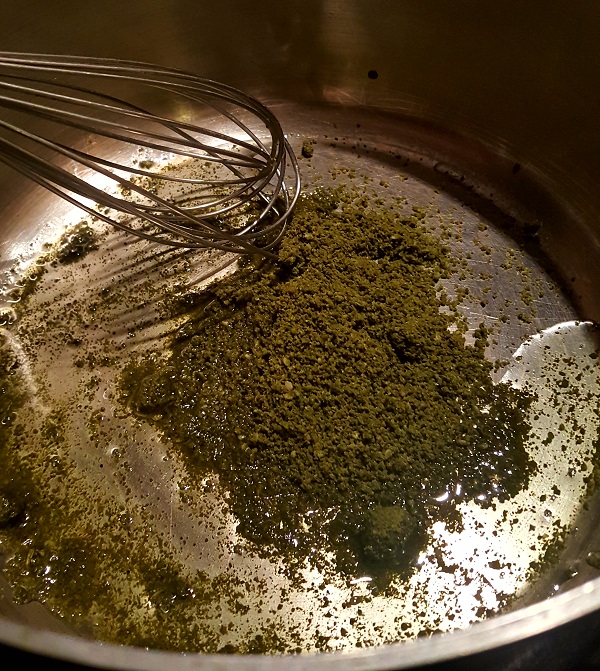
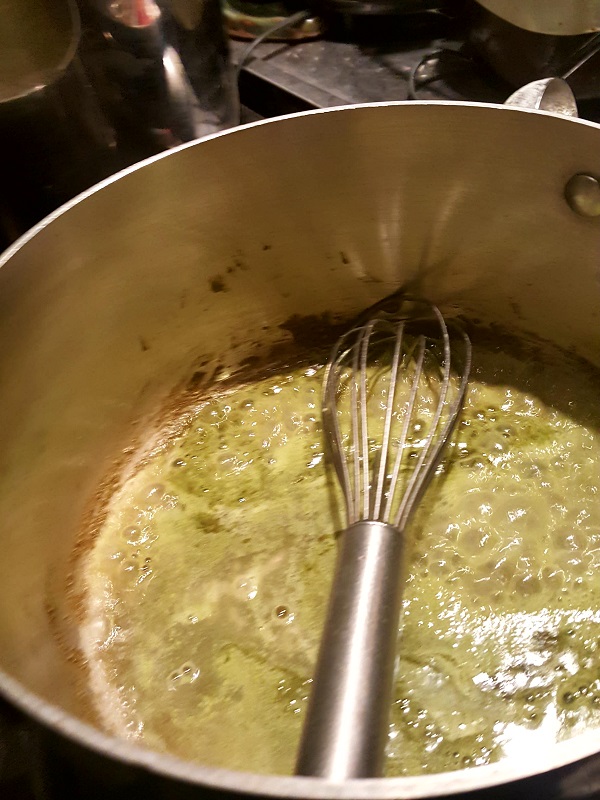
I started with Mano Y Metate Mole Verde powder, sautéed in mild oil and thinned with chicken broth.

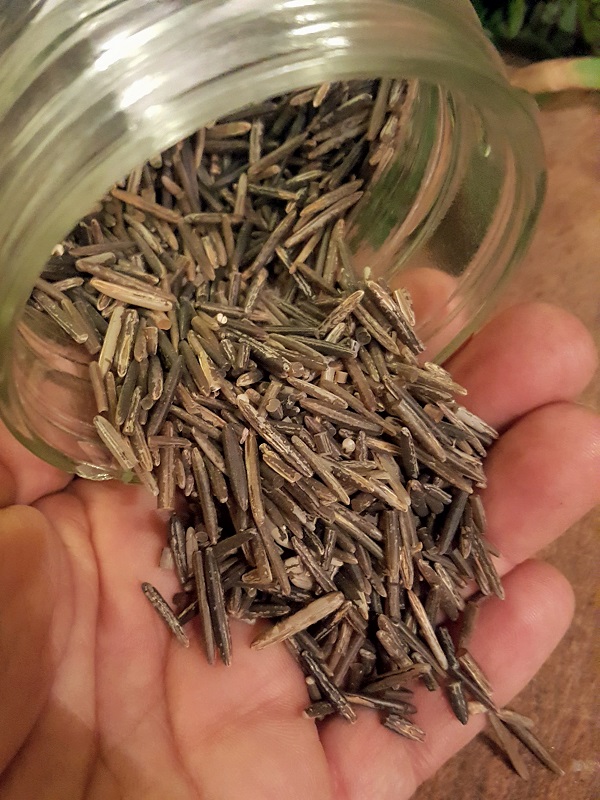
I broke out a stash of wild rice that a friend had given me as a gift. It was collected on lakes in northern Minnesota and parched over a wood fire.

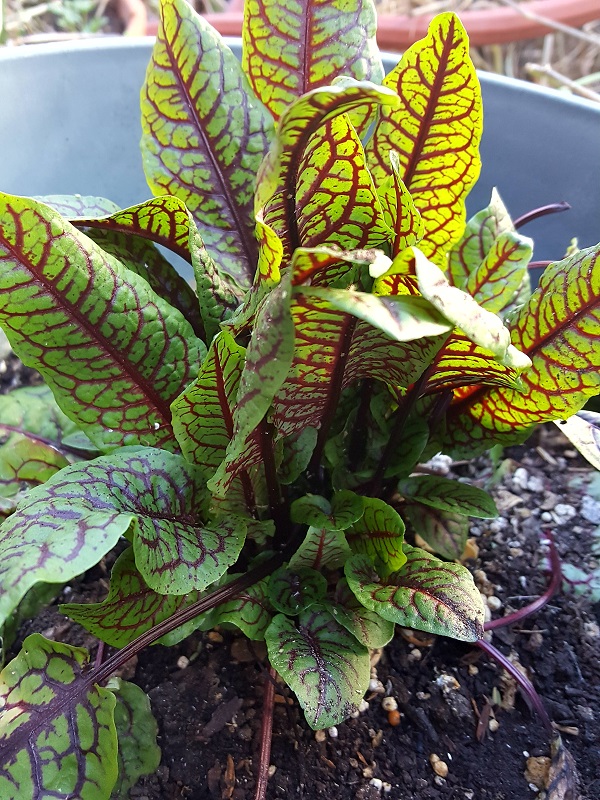
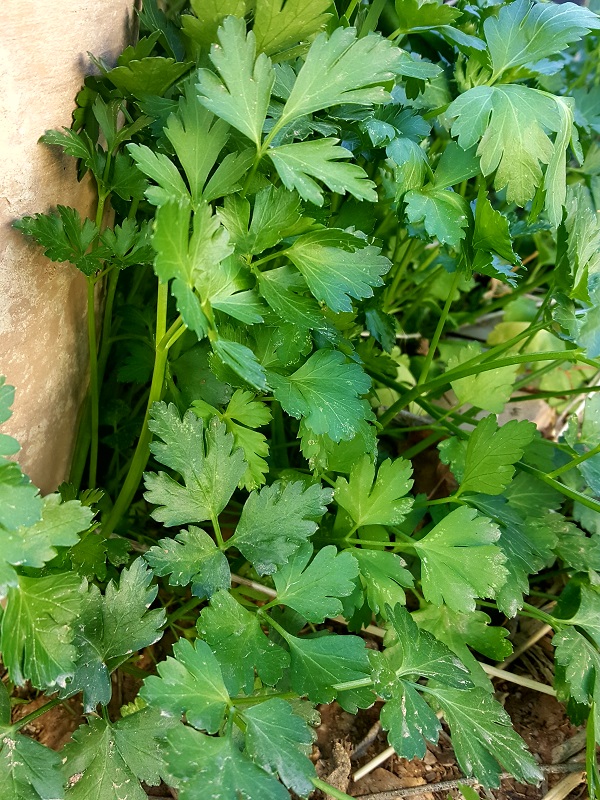
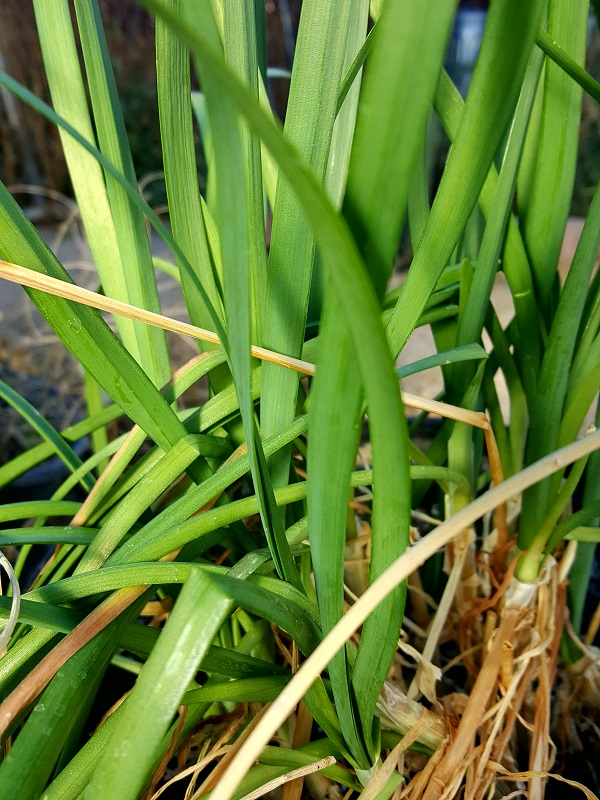
For a wild salad, I harvested some sorrel, parsley and garlic chives from the garden.

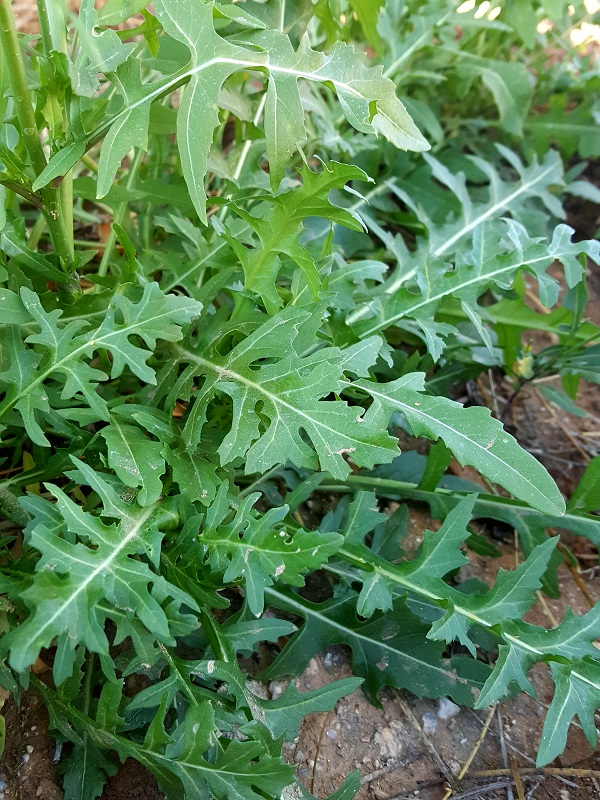
For bite I added some volunteer mustard greens aka “wild arugula” and for creaminess some avacado.

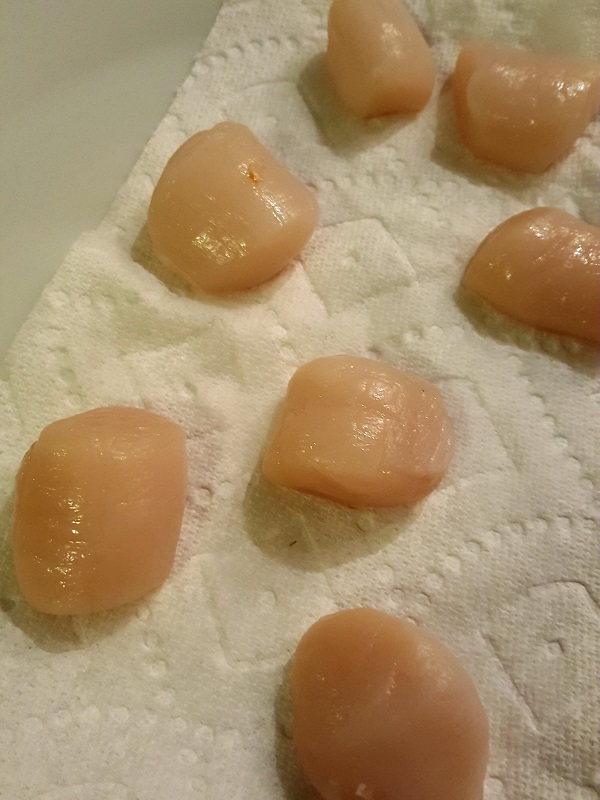
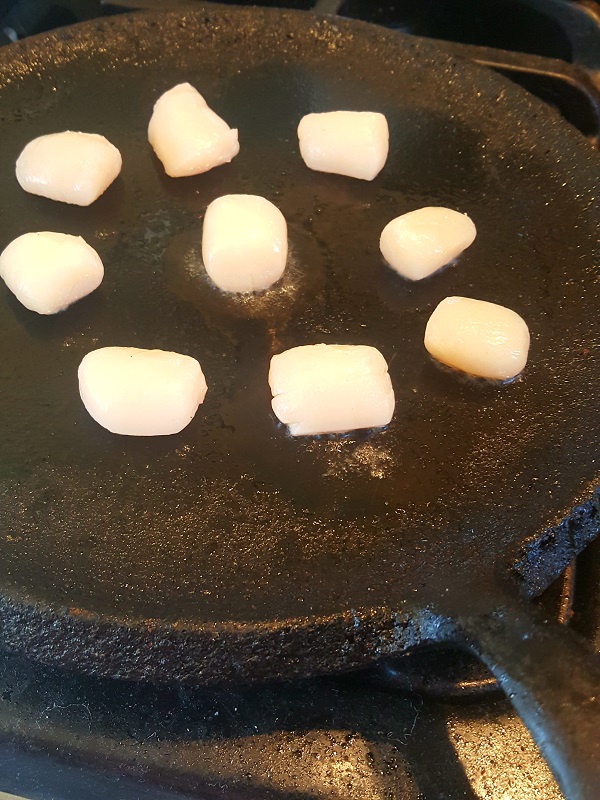
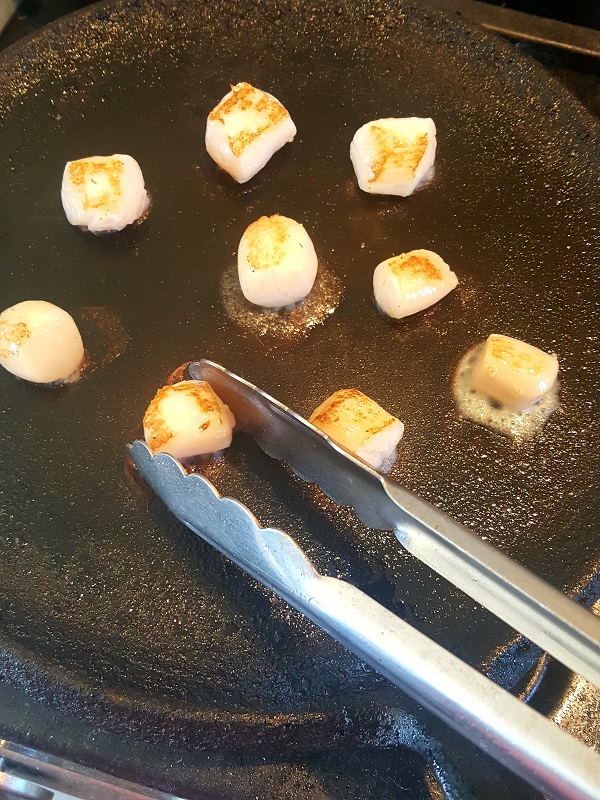
The scallops only needed a rinse, a pat dry and a sprinkle of salt.

I seared in part oil and part butter on a hot skillet

Which went FAST!!!!

I hope you take the time for self care and make yourself a treat today, too. Love, Amy

Mole Marinated Roast Poultry

Happy November full moon! Amy here today experimenting with roast poultry.

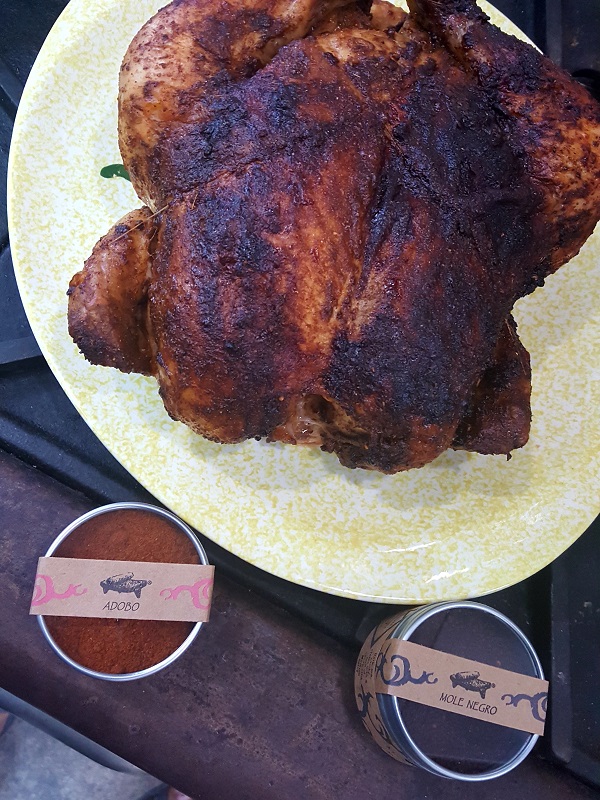
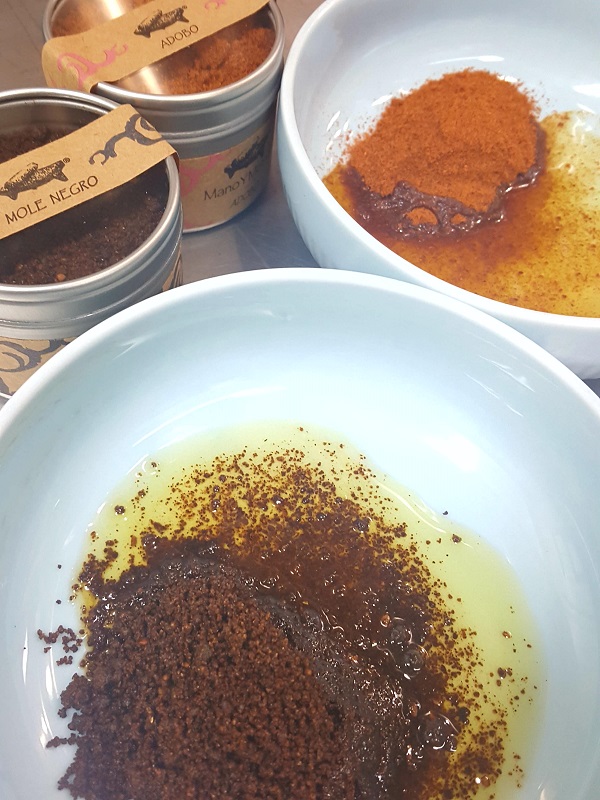
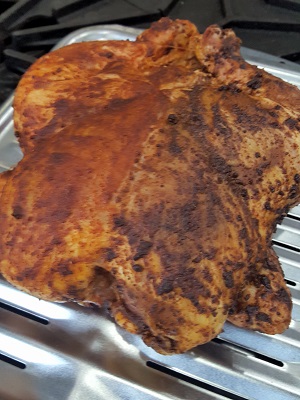
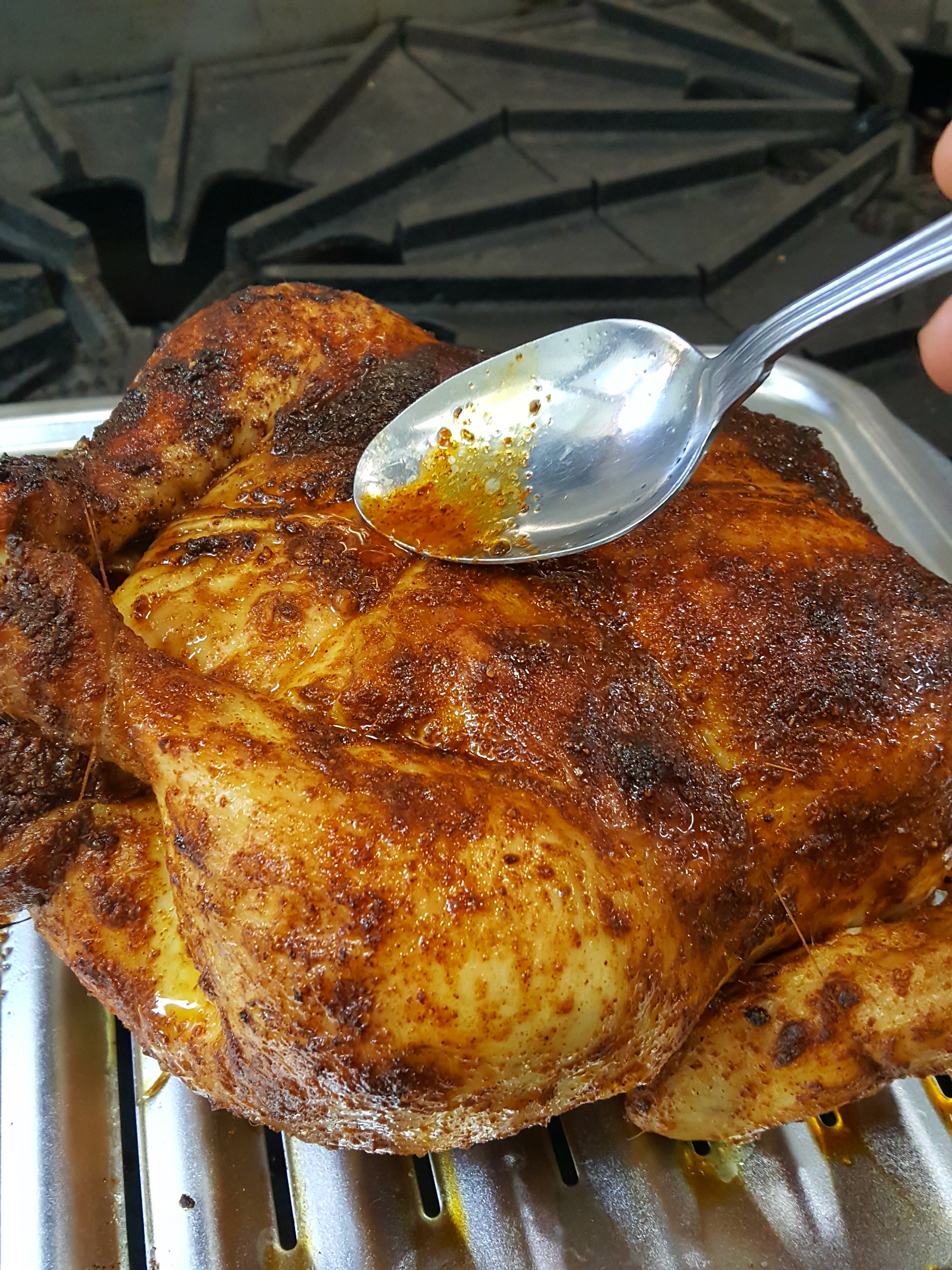
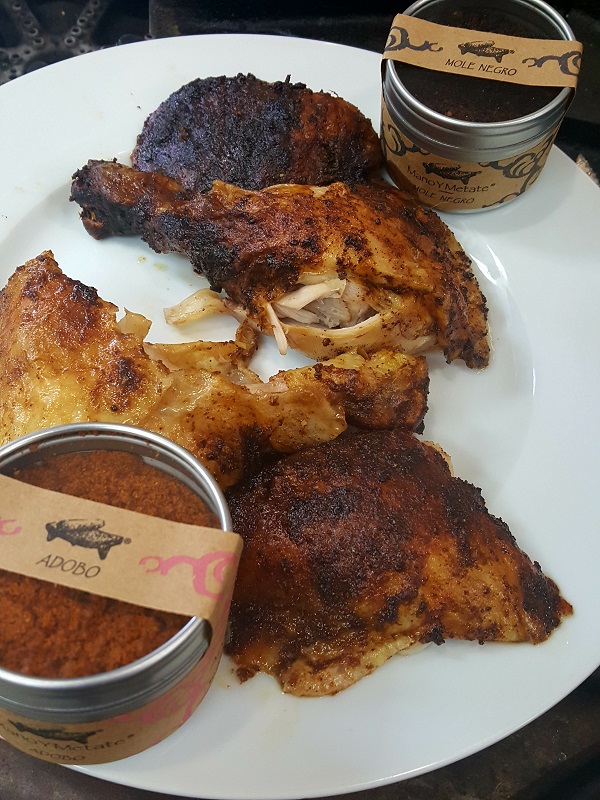
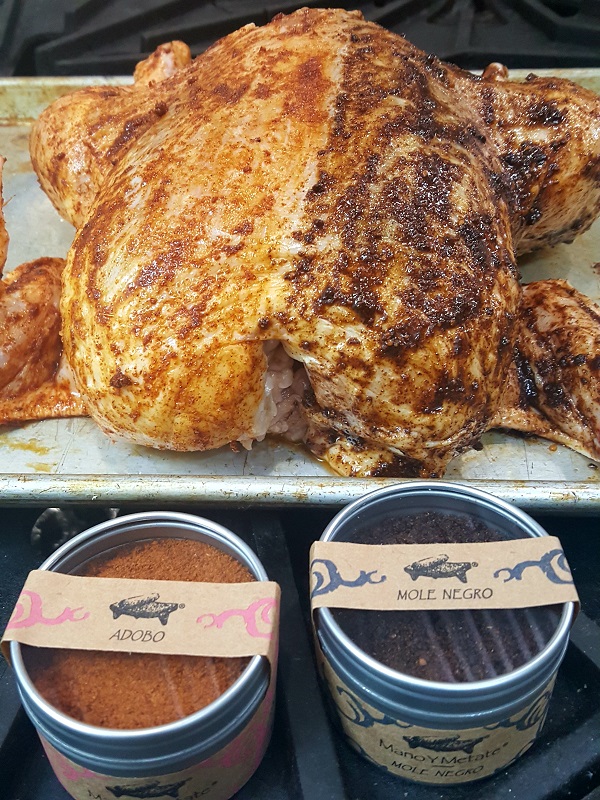
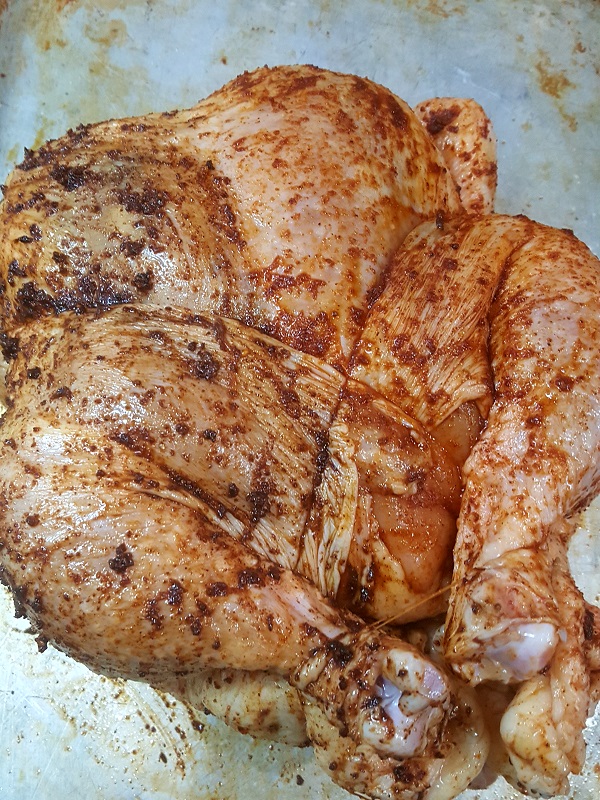
I wanted to make a roast chicken with mole as a seasoning, rather than as a sauce. Something exciting but still traditional enough for a roast chicken or turkey. Also, I couldn’t decide which variety of mole to use. So I separately mixed some Mano Y Metate Adobo and Mole Negro powders with olive oil and rubbed them one on each side of a chicken. I slid some under the skin and in the cavity. I sprinkled a little salt everywhere, too.

I trussed the wings and legs with dental floss.

I let it marinate uncovered in the refrigerator for 36 hours. Supposedly this helps the skin get crisp when baking.

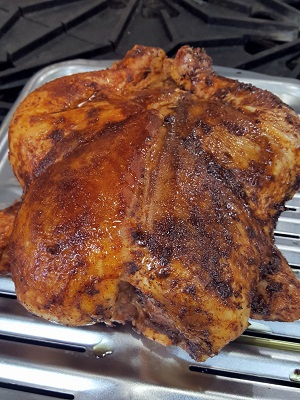
In that time the mole dyed the skin a deep color, but it looked dull. So I moistened it with a little more olive oil and set in a 375 degrees F oven.

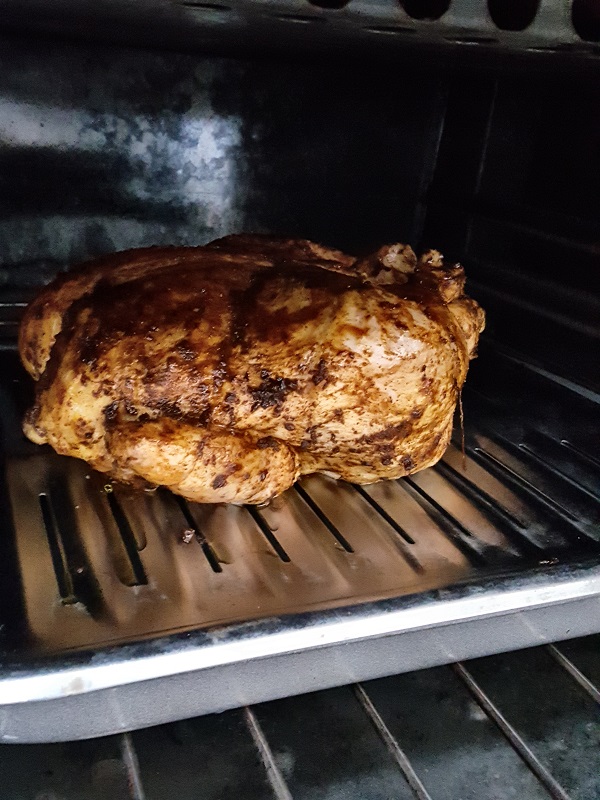
As it baked, I basted it a few times with its own drippings.

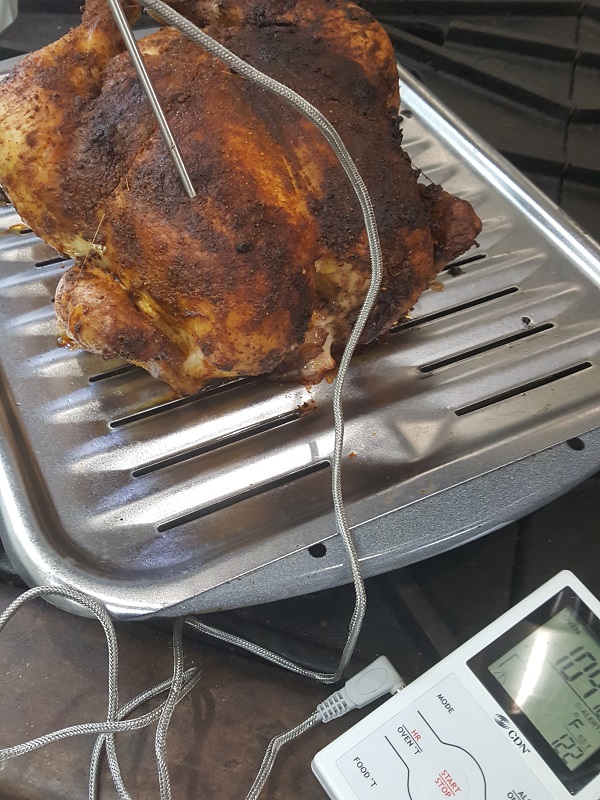
After it was almost to temperature (160 degrees F) I cranked the oven to 400 to crisp the skin for the last few minutes. Then I removed it from the oven, and while resting ensured the breast temperature climbed over 165F.

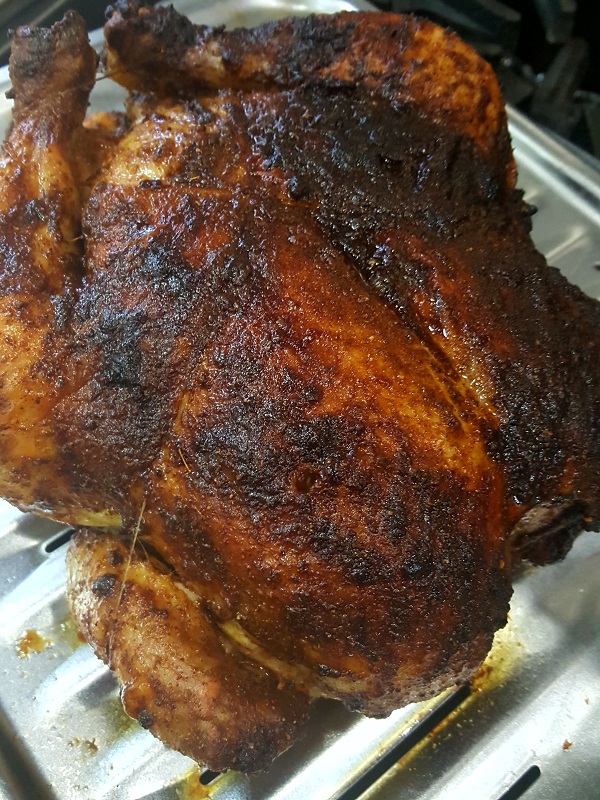
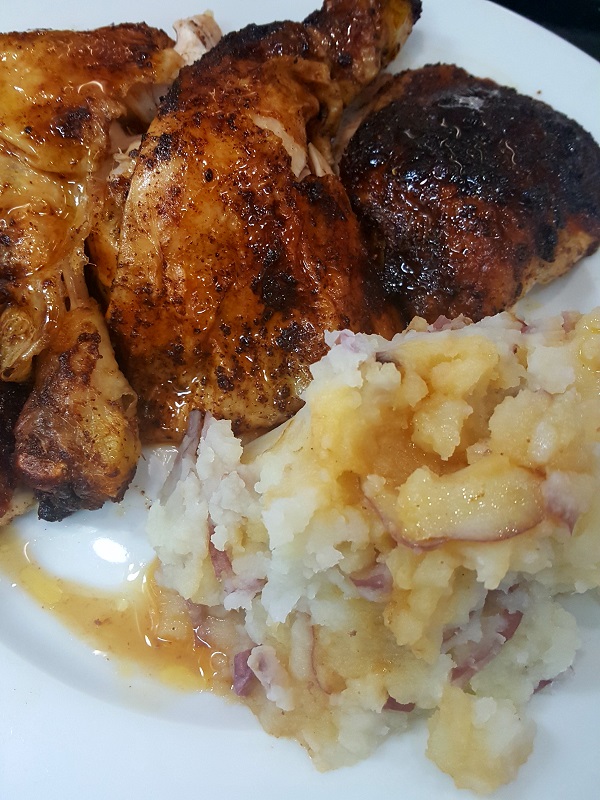
The skin was crisp and spicy! The meat was savory, flavorful and complex but less spicy. It was bold and special without feeling wild and crazy, or that the sides needed to work around the mole theme.

As for Mole Negro vs Adobo, I think the extra heat of the Mole Negro was my favorite, but the Adobo made the prettier crust and would be my choice for a serving a crowd.

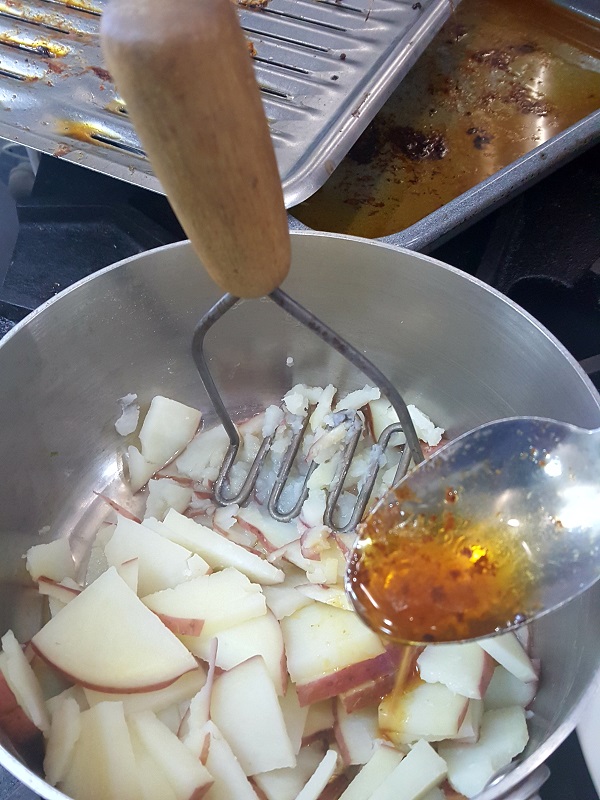
I considered making mole sauce to spoon on the plate, but instead put some of the drippings into and on top of the mashed potatoes. Delicious!!!!!

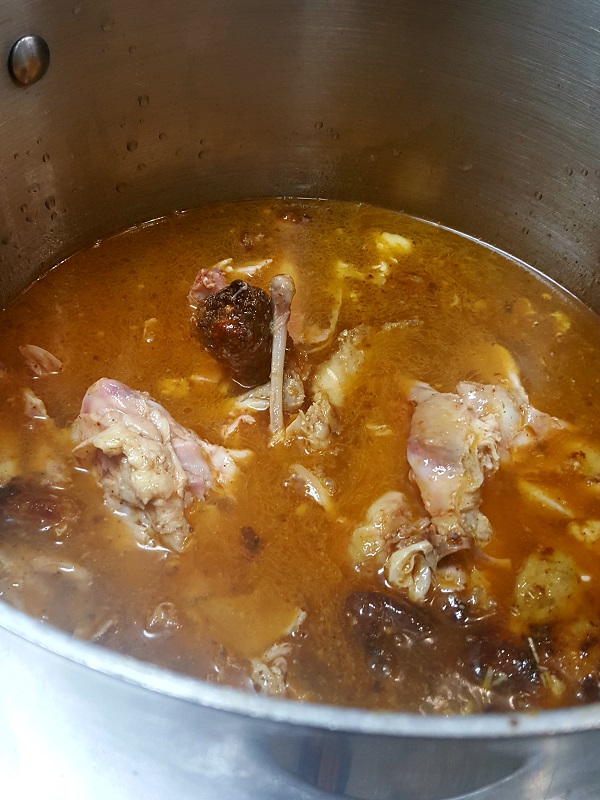
The bones and drippings made an incredibly rich colored broth with hints of mole. It was spicier than I thought it would be. I can’t wait to make it into soups, the best part of roasting a bird. Enjoy the weather and happy cooking!

Mole Nachos

Hello Friends,

Amy here, sharing a classic dish that I’ve made several times recently. Years ago my young niece showed me how she made nachos. I didn’t grow up with them, and had never before gotten into making or eating nachos. Ava’s authoritative recipe in the microwave was such a delight that afternoon. So even if I make my own version now, I always think of her when I do.

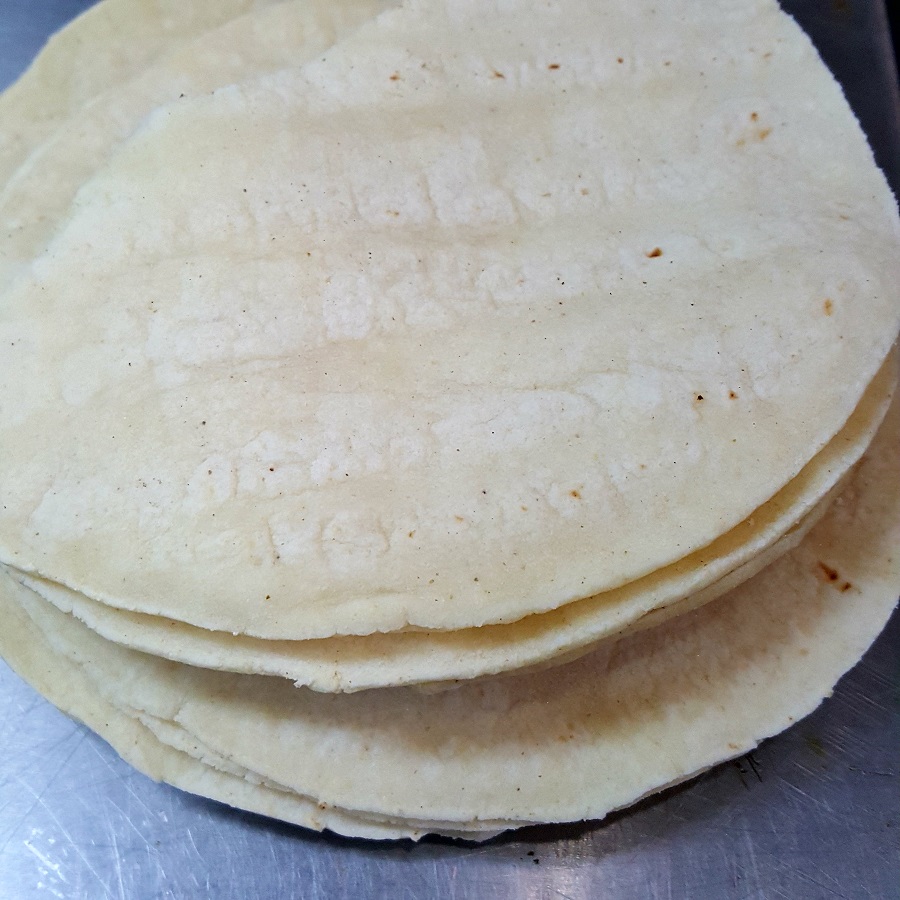
I like to start with corn tortillas. Thin ones are best, and if they’re dried out a little, even better.

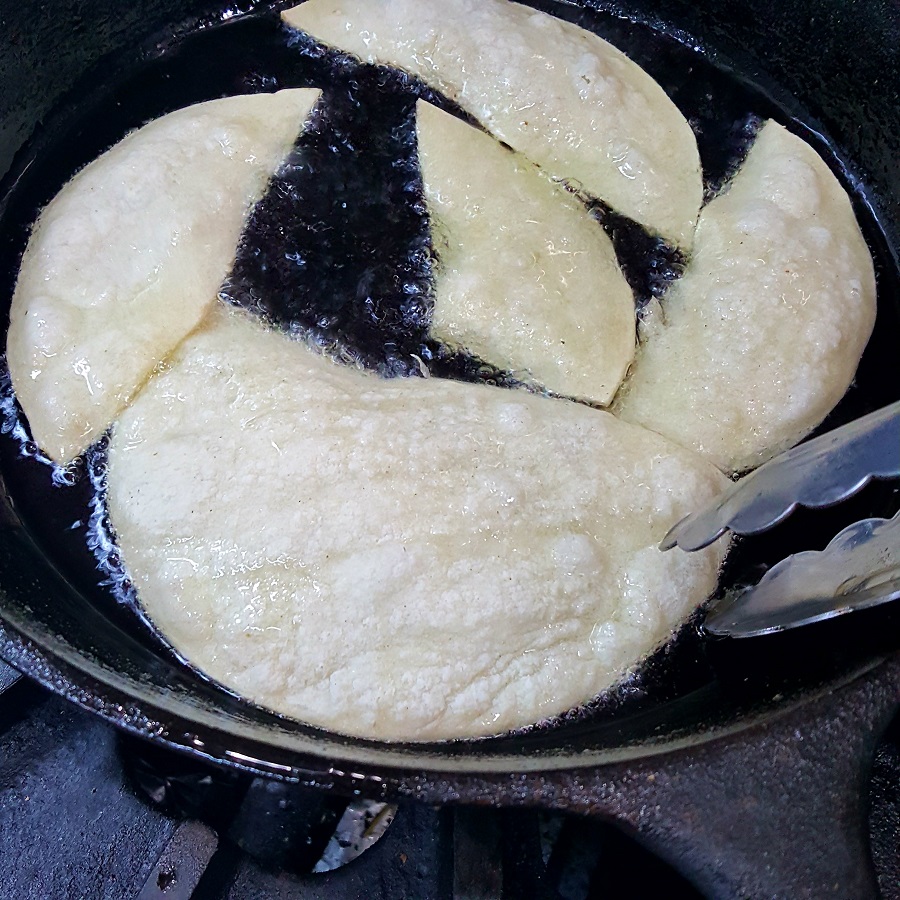
I fry them in a shallow layer of neutral oil until crispy and brown.

Then sprinkle them generously with salt right after coming out of the oil.

Freshly grated cheese is a must. I like jack, but of course anything that melts is good!

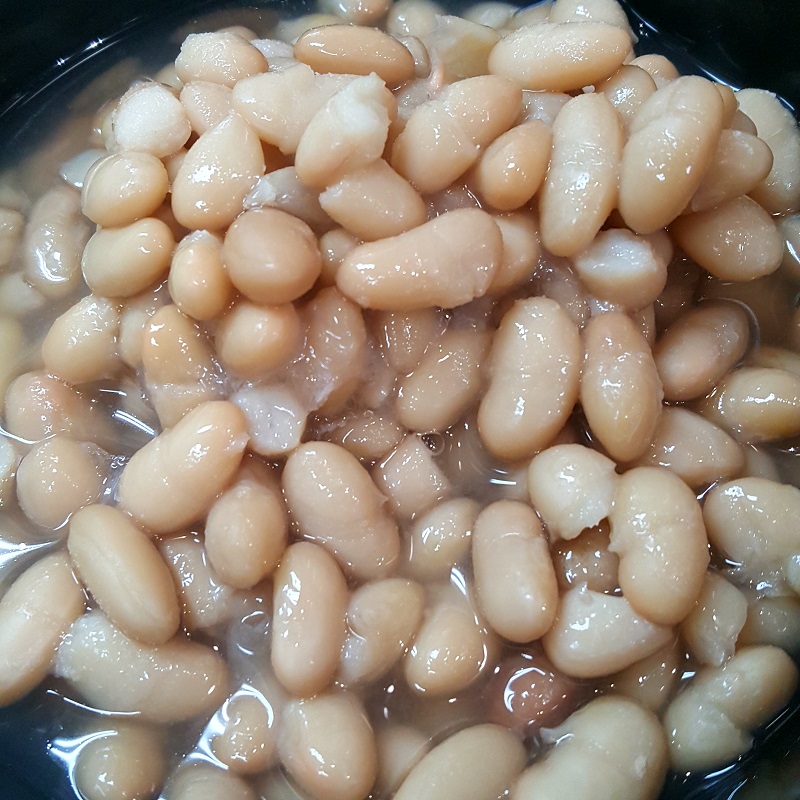
My niece used leftover beans and so did I. These are mayocoba beans cooked with just water, garlic and salt.

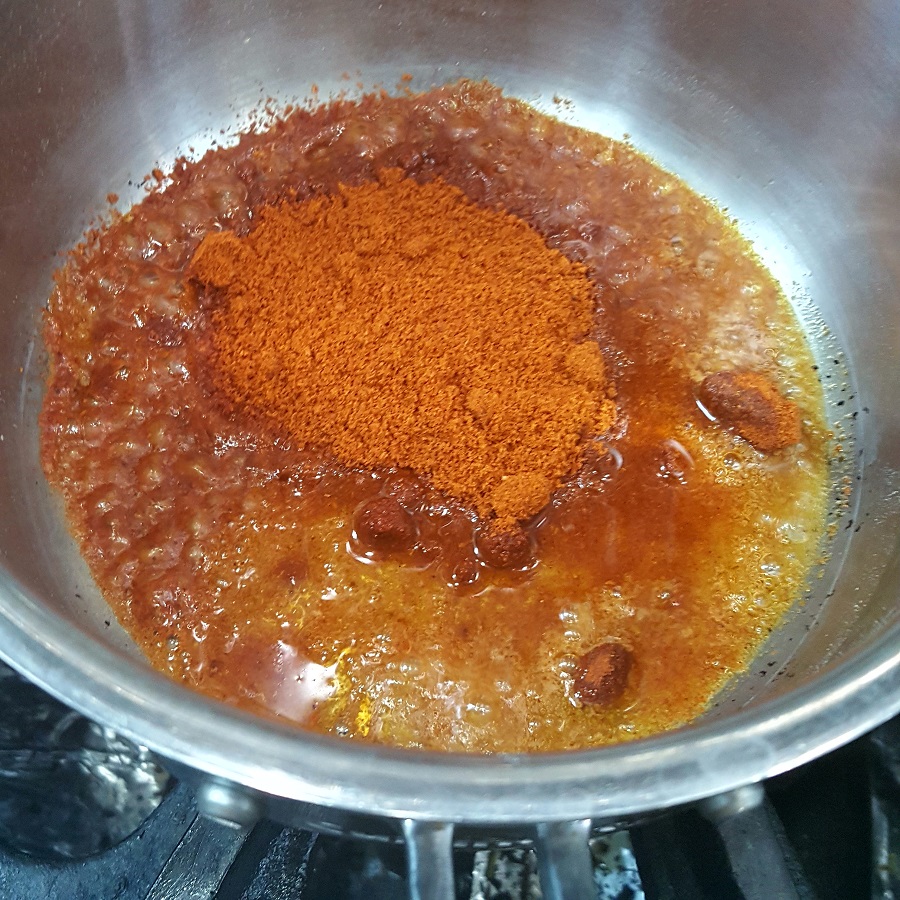
For sauce and spice, I made some Pipian Picante with my Mano Y Metate mole powder and the oil left after frying tortillas.

Then I added some leftover carnitas to it!

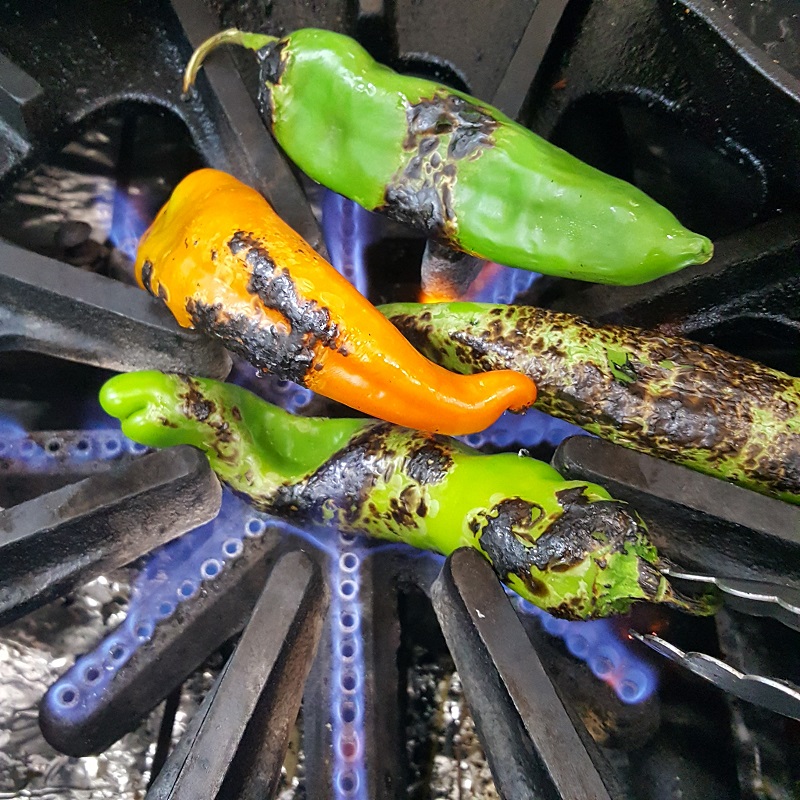
Since it is chile season, I roasted some from the Tucson CSA over the gas stove inside. After evenly charring, I put them in a lidded dry, cold saucepan, allowing them to steam in their own heat. Then the skins slip off easily.

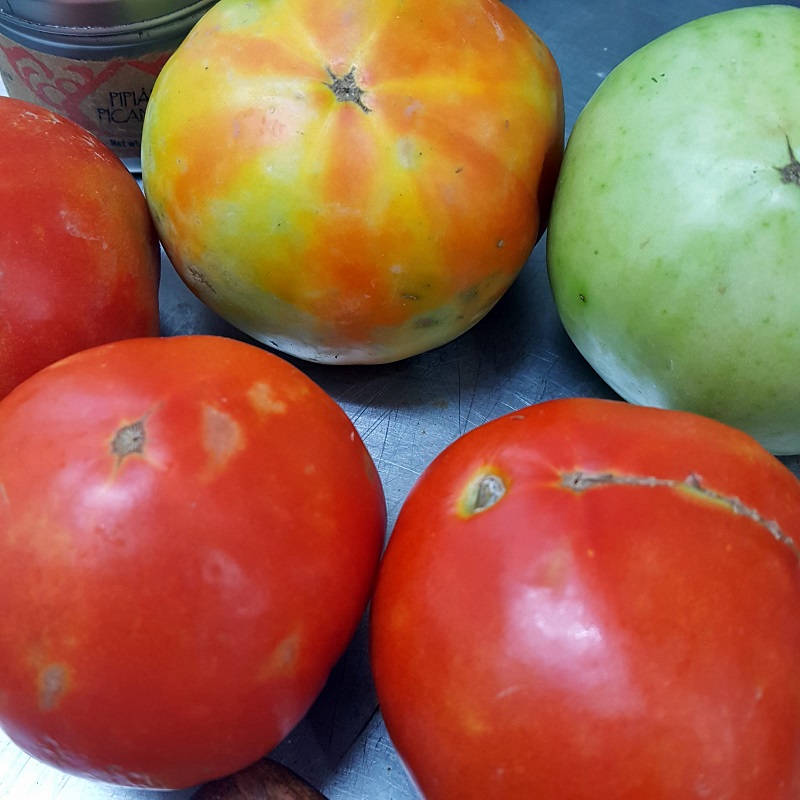
Tucson CSA has had a good heirloom tomato year, so they go in whatever dish I’m making on the day they are ripe. And I sliced some white onion thinly.

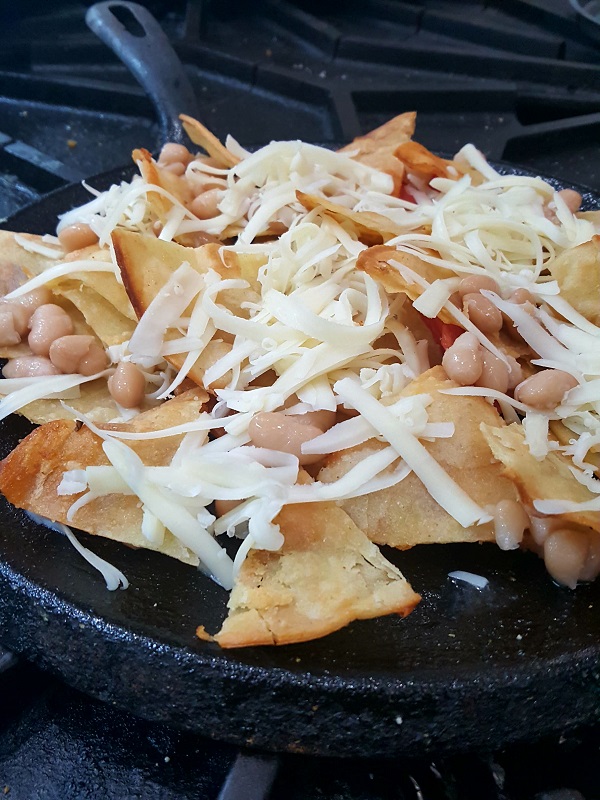
I put the tortillas, cheese and beans to heat in the oven.

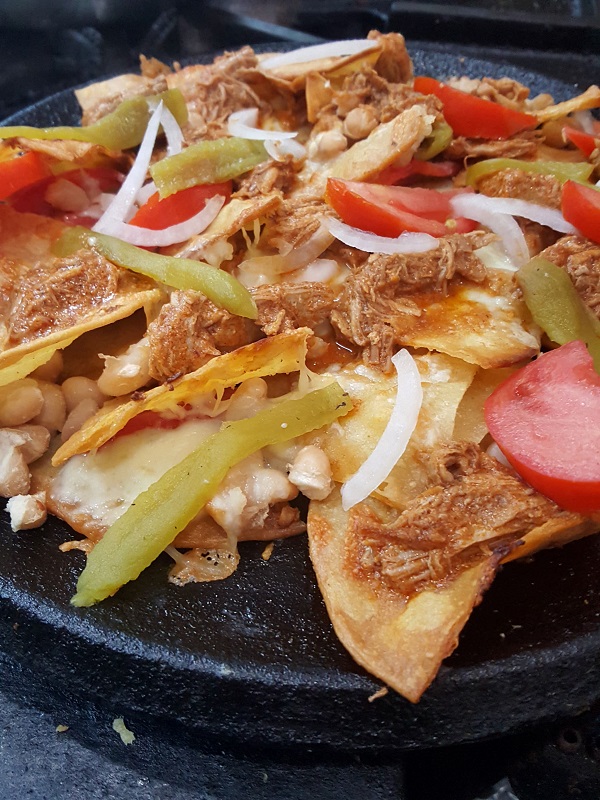
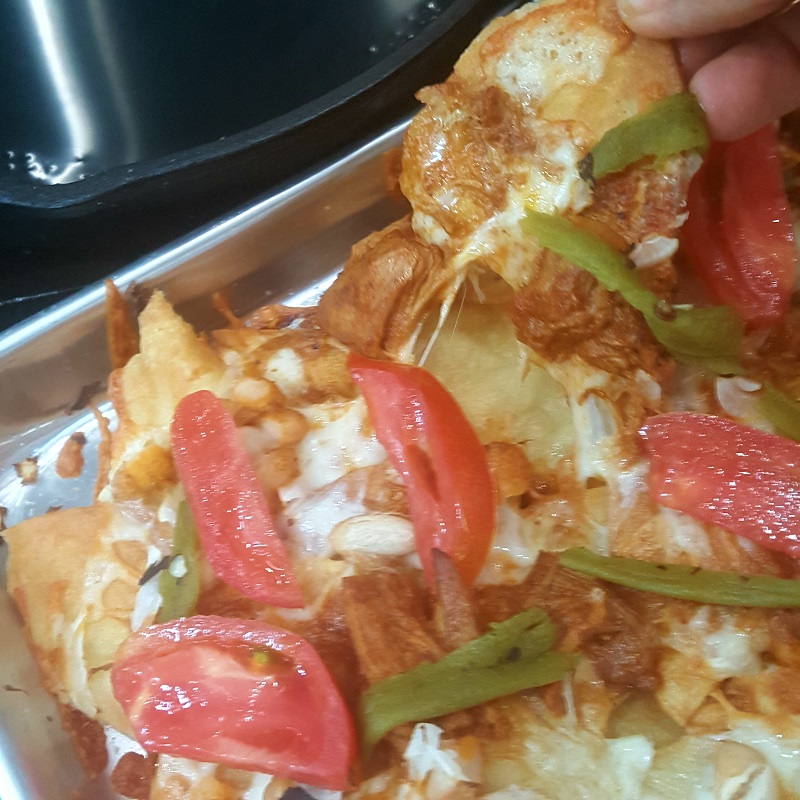
A thin layer of tortillas makes for more edges that can get crisp, but a full sheet pan with extra sauce and cheese is good, too! After baking, I top with the pork in Pipian Picante, tomato, onion and green chile. I recommend eating immediately like I did with my niece, enjoying the outdoors.

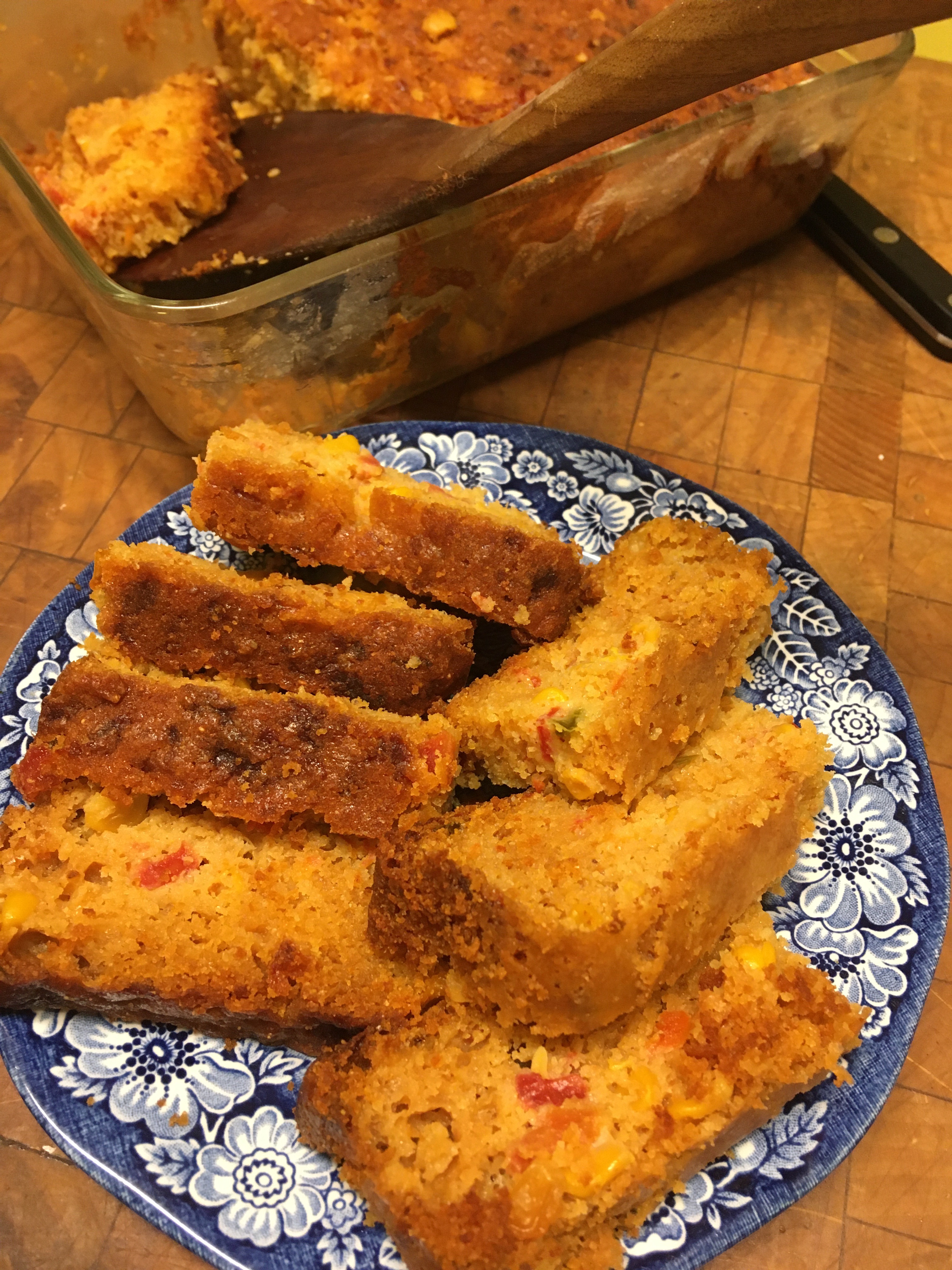
Hu:ñ Pasti:l — Pastel de Elote — muy saboroso as in yummy!

HU:Ñ PASTI:L aka PASTEL DE ELOTE — A most delectable treat inspired by corn-harvesting time (MABurgess photo)

So in case you are wondering…. Hu:ñ (pronounced HOOONya) is corn and Pasti:l (pronounced pasTEEEEra) is pie in O’odham language. The Spanish Pastel de Elote (passTELL day ay-LOW-tay) essentially means pie made of fresh corn. In English it goes by a more pedestrian name — sweet corn casserole–but it is just as delish.

It’s like a slightly sweet tamale pie or casserole–full of protein—easy to make! Tia Marta here to share a fun fast recipe using our local Native summer corn in its fresh and dried forms….

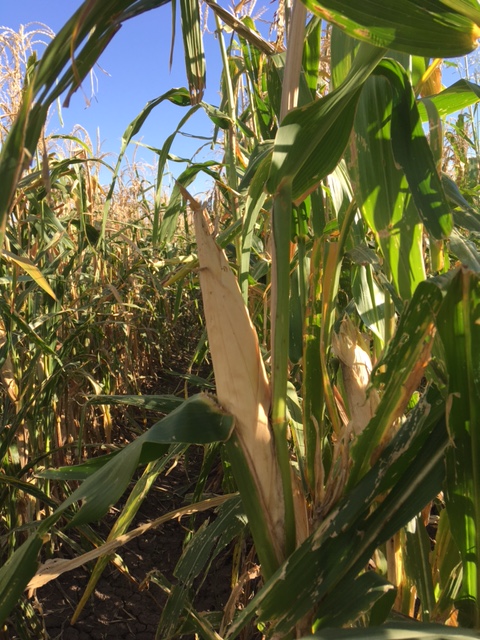
Heirloom O’odham 60-day corn ripe in the husk ready to harvest at San Xavier Coop Farm

This ancient and honorable 60-days-to-ripen corn was genetically selected long ago by the Desert People, and almost lost in the mid-20th Century due to agricultural “faddism.”  Thanks to a few traditional gardening families and to NativeSeedsSEARCH gardeners and seed-bankers, a handful of kernels were saved and multiplied through that bottleneck of time, so that now seeds are available for many farms to grow this amazing corn.  San Xavier Farm alone now has ACRES producing perhaps TONS of ears to feed a growing population–and a community also growing in appreciation of this amazingly nutritious and desert-adapted grain.  Imagine a protein-packed grain that can handle the heat of the Sonoran Desert summer and can ripen in 60 days!  In food production terms, that’s like zero to sixty in less than 10 seconds!

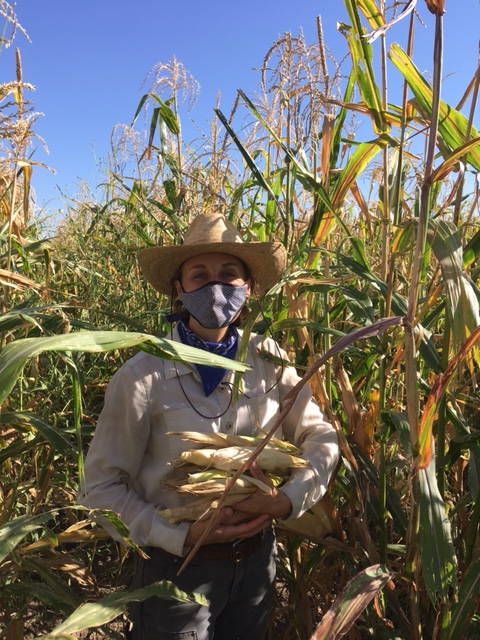
Mission Garden’s Garden Supervisor Emily Rockey cradles an armload of Tohono O’odham 60-day corn at San Xavier Coop Farm harvested for the community. (MABurgess photo)

A group of us volunteers from Mission Garden recently went to help hand-harvest traditional Tohono O’odham 60-day corn at a community picking in the productive fields of San Xavier Coop Farm. Harvesting this sacred corn together inspired me to prepare a dish to share with dear friends.

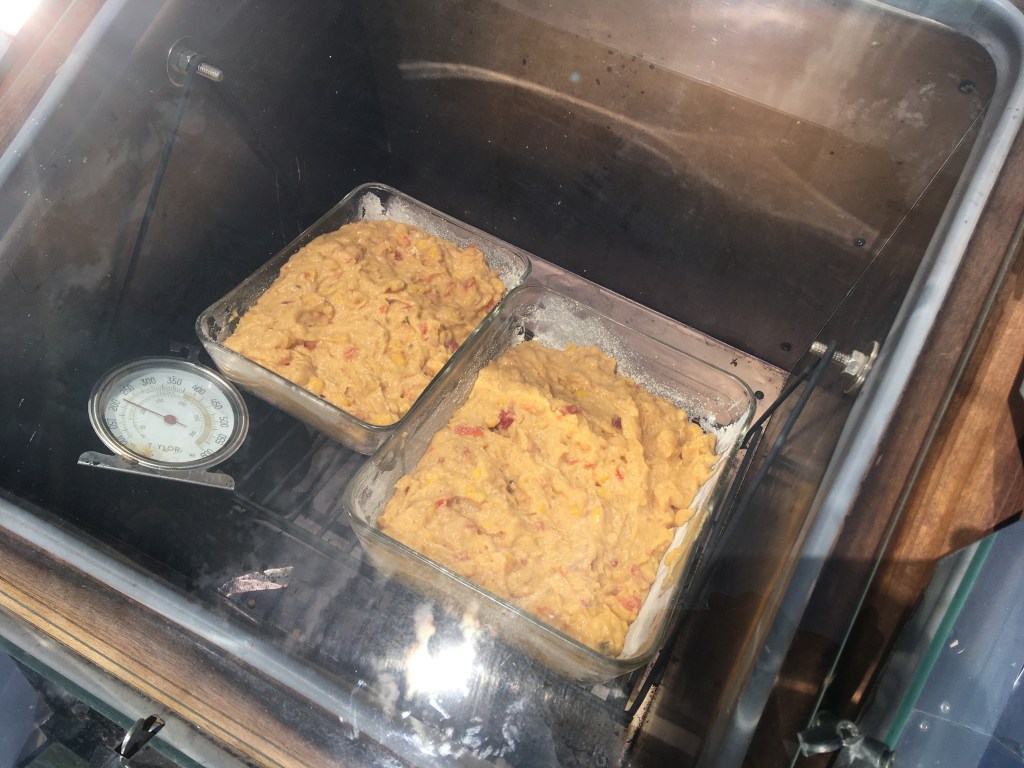
The recipe calls for fresh corn cut off the cob, but you can easily substitute canned corn.  Since our household is trying to “go local” as much as possible, I used flour milled from BKWFarms’ organic white Sonora wheat, eggs from the happy chickens at Mission Garden, and local naturally-grown corn and cornmeal. I used a sunny day and a solar oven!

Muff’s Hu:ñ Pasti:l or Pastel de Elote Recipe:

Preheat solar oven or conventional oven to 350F degrees–(solar may be less).

Grease and lightly flour one large (or 2 smaller) baking dish(es) or iron skillet.

Cream together: 3/4 cup (1 1/2 sticks) butter. and ½ cup agave syrup “nectar” or sugar

Beat in 4 eggs.

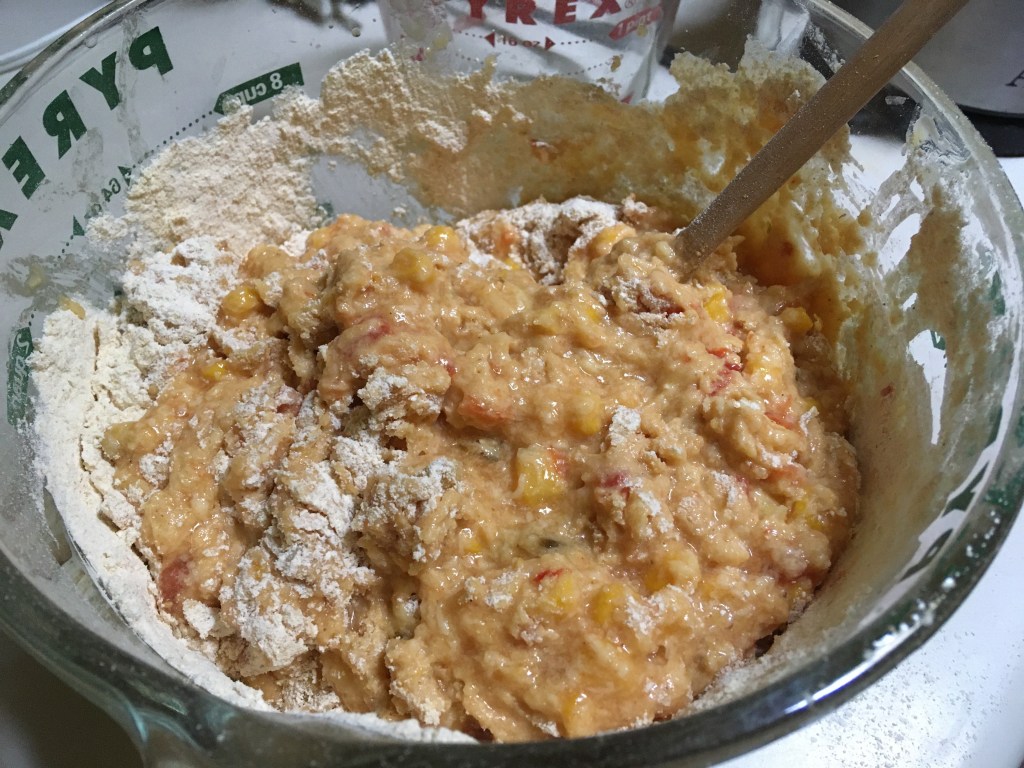
Add and mix thoroughly into the moist mixture:

1 cup homemade salsa, OR 1 can Herdez Salsa Casera, OR 1 cup diced green chiles

1 pint fresh corn kernels cut off the cob (ca.3 ears), OR 1 16oz. canned corn (I use organic non-GMO)

1 cup shredded longhorn/cheddar cheese

Sift together, then stir into the corn/cheese mixture:

1 cup white Sonora wheat flour (or other whole grain flour)

1 cup cornmeal (non-GMO)

 4 tsp. baking powder

¼-1/2 tsp. sea salt

Pour mixture into greased and floured baking dish(es).

Reduce heat to 300F and Bake 50+ minutes in conventional or solar oven, or until “pie” tests done with toothpick. (Solar may take longer.)

This recipe serves 8 graciously, piping hot or chilled, for dinner, lunch or snack. Hu:ñ Pasti:l (Pastel de Elote) can be refrigerated for a week-plus, then sliced and re-zapped in microwave for quick easy servings.  Or, it can be sealed and frozen for longer storage.

You can find fabulous local cornmeals roasted or made as pinole (that work great in this recipe) at Ramona Farms online and NativeSeedsSEARCH online store.

White Sonora Wheat flour is available at NativeSeedsSEARCH, San Xavier Coop Farm, BKWFarms, and Barrio Bread. You can come soon to see O’odham 60-day corn in the field at Tucson’s Mission Garden, soon to be harvested. While there you can pick up fresh eggs from their heirloom chickens.

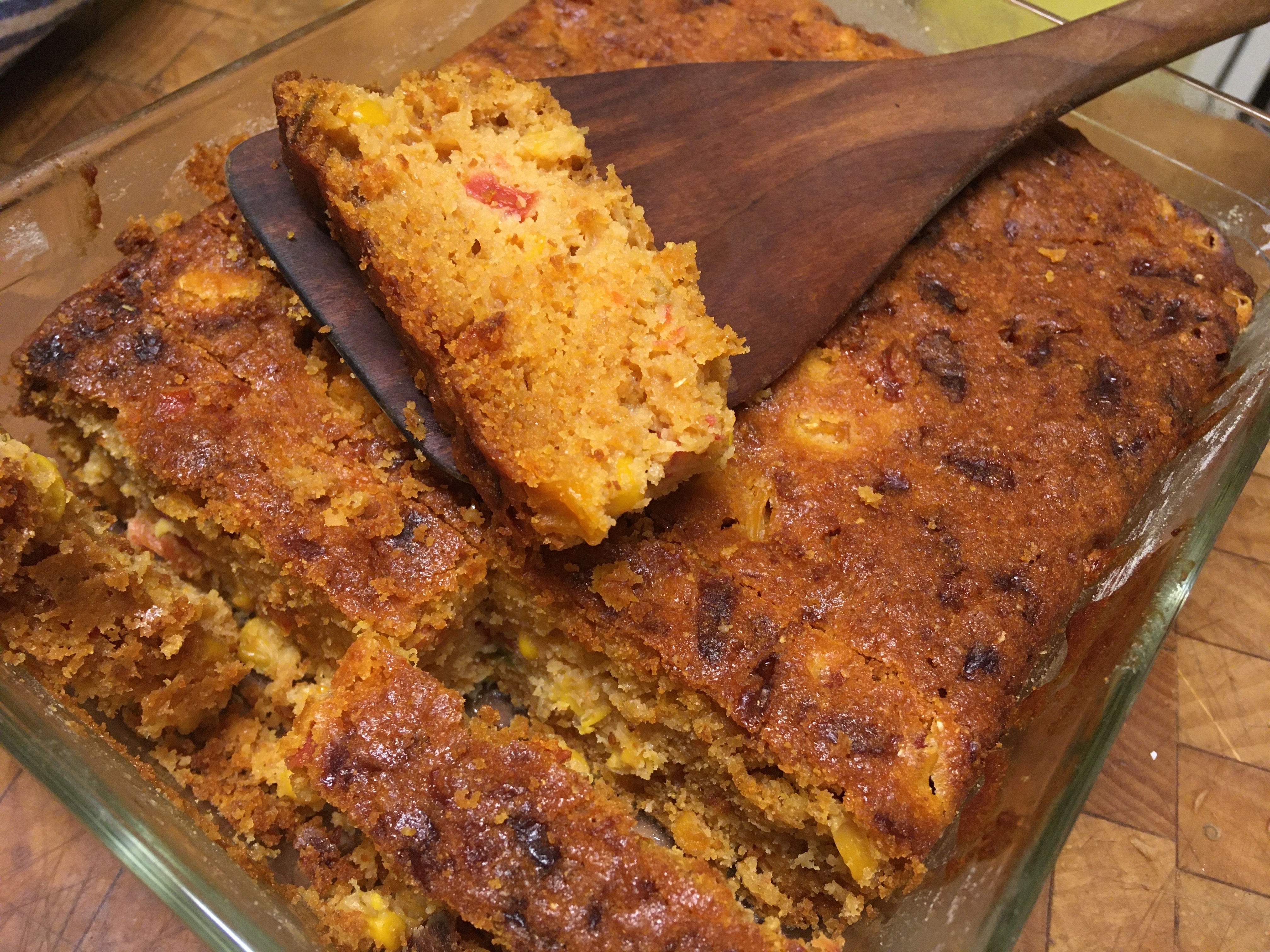
[Also check out a totally different dish of sweet mole cornbread–entirely different personality–made with many of these same maize ingredients by Savor-blog-Sister Amy in an earlier post.]

Enjoy these flavors and nutrition, and rejoice in a local monsoon desert crop!
MoleVerde Sweetcorn Cornbread

Hello Friends, Amy here with summer sweet corn and tomatoes! I canned some tomatoes and froze some corn kernels for later.
I started with my favorite cornbread recipe. When I make Mano Y Metate mole powders I use masa harina, made from corn that has been treated with lime (as in limestone, not the citrus) and coarsely ground to make tamales. It is too coarsely ground to make mole but it is the only one I can get non-GMO in small quantities. I only need a couple 50 pound bags a year, not a pallet of 50 pound bags at once! So I sift it for the mole powders, leaving me with surplus of very coarse meal that certainly has a higher portion of the germ and bran. That makes it more nutritious but not at all starchy. For cornbread, I use three fourths cup of this coarse meal and one quarter cup wheat flour, even though the original recipe does not call for any wheat.

In lieu of yogurt or buttermilk, I used one and a half cups fresh milk with a one and a half tablespoons cider vinegar. Also a tablespoon mesquite honey from Sleeping Frog Farm, an egg, a quarter teaspoon each of salt and baking soda.

I like crust. So I start by preheating an eight inch skillet (or any baking pan, it does not have to be cast iron to be improved by preheating) at 425 degrees. When it is to temperature, I let 2 tablespoons oil or lard melt in the pan. Butter works too but it does get very toasty. My friend rendered this lard from a local pig.

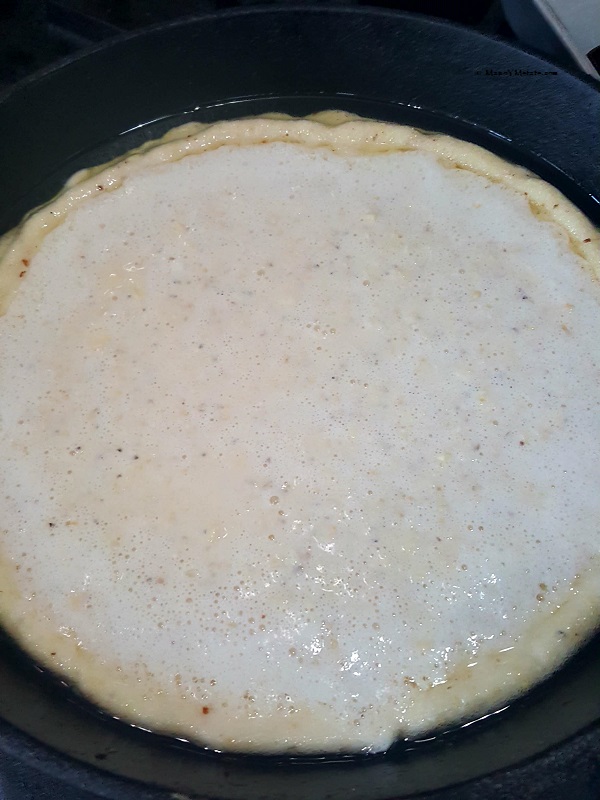
For the best crust, I put the oiled pan back in the very hot oven. When the oil is to temperature, I pour the batter in the pan and it immediately bubbles and puffs!

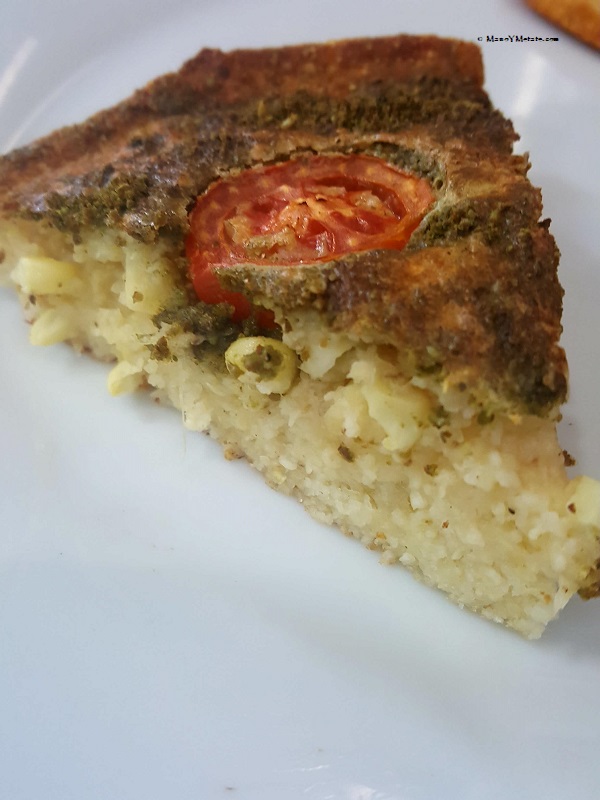
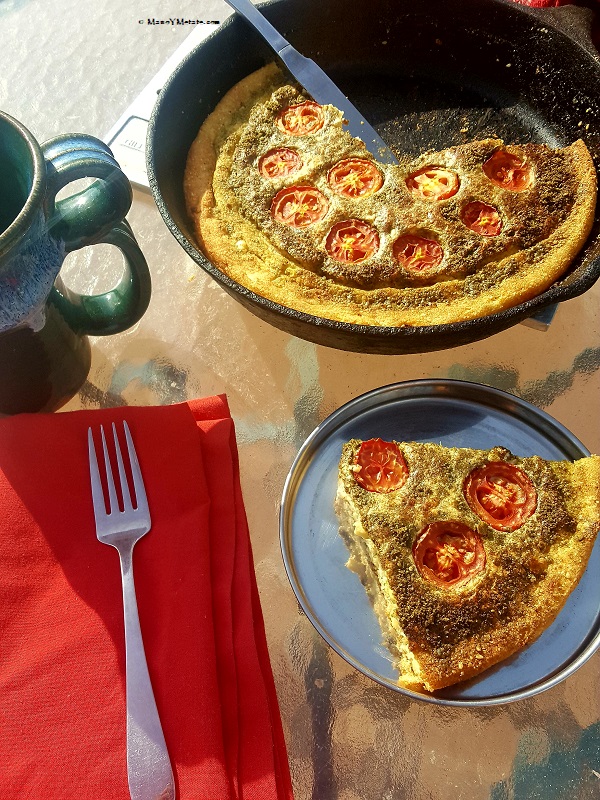
Tucson CSA has not shared any green chile, yet, but hopefully it will very soon. Inspired by Mole Dulce dry sprinkled on brownies, I sprinkled the top of the cornbread with Mole Verde powder.

Also, fresh tomato slices, for color. It’s been a good year for tomatoes at Crooked Sky Farms, lots of heirlooms and Romas.

After 20 something minutes in the oven, it was golden. No need for a toothpick test here! Spicy crusty exterior and creamy sweet corn studded interior.

Breakfast outside on a steamy desert morning, watching the plants in the yard grow explosively with the summer rains.

Brown butter pecan ice cream

Hello friends, happy summer. Amy here, sharing a dream come true: goat sitting! Friends that were home all last year became new goat parents during quarantine, but are finally traveling and busy again. Ten years ago I co-milked a huge mama goat in my neighborhood with three other families. Eventually the goats moved to the grassland southeast of Tucson but sharing the responsibilities of milking twice a day suits me well.

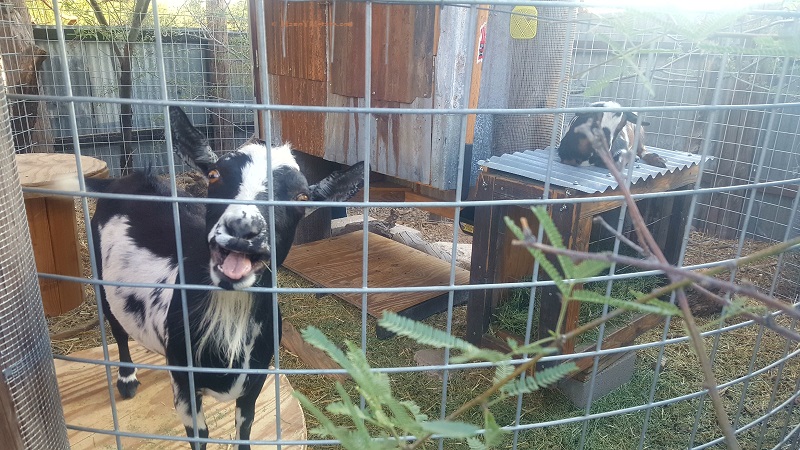
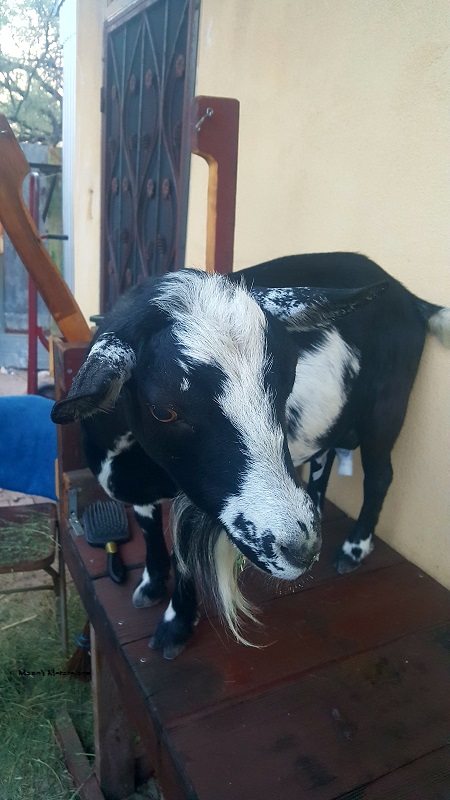
Lyric is a miniature milk goat that lives a mile from my house. Her baby Skunky was born in February completely black and white, like a spotted skunk. Twice a day they go on guided foraging excursions in their urban neighborhood. Lyric is easy going, but Skunky gets stir crazy without her walks.

While Lyric is the easiest going goat imaginable, it still takes all my concentration and both hands to milk. I’ll have more photos someday. Lyric provides two cups twice a day, so I’m freezing it, saving up to make cheese. But a batch of ice cream only takes a pint!

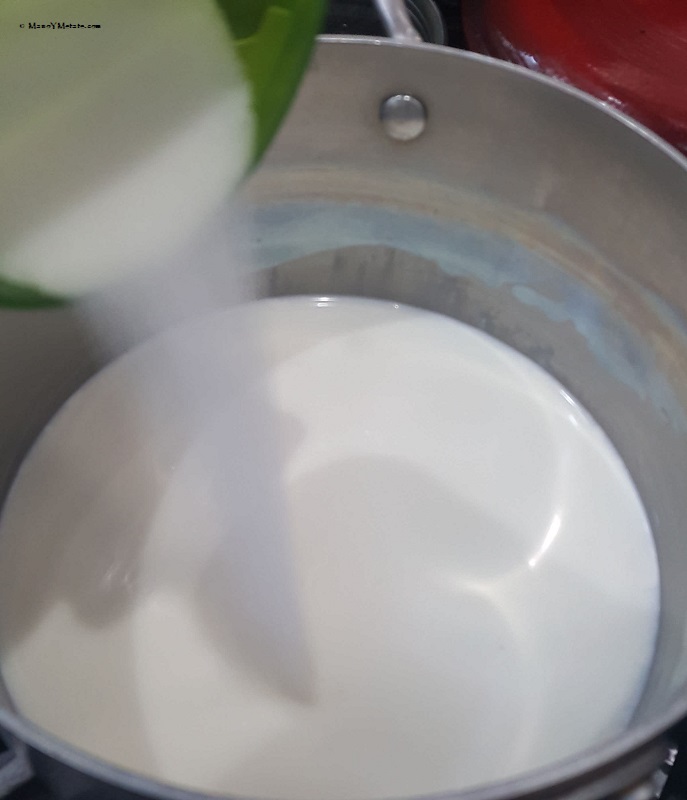
I didn’t want to buy cream and I didn’t want rock hard ice milk. Wondering if I could add enough butter to make it work, I found this recipe and adapted it to make butter pecan. I started with just over 2 cups milk, a scant 3/4 cup sugar, 1/2 teaspoon vanilla powder (ground vanilla pods) and 1/8 teaspoon salt over low heat.

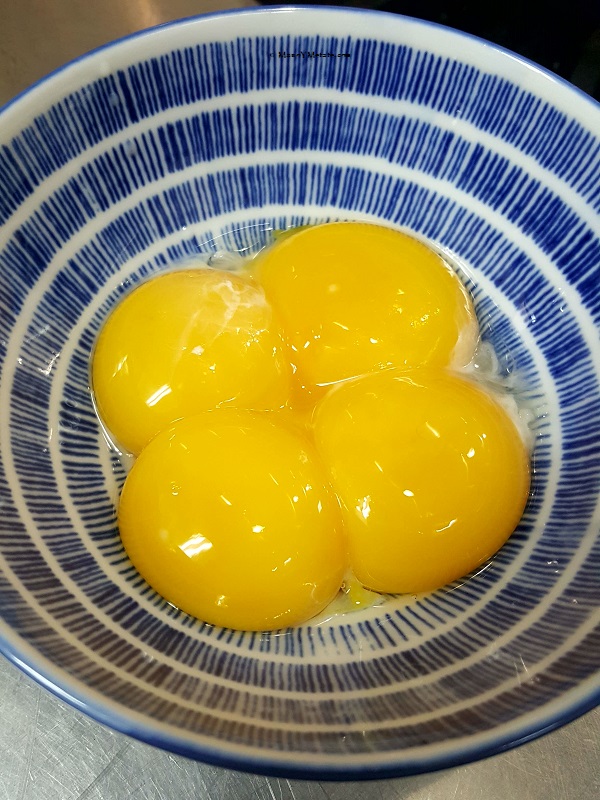
I separated 4 room temperature egg yolks and used the whites for another meal.

After mixing a small amount of the hot milk to the yolks, I added the mix to the pot. I stirred while heating slowly until the mixture was barely thickened. Then I strained the thin custard to remove any traces of egg white and cooled it somewhat in the refrigerator.

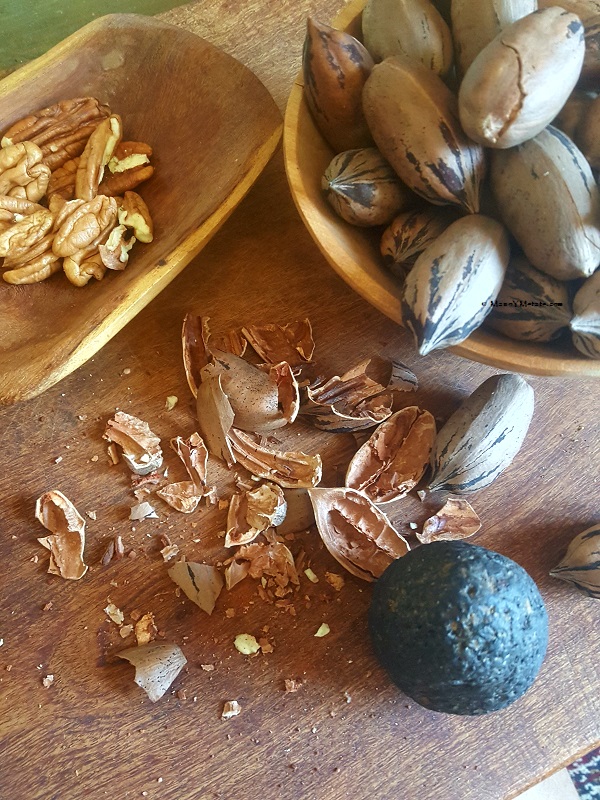
Meanwhile, I made the flavor. A friend from Bisbee gave me pecans from her tree.

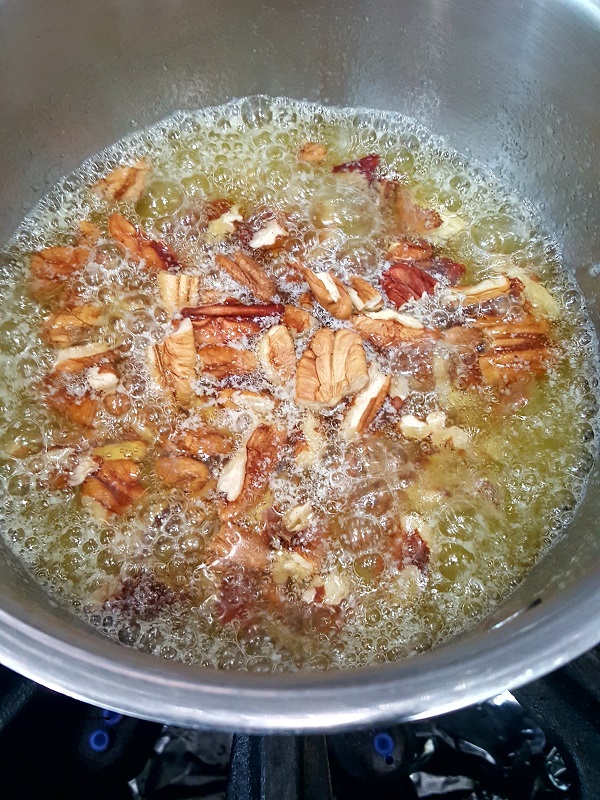
I browned 5 tablespoons unsalted butter! (Remember, this is making it like ice CREAM instead of ice MILK.) Then I added over half a cup of broken pecans to toast in the butter. Yes, it smelled as good as it looks.

I added the slightly cooled custard to the browned liquid butter.

and poured the whole into a little electric ice cream maker. Some butter did solidify into tiny bits, which remained in the finished product. But the nutty butter pieces combined with the nut pieces and it is actually a DELICIOUS result. Rich and flavorful.

Soon it firmed up to soft serve. After a time in the freezer, it made perfectly delicious, not too hard. ice cream.

Enjoy!

Nopalitos Pulao

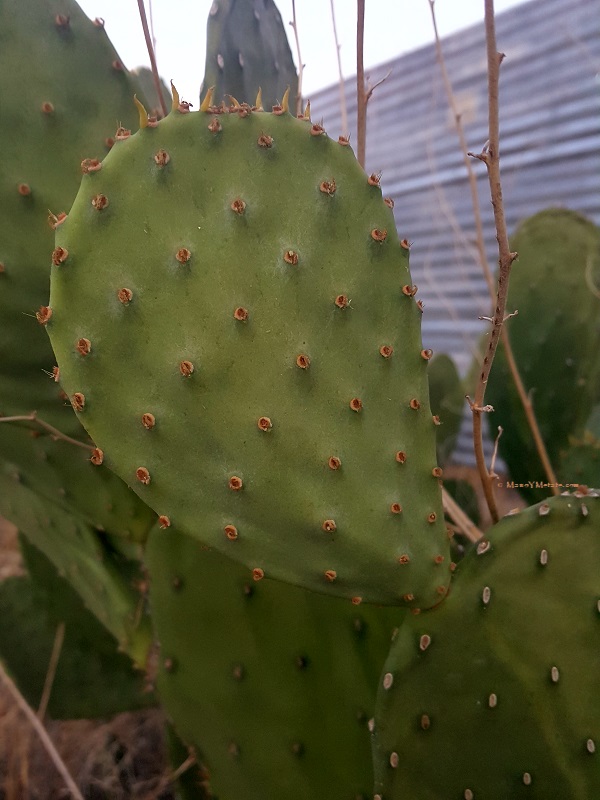
Hello friends, Amy here making something different out of the same characters I always eat, again and again and again. Eating more locally and seasonally encourages creativity! Nopalitos, young prickly pear cactus pads of many species, are DELICIOUS but like okra need special care to not let them overpower the texture of a meal. Start by harvesting a tender young pad that still has its true leaves, the little cones at the top of the pads seen in the photo below. As the pad matures, the leaves yellow, fall, and a woody internal structure develops. This might be the last I harvest before a new flush of pads comes with summer rains.

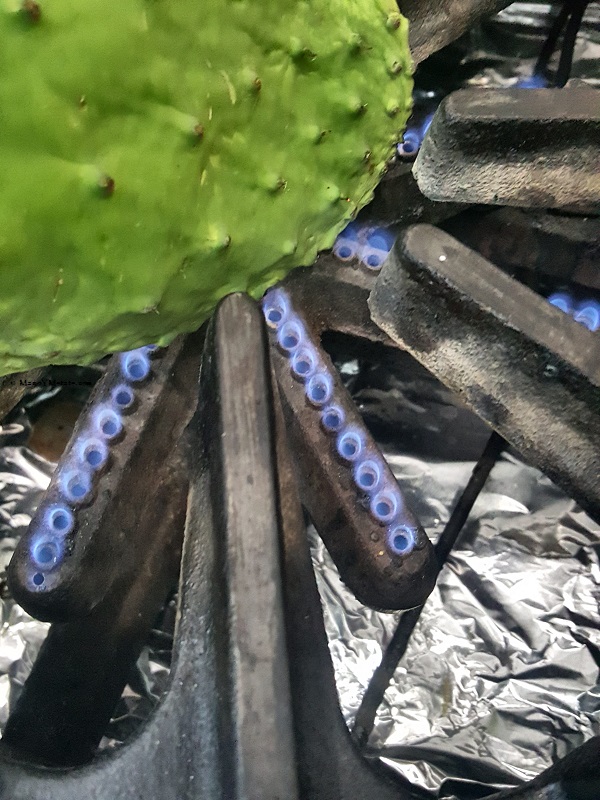
Any large spines or tiny glochids can be quickly singed to ash over an open flame, holding the pad with tongs.

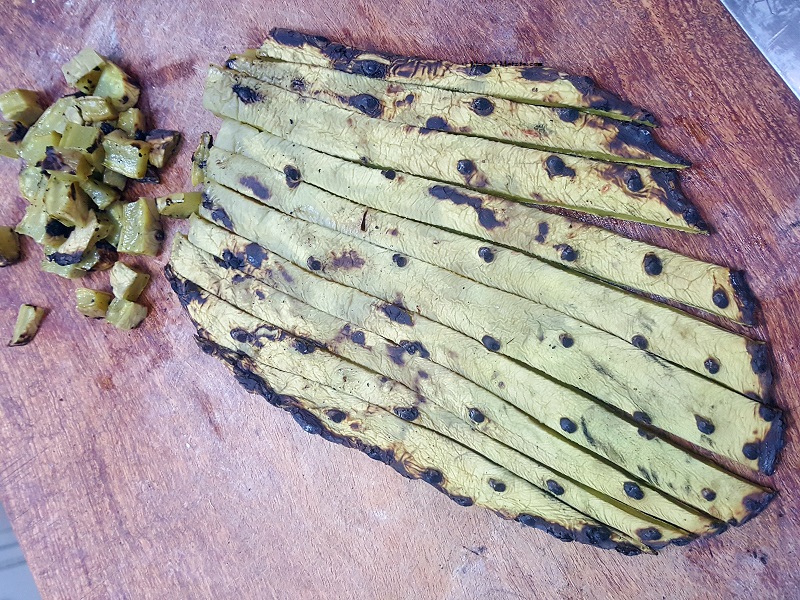
Singed nopalitos can be safely touched and if they turn from bright green to pale olive, they are cooked and ready to be eaten.

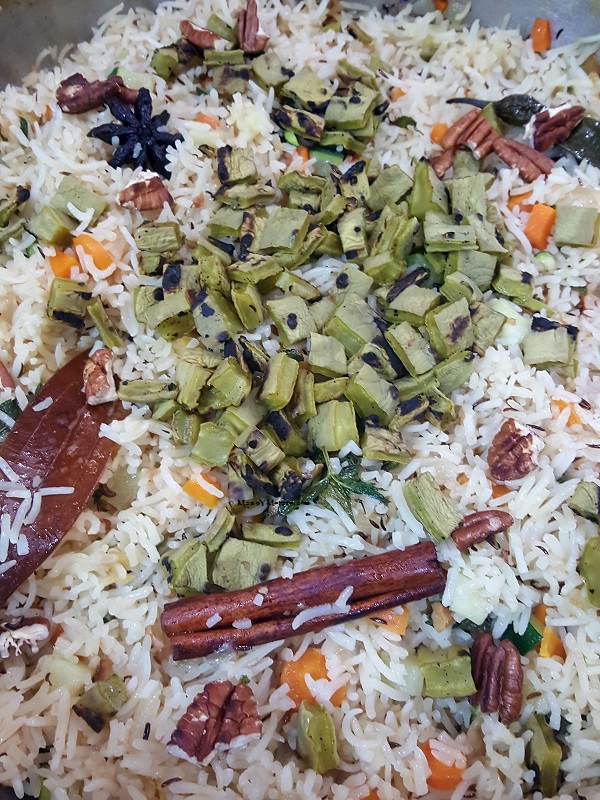
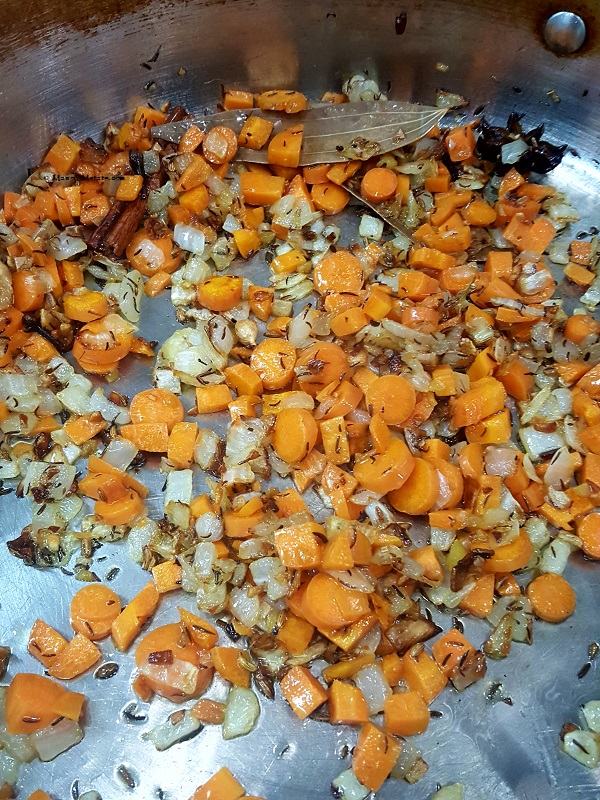
To showcase this little harvest I made pulao, an extremely flexible rice pilaf from India. I started with a traditional recipe changing to local veggies and nuts. Whole cinnamon, cloves, cardamom, star anise, Indian bay, fennel and black cumin can be toasted in oil or ghee. I wish I had whole nutmeg or mace to add at the beginning, because I forgot to add them as ground spices later.

Then onion, garlic, ginger and a whole green chile (a serrano frozen from last autumn’s harvest) went in to fry. Followed by Tucson CSA carrots.

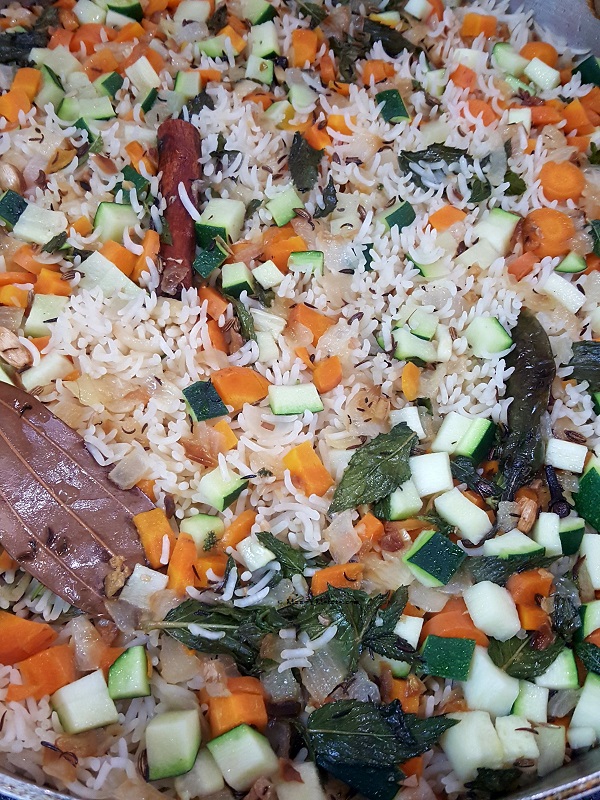
Then Tucson CSA zucchini, soaked basmati rice and mint from the garden.

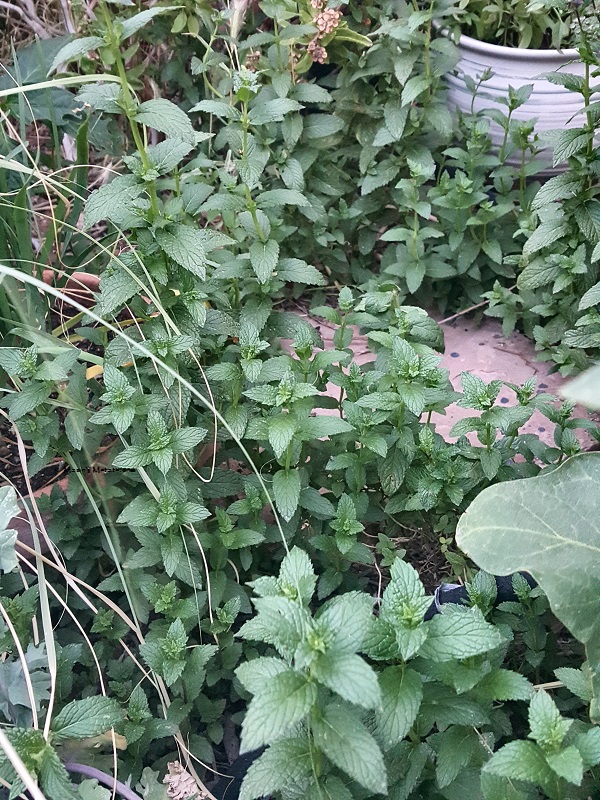
After several years without, I now have a great spearmint patch again. A smart gardener gives plant starts away to friends and family for backups and last year I was a grateful recipient. Anybody need some?

After water, salt and 20 minutes covered over low heat, it was ready.

After fluffing, I toasted some local pecans and sprinkled them as well as the nopalitos on top. A totally new taste for my usual veggie friends. If you like this, you make like Tia Marta’s cholla bud jambalaya.