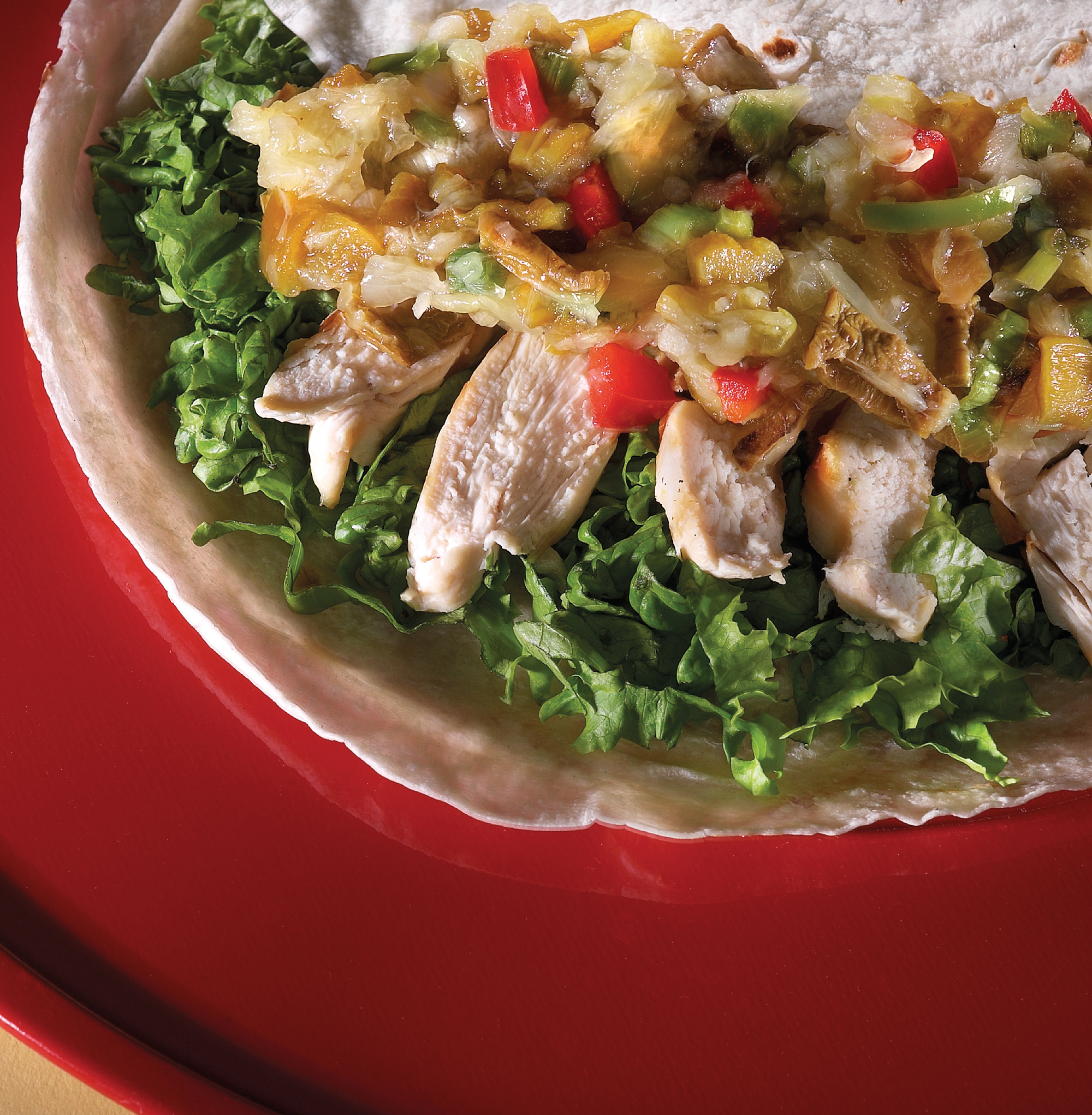
Grilled Chicken with Nopalito and Pineapple Salsa (from The Prickly Pear Cookbook)
(Note: I will be teaching a class on cooking with nopales at the Presidio of Tucson on April 3. You can sign up on their website.)
The new prickly pear pads (nopales) that we cook and use for nopalitos are usually ready in from March to early May. It’s Carolyn here today tempting you with two recipes for a delicious salsas made with nopalitos. (Definition of nopalito: a nopal, or cactus pad, cut into little pieces).
Why bother to learn how to use prickly pear pads? For hundreds of years, both the fruit and pads were considered folk medicine in Mexico and early research showed that the fibers in nopales were helpful in curbing blood sugar. Today, researchers in the US and Europe are using sophisticated laboratory techniques and specially bred mouse models (that would be transgenic mice, not transgender mice) to investigate prickly pear fruits, pads, flowers, and seeds as a cure for a wide array variety of ills.
Investigators are looking into prickly pear compounds as antioxidant, antiviral, anti tumor, anti diabetic, and antiparasite. It may be useful in combating a range of cancers including leukemia, lung, gastric, colon, and ovarian. Studies have considered its use in the treatment of ulcers and alcoholism and a possible role in boosting memory and energy metabolism. Many research labs are investigating prickly pear for cancer prevention.
The many varieties of prickly pear put out their new growth when the spring warms up. All prickly pear pads are edible (meaning they not only won’t kill you but in this case are very nutritious), but they are only appropriate for food when they are new. After about six weeks, they develop a fibrous infrastructure. The easiest kind of pads to prepare are those from the large Mexican variety of prickly pear that do not grow wild north of Mexico. You can grow them in your yard if your winter doesn’t bring much freezing. Or you can get them at a Mexican grocery story. They are called Ficus indica or sometimes Burbank because Luther Burbank did some breeding work on them. The wild cactus pads are also delicious, but harder to prepare because of the abundance of spines.
You can do a rough estimate of when a pad is ready to pick if it is about the size of your hand. The nopales available in Mexican grocery stores are grown by farmers who know how to manipulate the plant to keep fresh pads coming year ’round.
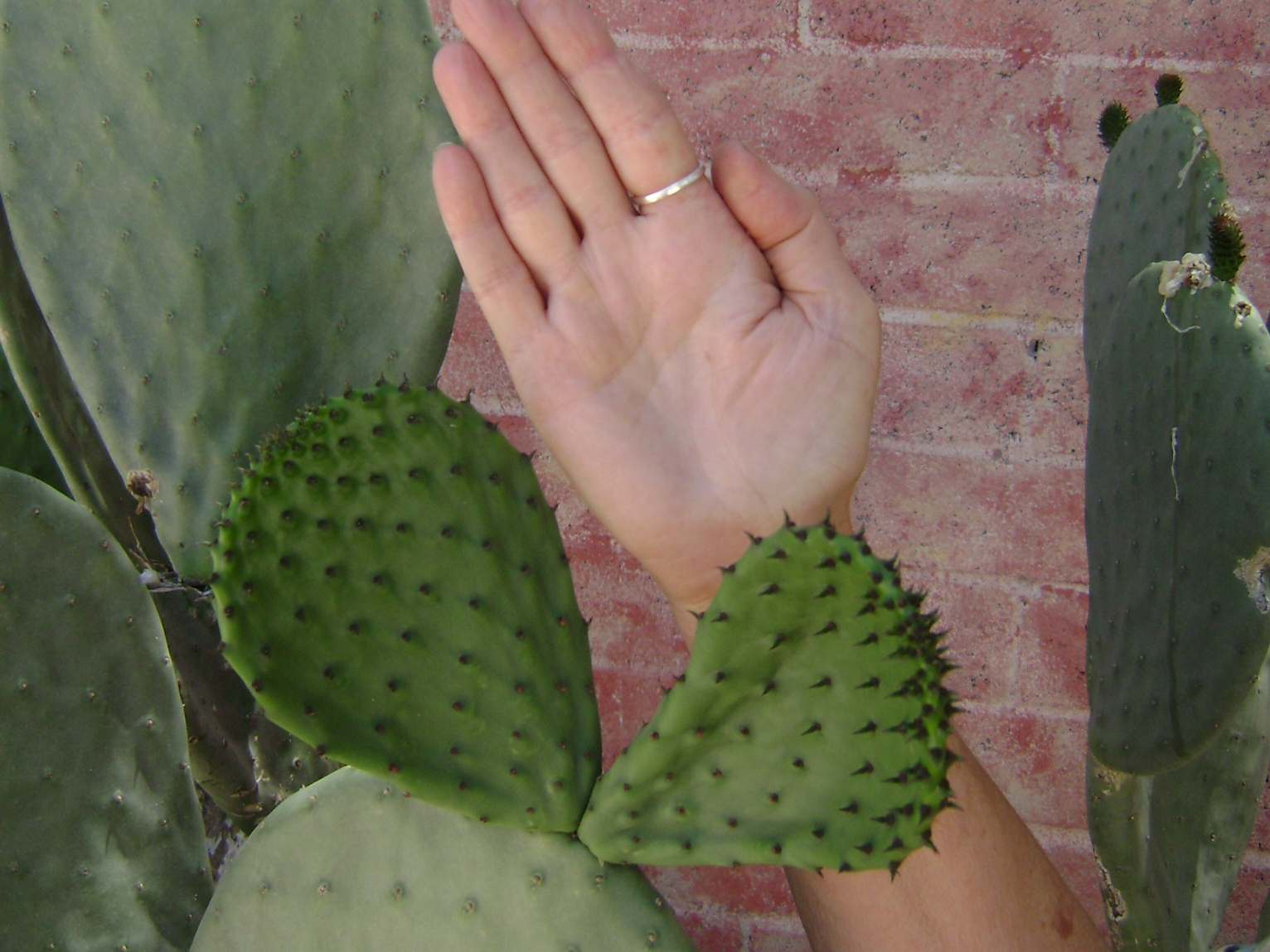
Pick nopales in the spring when the size of your hand.
To prepare the nopales, you’ll use tongs, of course, and then don rubber kitchen gloves to protect your hands as you get rid of the stickers. You don’t need industrial strength gloves, just good quality ones from the grocery store will do. Using a common steak knife, scrape vigorously against the growth (from outer edge to stem) to remove the stickers.
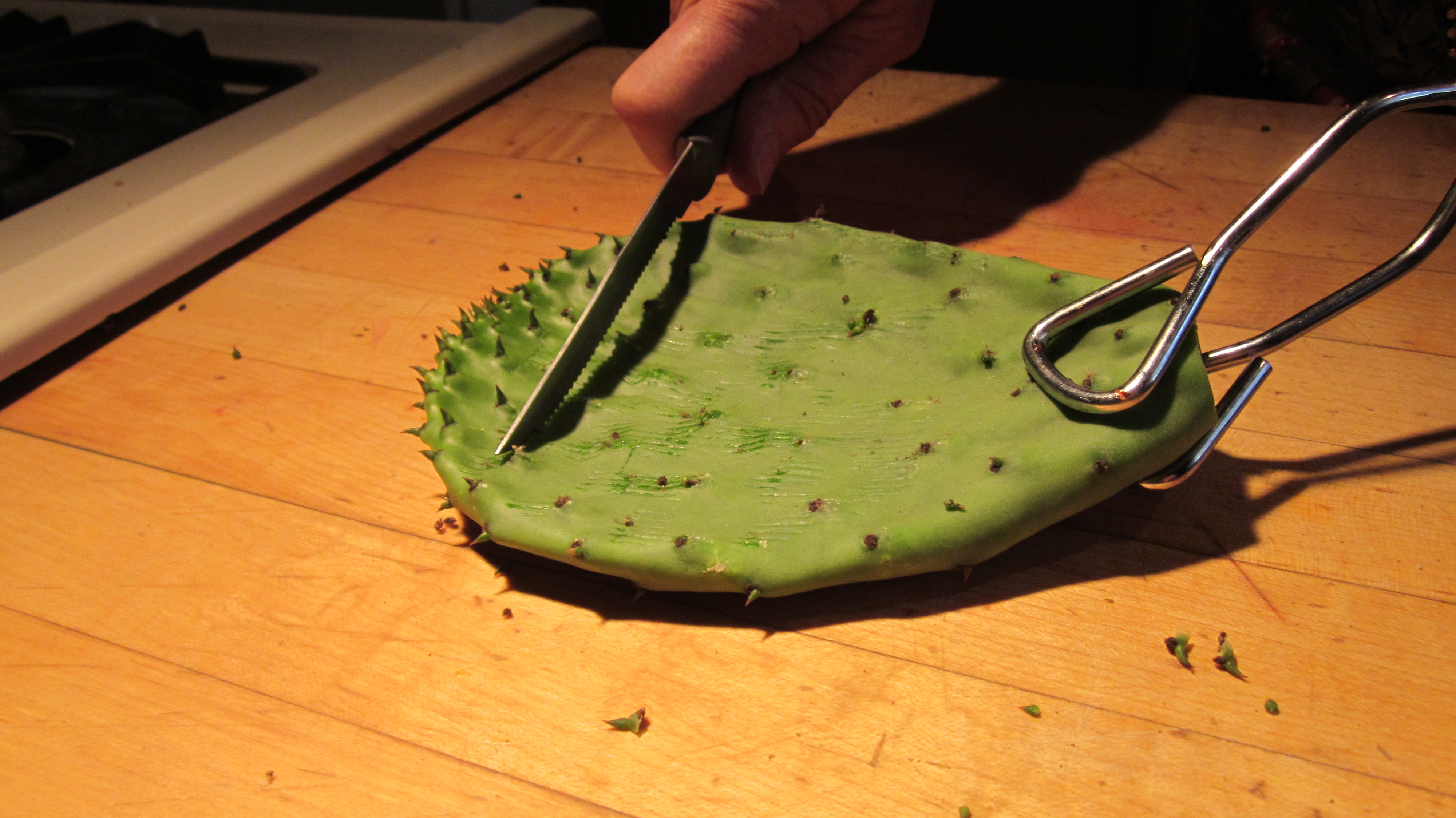
Scrape the thorns vigorously in the direction of the stem.
The edge has lots of stickers so just trim it off.
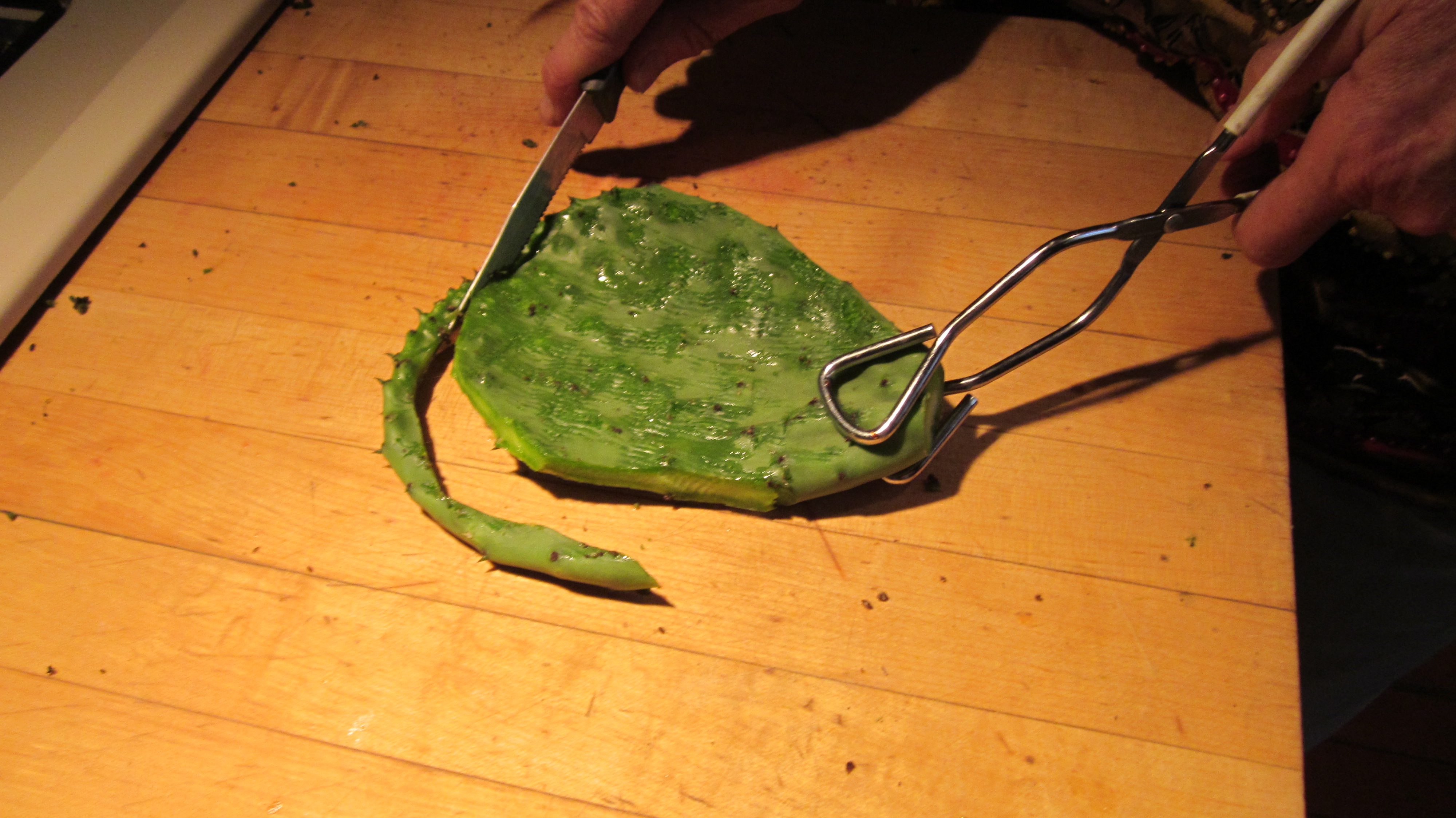 At this point, you can cut it into small pieces to cook or leave it whole and cut it up later. You can cook them in a frying pan filmed with oil, or use the Rick Bayless method (of TV show fame) and toss them with a little oil, sprinkle with sale, put on a cookie sheet and roast in a 375 degree oven for 20 minutes. In any case, you should check them and turn them over as they cook.
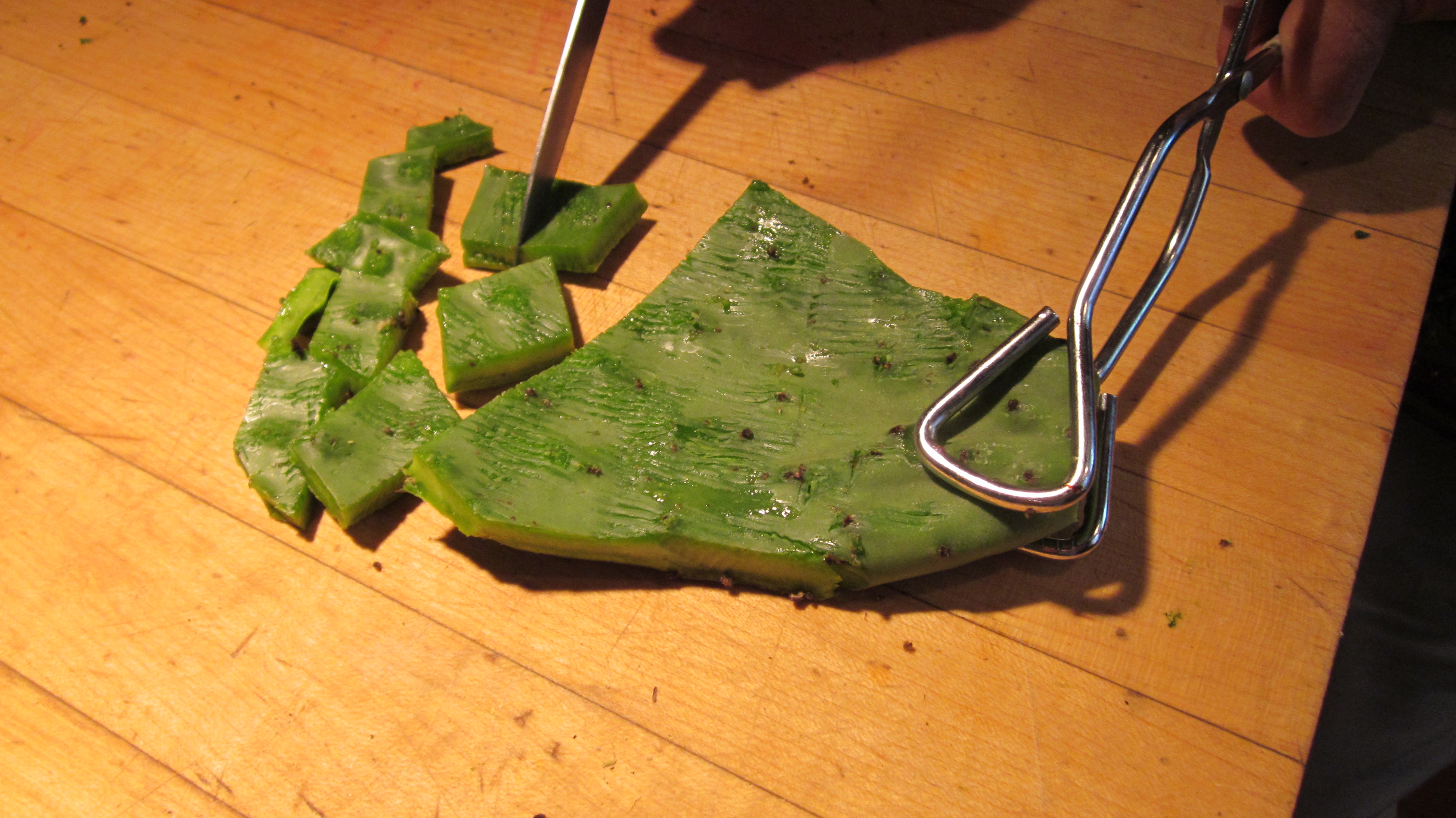
Cut into small pieces to cook.
The nopales will turn from bright green to a more olive color as they cook. The gummy sap that some people find objectionable will dry up and become less noticeable.
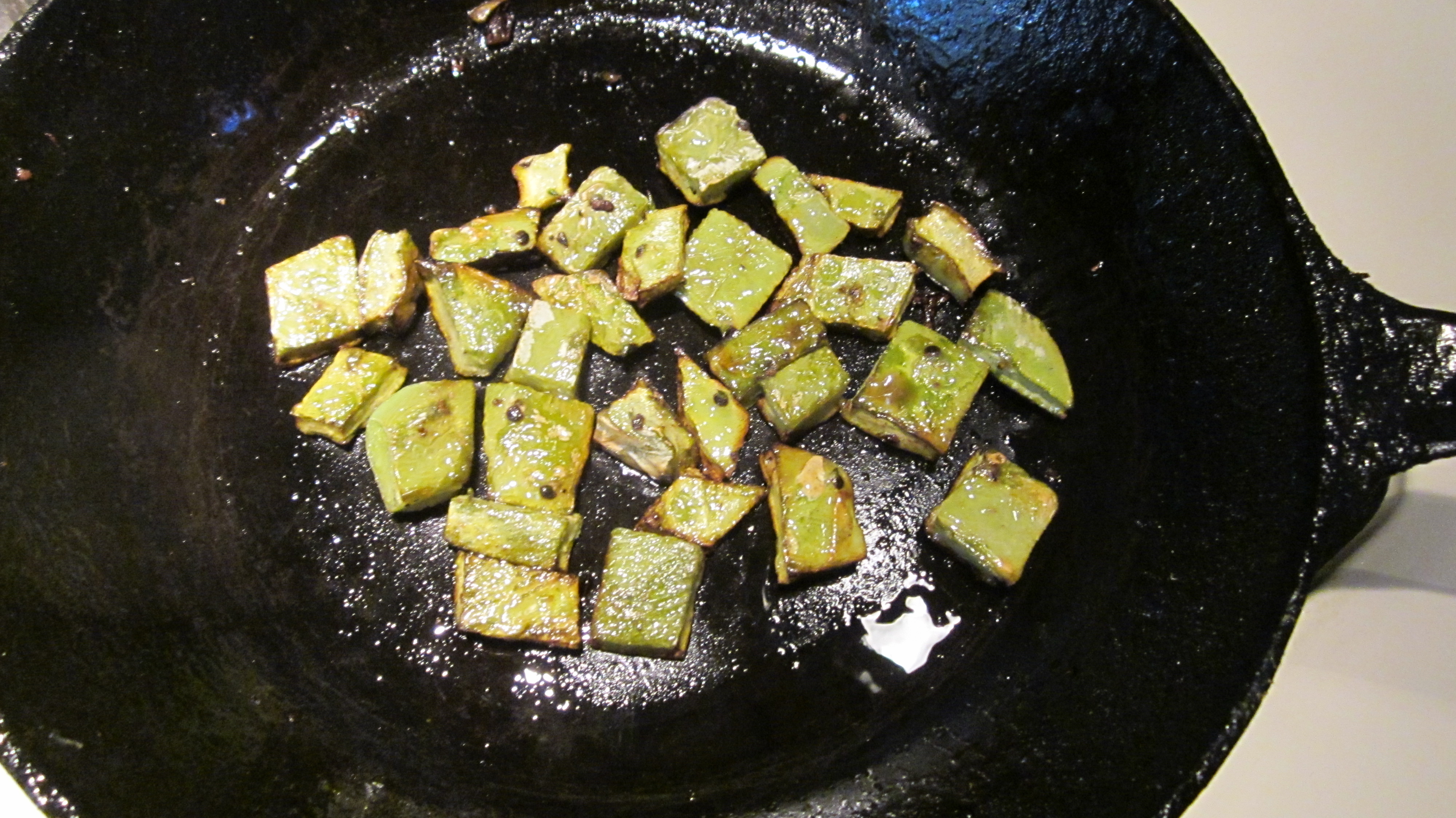
The cooked nopalitos turn from bright green to olive.
You can also cook nopales on the barbecue alongside some chicken to make a delicious taco.
Here’s the recipe for the sauce in the picture at the top of the blog:
Nopalito and Pineapple Salsa
1 raw, cleaned prickly pear pad
1 tablespoon vegetable oil
1 cup canned crushed pineapple packed in it’s own juice
¼ cup finely chopped red bell pepper
¼ cup thinly sliced green onions, including some tops
1 tablespoon canned green chiles
1 finely minced serrano chile (optional)
½ teaspoon finely minced garlic
2 tablespoons lime juice
¼ teaspoon salt
1 tablespoon finely minced cilantro (optional)
Cut prickly pear pad in 1 ½ inch squares. Film a heavy frying pan with the oil and add the prickly pear pads. Cook over low heat, turning occasionally, until pieces have given up much of their juice and are slightly brown. Remove from pan, cool, and chop into pieces as wide as a matchstick and about ¼-inch long.
Transfer to medium bowl. Add remaining ingredients, stir to combine and set aside for flavors to mingle.
Nopalito and Bean Salsa
Here’s an even easier recipe and you might have everything except the nopales in your pantry.
1 1/2 cups commercial red salsa
1/2 cup canned black beans, rinsed
1/2 cup cooked nopalitos
1 tablespoon lime juice
1-2 tablespoons chopped cilantro
Combine all ingredients in a bowl. Serve with chips.
______________________
You can learn more about the history of food in Southern Arizona in my latest book A Desert Feast, the story of the last 4,000 years of food in the Sonoran Desert. Want more recipes using foods of the Southwest? You’d find ideas for collecting and using 23 easily recognized and gathered desert foods in Cooking the Wild Southwest: Delicious Recipes for Desert Foods. . Recipes from top Southwest chefs are collected in The New Southwest Cookbook. Just click on the titles for more information. You can learn more about me on my website.
 Savor the Southwest:
Pingback: Lean Times for Desert Foods Foraging | Savor the Southwest:
I love nopalitos and was so happy when we moved to Tucson and found fresh ones! (Only jarred ones in Maine.) I wish I were here to take your class — but we planned our trip to Spain almost a year ago!
LikeLike